


The Big Picture |

- SOPA, PIPA, ACTA … What’s Next?
- Anecdotes Wanted . . .
- 10 Monday PM Reads
- How Bullish is the Golden Cross ? (UPDATED)
- January 30 2012 Economic Preview & Review
- Is the Rally in Treasury Bonds Over?
- 10 Monday AM Reads
- Stuff, mostly Europe of course
- GDP Post Mortem: Less Than Meets the Eye
- Doodling in Math: Spirals, Fibonacci, and Being a Plant
| SOPA, PIPA, ACTA … What’s Next? Posted: 30 Jan 2012 10:30 PM PST ACTA: "Would Usurp Congressional Authority", "Threatens Numerous Public Interests", a "Backroom Special Interest Deal", a "Masquerade"We just beat back SOPA and PIPA with the web blackout. Now everyone is talking about ACTA. But – because ACTA is complicated, and is just starting to receive coverage – most are not sure exactly what ACTA really is, or why we should be concerned about it. We'll give you an executive summary of what you need to know. Instead of giving you the specifics about what's actually in the bill (we provide links at the end for those who want to know), we'll explain why the procedure used is a recipe for disaster. Why are we stressing procedure over substance? Because, as awful as ACTA is, there are other horrible bills such as the Trans Pacific Partnership Agreement waiting in the wings … which may be even worse than ACTA. Unless we understand the rotten, anti-democratic process which is causing these bad bills to be introduced, we will be caught off-guard by the introduction of one draconian bill after another … and we will lose the fight for Internet freedom. (The problem is that powerful men are making laws in secret to protect their interests.) Hollywood Tries to Ram U.S. IP Policies Down the Throat of EuropeOn the most superficial level, ACTA is an attempt to ram American intellectual property policies down Europe's throat. As the Electronic Frontier Foundation's Eva Galperin told me:
But this is a superficial analysis. Specifically, it is also an attempt to ram Hollywood's interests down the throats of the American people … and Congress. A Handful of Powerful Men Are Trying to Railroad Democracy and the Constitution to Protect Their InterestsThe fastest way to understand ACTA is to look at the way in which its backers have tried to trample the normal democratic processes in the U.S., Europe and elsewhere in order to railroad it through. As an international treaty, ACTA is supposed to be ratified by the American Senate and other appropriate government legislatures. But this is not at all what has happened. Instead, ACTA has been negotiated for years in secret, without disclosing its contents – let alone seeking approval from – Congress or other legislatures. In the United States, for example, President Bush and President Obama hid ACTA negotiations under the veil of "National Security", thus keeping it away from prying eyes … including Congress. Republican Congressman Darrell Issa says that ACTA is more dangerous than SOPA:
Democratic Senator Wyden has argued for years – in letters to USTR ambassador Ron Kirk, President Obama, and the administration's top international law expert Harold Koh. – that adoption of ACTA is unconstitutional unless without Senate approval. For example, Wyden wrote last October:
The Member of the European Parliament who was appointed to be the rapporteur for ACTA in the European Parliament (Kader Arif) quit last week in protest. Arif said:
As rapporteur of this text, I have faced never-before-seen manoeuvres from the right wing of this Parliament to impose a rushed calendar before public opinion could be alerted, thus depriving the Parliament of its right to expression and of the tools at its disposal to convey citizens' legitimate demands." Everyone knows the ACTA agreement is problematic, whether it is its impact on civil liberties, the way it makes Internet access providers liable, its consequences on generic drugs manufacturing, or how little protection it gives to our geographical indications. This agreement might have major consequences on citizens' lives, and still, everything is being done to prevent the European Parliament from having its say in this matter. That is why today, as I release this report for which I was in charge, I want to send a strong signal and alert the public opinion about this unacceptable situation. I will not take part in this masquerade. As Harvard professors Jack Goldsmith and Lawrence Lessig wrote in the Washington Post in March 2010:
Over 75 law professors – some of them quite prominent – wrote a letter to President Obama in October 2010 stating:
Indeed, just as most copyright lawyers actually oppose SOPA and PIPA, the secrecy and dishonest end-run which has characterized the ACTA process mean that the main U.S. and international intellectual property organizations have had no input into the drafting of ACTA. We Can Still Stop ItWhile ACTA has already been signed by dozens of countries, it will not go into effect unless the European Union parliament ratifies it in a couple of months. We can still stop it. And see this and this. | ||||||||||||||||||||
| Posted: 30 Jan 2012 05:40 PM PST
> In The Mystery of Capital, de Soto raised a fascinating thesis: That the West’s system of record keeping and property recording is why Capitalism took hold here. In other regions — namely, Asia, Africa and much of South America, the Peruvian born economist argued that the economic system was highly dependent on elders, neighbors, and recollections — rather than recorded deeds — for transferring property. This would, as you might imagine, stifle the willingness to invest in or lend against property. Tonight, I want to ask you for actual anecdotes about this. What sort of stories or narratives is anyone familiar with that demonstrate the East’s problems with this, and why it may have stifled the spread of capitalism. This is for a wicked cool project that I cannot talk about yet . . . | ||||||||||||||||||||
| Posted: 30 Jan 2012 01:30 PM PST My afternoon train reading:
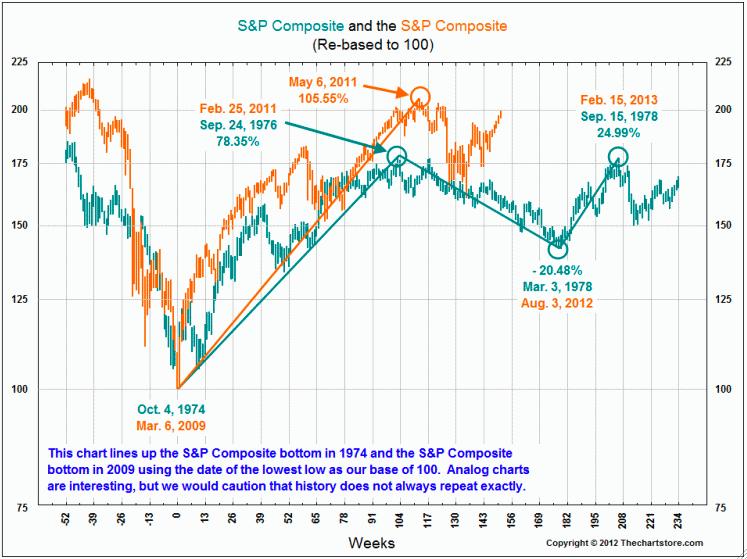
What are you reading? 2009 low vs 1974
| ||||||||||||||||||||
| How Bullish is the Golden Cross ? (UPDATED) Posted: 30 Jan 2012 09:00 AM PST Pinging around trading desks last week was a report from Birinyi Research on the Golden Cross. Given where prices are (and the days dropping off the MA from 200 days ago) the S&P Composite is likely to see the Golden Cross soon Here’s the excerpt:
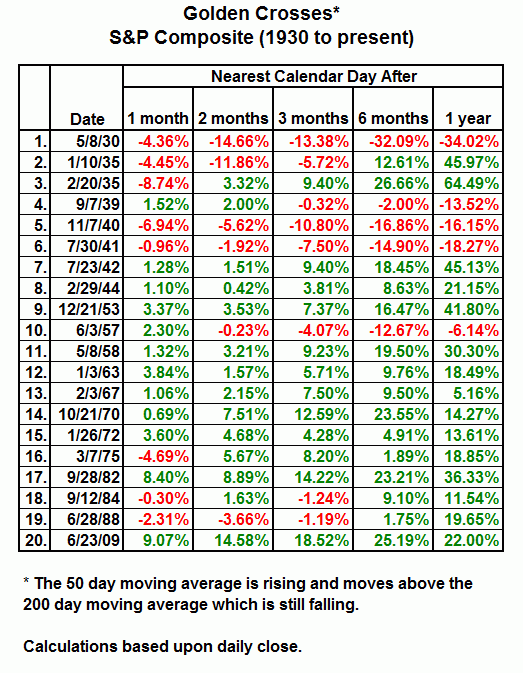
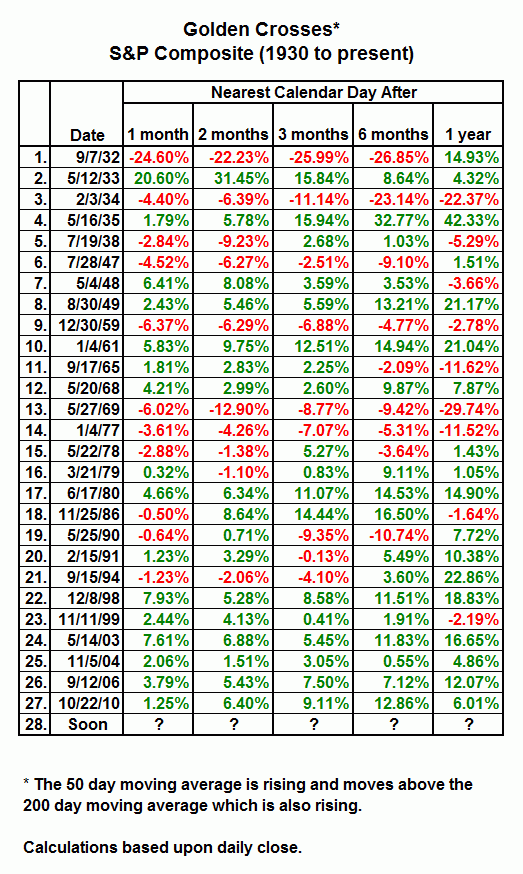
There were two unfortunate problems errors in that piece: First, there were two mistakes for two specific years (1/26/72 and 9/15/94). That is based on Ron Griess’ work, using data from The Chart Store. Second, they used an odd time period — 1960 to present. Data exists back to 1930s, so why not use it? The usual answer is data mining, and as we see below, that very much applies here. The post 1960 data is far more bullish than the earlier data — so why use it? Overall, the Golden Cross does have a positive bias — its just not nearly as Bullish as that Birinyi report suggests. (File that in the blue recycle bin) The following two tables and 17 charts (from The Chart Store) show the history of such events for the S&P Composite from 1930 to the present, including ALL 47 crosses where the 50 day moving average is rising and moves above the 200 day moving average. Not how the data after 1960 is much more bullish. (I am surprised this came from Birinyi Research — I have never known them to data mine previously) > Click to enlarge:
> Based on 50 day crossing a rising 200 day Moving Average All tables courtesy of The Chart Store All > Chart examples of nearly all of these are after the jump Previously: See also:
> A few interesting charts showing Golden Cross All Charts courtesy of The Chart Store | ||||||||||||||||||||
| January 30 2012 Economic Preview & Review Posted: 30 Jan 2012 08:17 AM PST | ||||||||||||||||||||
| Is the Rally in Treasury Bonds Over? Posted: 30 Jan 2012 08:00 AM PST One of my favorite sections of Barron’s each week is the Review/Preview — including a weekly question where they ask “They Said What?” Its a weekly must read. This week, they asked the loaded Is the Rally in Treasury Bonds Over? Here are the answers:
Fascinating stuff. > Source: | ||||||||||||||||||||
| Posted: 30 Jan 2012 06:30 AM PST My reads to start the week off:
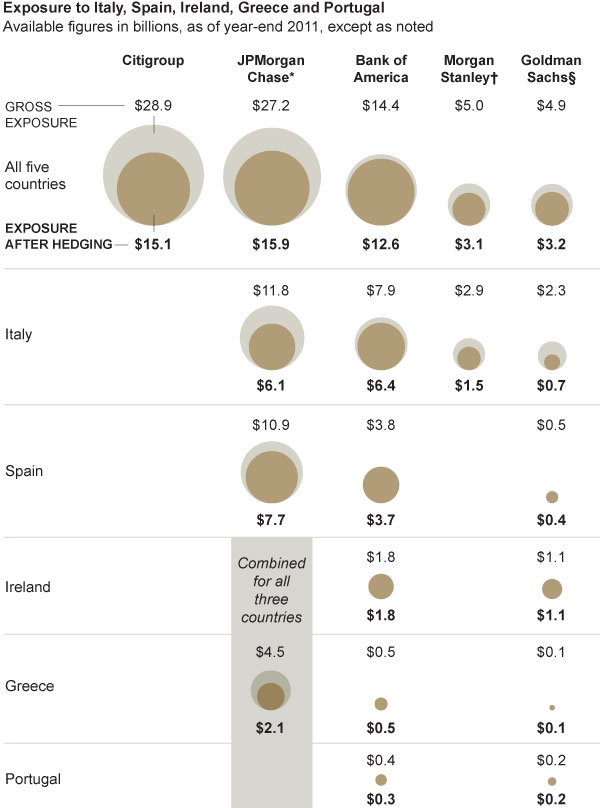
What are you reading? > U.S. Banks Tally Their Exposure to Europe's Debt Maelstrom | ||||||||||||||||||||
| Stuff, mostly Europe of course Posted: 30 Jan 2012 05:27 AM PST Verbalizing what many of us market participants have been thinking over the past month, UK Chancellor of the Exchequer said “the fact we’re still at the beginning of 2012 talking about Greece is a sign this problem hasn’t been dealt with.” ‘This problem’ remains a lack of structural reform and growth to finance too much debt. With another EU summit today, Greece will be the highlight at the same time officials dot i’s and cross t’s on the ESM and the fiscal pact to better oversee country budgets. Greece will also need 145b euros in the 2nd bailout package vs 130b euros thought before. I’m sure Portugal will enter the conversation again as they will be the next debt restructuring as yields spike again today with the 2 yr yield in particular up 180 bps to 19%. Portugal’s 5 yr CDS is up another 40 bps. Euro zone Economic Confidence rose .6 pts to 93.4 but was slightly below expectations. Italian business confidence fell to the lowest since Nov ’09. Italy sold bonds with maturities of ’16, ’17, ’21 and ’22 totaling 7.5b euros, below their max target of 8b euros. Italian yields are moving higher in response. Spain’s GDP contracted in Q4 by .3%, in line with forecasts. In Asia, the Shanghai index fell 1.5% as it reopened after its holiday but tech heavy Taiwan rallied 2.4% following Apple’s #’s last week. | ||||||||||||||||||||
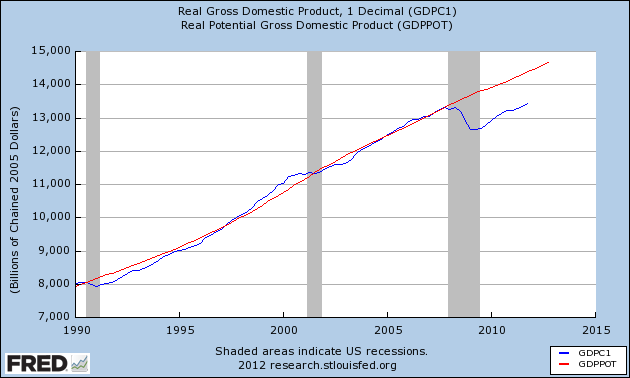
| GDP Post Mortem: Less Than Meets the Eye Posted: 30 Jan 2012 04:00 AM PST Friday’s release of GDP prompted me to get back to the keyboard. I confess that between my day job and musing about economic issues for TBP and @TBPinvictus, I have been time challenged. I’ve been leaning toward the one that pays the bills. Back to Friday’s GDP data: 2.8% was weaker than expectations, and the guts were weaker still. Dean Baker does a very nice job explaining the weakness here. A few simple charts show the magnitude of the hole we’re still struggling to dig out of. All three involve Real GDP and Potential GDP; we’re just getting three distinct views. At this point, Real GDP and Real Potential GDP are running roughly parallel to each other — we’ll obviously never close the gap with that being the case:>
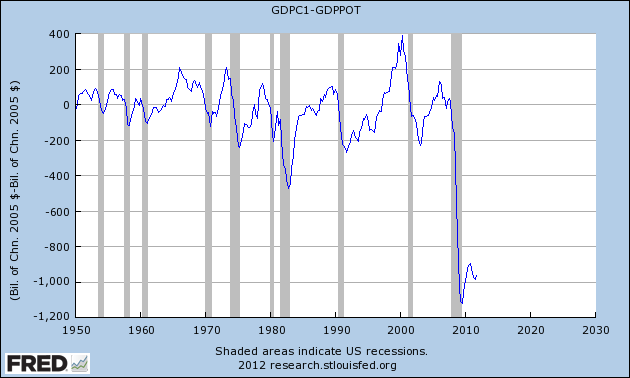
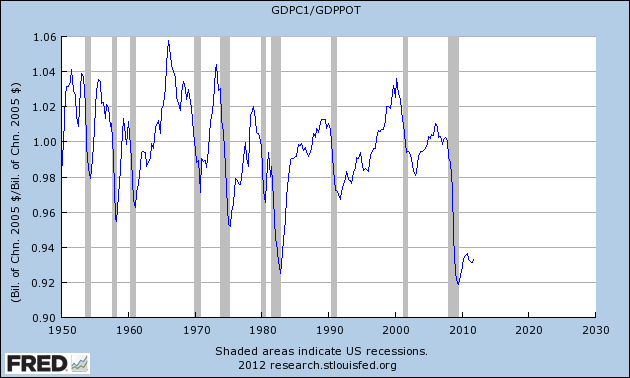
We still have a “hole” of almost $1 trillion dollars of slack in our economy:
That $1 trillion of slack represents a deficit of about 7% off our potential.
A few noteworthy comments on GDP: Via Catherine Rampell’s Twitter stream I learned that “2011 overall was the slowest non-recessionary year of GDP growth since 1947, says Neal Soss of Credit-Suisse.” And from Stephanie Pomboy, via Alan Abelson in Barron’s, we learned that:
To quantify Mr. Abelson’s parenthetical comment: Historically speaking, there appears to be about a 68 percent probability we’ll see an inventory contraction for the first quarter. In the past 52 years — 208 quarters — inventories contributed more than 1.75% 40 times (a 1-in-5 occurrence). Of those 40 times, the following quarter showed contraction in inventories 27 times. Among our ongoing trouble spots, of course, is the housing market, which at this point seems to be bouncing along what we all hope will be the bottom. One category measuring activity in that sector is Private Residential Fixed Investment (PRFI), which peaked in early 2006 at $813 billion (SAAR). It is now about 42% of that level — at $346 billion (SAAR), and has been running at roughly 60 percent of the level it was at when we slipped into recession (i.e. the economic peak) in the fourth quarter of 2007. Below is a chart demonstrating exactly how weak housing is relative to other recessions:
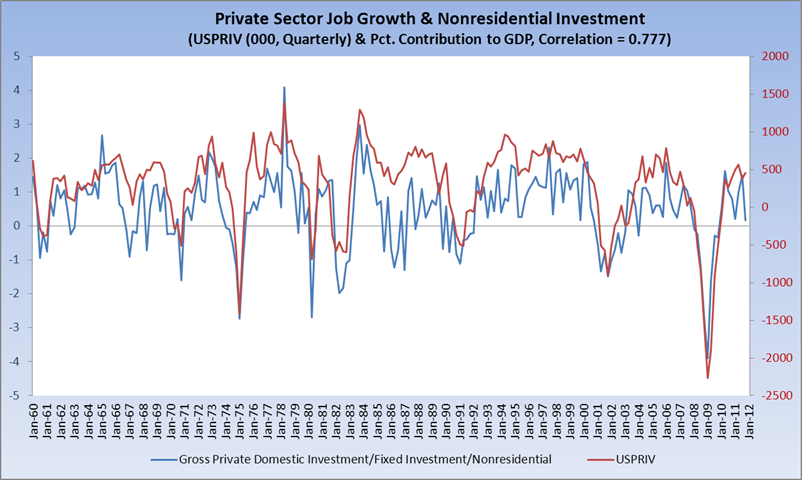
With my primary concern always being a focus on creating jobs, I took a quick historical look at the components of GDP to see what line item correlates most closely to private sector jobs (USPRIV at the St. Louis Fed). Here is what I found, with a brief explanation below. The chart shows quarterly private sector job growth/contraction in thousands (red, right hand scale) vs. percent contribution to overall GDP by Gross Private Domestic Investment/Fixed Investment/Nonresidential (blue, left hand scale), which represents roughly 10 percent of GDP:
What correlates most closely to private sector jobs is Line 9 of the GDP tables: Gross Private Domestic Investment > Fixed Investments > Nonresidential. The correlation is 0.777. The bad news is that, as a percent contribution to overall GDP, this metric just printed its worst number in the past 8 quarters, or since the recovery was getting established:
To add a bit of color, please have a look at the BEA’s guide to its tables, focusing on Page 9:
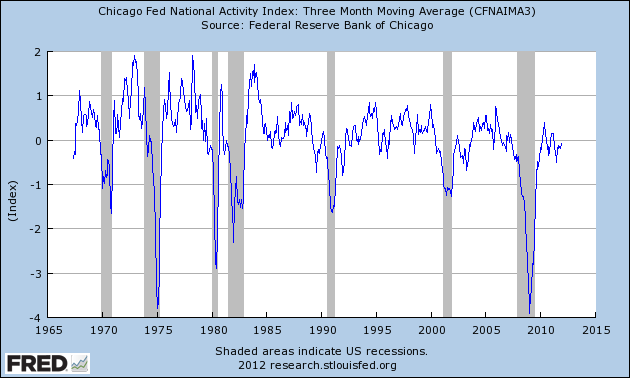
Lastly on this point, the widely cited change in inventories (see above) only correlates about 0.28 with private sector jobs. I’ll be keeping an eye on this as we move forward. And no discussion of the macro picture is complete without a mention of the Chicago Fed’s National Activity Index, which also printed last week at 0.17, with the more closely watched 3-month moving average ticking up to -0.08. (My first Big Picture post about CFNAI appeared here exactly two years ago, and remains a good introduction to the metric.)
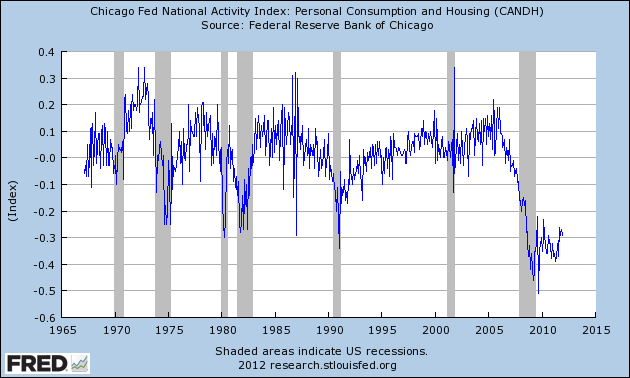
What ails us is generally the consumer and housing, as evidenced by that sub-component (one of four) of the overall index. C&H has printed negative for an astounding 60 consecutive months, its last positive print occurring in December 2006.
This is all by way of saying there’s nothing cosmic or extraordinary going on — and there needs to be. We’re mired in a slow-growth, fragile economy that could be easily derailed by any unexpected exogenous shock (looking at you, Europe). I have to point out here that I chafe when I read about where we’re “supposed” to be economically four years after a normal recession’s inception or two-and-a-half years into a normal recovery. There was simply nothing normal about the recession that began at the end of 2007, and to compare this recovery to recoveries from anything other than the Great Depression is to commit a tremendous disservice. I see economists do this all the time, all of whom know better. It is just not a fair, apples-to-apples comparison. Barry has written about this, but I felt compelled to add my two cents. Finally, I pointed out some time ago (November 30) on Twitter that there was an SPX Golden Cross in the offing. That moment is now upon us (the Dow’s occurred a short while back). I leave it to Birinyi and Bespoke to shower us with the implications of this milestone (and there are many, and they are generally positive). (BR: I have lots of good data on this; I’ll post something before lunchtime today) Busy week upcoming on the economic front, culminating with the Employment Situation report on Friday. Never a dull moment. And, a caveat: GDP will get revised in February, and again in March. So much of what appears above is, obviously, subject to change. | ||||||||||||||||||||
| Doodling in Math: Spirals, Fibonacci, and Being a Plant Posted: 30 Jan 2012 03:00 AM PST Part 1: http://youtu.be/ahXIMUkSXX0 |

| You are subscribed to email updates from The Big Picture To stop receiving these emails, you may unsubscribe now. | Email delivery powered by Google |
| Google Inc., 20 West Kinzie, Chicago IL USA 60610 | |



0 comments:
Post a Comment