


The Big Picture |

- Falling Oil Prices Not Good for the Economy
- Spanish & Greek Bank Deposits
- Books Bought By Big Picture Readers (May 2012)
- Have Republicans Become Political Insurgents?
- 10 Monday PM Reads
- The Growth of Social Media
- Predator Nation: How Wall Street Crashed the Economy & Got Off Scott Free
- When to Sell
- Stiglitz: Inequality Major Impediment to Recovery
- 10 Monday AM Reads
| Falling Oil Prices Not Good for the Economy Posted: 05 Jun 2012 01:00 AM PDT Source: Yahoo Ticker |
| Posted: 04 Jun 2012 11:00 PM PDT Click to enlarge:
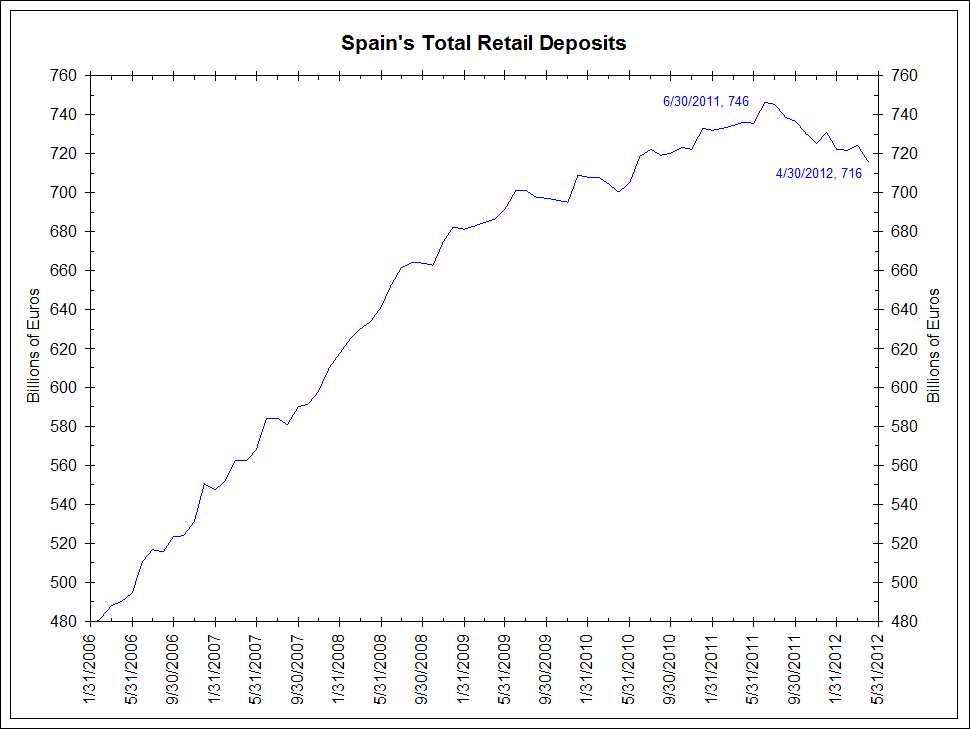
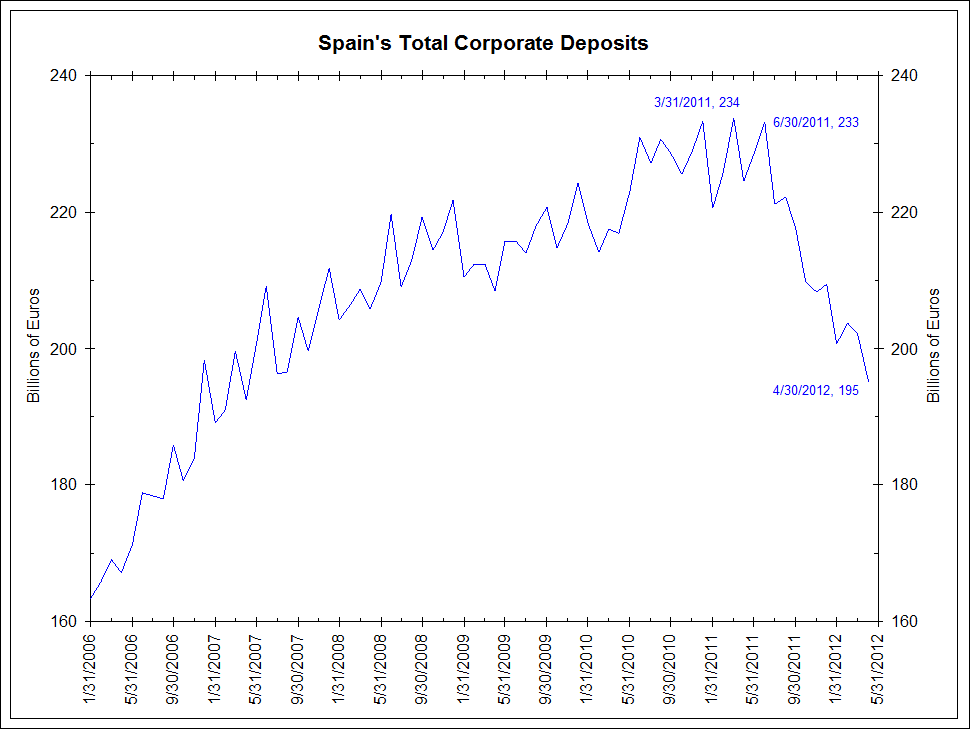
Reuters – Money flies out of Spain, regions pressured The Financial Times – Spain reveals €100bn capital flight The Independent (UK) – Spain told to get a grip of bank crisis as bailout looms large The Economist – The euro crisis: How to save Spain The Economist – Spain's banking system: Teetering Comment The chart above is current through April. As mentioned with Greek bank deposits below, the real outflows did not begin until May as a by-product of the Greek election results on May 6. 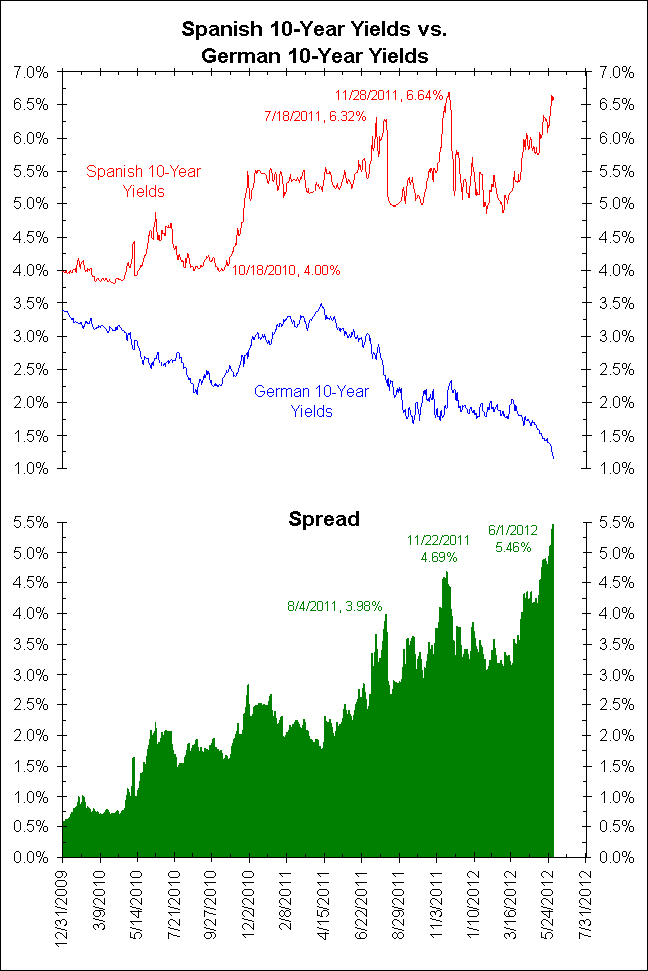 Source: Bianco Research Greek Bank Deposits Click to enlarge:
City AM – Greek banks see deposits shrink as customers lose confidence Comment It is important to note that this data is only current through the end of April. The real panic did not even begin in Greece until after the May 6 elections when Tsipras announced all previous bailout negotiations should be considered null and void. This shook the confidence of most Greeks and, if anecdotal evidence is to be believed, the real bank run began throughout May. Source: Bianco Research |
| Books Bought By Big Picture Readers (May 2012) Posted: 04 Jun 2012 04:00 PM PDT Click to enlarge:
Once again, its time to peruse the data to see which books TBP readers bought last month. Amazon’s embed code lets me track every click from these links — how many people look at the page, how many books get seen, and/or collectively purchased. Its anonymous — I don't know who bought what — but there's lots of data on the various books generated. These were the most popular TBP books for May:
|
| Have Republicans Become Political Insurgents? Posted: 04 Jun 2012 02:00 PM PDT What ever happened to Country first . . . ?
Visit msnbc.com for breaking news, world news, and news about the economy Part II Visit msnbc.com for breaking news, world news, and news about the economy Part III Visit msnbc.com for breaking news, world news, and news about the economy |
| Posted: 04 Jun 2012 01:30 PM PDT My afternoon train reading:
What are you reading?
Iraq Oil Production Coming back Online |
| Posted: 04 Jun 2012 11:30 AM PDT |
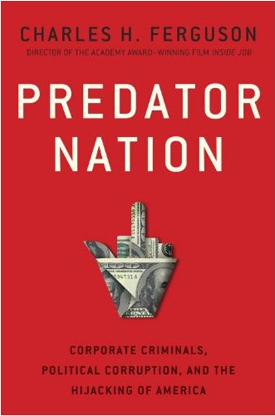
| Predator Nation: How Wall Street Crashed the Economy & Got Off Scott Free Posted: 04 Jun 2012 10:05 AM PDT
He exposes the networks of academic, financial, and political influence, in all recent administrations, that prepared the predators' path to conquest. Over the last several decades, the United States has undergone one of the most radical social and economic transformations in its history. ·Finance has become America's dominant industry, while manufacturing, even for high technology industries, has nearly disappeared. · The financial sector has become increasingly criminalized, with the widespread fraud that caused the housing bubble going completely unpunished. · Federal tax collections as a share of GDP are at their lowest level in sixty years, with the wealthy and highly profitable corporations enjoying the greatest tax reductions. · Most shockingly, the United States, so long the beacon of opportunity for the ambitious poor, has become one of the world's most unequal and unfair societies. Ferguson shows how from the Reagan administration forward, both major political parties have become captives of the moneyed elite. It was the Clinton administration that dismantled the regulatory controls that protected the average citizen from avaricious financiers. It was the Bush team that destroyed the federal revenue base with its grotesquely skewed tax cuts for the rich. And it is the Obama White House that has allowed financial criminals to continue to operate unchecked, even after supposed "reforms" installed after the collapse of 2008.
Except after the jump
Predator Nation: How Financial Criminalization Crashed the Economy, and the Culprits Got Off Scot-FreeIt is no exaggeration to say that since the 1980s, much of the American (and global) financial sector has become criminalized, creating an industry culture that tolerates or even encourages systematic fraud. The behavior that caused the mortgage bubble and financial crisis was a natural outcome and continuation of this pattern, rather than some kind of economic accident. It is important to understand that this behavior really is seriously criminal. We are not talking about neglecting some bureaucratic formality. We are talking about deliberate concealment of financial transactions that aided terrorism, nuclear weapons proliferation, and large-scale tax evasion; assisting in concealment of criminal assets and activities by others; and directly committing frauds that substantially worsened the worst financial bubbles and crises since the Depression. None of this conduct was punished in any significant way. On November 7, 2011, the New York Times published an article (Wall Street's Repeat Violations, Despite Repeated Promises) based on its own review of major banks’ settlements of SEC lawsuits since 1996. The Times’ analysis found fifty-one cases in which major banks had settled cases involving securities fraud, after having previously been caught violating the same law, and then promising the SEC not to do so again. The Times’ list, furthermore, covered only SEC securities fraud cases; it did not include any criminal cases, private lawsuits by victims, cases filed by state attorneys general, or any cases of bribery, money laundering, tax evasion, or illegal asset concealment — all areas in which the banks have numerous and major violations. In Predator Nation, I provide detailed, well-documented accounts of behavior ranging from assisting Enron’s frauds (Citigroup, Merrill Lynch), to fraudulently exploiting the Internet bubble (most of the major investment banks), to using for-profit colleges to exploit government student loan programs (Goldman Sachs), to assisting in money laundering and tax evasion on a large scale (at least eleven banks including UBS, Barclay’s, and Lloyds), to using bribery and artificially complex derivatives to destroy the finances of a county government (JP Morgan Chase), to profiting from Bernard Madoff even while strongly suspecting him to be a fraud (JP Morgan Chase, UBS). Total fines for all these cases combined appear to be far less than 1 percent of financial sector profits and bonuses during the same period. There have been very few prosecutions and no criminal convictions of large U.S. financial institutions or their senior executives. Where individuals not linked to major banks have committed similar offenses, they have been treated far more harshly. Given this background, it is difficult to avoid the conclusion that the mortgage bubble and financial crisis were facilitated not only by deregulation but also by the prior twenty years’ tolerance of large scale financial crime. First, the absence of prosecution gradually led to a deeply embedded cultural acceptance of unethical and criminal behavior in finance. And second, it generated a sense of personal impunity; bankers contemplating criminal actions were no longer deterred by threat of prosecution. And just as the last twenty years of unpunished financial crime constituted a green light for the bubble, so, too, America’s non-response to the bubble and crisis is setting the tone for financial conduct in the future. The Obama administration has rationalized its failure to prosecute any senior financial executives (literally, not a single one) for bubble-related crimes by saying that while much of Wall Street’s behavior was unwise or unethical, it wasn’t illegal. Here is President Obama at a White House press conference on October 6, 2011:
The president and senior administration officials (such as Lanny Breuer, head of the Justice Department’s Criminal Division) have portrayed themselves as frustrated and hamstrung — desirous of punishing those responsible for the crisis, but unable to do so because their conduct wasn’t illegal, and/or the federal government lacks sufficient power to sanction them. With apologies for my vulgarity, this is complete horseshit. When the federal government is really serious about something — preventing another 9/11, or pursuing major organized crime figures — it has many tools at its disposal and often uses them. There are wiretaps and electronic eavesdropping. There are special prosecutors, task forces, and grand juries. When Patty Hearst was kidnapped by the radical Symbionese Liberation Army in 1974, the FBI assigned hundreds of agents to the case. In organized crime investigations, the FBI and federal prosecutors often start at the bottom in order to get to the top. They use the well established technique of nailing lower-level people and then offering them a deal if they inform on and/or testify about their superiors — whereupon the FBI nails their superiors, and does the same thing to them, until climbing to the top of the tree. There is also the technique of nailing people for what can be proven against them, even if it’s not the main offense. Al Capone was never convicted of bootlegging, large scale corruption, or murder; he was convicted of tax evasion. In this spirit, here are a few observations about the ethics, legalities, and practicalities of prosecution related to the bubble: First, much of the bubble was directly, massively criminal. Second, if you really wanted to get these people, you could. Maybe not all of them, but certainly many. Some bubble-related violations are very clear, with strong written evidence, as my book Predator Nation demonstrates. And if you flipped enough people, some of them would undoubtedly have interesting things to say about what their senior management knew. In fact, there are many techniques, venues, organizations, regulations, and statutes, both civil and criminal, available to investigate these people, punish them, and recover the money they took — if you really wanted to. The federal government has used almost none of them. Third, the moral argument for punishment is very strong, providing ample justification for erring on the side of aggressive legal pursuit. Whatever portion of banking conduct during the bubble was criminal, it was certainly substantial, and there is no doubt whatsoever that it was utterly, pervasively unethical, designed to defraud in reality if not in law. Since the crisis, the people who caused it have been anything but honest or contrite. They have been evasive, dishonest, and self-justifying, returning as quickly as possible to their unerringly selfish behavior. Their behavior caused enormous damage, both human and economic; the consequences of their wrongdoing are so large as to justify almost any action that could help to prevent another such crisis by creating real deterrence. There would also be intangible but large benefits to raising the general ethical standard of a vital industry, and one whose executives often become high-level government officials. Given this background, let’s now consider the question of criminal liability, as well as the feasibility of prosecution. J’Accuse The list of prosecutable crimes committed during the bubble, the crisis, and aftermath period by financial services firms and senior executives includes: securities fraud (many forms); accounting fraud (many forms); honest services violations (mail fraud statute); bribery; perjury and making false statements to federal investigators; Sarbanes-Oxley violations (certifying accounting statements and financial controls); RICO offenses and criminal antitrust violations; Federal aid disclosure regulations (related to Federal Reserve loans); Personal conduct offenses (many forms: drugs, tax evasion, etc.). In Predator Nation I consider each of these categories in detail, naming many names and providing many specific examples. But in considering only one category, securities fraud, we already face an embarrassment of riches. Almost all the prospectuses and sales material on mortgage-backed securities sold from 2005 through 2007 were a compound of falsehoods. But it starts even earlier in the food chain. We also know that mortgage originators committed securities fraud when they misrepresented the characteristics of loan pools, and the nature and extent of their due diligence with regard to them, when they sold pools to securitizers (and accepted financing from them). Most or all of the securitizers (meaning nearly all the investment banks and major banking conglomerates) then committed securities fraud when they misrepresented the characteristics of the loans backing their CDOs, the characteristics of the resulting mortgage-backed securities, and the nature and results of their due diligence in the process of creating those securities. The securitizers also committed securities fraud when they made similar misrepresentations to the insurers of, and sellers of credit default swap (CDS) protection on, those securities. The executives of both originators and securitizers then committed a separate form of securities fraud in their statements to investors and the public about their companies’ financial condition. They knew that they were engaging in a Ponzi-like fraud that would eventually need to end, and as the bubble peaked and started to collapse, they repeatedly lied about their companies’ financial condition. In some cases they also concealed other material information, such as the extent to which they, themselves, and/or other executives of their firms, were selling or hedging their own stock holdings because they knew that their firms were about to collapse. Next, several investment banks committed securities fraud when they failed to disclose that they were selling securities that were designed to fail so that the investment banks, and/or their hedge fund clients, could profit by betting on their failure. The Hudson and Timberwolf synthetic CDOs sold by Goldman Sachs, and which were the focus of the Levin Senate subcommittee hearings, provide a very strong basis for prosecution. Goldman’s trading arm had been dragooned into finding and dumping their most dangerous assets to naive institutional investors. Important representations in the Hudson sales material–that assets were not sourced from Goldman’s own inventory — were lies, and they were material lies, since investors had learned to be wary of banks clearing out their own bad inventory. E-mail trails show that top executives closely tracked the garbage disposals and were gleeful at the unloading of the Timberwolf assets — as they should have been, for the assets were nearly worthless within months. There have been no prosecutions. In some cases, we already have clear evidence of senior executive knowledge of and involvement in these frauds. For example, quarterly presentations to investors are nearly always made by the CEO or CFO of the firm; if lies were told in those presentations, or if material facts were omitted, the responsibility lies with senior management. In some other cases, such as Bear Stearns, we already have evidence from civil lawsuits that very senior executives were directly involved in constructing and selling securities whose prospectuses contained lies and omissions. The list is long. In chapters three through six of Predator Nation, I survey the financial sector’s behavior during the bubble, and provide dozens of examples of major criminal behavior. Again, there have been no prosecutions. |
| Posted: 04 Jun 2012 08:35 AM PDT Jeff Saut channels Justin Mamis via When to Sell:
Its an overlooked key to managing downside risk — knowing when to ride it out and when to hit the eject button.
|
| Stiglitz: Inequality Major Impediment to Recovery Posted: 04 Jun 2012 07:04 AM PDT ‘The Price of Inequality’ |
| Posted: 04 Jun 2012 06:50 AM PDT My early morning reads:
What are you reading?
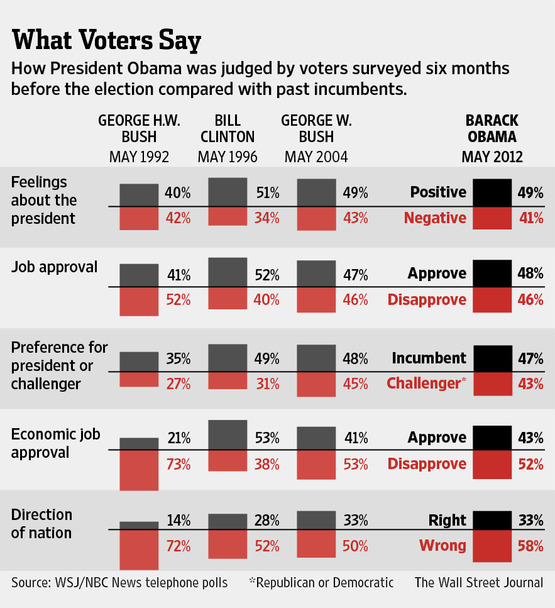
Obama Seeks Way Out of Jobs Gloom |



| You are subscribed to email updates from The Big Picture To stop receiving these emails, you may unsubscribe now. | Email delivery powered by Google |
| Google Inc., 20 West Kinzie, Chicago IL USA 60610 | |



0 comments:
Post a Comment