


The Big Picture |

- Fukushima Likely to Produce “Pockets” of Highly-Concentrated Radiation
- Are We Bottoming or is There More Downside?
- 10 Tuesday PM Reads
- Bloomberg Appearances: Market Outlook, TBTF
- Fun & Games with MF Global
- MF Global Trustee’s Investigation Report (in Color)
- Uncollateralized Trillion Euro Perpetual Zero Coupon
- Better US (non manufacturing) ISM data
- Service sector exec’s see daylight, not a train
- 10 Tuesday AM Reads
| Fukushima Likely to Produce “Pockets” of Highly-Concentrated Radiation Posted: 05 Jun 2012 10:00 PM PDT Previously-Secret 1955 Government Report Concluded that Ocean May Not Adequately Dilute Radiation from Nuclear AccidentsPosted on June 1, 2012 by WashingtonsBlog Fukushima Likely to Produce "Pockets" and "Streams" of Highly-Concentrated RadiationThe operator of the stricken Fukushima nuclear plant has been dumping something like a thousand tons per day of radioactive water into the Pacific ocean. Remember, the reactors are "riddled with meltdown holes", building 4 – with more radiation than all nuclear bombs ever dropped or tested – is missing entire walls, and building 3 is a pile of rubble. The whole complex is leaking like a sieve, and the rivers of water pumped into the reactors every day are just pouring into the ocean (with only a slight delay). Most people assume that the ocean will dilute the radiation from Fukushima enough that any radiation reaching the West Coast of the U.S. will be low. For example, the Congressional Research Service wrote in April:
And a Woods Hole oceanographer said:
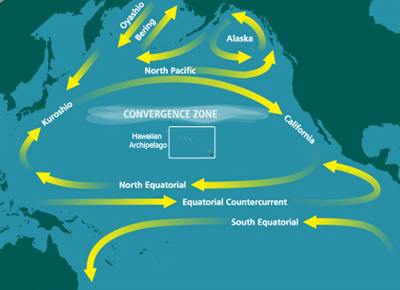
But – just as we noted 2 days after the earthquake hit that the jet stream might carry radiation to the U.S. by wind – we are now warning that ocean currents might carry more radiation to the at least some portions of the West Coast of North America than is assumed. Specifically, we noted more than a year ago:
An animated graphic from the University of Hawaii's International Pacific Research Center shows the projected dispersion of debris from Japan:
Indeed, an island of Japanese debris the size of California is hitting the West Coast of North America … and some of it is radioactive. In addition to radioactive debris, MIT says that seawater which is itself radioactive may begin hitting the West Coast within 5 years. Given that the debris is hitting faster than predicted, it is possible that the radioactive seawater will as well. And the Congressional Research Service admitted:
Indeed, nuclear expert Robert Alvarez – senior policy adviser to the Energy Department's secretary and deputy assistant secretary for national security and the environment from 1993 to 1999 – wrote yesterday:
Because of the huge amounts of radioactive water Tepco is dumping into the Pacific Ocean, and the fact that the current pushes water from Japan to the West Coast of North America, at least some of these radioactive "streams" or "hot spots" will likely end up impacting the West Coast. |
| Are We Bottoming or is There More Downside? Posted: 05 Jun 2012 04:30 PM PDT I want to do an experiment with a new kind of survey mechanism. (There are 4 kinds: Yes/No, Multiple Choice, Suggest you own answers, and Brainstorm). This is essentially a simple Yes/No survey. You can explain your answer in details if you like.
click to answer
|
| Posted: 05 Jun 2012 01:00 PM PDT My afternoon train reading:
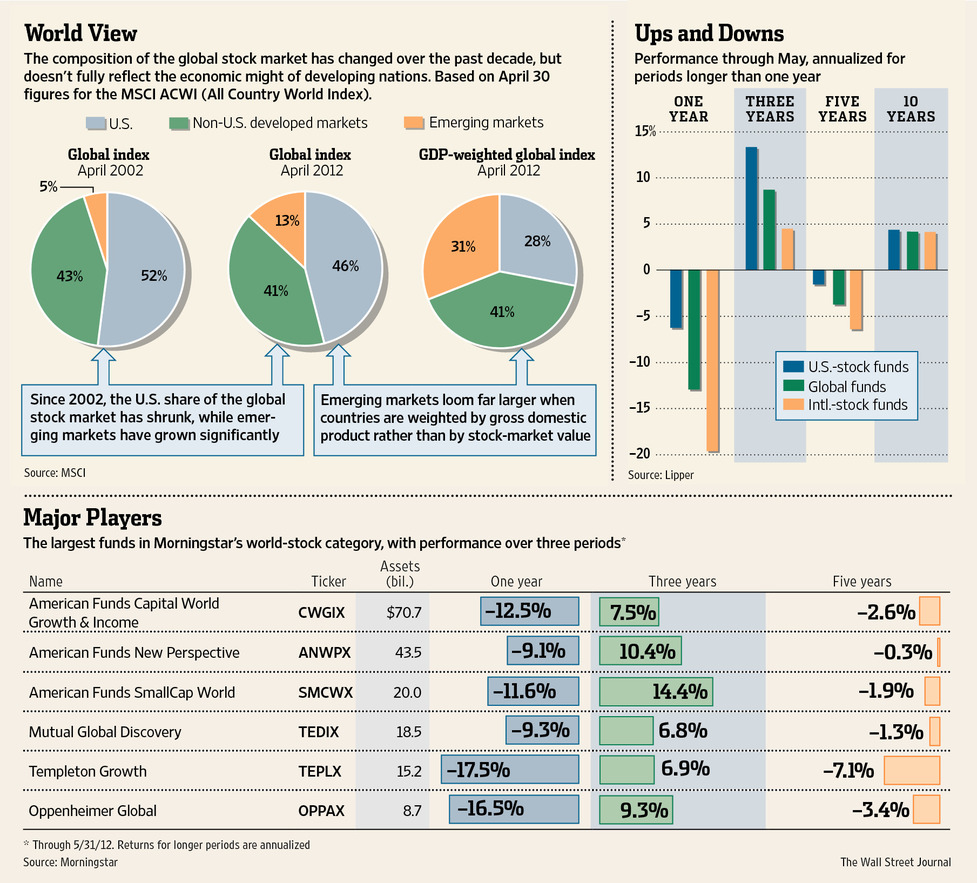
What are you reading? > A Smarter Way to Invest Globally? |
| Bloomberg Appearances: Market Outlook, TBTF Posted: 05 Jun 2012 11:41 AM PDT Barry Ritholtz, chief executive officer of FusionIQ, an equities research firm, talks about the outlook for financial markets and investment strategy. Ritholtz speaks with Betty Liu, Dominic Chu and Joshua Lipton on Bloomberg Television’s “In the Loop.” Ritholtz on Wal-Mart, JPMorgan, Market Outlook ~~~ Part 2 Neil Barofsky, former special inspector for the U.S. Treasury’s Troubled Asset Relief Program and a Bloomberg Television contributing editor, and Barry Ritholtz, chief executive officer of FusionIQ, participate in a roundtable discussion about the role of the Federal Deposit Insurance Corp. and financial regulations. They speak with Betty Liu on Bloomberg Television’s “In the Loop.” Ritholtz, Barofsky on FDIC, Financial Regulations |
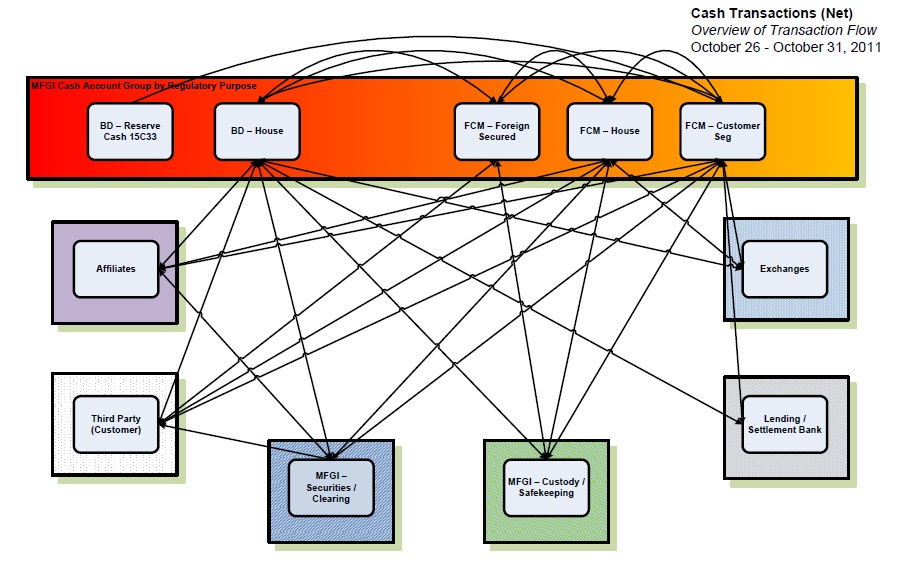
| Posted: 05 Jun 2012 11:15 AM PDT MF Global Trustee’s Investigation Report (in Think Tank) has some fascinating details, as you can see from this particular graphic, courtesy of FT Alphaville. That makes it appear that MFG was regularly shuttling money around, fior what legitimate purpose I don’t know. It confirms the advantages of simplicity over complexity in basic functions like brokerage transactions. I’d suggest you read through as much of the report as you can bear . . .
click for full report |
| MF Global Trustee’s Investigation Report (in Color) Posted: 05 Jun 2012 11:00 AM PDT |
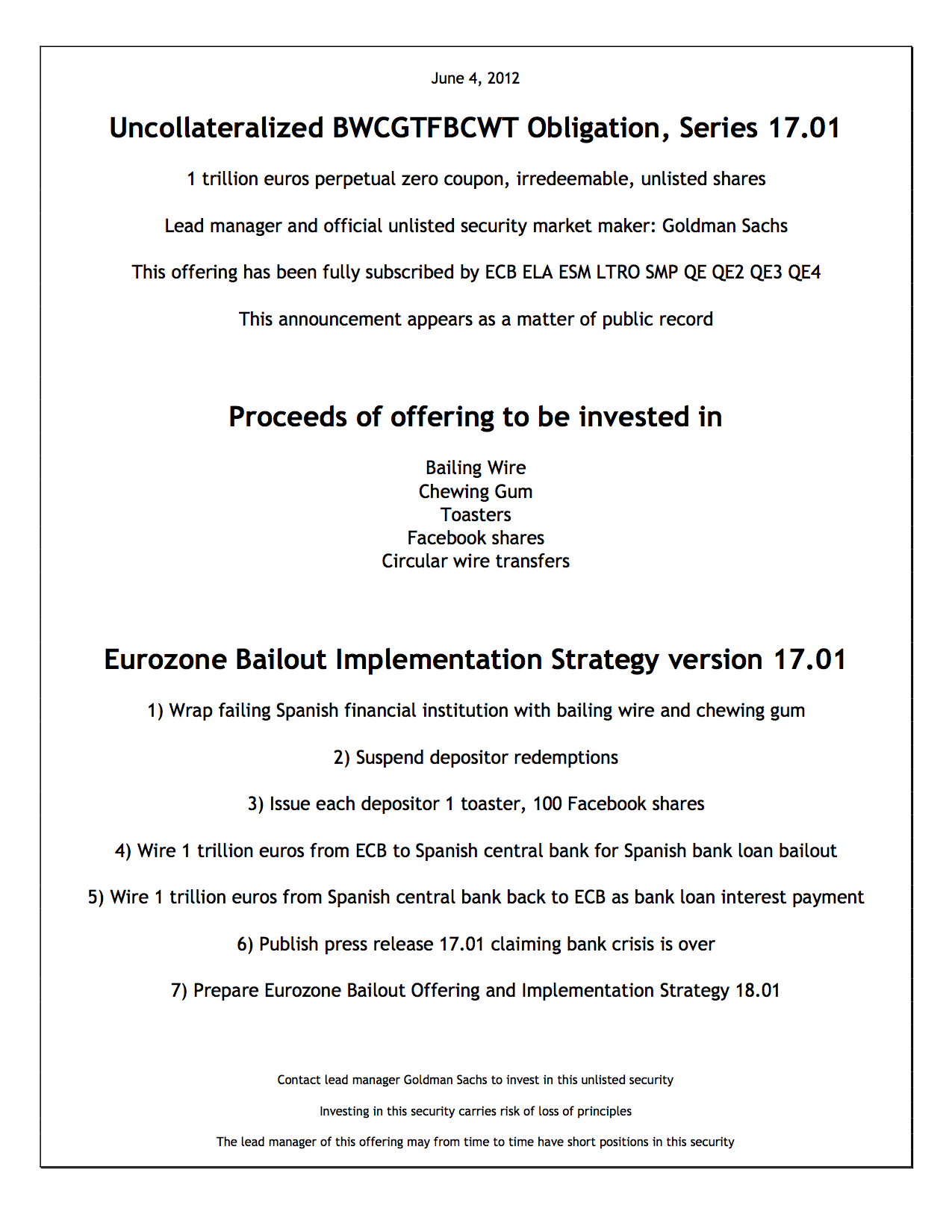
| Uncollateralized Trillion Euro Perpetual Zero Coupon Posted: 05 Jun 2012 08:45 AM PDT Michael Belkin is the author of the eponymously named Belkin Report — a highly respected institutional quantititative/technical service that looks at global markets in equities, commodities, currencies and bonds. His report this week is tongue-in-cheek titled “Where Else Are You Going To Put Your Money?” and begins with this delightful spoof of the Euro bailout being contemplated by the ECB, LTRO, Germany and others and is appropriately named Uncollateralized BWDGTFBCWT Obligation, Series 17.01. Mike imagines a trillion Euro perpetual zero coupon offered by Goldman Sachs, proceeds of which will be invested in Bailing Wire, Chewing Gum, Toasters, Facebook Shares and Circular Wire Transfers, which if you have to ask then you don’t want to know. Prospectus below — be sure to read the fine print. |
| Better US (non manufacturing) ISM data Posted: 05 Jun 2012 08:00 AM PDT The Australian Central Bank, the RBA, reduced its overnight cash rate by 25bps to 3.5%, as expected. The Governor of the RBA stated “The board (of the RBA) judged that, with modest domestic growth and a weaker and more uncertain international environment, the outlook for inflation afforded scope for a more accomodative stance of monetary policy”. The A$ improved marginally following the news, as markets had expected an even larger rate cut. A further rate cut is July is likely;
Yesterday, Chinese markets closed 64.89 points lower. For the superstitious Chinese, the decline reminded them of the Tiananmen Square massacre 23 years ago on June 4th 89. The reaction – well authorities blocked all references on the internet. The key issue is that it just confirms the paranoia of the Chinese authorities;
The HSBC Chinese services PMI rose to a 19 month high in May of 54.7, from 54.1 in April. Interestingly, the official services PMI number indicated a decline in services PMI in May;
EZ May services PMI were as follows: Italy came in at 42.8, up from 42.3 in April and better than the forecast of 41.8; France (final) came in at 45.1, slightly lower than the initial estimate of 45.2; German (final) came in at 51.8, lower than the initial 52.2; Overall, the EZ May final services PMI came in at 46.7, slightly better than the flash reading of 46.5. The EZ composite PMI came in at 46.0, also slightly better than the flash reading of 45.9, but the lowest since June 2009.
EZ April retail sales were down -1.0% MoM, or -2.5% yoY, much weaker than the forecast of -0.1% and -1.1% respectively. Spain was down -2.4% MoM. May’s data should be even worse;
For the 1st time, Spain (the Budget Minister) has called for direct EZ aid into its insolvent banks – he states that at current borrowing costs, the market is not open for Spain. However the Spanish authorities (the PM) still does not want EZ oversight. Will a recap of Spanish banks be enough. I very much doubt it. The PM will have to cave in. The head of Santander suggests that Spanish banks need just E40bn – most analysts are higher, with UBS as high as E100bn. Spain is to test bond markets this week, with an auction of longer term bonds;
German April manufacturing orders were -1.9% lower MoM, much weaker than the -1.0% expected. However, March’s data was revised higher to +3.2% MoM, up from +2.2% previously. The German economy Minister states that the reason for the decline was the strong data in March. However, I expect the data to show (significant?) weakness in coming months. An analysis of the data reveals a sharp drop (-4.7% MoM) of non EZ manufacturing orders and of foreign orders generally (-3.6% MoM), though domestic orders have held up (+0.4%) marginally;
Both Mrs Merkel and her Finance Minister, Mr Schaeuble, support the concept of bringing systemically important EZ banks under EZ supervision., rather than leaving them to regulation/supervision by individual countries. However, both Mrs Merkel and Mr Schaeuble reiterated that Germany would not support the creation of Euro Bonds, prior to “real fiscal union”. Mr Schaeuble also suggested that the German inspired “debt redemption fund” was “a medium term project”. However, the opposition parties in Germany want to discuss precisely this idea, in exchange for passing the fiscal compact through the German lower house.
Some analysts suggest that the ECB will cut interest rates tomorrow. The ECB will release revised economic data, including growth and, more importantly, inflation data, which should suggest a (much?) reduced inflation outlook. Personally, whilst I believe that the ECB will cut rates, I believe they will hold off until they can assess the outcome of the French and Greek elections and the results of the EU heads of State meeting at the end of the month, in particular. The ECB is anxious for EZ governments to act, rather than relying on them;
US May ISM (non manufacturing) came in at 53.7, higher than the 53.5 expected and above the 53.5 in April. Whilst the employment component was lower at 50.8 (the lowest since December), as opposed to 54.2 (supporting recent employment data), prices paid was sharply lower at 49.8, versus 53.6 and new orders were also higher at 55.5, as opposed to 53.5 previously. Overall, respondents suggested that activity had picked up. In addition, inflation is likely to weaken materially in coming months – lower oil price impact.;
The G7 finance ministers and central bankers are discussing Europe this morning. Cant see a great deal coming out of that chat. Indeed, comments from the Japanese, following the tele conference confirmed precisely that. US sources suggested that fiscal union in Europe ie Euro Bonds was discussed – yeah, I’m sure, but the German participants were deaf, he should have added;
Bloomberg reports that oil tanker rates have fallen to the lowest since 1997. Not going to be good for the Greek ship owners, the largest part of the Greek economy, with tourism next – which has also gone down the plug hole given the civil unrest;
Outlook
Gloomy EZ data, though the US non manufacturing data has improved sentiment. Bernanke’s comments are going to be listened to carefully – I would expect him to be dovish. Expect a lot of hot air in respect of Spain/Spanish banks, but ultimately Spanish banks will need funds from the ESM and will have to accept oversight.
The better US ISM report has improved US market sentiment. Oil is well off its lows and currently just over US$99 (July Brent).
UK markets will reopen tomorrow, following the 4 day holiday to celebrate the Queens Diamond Jubilee, a spectactular event and much more interesting than watching markets at present.
Kiron Sarkar
5th June 2012 |
| Service sector exec’s see daylight, not a train Posted: 05 Jun 2012 07:32 AM PDT ISM services in May at 53.7 was slightly above expectations of 53.4 and up a touch from 53.5 in April and vs 56.0 in March. It’s certainly a ‘phew’ moment in that it wasn’t much weaker in light of the growing economic fears. Business Activity rose 1 pt to 55.6 but is still down from 58.9 in March. New Orders rose 2 pts to 55.5 while Backlogs were flat. The Employment component fell 3.4 pts to 50.8, a 5 month low and squares with the lackluster payroll report last Friday. Export Orders fell 5 pts but after inexplicably rising 5.5 pts in March. Prices Paid fell below 50 for the 1st time since July ’09. Of the 18 industries surveyed, 13 reported growth and 3 contraction with the balance seeing no change. ISM said “the majority of the respondents’ comments are positive and optimistic about business conditions and the direction of the economy.” This quote in the face of a clearly slowing global economy and European debt mess shows quite a disconnect where service sector exec’s apparently see daylight thru the tunnel while some see a high speed train. |
| Posted: 05 Jun 2012 07:30 AM PDT Back from Bloomberg TV, ready with some not-so-early morning reads:
What are you reading?
|



| You are subscribed to email updates from The Big Picture To stop receiving these emails, you may unsubscribe now. | Email delivery powered by Google |
| Google Inc., 20 West Kinzie, Chicago IL USA 60610 | |



0 comments:
Post a Comment