


The Big Picture |

- Cosmology and the Arrow of Time
- Succinct Summation of Week’s Events (6.8.12)
- Gold, Treasuries & SPX: Returns Since The Greek Crisis
- 10 Friday AM Reads
- PBOC rate cut doesn’t excite
- The Hope Trade Returns Ahead Of Bernanke’s Presser, Jackson Hole 2.0?
- Fitch downgrades Spain 3 notches, with a negive outlook
- Investment Update: June 1st 2012
- Overfishing
- Look Out (modestly) Below, Friday Edition
| Cosmology and the Arrow of Time Posted: 08 Jun 2012 01:00 PM PDT TEDxCaltech – Sean Carroll Sean Carroll is a theoretical physicist at Caltech. He received his Ph.D. in 1993 from Harvard University, and has previously worked at MIT, the Institute for Theoretical Physics at the University of California, Santa Barbara, and the University of Chicago. His research ranges over a number of topics in theoretical physics, focusing on cosmology, particle physics, and general relativity, with special emphasis on dark matter, dark energy, and the origin of the universe. He is the author of “From Eternity to Here,” a popular book on cosmology and the arrow of time, and of “Spacetime and Geometry,” a textbook on general relativity; has produced a set of introductory lectures for The Teaching Company entitled “Dark Matter and Dark Energy: The Dark Side of the Universe;” and is a co-founder of the popular science blog Cosmic Variance, http://blogs.discovermagazine.com/cosmicvariance/. About TEDx, x = independently organized event: In the spirit of ideas worth spreading, TEDx is a program of local, self-organized events that bring people together to share a TED-like experience. At a TEDx event, TEDTalks video and live speakers combine to spark deep discussion and connection in a small group. These local, self-organized events are branded TEDx, where x = independently organized TED event. The TED Conference provides general guidance for the TEDx program, but individual TEDx events are self-organized. (Subject to certain rules and regulations.) On January 14, 2011, Caltech hosted TEDxCaltech, an exciting one-day event to honor Richard Feynman, Nobel Laureate, Caltech physics professor, iconoclast, visionary, and all-around “curious character.” Visit TEDxCaltech.com for more details. |
| Succinct Summation of Week’s Events (6.8.12) Posted: 08 Jun 2012 12:00 PM PDT Succinct summation of week’s events: Positives:
Negatives:
|
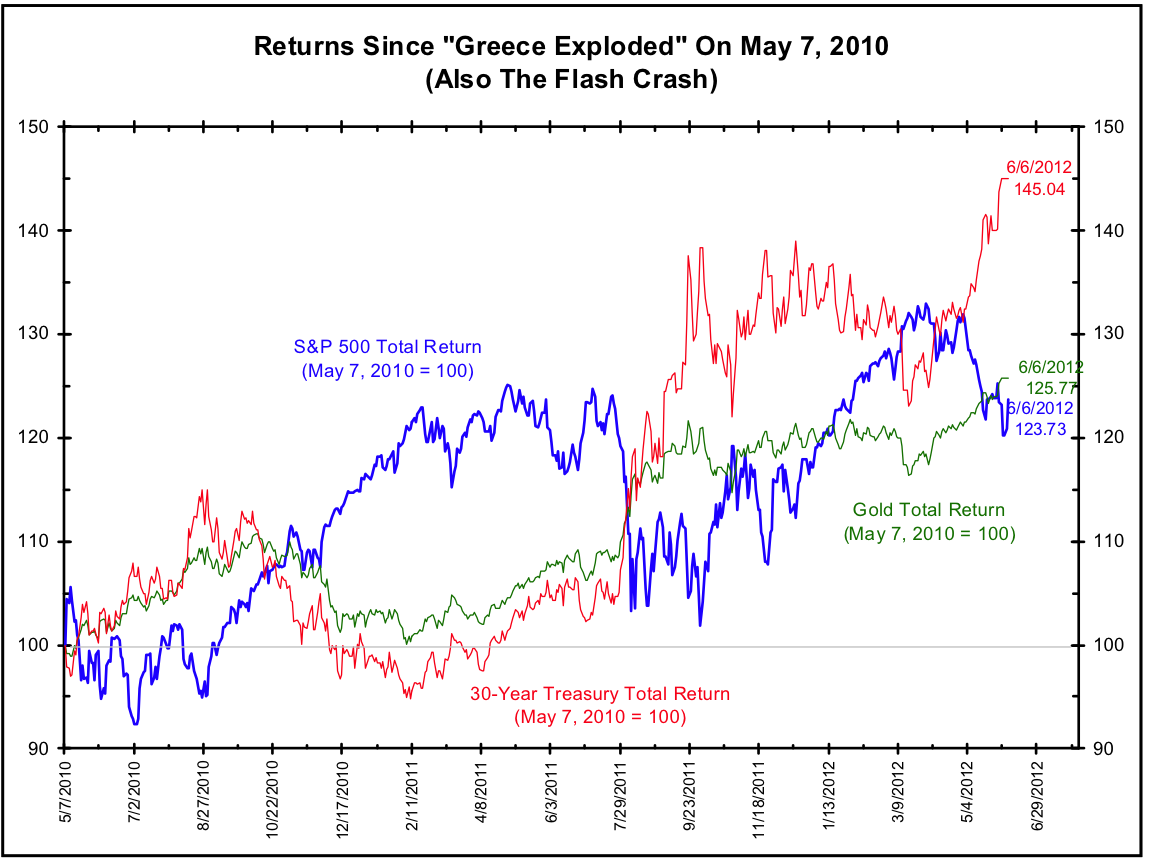
| Gold, Treasuries & SPX: Returns Since The Greek Crisis Posted: 08 Jun 2012 09:00 AM PDT
Fascinating: Returns on Gold, Treasuries and the S&P500 since the Greek financial situation 2 years ago . . .
|
| Posted: 08 Jun 2012 06:30 AM PDT My early morning reads:
What are you reading?
Stock Rally Snags on Gloom |
| Posted: 08 Jun 2012 06:13 AM PDT Rather than boost confidence that the economic moderation in China can be reversed, the PBOC interest rate cut yesterday instead reinforced why it happened to begin with, the slowdown is beginning to hurt. This was seen as the Shanghai index closed down .5% after opening higher by .5%. This lame response was the cue for another selloff in copper and crude. Elsewhere in Asia, South Korea kept rates unchanged as expected. Next week central bankers in Indonesia, Thailand, New Zealand and Philippines all meet. In Europe, Spain will may request a bank bailout (EFSF money going to the sovereign and then onto its banks rather than directly) over the weekend, according to comments, with the total amount determined by month end when further estimates of what’s needed are released. While the IMF said the hole is about 40b euros, some think they need 80-100b. |
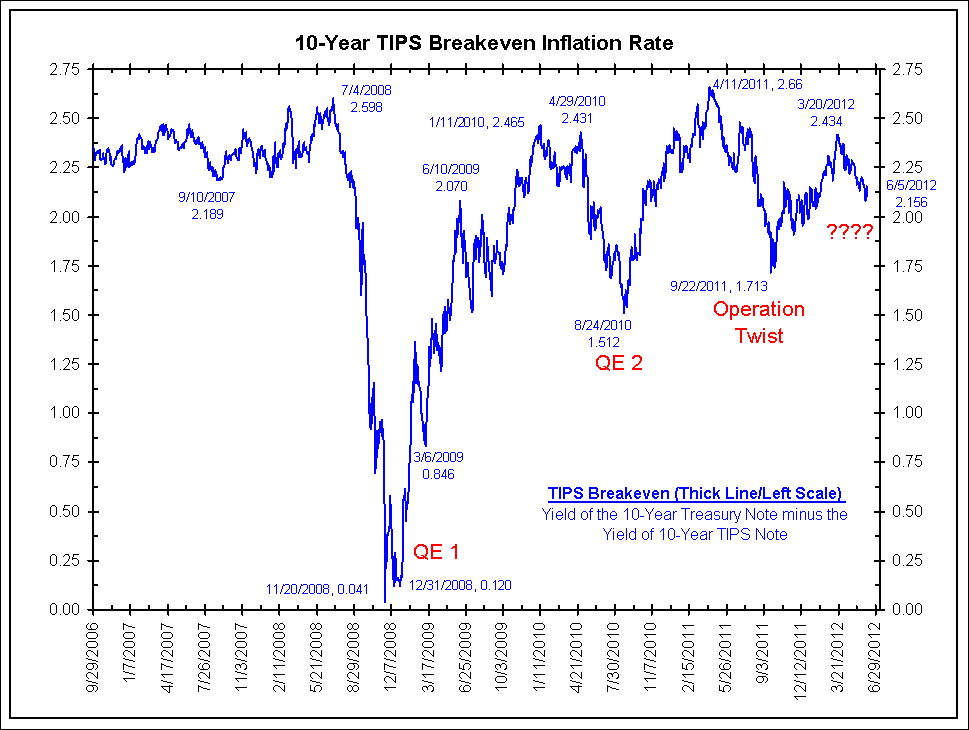
| The Hope Trade Returns Ahead Of Bernanke’s Presser, Jackson Hole 2.0? Posted: 08 Jun 2012 06:00 AM PDT MarketBeat (WSJ Blog) – Drumbeat's Getting Louder: the Fed Must Save the World The Wall Street Journal – Officials Say Fed May Need to Act Real Time Economics (WSJ Blog) – 2012 Feeling Like 2008, Except Then Policy Makers Were Ready to Act Bloomberg.com – Europe's Last Chance to Save Itself The Independent – Eurozone divided as time runs out for Spain Comment The markets appear to be ready/hopeful for the big QE3 announcement by Bernanke this morning. This testimony is being viewed as "Jackson Hole 2.0," referencing the August 2010 speech in Jackson Hole, WY when Bernanke all but announced QE2. Will this happen while the S&P 500 is still at 1,315 and 10-year TIPS inflation breakeven rates are at 2.15%? To expand on the answer we gave to this question in the chat window at the top of this page: The Jon Hilsenrath story yesterday seems to point to further stimulus in the near future. Whether or not that happens today when Bernanke speaks in front of Congress is anyone's guess, but between yesterday's rally in the stock market and the pop in the futures market this morning after China's rate cut, traders appear to be positioning for big news today. Reading the highlighted quotes in the stories above, the press gives the impression that further stimulus is a foregone conclusion. With a TIPS 10-year inflation breakeven rate of 2.15% and the S&P above 1300, announcing QE today risks overheating the markets later on. This could lead to the Federal Reserve cutting any QE short. There is also going to be a lot of pushback from the hawkish governors given the current level of the stock market and inflation statistics. What does Ben do if we are at 1475 on the S&P 500 and a breakeven rate of 2.90% before QE3 starts? Do you cancel it before it starts? That is the risk. Starting now risks too much inflation. Source: Bianco Research |
| Fitch downgrades Spain 3 notches, with a negive outlook Posted: 08 Jun 2012 05:11 AM PDT Japan’s current account surplus shrank to Yen333.8bn in April, well below the forecast of Yen441bn. Exports are being constrained by the strong Yen and the slowing global economy. The net international investment surplus is keeping the current account in surplus for present, though as this declines……..Japan did revise its 1st Q GDP growth rate upwards to +4.7% on an annualised basis, from +4.1%. Fitch warned today that Japan’s sovereign credit profile is under pressure, given the high and ever increasing government debt. When will it be time to short the Yen?; Yesterdays announcement that Chinese banks will have more flexibility to set their own rates within a wider band of the benchmark rate has been taken up in full. Chinese banks have raised rates on demand deposits (about 40% of deposits, according to Bloomberg) to the full amount possible (10% above the benchmark), suggesting that banks are scrambling for deposits. The moves will reduce margins – oops; The FT reported that views that the Yuan is undervalued may not be the case. I have and continue to totally agree with Mr Chanos (who is also of the view that the Yuan is not undervalued, indeed its overvalued) and the increasingly sceptical views of the FT. In my humble opinion, most analysts/observers have (grossly?) underestimated the deterioration of China’s economy and its terms of trade. The FT adds, that a reduction in forex reserves (likely in my opinion) will result in China selling US bonds – going to be interesting. The IMF has changed its views materially on the Yuan – it now says that the Yuan is “moderately undervalued” from previous statements of “materially undervalued”. Just follow the trend; The surprising Chinese rate cut yesterday has been viewed with extreme scepticism. The market has taken the cut as a preemptive move by the Chinese authorities, in anticipation of much worse economic data coming out over the weekend. As you know, I believe that analyst expectations of GDP growth of 8.0%+ this year are wildly optimistic – reaching 7.0%, without a stimulus programme is going to be difficult. Having said that, I do believe that the Chinese authorities, having done too little too little, will act further, with lower RRR’s, interest rate cuts and a mini stimulus programme. The Chinese markets and Hong Kong markets closed lower today – they don’t seem to have viewed the rate cut optimistically either – the most telling indicator. However, I do expect that inflation will have reduced further – below 3.0%?; Greek newspapers report that Greek banks experienced deposit withdrawals of between E5bn to E6bn in May, twice the average monthly deposit outflow over the past year; Fitch downgraded Spain 3 notches to BBB from A previously, with a negative outlook, citing the cost of the bank recapitalisation and a lengthening recession. They also estimated that Spain would require E100bn to recap their banks (extreme case), some 9.0% of its GDP, though E60bn in the base case. Fitch now has the worst rating for Spain amongst the main agencies. Fitch followed up with downgrades for 11 local and regional governments and 5 PSES, today as usual – banks next. Italian April industrial output declined by -1.9% MoM, much weaker than the -0.5% expected. Production has slumped -9.2% YoY on a workday adjusted basis; Much more importantly, Germany’s April trade balance came in better at E14.4bn (March E17.4bn), as opposed to expectations of E13bn. The current account surplus declined to E11.2bn, from E19.9bn in March, though slightly higher than expectations of E11.0bn. Exports declined -1.7% MoM, much greater than the -0.7% expected, with imports down -4.8% (oil price impact?), versus expectations of just -0.1%. The data reinforces my view that Germany is not immune and that upcoming data will reveal a (sharp?) decline in exports, in particular, followed by a slowdown in domestic consumption, the key driver of the German economy recently. Funnily enough this will be good news, as it will put more pressure on Germany to act sooner; The Bundesbank has raised German 2012 GDP forecast to 1.0%, from +0.6% previously, though downgraded its 2013 forecast to +1.6%, from +1.8%. However, they added that risks were rising materially, particularly given the situation in the EZ. Whilst the Buba has raise 2012 GDP forecasts, the overall views of the Buba were downbeat, indeed, particularly so – not surprisingly and suggests to me that the German economy is slowing far faster than most believe; UK May producer output prices were -0.3% lower MoM, or +2.8% YoY, well below expectations of +3.2% YoY and the lowest since November 2009. Essentially, I expect UK inflation to decline materially this year; Mr Bernanke’s comments to the Joint Economic Committee yesterday were taken negatively by markets, as he did not announce any FED policy action. However, given the upcoming Presidential elections and the fact that the FED has not used this event to announce decisions on monetary policy, I believe that market expectations/reaction were unrealistic. Mr Bernanke did say that the FED would act if necessary and, in recent days, a number of FED voting members ( including Janet Yellen for example) have made dovish comments. In addition, the composition of the FED board suggests that it is likely that the FED will act to ease further through another QE programme, rather than not, particularly if the situation in Europe deteriorates – he stated that the situation in Europe posed “significant risks”; Outlook Asian markets closed lower, ignoring the Chinese rate cut on suspicion that the Chinese data, to be released this weekend, will be more negative than expected. Quite possible, though inflation data is likely to be lower than current estimates – maybe even 3.0% or lower? European markets (ex Spain) are lower. The Euro is weaker, as is oil and gold. German 10 year bund yields have come in – currently 1.29% Sentiment remains pessimistic. Whilst I can understand that, it seems as if there is progress in Europe – OK slower than markets want, but there is progress. In addition, markets will force the EZ politicians to act – I very much agree with Soros’s view that the EZ has just 3 months to act – indeed, I would be closer to just 1 month. I also believe that the ESM will have to be granted a banking licence – the resources available to the ESM are just insufficient for its purpose – clearly bullish. One of my biggest fears in the EZ is France – the first round of the French Parliamentary elections is this Sunday, with the second round a week later. The most recent polls suggest that Hollande’s party will not gain a majority and will have to rely on the even more extreme left wing parties. How’s that going to work with Merkel’s/German views?. Not well. French bond yields have declined materially – I must say, I’m surprised (I’m much more negative) and will watch carefully, following this weekends elections. The Chinese authorities will have to do more – the current policies are insufficient – once again bullish (OK in the short term as, in my humble view, the Chinese economy is near being described a “basket case”), assuming I’m right. Bernanke will enact another QE programme as will the BoE, if necessary, though I question as to whether these measures will have much of an impact. Yesterdays (part) sell off on no news from Bernanke was way overdone, though the concerns re China remain valid. Whilst I’m not a super bull, the present gloom and doom, whilst understandable, seems overdone. Personally, I will look to nibble away on weakness, though only next week – will want to assess Chinese economic data to be released over the weekend – likely to be dodgy, ex better inflation numbers. Have a great weekend. Kiron Sarkar 8th June 2012 |
| Investment Update: June 1st 2012 Posted: 08 Jun 2012 05:00 AM PDT Last month, we explained how we came to be carrying so little equity exposure, and why we were "in no hurry to redeploy this cash we've raised." The events of May have validated our perspectives. We see an ongoing slowdown in the world's economy, with continued softness in equity markets (though that can change). Just how weak were global stock markets? This past month saw the equity markets slide 6%. It was the worst single month for the S&P500 in two years; the Dow Jones Industrial Average was unable to string two consecutive winning days in a row during the entire month! As of today, June 1st 2012, the DJIA has given up all of its gains since January 1 and is now flat year-to-date; Nasdaq is up modestly, while the S&P500 is barely above water. This consolidation follows the 12% first quarter, and was not unexpected. With today's weakness, the selloff has run almost 10% from the April 2nd highs. Since this rally began in March 2009, both times markets approached that magic 20% loss level, the Fed has intervened. Whether or not this will occur a third time is the primary question Fed Watchers will be pondering over the next few months. The key will be the economic data, which has been slowing appreciably of late. Indeed, the global economy, while not yet contracting, has been struggling. Parts of Europe are already in recession (Greece is in an outright depression). China has slowed from a torrid 11% to a still strong 8% growth rate; India also is cooling albeit to 6.5%. The world's largest economy, the United States, probably expanded at a 1.5-2% rate in Q2. This is the backdrop in which the Fed is contemplating their next move. Our best guess is that we need to see even more economic weakness and another 10% or so downwards before the Fed has the political cover to act. You may recall in January I lowered my US Recession probability over the next 12 months from 50% down to 30%. Today, that creeps back up to 40%. We continue to be underweight equities, overweight bonds and cash. Anticipating that possibility of a recession, today we added a 1% position in Wal-Mart across all accounts. Since it topped out in January 2,000, Wal-Mart's stock has gone nowhere – until now. It has finally broken out to levels not seen in a decade. WMT yields 2.4%, trades at a 20% discount to its Enterprise Value, and has a forward P/E of 12. While the Fed may act (eventually), we prefer to keep healthy amounts of cash and bonds on hand as the economy slows and earnings top out. In addition to our core models being risk averse, our tactical portfolio (Good Harbor) were 100% Treasurys for the entire month of May. We continue to remain cautious and watchful. -Barry Ritholtz |
| Posted: 08 Jun 2012 04:00 AM PDT Despite an increased awareness of overfishing, the majority of people still know very little about the scale of the destruction being wrought on the oceans. This film presents an unquestionable case for why overfishing needs to end and shows that there is still an opportunity for change. Through reform of the EU's Common Fisheries Policy, fisheries ministers and members of the European Parliament can end overfishing. But only if you pressure them. ~~~ Farmed Fish Eating Fish from Nigel Upchurch on Vimeo. |
| Look Out (modestly) Below, Friday Edition Posted: 08 Jun 2012 04:00 AM PDT
Some good news and some bad news about the past few days of rallies: The big rally on Wednesday saw a 92% Up/Down Volume on moderately expanding volume (modestly above the 30 day average). It offset Friday's NFP sell off (which was also a 90% down day). Choose your technical poison: 200 day moving average for S&P 500, 14-day Stochastic indicator, and other short-term indicators were all deeply oversold. Watch the percentage of stocks trading above 10-day moving averages to determine when this condition is abated. For this snapback to have staying power, a rise in volume as the rally progresses is significant. The key resistance will be the May 29th highs. Note also that option traders are not believers in this move. Now for the bad news: Yesterday stunk the joint up. Worse than a down day is a strong open that fades. Yesterday saw the Dow up 140 points, the Nasdaq up nearly 30 points. The Dow gave up 100 points, the S&)500 flipped negative, and the Nasdaq got clocked. As markets got closer to those May 29th highs, the buying interest collapsed. That is a classic failed test of prior highs. Lowry's reports that market internals were negative, with "57% of Up/Down Volume to the downside. NASDAQ internals were worse, with Down Volume 69% of total Up/Down Volume and 414 more declines than advances.“ |

| You are subscribed to email updates from The Big Picture To stop receiving these emails, you may unsubscribe now. | Email delivery powered by Google |
| Google Inc., 20 West Kinzie, Chicago IL USA 60610 | |



0 comments:
Post a Comment