.

{2} GoogleTranslate (H)

English French German Spanish Italian Dutch Russian Portuguese Japanese Korean Arabic Chinese Simplified

Our New Stuff

{3} up AdBrite + eToro

Your Ad Here

Sunday, June 10, 2012

The Big Picture

The Big Picture


Where the World’s Millionaires Live

Posted: 09 Jun 2012 02:00 PM PDT

15. The Netherlands
Population: 16.7 million
Percentage of millionaire households: 2.1%

14. Ireland
Population: 4.8 million
Percentage of millionaire households: 2.2%

13. Oman
Population: 2.8 million
Percentage of millionaire households: 2.5%

12. Belgium
Population: 10.4 million
Percentage of millionaire households: 2.9%

11. Japan
Population: 125.2 million
Percentage of millionaire households: 2.9%


10 through 1 after the jump

10. Bahrain
Population: 1.3 million
Percentage of millionaire households: 3.2%

9. Taiwan
Population: 23.2 million
Percentage of millionaire households: 3.2%

8. Israel
Population: 7.8 million
Percentage of millionaire households: 3.6%

7. U.S.
Population: 322.4 million
Percentage of millionaire households: 4.3%

6. United Arab Emirates
Population: 322.4 million
Percentage of millionaire households: 5.0%

5. Hong Kong
Population: 7.2 million
Percentage of millionaire households: 8.8%

4. Switzerland
Population: 7.7 million
Percentage of millionaire households: 9.5%

3. Kuwait
Population: 3.6 million
Percentage of millionaire households: 11.8%

2. Qatar
Population: 1.9 million
Percentage of millionaire households: 14.3%

1. Singapore
Population: 4.8 million
Percentage of millionaire households: 17.1%

Source: Bloomberg

A Dysfunctional Nation

Posted: 09 Jun 2012 12:56 PM PDT

A Dysfunctional Nation
John Mauldin
June 9, 2012


A Dysfunctional Nation
One Minute to Midnight?
The Triumph of Hope
A Quadrillion Here, A Quadrillion There
New York, Chicago, Italy, and Singapore


dysfunctional [dɪsˈfʌŋkʃənəl] adj

1. (Medicine) Med (of an organ or part) not functioning normally

2. (especially of a family) characterized by a breakdown of normal or beneficial relationships between members of the group


European leaders launched the euro project in the last century as an experiment to see whether political hope could become economic reality. What they have done is create one of the most dysfunctional economic systems in history. And the distortions inherent in that system are now playing out in an increasingly dysfunctional social order. Today we look at some rather disturbing recent events and wonder about the actual costs of that experiment. What type of “therapy” will be needed to treat the dysfunctional family that Europe has become? And maybe I’ll throw in a “fun” item to finish with, so let’s get started.

A Dysfunctional Nation

Michael Lewis has documented quite tellingly in Boomerang the dysfunctional country that is Greece – how citizens avoid taxes, how over 600 categories of workers can retire at the age of 50 with full pensions, and how fraud and corruption are endemic. Other stories have surfaced about how few doctors report more than 10,000 euros of income and how few professionals pay their property taxes.

Recently, when the current Greek government committed to actually collect some taxes in order to get more loans, a bureaucrat decided that a great way to collect property taxes would be to include them in people’s electricity bills, a move that caused an uproar. Lawsuits followed, as the national power company tried to cut off electricity for nonpayment. In a country where it can take a decade for a legal matter to get on a court docket, a court rather quickly took up the case and ruled it illegal for the power company to cut off service for non-payment. This ruling led to a massive financial loss by the power company as people simply stopped paying their electric bills.

The government had to step in with a rather large chunk of cash to keep the power on. As of May 1, the power company announced, it would no longer collect property taxes. The natural gas company threatened to cut off supplies to the electric utility for nonpayment, and emergency meetings are being held to“… avert the collapse of the natural gas and electricity system.”

The credit system in Greece is in a shambles, and there has been an open bank run this year. Reports that hospitals cannot get necessary life-saving medicines abound, as there is no more credit to be had from most manufacturers. Unemployment is at 22%, and youth unemployment is over 50%. “A collapse in the country’s economy has forced many Greeks to turn to black market barter economies and has left millions financially devastated, with no hope of finding an income stream for the foreseeable future.” (infowars.com)

The last election resulted in no possibility of a governing coalition, and new elections are scheduled for next weekend (June 17) – except that the employees who run the elections are threatening to strike if they are not given more pay. The head of the government workers union said Thursday that the union will hold a two-day strike on June 16-17. He also said municipal employees will refuse to do any election-related work until then. We will now see whether the courts will declare such a strike illegal and whether the members will honor a court decision. (http://www.washingtonpost.com/business/greek-municipal-workers-call-electoral-strike-threatening-to-derail-crucial-june-17-vote/2012/06/07/gJQAlhOjLV_story.html)

Greece was already in enough turmoil, with no clear winner emerging in the last polls that were taken this week. (Note: It is against Greek law to publish the results of a poll less than two weeks before an election.) And then there was the “debate.”

I assume that by now you have seen the video of the televised debate among representatives of the seven Greek parties. In a bit of poor planning, the very nationalistic Golden Dawn party head, a rather solid-looking young body builder, was seated next to the Communist Party leader, who is a lady. A few insults were exchanged, some water was thrown in the face of a rather pleasant-looking young lady (a representative of a leftist party) across the table from the Golden Dawn guy, there was a slap on his arm with a folder by the Communist Party leader; and then they were on their feet and Mr. Golden Dawn was repeatedly slapping and then punching Ms. Communist Party.

If for some reason you have not viewed this short but exciting clip, here is a link: http://www.rt.com/news/greek-politician-slaps-rival-278/ . Or you can Google “golden dawn greek slap” and get a link to a report in your language of choice. If you choose the German version from Der Spiegel, you can hear the word neo-Nazi repeated several times by the German reporter.

This exchange provokes a few thoughts. First, incidents of violence and vigilantism in Greece are rising, along with the lawful public demonstrations. Whatever veneer of civility that was left was ripped away by the boorish behavior of the Golden Dawn representative.

Second, this fracas will now dominate the national conversation. Rather than focusing on what they should do about remaining in the eurozone, accepting or rejecting austerity, and putting together some sort of coalition that can govern the country, they will be focused on this event. Nine days before an election in which no party seemed to have a clear lead or a path to a ruling coalition, the results are now even more in question. Golden Dawn had some 6% of the Greek vote. Will it maintain that percentage? If not, where will its votes go? Will this help or hurt the mainstream conservative or left-of-center parties?

Whether it be families or nations, such a level of dysfunctionality almost always ends in tears. The “slap” is just one more telling incident in a country that is on the brink of self-destruction. It is very possible that the winner of the election will be a party that wants to reject austerity but believes that the rest of Europe will give them the money they need to continue to pay their public employees, maintain services, and keep the government functioning. The reasoning seems to be that Europe will do that because they need the Greeks to continue to pretend that they will pay off their national debt to the European governments and ECB.

Why are we still fixated on Greece? Even though Greece is small, it matters; because if Greece leaves the euro then the markets will immediately ask, “Who’s next?” And while a year ago everyone thought the answer was Portugal, the market is now looking hard at Spain, which is on the same path to insolvency that Greece was only a few years ago.

Spanish government leaders are now beginning to admit they must have help, as it appears they will soon be frozen out of the bond market, if that has not happened already. As I have written, it will take a massive commitment of European (read German) money to save Spain, and it’s not a one-time commitment. It is not just 100 billion euros to re-fund Spain’s banks. If Spain gets frozen out of the market, adding another €100 billion in debt will not make things better, when there is a nearly 10% fiscal deficit, unemployment as bad as Greece’s, and an economy that is in freefall.

Europe is going to have to buy all Spanish debt for years. And not just new debt but all the old debt that is coming due and must be refinanced. We are talking hundreds of billions of euros. And if there is a bank run on the order of Greece’s? The number just keeps getting bigger. To think it will be anything like the €46 billion being talked about by the IMF today is to simply ignore economic reality.

That money will have to come from somewhere. Either the ECB will have to monetize it directly (possible but not likely) or a pan-European entity like the ESM will have to be allowed to become a bank and then apply to the ECB for loans and a capital infusion in order to then bail out Spanish (and other) banks.

It is obvious, at least to your humble analyst, that if the eurozone is to survive several things must happen. First, there must be something created on the order of a European FDIC. Banking guarantees and regulation must become a European responsibility, not a country responsibility. How would it have worked if the rest of the US had decided that New York should bail out its own banks, when they had their crisis in 2008?

Second, if the ESM is allowed to become a bank, then what will those guarantees look like? Because the original agreement of member countries to back a specific and limited amount of debt will now be increased ten-fold. And that will mean something in the neighborhood of €4-5 trillion.

How could they need that much? The answer is, because it will not be just Spain. Can Italy be far behind, given the unfolding European recession? And the French banks? France itself, given the new policy direction of its government and its own massive unfunded liabilities?

Assume it is just €4 trillion, spread over a few years. Germany will be responsible for at least 25% of that amount, or about 40% of their GDP. And that assumes that Spain, Greece, Ireland, et al. will be good for their portions.

Will Germany want to take on such a massive new debt? The periphery countries already owe the German Bundesbank over €1 trillion. German debt-to-GDP is already at 80%. German credit default swaps are rising in cost.

If Germany takes that first step, it must be prepared to keep marching, because to stop at any point will mean even more pain, since they will still be responsible for their share of any debt created after that first step. As they say at the poker table, “In for a dime, in for a dollar.”

Certainly, if they are to take on such a debt, there must be guarantees of fiscal control by the nations who need help.

And that means a tighter fiscal union. When the euro was created, European leaders thought that a common currency would naturally lead to a fiscal union. Monetary unions without fiscal union always become dysfunctional.

Or there will have to be direct monetization of the debt by the ECB, which goes against the policy that Germany thinks it agreed to.

Either way, it is a very large change in position for Germany.

There are three problems that Europe must solve. They have a sovereign debt problem and a resulting banking debt problem. Both of these are evident and there might be some solution, given time and money.

But the third problem is the more difficult one. That is the trade imbalance between Germany and the peripheral countries and the differing levels of productivity of their workers. Trade deficits must be brought into line. The usual way to do this is through currency devaluation by the country with the trade deficit. That is not possible for the countries in the eurozone. So, the only other way is for the workers of an uncompetitive country to accept lower wages. Since no one thinks they are underpaid, that will happen slowly and painfully and mean a protracted recession or depression.

Which leads to voter frustration and frayed nerves that spill over into dysfunctional actions. It also leads to political changes.

Let’s hold that thought for a moment. In the weekend Financial Times, my friends Niall Ferguson and Nouriel Roubini have written an op-ed calling for a European banking authority and tighter fiscal union, if the eurozone is to survive. http://www.ft.com/intl/cms/s/0/c49b69d8-b187-11e1-bbf9-00144feabdc0.html#axzz1xHuDXIr4

Let’s look at a few paragraphs from the op-ed, with its leading question:

One Minute to Midnight?

“Is it one minute to midnight in Europe?

“We fear that the German government’s policy of doing ‘too little too late’ risks a repeat of precisely the crisis of the mid-20th century that European integration was designed to avoid.

“We find it extraordinary that it should be Germany, of all countries, that is failing to learn from history. Fixated on the nonthreat of inflation, today’s Germans appear to attach more importance to 1923 (the year of hyperinflation) than to 1933 (the year democracy died). They would do well to remember how a European banking crisis two years before 1933 contributed directly to the breakdown of democracy not just in their own country but right across the European continent….


“But now the public is finally losing faith and the silent run may spread to smaller insured deposits. Indeed, if Greece were to leave the eurozone, a deposit freeze would occur and euro deposits would be converted into new drachmas: so a euro in a Greek bank really is not equivalent to a euro in a German bank. Greeks have withdrawn more than €700m from their banks in the past month.

“More worryingly, there was also a surge in withdrawals from some Spanish banks last month. The government’s bungled bailout of Bankia has only heightened public anxiety. On a recent visit to Barcelona, one of us was repeatedly asked if it was safe to leave money in a Spanish bank. This kind of process is potentially explosive….

“Until recently, the German position has been relentlessly negative on all such proposals. We understand German concerns about moral hazard. Putting German taxpayers’ money on the line will be hard to justify if meaningful reforms do not materialise on the periphery. But such reforms are bound to take time. Structural reform of the German labour market was hardly an overnight success. By contrast, the European banking crisis is a real hazard that could escalate in days.

“Germans must understand that bank recapitalisation, European deposit insurance and debt mutualisation are not optional; they are essential to avoid an irreversible disintegration of Europe’s monetary union. If they are still not convinced, they must understand that the costs of a eurozone breakup would be astronomically high – for themselves as much as anyone.

“After all, Germany’s prosperity is in large measure a consequence of monetary union. The euro has given German exporters a far more competitive exchange rate than the old Deutschmark would have. And the rest of the eurozone remains the destination for 42 percent of German exports. Plunging half of that market into a new Depression can hardly be good for Germany.

“Ultimately, as Angela Merkel, the German chancellor, herself acknowledged last week, monetary union always implied further integration into a fiscal and political union. But before Europe gets anywhere near taking this historical step, it must first of all show it has learnt the lessons of the past. The EU was created to avoid repeating the disasters of the 1930s. It is time Europe’s leaders – and especially Germany’s – understood how perilously close they are to doing just that.”

The Triumph of Hope

When the Eurozone was created it was the triumph of hope over the reality of political and economic discord. Somehow, countries that had different languages, customs and national characteristics; that had fought each other for centuries; and that all had different views of themselves in relation to the rest of their fellow Europeans, were supposed to come together into a fiscal union, because they now shopped with the same money.

Rather than simply creating a free-trade zone and allowing for a common understanding and economic integration to develop over time, the European leaders wanted to jump-start the process. And they had numerous critics. Many of the best and brightest in the economics world pointed out the problems.

The reality is that the euro has never been a real currency. It is still an experiment. If it is even around in five years, it will be a true currency, as it will have endured its first real crisis. The peripheral countries used the low interest rates of the euro to borrow heavily (both privately and publicly) and got in trouble, and now the true costs of the euro project are being revealed.

A break-up will cost multiple trillions of euros. Keeping the eurozone together will cost multiple trillions of euros. But keeping the eurozone together will also cost countries a substantial loss of sovereign independence. When voters all over Europe signed on for the euro project, they did not think they were giving up their national independence and the right to control their own budgets.

Will Spain or Italy or Germany be willing to allow a European institution to set their budget priorities and limits? To set their retirement policies and health care? To tax them independently? That is what is meant when one talks fiscal integration. Germany is now a minority on the ECB and is beginning to realize it has lost control. Will its voters want to give up political control and become a minority in a “United States of Europe”?

That is the true problem. When real economic difficulties arise, as in Greece or Spain, voters tend to get rather touchy. Tensions rise. And the center does not hold.

George Soros said this week that Europe has three months to resolve its problems. Nobel Laureate Joseph Stiglitz said Soros was being optimistic. A decision is going to have to be made quite soon about Spain, and likely before it becomes clear whether Greece will stay in or leave the euro. And that makes it difficult to give Spain aid that is not offered on equal terms to those Greece got. Monetizing Spanish debt (however you want to do it or whatever you want to call it) when Spain is running an almost 10% deficit, when it had agreed to a little over 5% only a few months ago, will not sit well with Greece.

But it now seems that Europe is unlikely to get the time it needs, absent some rabbit pulled out of its monetary hat to allow Spain to borrow money at rates that it can afford. The Endgame approaches. It will be a long summer.

I get asked all the time if the euro will break up. The honest answer is, we really don’t know. I think the economically rational thing to do in the very long term is for some countries to figure out how to leave the euro, but that is more a political question than an economic one. And if you can tell me what politicians and voters will do in a political crisis and deepening recession, then your crystal ball is less foggy than mine.

I think it is 50-50. The drive to hold the euro together will go head to head with national self-interest. Right now, it depends on whom you ask as to what answer you get. But I do not think we will be asking the question much longer. Soon enough, we will know.

To be clear, Europe has no good choices, only a choice among very distressing and expensive options. This will not be good for them or for the world. I think we are already seeing a global slowdown, in great part due to Europe. Let us hope they get the answer right, whatever it is.

A Quadrillion Here, A Quadrillion There

Everett Dirksen was a Republican Senator from Illinois back in the ’50s and ’60s. He is credited with saying “A billion here, a billion there, and pretty soon you are talking about real money.” It seems that thorough research does not turn him up actually saying that line, although researchers do note that one reporter said he had asked Dirksen about it and received the reply, “Oh, I never said that. A newspaper fella misquoted me once, and I thought it sounded so good that I never bothered to deny it.”

But that quote has slipped into the US national memory, and whether or not he said it, it does make a real point. And that was back in the early ’60s, when a billion dollars was not just a rounding error in the national budget.

Today we have become rather casual in our use of the word trillion. “A trillion dollars” slips so easily off the tongue, but it is too big a number for most of us to even fathom. Estimates of the total stars in our galaxy run between 100 and 400 billion. A trillion barrels of oil would fuel the world for over 30 years. One trillion seconds is almost 32,000 years. The mind boggles. Yet today we think almost nothing of adding a trillion dollars every year to the already bloated US debt! In fact, economists like Paul Krugman fume that we are not adding more trillions to the debt each year, as if debt brought no consequences. By this thinking, Greece should not be made to have to suffer austerity because it has taken on too much debt. Rather, other nations should be taxed to give Greece the money to go even deeper into debt that it cannot and most likely will not repay.

So, I must admit that when I came across this next item, it gave me pause. We turn now to a report published by Bloomberg and authored by my friend Dr. Gary Shilling, talking about the massive debt that has been accumulated by Japan. Gary argues that Japan is reaching a critical point where its debt cannot be financed except by extreme monetization by its central bank, because turning to world markets to sell the debt will drive up interest rates to unsustainable levels. I have made similar arguments, but that is a topic for another letter. Today, I want to quote just one paragraph. (http://www.bloomberg.com/news/2012-06-07/strong-yen-won-t-survive-japan-s-fiscal-cliff.html)

“As Japan’s government debt of 1,085 trillion yen matures over time, it will be subject to any higher refinancing rates. The average maturity of Japanese government debt is six years and 11 months. Yet 17 percent of that debt matures this year, 52 percent in the next five years and 76 percent in the next decade. Markets anticipate, so Japanese bonds throughout the spectrum will probably plummet in price and leap in yield at the first sign of a current-account deficit, maybe even before.”

One thousand trillion yen. 32,000,000 years’ worth of seconds. Yes, I know a yen has a few extra zeros in relation to the dollar, but we are talking about one quadrillion yen.

Are we really ready for the word quadrillion to enter the lexicon in what is supposed to be the developed world? In the case of Japan, we are apparently there. A hundred years ago, a deficit of US$1 billion would have been unthinkable. We actually had balanced budgets for most of our first 200 years, except during wars and economic crashes. And now we talk trillions, albeit in the wake of inflation that has made the word trillion less than it was 100 years ago. Will our grandchildren in the latter half of this century talk quadrillions? Or quintillions? Is that even thinkable? Let’s just hope the word quadrillion doesn’t come into common parlance any time soon.

New York, Chicago, Italy, and Singapore

I leave for New York Monday afternoon, arriving in time to have dinner with Art Cashin, Barry Ritholtz, Barry Habib, Rich Yamarone, and a few other friends, before I spend the following day speaking at a few private events with my partners from Altegris. I am back in Dallas Wednesday and home till the middle of next week, when I make a quick trip to Chicago for the Morningstar National Investment Conference, again with Altegris.

Then Friday evening I leave for Tuscany (with a night in Madrid) for two weeks. I will be writing from there and catching up on my reading, but a vacation for me is staying in the same place for two weeks. I will have some friends in, as well as some family, with a few side trips here and there, but I’m hoping to relax some.

I expect to be writing this letter as usual from Tuscany, although right now Ed Easterling and I are talking about revisiting some work we did in 2002 on secular bull and bear markets. We both believe we are still in a secular bear, but the question now is, when will it end? The original work was published in this letter and in Bull’s Eye Investing and is the core of that book.

Wiley recently released an edited, smaller version of the book, called The Little Book of Bull’s Eye Investing, which updates the main points. Given that the single most important thing for an equity investor is to know what long-term secular cycle we are in, the material is most topical. (And if you are asking what a secular cycle is, then you REALLY need to read the book). I like the way the book turned out. You can order a copy at http://www.amazon.com/Little Book.

I think it will take us at least two weeks to cover the topic, but it is important and will help us all think about something besides Europe, even if I am sitting right there in the middle of it.

On a personal note, many of you know that I quit drinking alcohol about ten months ago, for health reasons. It has helped. One of the side benefits, I thought, was that I could expand my diet somewhat, since I was no longer consuming all those calories in wine and scotch. I added bread and desserts and a lot of red meat. Then this week I got the results of my latest blood tests. It seems I now have a cholesterol problem. Nothing that changing my diet can’t fix, but I have to admit, I was enjoying indulging myself and not really gaining any weight. Oh well. A little moderation is good for the soul, or so they tell me.

Oh, and we’re getting really close to the launch of Mauldin Economics, with a brand-new website and an investment newsletter that will turn some heads. Stay tuned!

It really is time to hit the send button. The sun is coming up and I need to get some sleep. (I procrastinated much too long tonight.) My grandson (Henry’s son) has a birthday this weekend, so the family will gather on Sunday for brunch and a party. It will be good times. But I see chicken, not steak, on my menu. Have a great week.

Your needing to eat more fish analyst,

John Mauldin

John@FrontlineThoughts.com

Source: JohnMauldin.com (http://s.tt/1dRzK)

Abacus Indicted for Criminal Mortgage Fraud

Posted: 09 Jun 2012 10:00 AM PDT

While the name Abacus is famous as Goldman's fraudulent CDO scheme – the poster child for the rampant fraud on Wall Street – another Abacus (a small bank) has just made news by being criminally indicted for mortgage fraud.

Bloomberg's Anthony Lee Pacchia interviewed Bill Black on the meaning and ramifications, and sent me the following summary and clip:

Manhattan DA Cy Vance given us a rarity in filing *criminal* charges against Abacus Bank and 19 former employees for mortgage fraud. The papers say the bank originated liar loans, a common practice for most banks. But according to guest Professor William K. Black, don't expect this case to lead to more prosecutions of large banks despite overwhelming evidence of rampant fraud amongst the big banks in mortgage origination. A couple of his points:

-state and federal authorities don't have anywhere near the manpower or resources to actually prosecute big banks for fraud.

-Treasury Sec. Tim Geithner has actively discouraged prosecutors from going after big banks.

-the very idea of prosecuting Abacus for a crime while allowing it to remain open is completely nonsensical and is likely to provoke a run on the bank.


Of course, fraud caused the 1930s Depression and the current financial crisis, and there's no recovery because the government made it official policy not to prosecute fraud (and see this, this, this, and this).

But government regulators have said that they'll take on the small fish … and let the big-time criminals go.


Why the “Fed Model” Doesn’t Work

Posted: 09 Jun 2012 09:00 AM PDT

In this weekend’s Barron’s, Mike Santoli has a very simple criticism of the (so called) Fed Model for determining if equities are cheap or expensive (The Flaws in the Fed Model).

Stated simply, the “fabled stock-market predictor doesn’t work.

The idea here, once formalized as the “Fed Model,” is that stocks’ “earnings yield” (reported or forecast operating earnings for the S&P 500, divided by the index level) should tend to track the Treasury yield in some fashion. With this earnings yield now above 7%, based on a trailing price-to-earnings ratio near 13, this model and its various offshoots render equities a no-brainer buy. Or, if one prefers, that Treasuries are in a reason-defying bubble.

This simply doesn’t hold up in theory or practice. The Fed Model only “worked” as a predictor of market action in the 1980s and ’90s, when bond yields were steadily descending and stock values consistently rising as inflation and interest rates were slowly strangled. Both before that period and since, the Fed Model relationship has been mostly a non sequitur in terms of foretelling market performance.

For sure, the Fed Model is useless. But why it is useless is not well understood by most investors. Understanding this about the Fed Model or any other Wall Street hokum may help you look askance at other seemingly plausible, even persuasive arguments that actually fail.

Regarding the the Fed Model, it does not do what it claims to do. It does not tell an investor if stocks are cheap. Back in 2008, I made an attempt at explaining why: The key taker away is that it controls for two variables — not just one:

Note that the formula contains two variables: While it is commonly described as a way to evaluate when stocks are over- or under-valued, the other variable in the formula above is the forward S&P500 earnings consensus. SPX prices and the 10 year yield are the knowns, while BOTH valuation and forward earnings estimates are the unknowns.

Thus, the Fed model today might be telling you either of two things: When equities are undervalued — or when consensus earning estimates are simply too high.

-The Flawed Fed Valuation Model, February 5, 2008

Said differently, the Fed model assumes analysts consensus is accurate. That assumption has been the undoing of many an investor . . .


Source:
The Flaws in the Fed Model
MICHAEL SANTOLI
Barro’s, June 9, 2012
http://online.barrons.com/article/SB50001424053111904470204577446371761637272.html

Gary Shilling on Housing Market, Economic Outlook

Posted: 09 Jun 2012 08:06 AM PDT

Gary Shilling, president of A. Gary Shilling & Co., and a Bloomberg View columnist, talks about the outlook for the U.S. economy, housing prices and Federal Reserve monetary policy. Shilling, speaking with Erik Schatzker, Sara Eisen, Scarlet Fu and Stephanie Ruhle on Bloomberg Television’s “InsideTrack,” also discusses investment strategy for Treasuries and the European financial crisis. (Shilling is a Bloomberg View columnist. The opinions expressed are his own.


Source: Bloomberg June 5 2012

Yellen: Perspectives on Monetary Policy

Posted: 09 Jun 2012 07:30 AM PDT

How the FDIC can curb banks’ reckless speculation

Posted: 09 Jun 2012 06:30 AM PDT

How the FDIC can curb banks' reckless speculation
Barry Ritholtz
Washington Post, June 1 2012


Let's be blunt: Banking has devolved into an unruly mess.

After years of deregulation, it has become all but impossible to re-regulate modern banking. There was a brief window during the credit crisis, but that has passed. Today, profits trump soundness. Safety and security are secondary to risk-taking and speculation.

I have been wondering what we, as a democratic nation, are going to do about this. Are we going to rule banks, or are bankers going to rule us?

My curiosity got the best of me. To find the answer, I slipped off in my time machine to the near future. While I was there, I learned that (yeah!) we had ended Too Big to Fail, eliminated taxpayer liability for reckless speculation, and freed hedge funds and investment banks from onerous regulations. In short, in the future, they seem to have figured out how to make the entire financial system safer and more stable. All this, based on a simple rule change from the FDIC.

I managed to sneak back home a copy of the letter behind that fascinating development. That letter from the office of the Federal Deposit Insurance Corp.'s chairman, circa 2015, follows:


___________________________________

June 3, 2015

Dear Banker,

Thank you for your cooperation in our most recent series of bank stress tests. We had hoped that these would not be necessary, but after the credit crises of 2007-08 and the banking crises of 2014, the FDIC simply had no choice.

The results of these stress tests, especially as applied to our largest banks, are terribly troubling. Trading losses of billions of dollars have made it apparent that nearly every major depository bank is in a far more precarious financial condition than previously believed. It is as if many of our largest banks never fully recovered from the earlier crisis and now lack sufficient capital to withstand any further pressure.

This is especially concerning if the economy takes yet another turn for the worse or housing begins its third leg down.

Capital reserves are insufficient to support the trillions of insured deposits at these banks. Ever since interest rates hit record lows and the 10-year Treasury bond broke 1.5 percent, leveraged speculation has become the primary business of the largest FDIC-insured banks. We have grave concerns about the safety and soundness of these insured depositories. The ongoing collapse in Europe, the wild currency swings around the world, and that recent turmoil in China have all made the current state of finance extremely risky.

Following the most recent bank failures, the reserve position of the FDIC Deposit Insurance Fund (DIF) has fallen to perilously low levels. This pool of capital is the backstop for public money deposited in demand accounts at large and small banks around the nation. Given these exigent circumstances, the FDIC cannot sit idly by while speculation in derivatives and other complex financial instruments exhausts the DIF, thus putting taxpayers' money at great risk. Nor can we assume unlimited liability in guaranteeing deposits at firms where trading in derivatives is creating additional liabilities to the FDIC (and taxpayers) that is measured in the trillions of dollars.

Therefore, as chairman of the FDIC, with the full support of my board of directors, we have decided upon the changes in the regulations covering federal deposit insurance:

1. Effectively immediately, we have increased the FDIC deposit insurance for any U.S. bank that engages in ANY trading of derivatives or underwriting securities or other investment banking activities by threefold. This threefold fee increase goes into effect immediately. It applies whether these trades are hedges for proprietary trades or are made on behalf of clients.

2. Effective in 90 days, we are LOWERING the maximum insured deposit liability to $100,000 per account for derivative trading firms. Effective in 180 days, the insured maximum insured deposit liability will drop to $50,000 per account.

3. Effective one year from today, on May 23, 2016, we will no longer offer deposit insurance for any firm that engages in derivative trading or securities underwriting or that engages in investment banking.

4. Any bank with fewer than 1,000 depositors or less than $1 billion in assets may apply for a discretionary waiver of these rules.

We have been forced to make these changes because of the very real risks that your leveraged derivative trading has created. One or more of you may suffer an enormous loss, and that poses a risk to the DIF. Our governing statute requires the FDIC to act in such circumstances.

It is not our position to tell you what sort of non-depository banking activities you may engage in. Those are business choices you and your firm are free to make. However, it is our position not to engage in foolish insurance underwriting. We have elected to be more conservative in our risk management as well as the underwriting assumptions we make. Therefore, we cannot guarantee the kinds of risks that your firms have been undertaking.

This action should delight many of you. In the recent speeches of several bank CEOs, many of you have longed for a return to the days of less regulation and a truer free market. Once you no longer qualify for our insurance due to your other businesses, you will be freed up from all of the onerous bank reviews and regulations that are part and parcel of FDIC insurance.

As a bonus, without the intervention of government guarantees, those of you who continue to have depositors will finally be able to compete in a free and open market. Without FDIC insurance, your depositors will be making their decisions based on your reputation and their assessment of the safety and security of your operations — and not Uncle Sam's willingness to continually bail you out.

You have the FDIC's best wishes for success in the future — just not our insurance.

If you have any further questions, feel free to contact my office.

Thomas Hoenig

Chairman, Federal Deposit Insurance Corporation


___________________________________

Ritholtz is chief executive of FusionIQ, a quantitative research firm. He is the author of "Bailout Nation" and runs a finance blog, the Big Picture. You can follow him on Twitter: @Ritholtz

Interdependence: The Beauty of Pollination

Posted: 09 Jun 2012 05:00 AM PDT

Interdependence. Taken from TEDTalks

Weekend Reads

Posted: 09 Jun 2012 04:00 AM PDT

Some longer form writings for your weekend reading pleasure:

• The last days of MF Global (CNN Fortune)
• Michael Geismar’s $710,000 blackjack breakfast (Absolute Return+Alpha)
• End of Unions 2 fer:
…..-Who Killed American Unions? (The Atlantic)
…..-Bartlett: The Decline and Fall of Organized Labor (The Fiscal Times)
• Of Flying Cars and the Declining Rate of Profit (The Baffler)
• SCOTUS: Approval Rating for Justices Slide to Just 44% in New Poll (NYT)
• The Library of Utopia (MIT Technology Review)
• Why Law Firms Are Rigged to Fail (Yahoo Finance)
• Envy, or, The Last Infirmity by Sven Birkerts (LA Review Of Books
• The Perfected Self (The Atlantic)
• The Mayor of All Media (New Yorker)

What are you reading?


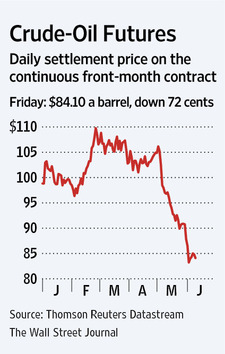
Crude Settles Above $84

Source: WSJ

An Unstable Okun’s Law, Not the Best Rule of Thumb

Posted: 09 Jun 2012 03:00 AM PDT

An Unstable Okun's Law, Not the Best Rule of Thumb
Brent Meyer and Murat Tasci
06.07.12


Okun's law is a statistical relationship between unemployment and GDP that is widely used as a rule of thumb for assessing the unemployment rate—why it might be at a certain level or where it might be headed, for example. Unfortunately, the Okun's law relationship is not stable over time, which makes it potentially misleading as a rule of thumb.

Rules of thumb can be very useful. At their best, they can help us avoid huge mistakes—testing the bathwater with your elbow to save the baby from a scalding, for example. These rules are not complicated or ambiguous, which allows us to make snap decisions without costly errors. So it's probably not a surprise that analysts attempt to use simple rules of thumb to describe economic phenomena. However, attempts to describe complex interactions in the economy with overly simple adages can lead to incorrect conclusions.

This Economic Commentary investigates one such rule of thumb, Okun's law—which describes the empirical relationship between output growth and the unemployment rate—and argues that this heuristic is unstable across time, and as a result not very useful as a forecasting tool.

Okun's Law in a Nutshell

In its simplest form, Okun's law is a linear regression that suggests there is a relationship between the growth rate of economic output and unemployment. It essentially predicts how much unemployment will decline as output grows by a certain amount or how much the unemployment rate will rise as output declines by a certain amount. Figure 1 traces out this relationship with annual data on real GDP growth and the unemployment rate from 1948 through 2011. The regression line that runs through the scatter plot implies that output growth above 3.4 percent is needed to see a decrease in the unemployment rate.

If the simple version of Okun's law were an accurate representation of the GDP growth–unemployment relationship, the behavior of real GDP growth and the unemployment rate since the onset of the 2007–09 recession would be puzzling. As highlighted in figure 1, real GDP growth contracted 0.5 percentage points during 2009, yet the unemployment rate jumped up a whopping 3.0 percentage points. More recently, the unemployment rate fell from 9.1 percent to 8.3 in 2011, but real GDP grew only 1.6 percent. That growth rate is roughly half of what our rule of thumb would suggest we need just to hold the unemployment rate constant.

As with any rule of thumb, its usefulness hinges on its applicability in a variety of settings and across different time periods. The initial example of the baby's bathwater is still as true today as it was 100 years ago. For Okun's rule to be useful as a rule of thumb, the relationship between real GDP growth and the unemployment rate needs to be stable across time. That is, we would need to have a reasonable expectation that today's relationship between output and the unemployment rate would behave in the same way tomorrow. Unfortunately, that does not appear to be the case, making it harder to draw simple inferences about unemployment rate movements from observed changes in output growth.

Rolling Instability

The deviations from the regression line in figure 1 might be interpreted as the result of unusual circumstances that don't hold in the long run. These data points could be temporary exceptions to the rule of thumb. For example, in 2009, firms might have shed far more workers than necessary in anticipation of further economic deterioration, but once the outlook appeared to be a little brighter, say in 2011, they could have started bringing their employment levels back in line with expected growth. Or perhaps the sluggishness of real GDP growth in the current recovery might have made employment gains hard to come by, pushing the 2011 data point far from the line. A third story might assume that data revisions will alter the picture for 2011.

Any of these explanations might sound reasonable, but knowing whether they actually hold is not straightforward. To pin down any explanation (or come up with others), we need to investigate the validity of the statistical relationship that is assumed to underlie them.

To assess the validity of Okun's law, we need to examine how the relationship between output growth and the unemployment rate evolves over time. If the relationship is roughly constant across time, then it is a useful rule of thumb. If the relationship is not stable over time, it is harder to use Okun's law to assess past movements in unemployment and forecast future movements.

We start testing stability by evaluating the simplest form of Okun's law, the difference version. It states that the change in the unemployment rate is equal to the sum of the product of the change in real GDP times an estimated coefficient, plus an estimated constant and an error term.

Using quarterly data on the change in the unemployment rate and the annualized quarterly change in real GDP, we estimate the coefficient on real GDP growth and the constant over a period of 10 years. Then we "roll" the estimation period forward one quarter and re-estimate the constant and coefficient over that 10-year period. We proceed this way throughout the sample, stopping at the end of 2011. Then, in figure 2, panel A, we gather up the coefficients and plot the estimates across time. A useful rule of thumb emerges if the estimates of the constant and the coefficient do not vary over time.

As you can see, the coefficients are far from stable. To illustrate exactly what this instability means, let's take our regression equation and solve it for the coefficient on real GDP growth. In effect, we are going to calculate the output growth needed to hold the unemployment rate constant over time. To do so, we set the change in the unemployment rate equal to zero and solve for the coefficient on real GDP growth.

If Okun's rule were stable across time, then the breakeven output growth rate would be fairly constant. Unfortunately, the output growth needed to hold the unemployment rate constant over time varies quite a bit, exhibiting a sizeable slowdown in the mid-1980s and dipping sharply in the early 2000s (figure 3). Interestingly, that sharp dip coincides with a 10-year window that did not include a recessionary quarter.

This finding agrees with research done by Edward Knotek in 2007, who found that the coefficient on real GDP growth is negatively correlated with the number of regression quarters in the sample period, and hence, the business cycle (see figure 4). This suggests that Okun's law may hold only during business cycle downturns, and that during long expansions the relationship breaks down (a finding we confirm in an analysis we did in April of this year—see Burgen, Meyer, and Tasci in the recommended readings). Unfortunately, the simplest version of Okun's law is not stable.

In Search of Stability

The instability of the simple linear form of Okun's law is well known. Consequently, researchers have looked for other specifications of the law that produce a stable relationship between output growth and changes in the unemployment rate.

A variety of approaches have been explored, ranging from including additional explanatory variables in the equation to the use of regressions that allow for nonlinear changes in the relationship between output growth and changes in unemployment. Other variables tried under the former approach include real Gross Domestic Income (GDI) in the place of real GDP and the employment-to-population ratio in place of the unemployment rate as the summary statistic for labor market health.

The use of real GDI as the variable for output growth centers on the fact that real GDI is conceptually similar to real GDP. In fact, in the absence of measurement error they should be equal. The key difference is that GDP is calculated using expenditure data, while GDI uses an income-based approach. Jeremy Nalewaik suggests that GDI may give us a clearer picture of output growth because it tends to predict GDP revisions and varies more closely with other business cycle indicators (such as industrial production). Yet, swapping GDI for GDP in the Okun's law regressions still yields instability. This is shown in figure 2, panel B, where the coefficients still bounce around a lot and still switch signs in the late 1990s.

One particular feature of the current recovery is that unemployment has been coming down rather quickly relative to the employment-to-population ratio—which hasn't improved much, if at all, since the end of the recession. This is mostly because labor force participation has been trending down significantly, even after the recession. Failure to account for shifting labor force participation in the simple version of Okun's law could be a source of the instability. In other words, the rather atypical behavior we have seen in Okun's law recently may be due to the unemployment rate being the wrong measure of labor market slack. It is for this reason that the employment-to-population ratio is sometimes used in Okun's law regressions as an alternative measure of labor market slack.

Unfortunately, the employment-to-population ratio yields a result similar to the unemployment rate (figure 2, panel C). The estimates of the coefficients still show substantial variability over time. In the end, the instability evident in all of these specifications of Okun's law—the simple formulation or the variations—suggests that none of them appears to correspond to what we actually see in the data.

The other approach to solving the instability problem is to adjust the regression so that it allows for nonlinear changes in the relationship between output growth and changes in unemployment over time. One way of doing this is to include lags of both the unemployment rate and real GDP growth in the regression. Edward Knotek performed this test as well, but the alteration did not produce a stable Okun's law relationship over time.

Another approach to allowing the regression to reflect a changing relationship between output growth and unemployment changes is based on the fact that these measures follow longer-run or structural trends, which change over time. Accounting for these trend changes may solve the instability problem.

The longer-run trend in real GDP growth is often referred to as "potential" GDP—the label indicates that the trend is thought of as a measure of how fast the U.S. economy could grow, given its underlying structural productivity growth and population growth. The difference between how fast output is actually growing and how fast it could grow is commonly referred to as the output "gap." The idea is that when output is growing below its potential pace, a gap opens up, which should put upward pressure on the unemployment rate (and vice versa).

Similarly, the unemployment rate is thought to have a slow-moving trend, so that an economy running at its potential would still have some unemployment, reflecting normal job churning. This trend unemployment rate is sometimes referred to as the "natural" rate of unemployment or the NAIRU (nonaccelerating inflation rate of unemployment). As the economy moves through a cycle of expansions and contractions around its potential, actual unemployment fluctuates around its own trend too.

Using a version of the regression that incorporates these gaps allows for changes in trend output and the trend unemployment rate, which may stabilize the regression coefficients. This line of reasoning implicitly argues that a robust relationship between output and unemployment exists—not between observed output growth and unemployment changes but between the gaps in both. Unfortunately, potential GDP and the natural unemployment rate are unobservable. Economists can only make educated guesses as to what these trends (and therefore the gaps) actually are.

So, while Okun's relationship may become more stable, it becomes harder to interpret and more nuanced. Instead of uncovering the elasticity of output growth relative to the change in the unemployment rate, the gap version relates a deviation from trend output growth to the unemployment gap. That is to say, if output falls below potential then the unemployment rate will rise above its natural rate. If the coefficient on the output gap is constant when we roll our estimation period across time, then we'll have a stable version of Okun's law.

In recognition that gaps are hard to uncover we try a few different estimates: The Congressional Budget Office's (CBO) estimate of the unemployment and output gaps, gaps created by detrending the observed data (using a Hodrick-Prescott filter), and a measure of the trend in the unemployment rate that takes into account the underlying labor market churn over time (Tasci and Zaman 2010). The coefficient that relates the output gap to the unemployment gap is plotted for each estimate in figure 5.

Unfortunately, these coefficients also suggest that Okun's law is still unstable after incorporating information on the gaps. Moreover, the unobserved nature of the true potential GDP or the natural rate of unemployment makes matters worse. While the coefficients for these specifications never change signs over any given sample period, they do vary substantially over time and by the type of gap measure that we use.

Conclusion

We have shown that the simple rule of thumb dubbed Okun's law is not stable over time. Given this instability, we judge that it's not an appropriate rule of thumb. The adjustments to the basic form of Okun's law that we investigated did not stabilize the relationship, and they just added complexity (an undesirable property for a rule of thumb).

There are many reasons why one should expect to see a dynamically changing relationship between output growth and changes in labor market slack. For instance, if one agrees with the idea that unemployment even in good times cannot go down to zero because of normal labor market churn, then there is no reason to expect a significant decline from this level in the unemployment rate as the economy experiences a long stretch of expansion. Figure 4 above confirms this point.

It would be folly to argue that there is no relationship between output growth and the unemployment rate. Unfortunately (for households and policymakers alike), fluctuations in the macroeconomy are more complicated than the simple linear relationship implied by most forms of Okun's law. As far as we're concerned, if a rule of thumb has a lot of exceptions, it's not much of a rule.

Recommended Reading

"How Useful Is Okun's Law?" Edward Knotek, 2007. Federal Reserve Bank of Kansas City, Economic Review, no. Q IV, pages 73–103.

"An Elusive Relation between Unemployment and GDP Growth: Okun's Law," by Emily Burgen, Brent Meyer, and Murat Tasci, Federal Reserve Bank of Cleveland, Economic Trends, 2012.

"Estimating Probabilities of Recession in Real Time Using GDP and GDI," Jeremy J. Nalewaik, 2007. Board of Governors of the Federal Reserve System, Finance and Economics Discussion Series, no. 2007-07.

.

0 comments:

Post a Comment

previous home Next

{8} chatroll


{9} AdBrite FOOTER

{8} Nice Blogs (Adgetize)