


The Big Picture |

- Spain’s Banks & Markets
- How Do You Say Rally in Spanish?
- U.S. Long-Term Budget Outlook Deteriorating as Fiscal Gridlock Looms
- Nonlinear Thinking: Perspective!
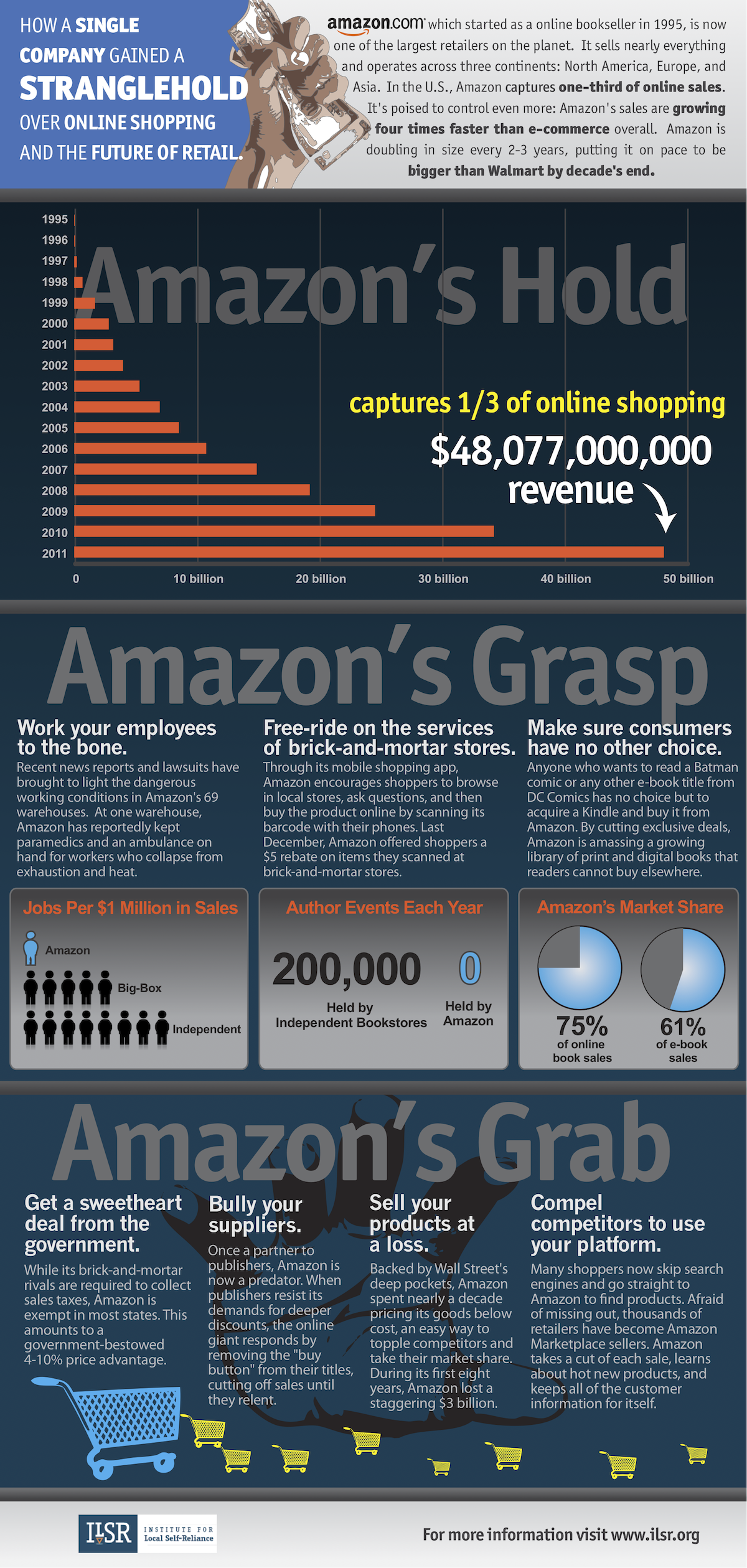
- How a Single Company Gained a Stranglehold over Online Shopping and the Future of Retail
- What Germans Own
- Alex Tanney Trick Shot Quarterback
- Missing: $496.5 Billion in Corporate Cash
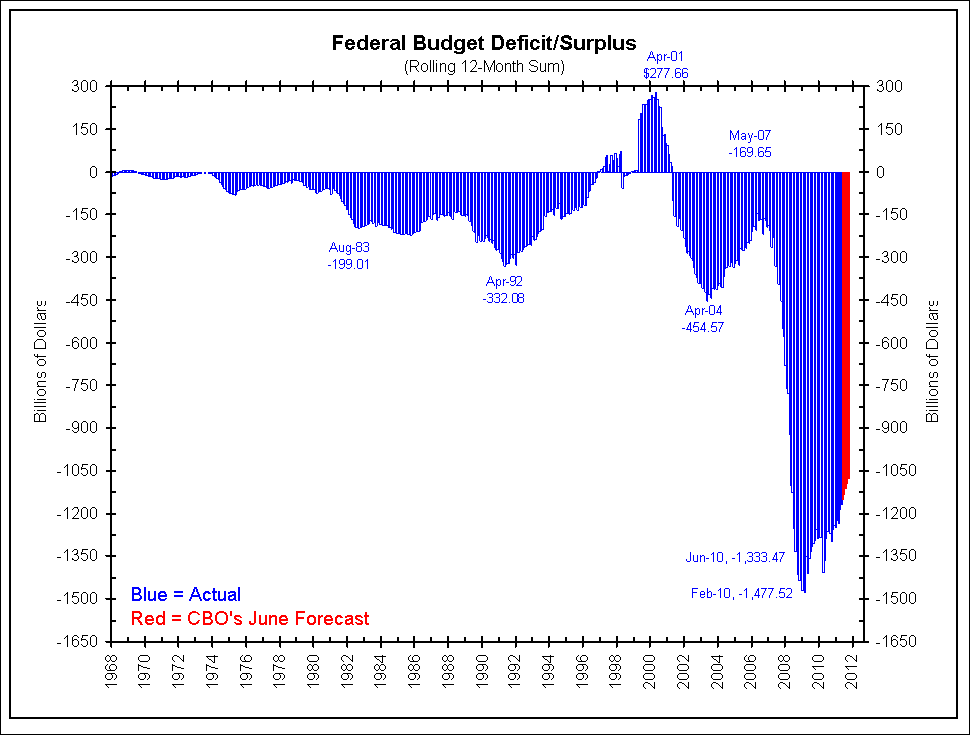
- The Federal Deficit
- Clint Eastwood: 35 Years, 35 Films, 64 Bucks
| Posted: 10 Jun 2012 10:00 PM PDT Spain's Banks & Markets
Eurozone leaders rose to the occasion. They had no choice. The Spanish bailout means Europe will not permit "runs" to sink their banking system. Notice how we have not seen TV coverage of a eurozone version of the "Northern Rock Affair." For those who do not remember that event, it was the run on a British bank that caused the bank to fail when depositors demanded their money. That triggered a panic. Disaster was averted by prompt action from the Bank of England. Think about it. Greek banks have lost tens of billions of euros in deposits and yet there have been no failures. Cyprus is bleeding deposits but no failures. Other countries, too. The Spanish deposit flight has been huge. Yet, there are no reported failures to pay euro depositors who demand their money. You cannot blame the depositors for seeking safety by moving their money to German, Dutch, or Finnish banks. I would. You would. We advised some clients to do so. Euros are euros regardless of which bank holds them for you. Why take a risk with your deposit under the present circumstances, when you can avoid it. The euro system leadership knows that bank runs can cause their 17-country, currency-zone system to collapse. All of banking history is supportive of this fact. Therefore, they faced the issue when their backs were to the wall. The fact is the absence of banking collapses is good news. That is correct. Good news! We establish that good news by what we DO NOT see on TV. We do not see banks collapsing and failing to pay depositors. This means we may not witness the euro system collapsing and failing. Bank runs and deposit failures are symptoms of liquidity constraints. Liquidity is not to be confused with solvency. A prime example: Greece is certainly insolvent. It cannot pay its debt or its governmental bills. Nevertheless, Greece's banks still have liquidity because of Emergency Liquidity Assistance (ELA) funding. ELA exists the euro system agents know that they cannot permit euro system banks to fail to pay their depositors. Therefore, our conclusion is that liquidity issues will be addressed in the euro zone. The Spanish banking chapter is unfolding before our eyes. Markets have been pricing in a fear of systemic failure on the liquidity side. Market bears will be disappointed, because the liquidity failure is not going to happen. Other market agents have priced the solvency issue correctly. That is why the Greek stock market has been decimated. That is why Greek bonds trade with astronomical yields. That is why Spanish stocks are down. That is why credit spreads are so wide. See www.cumber.com for updated spreads in Europe. Europe can fix or stopgap any illiquidity. They have the tools with the various funding sources like ESM, with the ELA and with the hands of the European Central Bank (ECB). The solvency issue requires governments with strong leadership and durable commitments to change behaviors. As we know from our own political experience in the US, this solvency/debt issue is much harder to tackle. Central bankers and institutions around the world have the ability to offset liquidity crunches. They know that another Lehman/AIG moment cannot be permitted. Do they have the ability to deal with insolvency? On that one, the jury is still out. We remain positive on markets; we are underweight Europe and we favor the US. We do not expect a market meltdown arising out of liquidity constraints. We remain nervously and fully invested in our US ETF accounts. We worry about solvency. That is the political side of the issue, and we are not in the least sanguine about politicians in any country, including our own. European politicians caused European government insolvency. Can they fix it? We shall find out in due time. The next test is coming on June 17, with French and Greek elections. ~~~ David R. Kotok, Chairman and Chief Investment Officer |
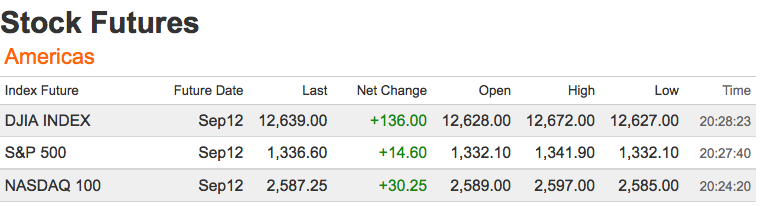
| How Do You Say Rally in Spanish? Posted: 10 Jun 2012 05:47 PM PDT click for updated futures
Tomorrow morning should be interesting.
|
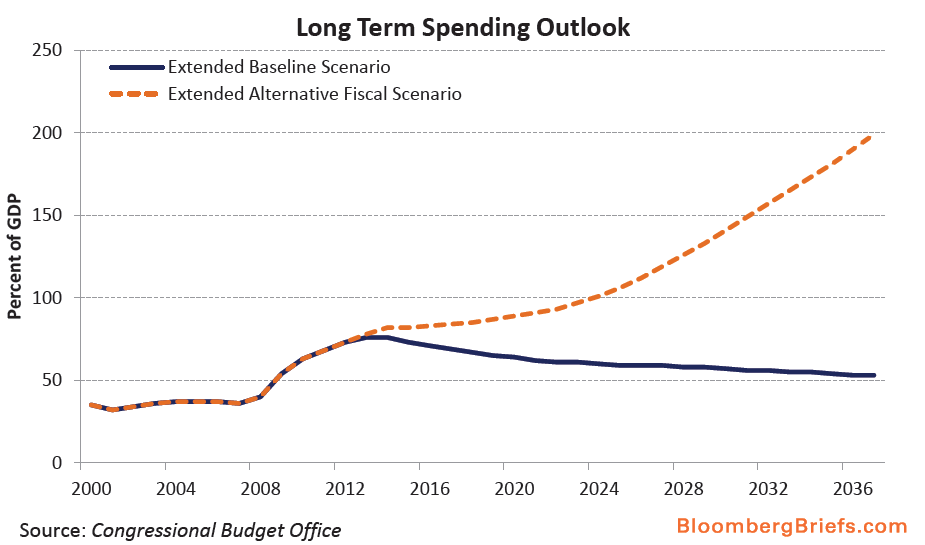
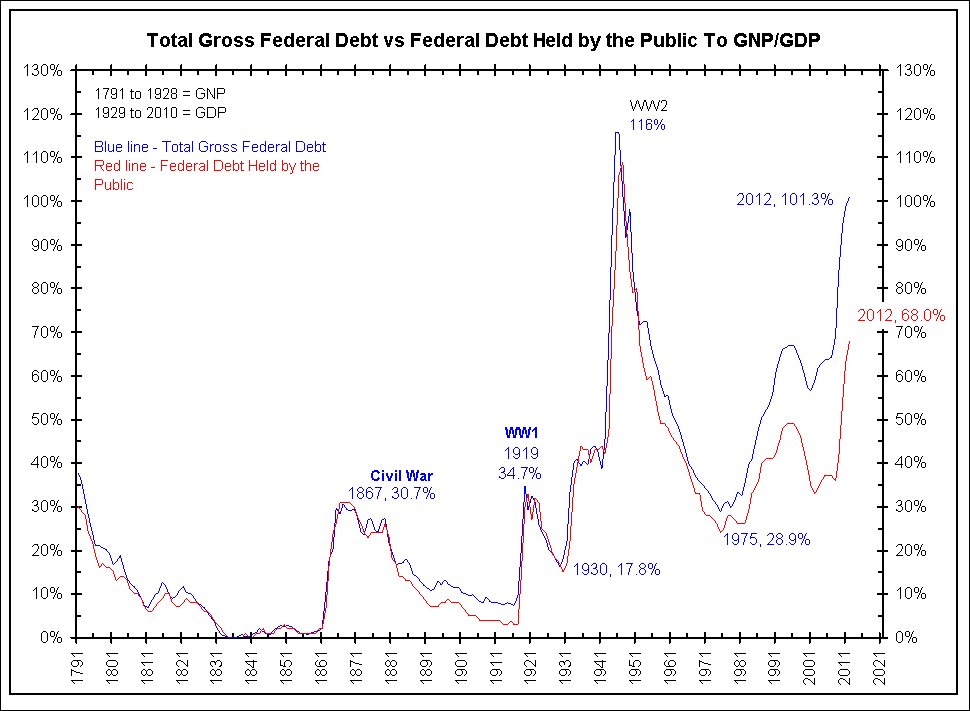
| U.S. Long-Term Budget Outlook Deteriorating as Fiscal Gridlock Looms Posted: 10 Jun 2012 05:00 PM PDT Fiscal gridlock in Washington has resulted in the deterioration of the nation's long term budget outlook. Based on data published by the Congressional Budget Office, should spending and revenues not be brought into alignment over the next several years, the fiscal drag on the economy will reach the point where it will become a long-term weight on overall growth, likely resulting in higher interest rates and funding problems for government-issued debt. Click to enlarge:
˜˜˜
Source: |
| Nonlinear Thinking: Perspective! Posted: 10 Jun 2012 03:00 PM PDT One of our golf buddies, who is an engineer, sent this over today. It really illustrates why we should think about the future with a nonlinear framework. Simply amazing!
Hat tip to James M.!
(click here if photo is not observable)
|
| How a Single Company Gained a Stranglehold over Online Shopping and the Future of Retail Posted: 10 Jun 2012 01:00 PM PDT |
| Posted: 10 Jun 2012 11:00 AM PDT click for larger graphic > I mentioned this de Spiegel article in the reads, but I found this graphic quite fascinating, having nothing whatsoever to do with the fact my last name is Ritholtz or I have a business trip to Berlin next month. > Source: |
| Alex Tanney Trick Shot Quarterback Posted: 10 Jun 2012 09:30 AM PDT Trick Shot Quarterback, Alex Tanney was signed yesterday by the KC Chiefs. Regardless of setting the NCAA Division III record for passing with 14,249 yards, the NCAA record for touchdowns with 157, and only throwing 30 interceptions in college, Tanney had gone undrafted Hat tip kottke |
| Missing: $496.5 Billion in Corporate Cash Posted: 10 Jun 2012 07:00 AM PDT You may have missed this fascinating Real Time Economics article (Corporations Not Hoarding Cash) buried at 5am Saturday morning in the WSJ, but here it is: In the Federal Reserve quarterly "Z1 flow of funds" report released late this past week, there was a slight discrepancy in the amount of corporate cash in Q1. It was “up to” $1.74 trillion dollars. And by up to, I mean down from $2.23 trillion dollars. Did this money actually go missing? From the Fed report, its not clear whether or not this based on a significant accounting revision from recent quarters — meaning it never was really there in the first place. Alternatively, the money actually was pent, and corporate America added an additional half a trillion dollars in economic activity. I suspect its the former . . . > Whoops! Where did I put that half trillion dollars? Source: |
| Posted: 10 Jun 2012 05:30 AM PDT Click to enlarge:
CNBC – US Could Be the Next Greece—in 2037: CBO Report AFP – Congressional study warns of dire US debt outlook Source: Bianco Research |
| Clint Eastwood: 35 Years, 35 Films, 64 Bucks Posted: 10 Jun 2012 05:00 AM PDT
I have been a huge Clint Eastwood fan — but those Spaghetti Westerns are part of this package. Note also that set is remastered DVDs — not BluRay. Still, at $63 bucks (list is $180), this is a whole lotta Clint for not a lot of money. I know quite a few people who would love this. Full list of 35 films after the jump.
1. Where Eagles Dare, 1968 plus The Eastwood Factor (2009 documentary). |





| You are subscribed to email updates from The Big Picture To stop receiving these emails, you may unsubscribe now. | Email delivery powered by Google |
| Google Inc., 20 West Kinzie, Chicago IL USA 60610 | |



0 comments:
Post a Comment