


The Big Picture |

- Treaty Threatens Global Government … Run by Giant Corporations
- Succinct Summation of Week’s Events (6.15.12)
- Counting on an Inheritance? Count Again.
- Confidence the weakest of the year
- Spanish Assets Wildly Overweighted with Housing
- Economic data
- 10 Friday AM Reads
- What Is A “Household” And Why Are They Buying Treasuries?
- Friday!
- New York City Party: Hip-Hop Map of NYC
| Treaty Threatens Global Government … Run by Giant Corporations Posted: 15 Jun 2012 10:30 PM PDT International Treaty Negotiated In Secret – Hidden Even from Congressmen Who Oversee Treaties – Threatens to Destroy National SovereigntyThe normally-reserved Yves Smith asks whether Obama should be impeached over it. Democratic Senator Wyden – the head of the committee which is supposed to oversee it – is so furious about the lack of access that he has introduced legislation to force disclosure. Republican House Oversight Committee Chairman Darrell Issa is so upset by it that he has leaked a document on his website to show what's going on. What is everyone so furious about? An international treaty being negotiated in secret which would not only crack down on Internet privacy much more than SOPA or ACTA, but would actually destroy the sovereignty of the U.S. and all other signatories. It is called the Trans-Pacific Partnership (TPP). Wyden is the chairman of the trade committee in the Senate … the committee which is supposed to have jurisdiction over the TPP. Wyden is also on the Senate Intelligence Committee, and so he and his staff have high security clearances and are normally able to look at classified documents. And yet Wyden and his staff have been denied access to the TPP's text. This is similar to other recent incidences showing that we've gone from a nation of laws to a nation of powerful men making laws in secret. For example, in the summer 2007, Congressman Peter DeFazio – who is on the Homeland Security Committee (and so has proper security access to be briefed on so-called "Continuity of Government" issues) – inquired about continuity of government plans, and was refused access. Indeed, DeFazio told Congress that the entire Homeland Security Committee of the U.S. Congress has been denied access to the plans by the White House (video; or here is the transcript). The Homeland Security Committee has full clearance to view all information about COG plans. DeFazio concluded: "Maybe the people who think there's a conspiracy out there are right". As University of California Berkeley Professor Emeritus Peter Dale Scott warned:
Watch this interview from today explaining why TPP is so dangerous to America … and the rest of the world: |
| Succinct Summation of Week’s Events (6.15.12) Posted: 15 Jun 2012 12:00 PM PDT Succinct summation of week’s events: Positives:
Negatives:
|
| Counting on an Inheritance? Count Again. Posted: 15 Jun 2012 10:00 AM PDT |
| Confidence the weakest of the year Posted: 15 Jun 2012 09:30 AM PDT The 1st look at June UoM confidence at 74.1 was light relative to expectations of 77.5, down from 79.3 in May and the lowest of the year. The decline was about equally spread between the two components as Current Conditions fell by 5.1 pts and the Outlook was down by 5.4 pts. One year inflation expectations were unchanged at 3.0%, matching the lowest since Dec ’10 primarily due to the recent drop in gasoline prices. As confidence is a coincident indicator and tells us nothing about the economic goings on in the future, the June decline likely reflects the lackluster labor market as seen in the data over the past few months and maybe the euro debt mess as the UoM survey is done over the phone just within the last few days thus capturing the nervousness many of us are feeling. |
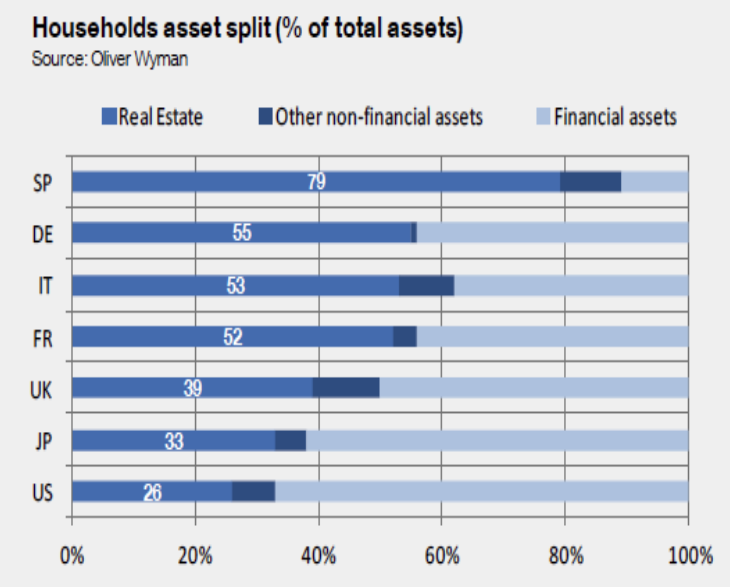
| Spanish Assets Wildly Overweighted with Housing Posted: 15 Jun 2012 08:45 AM PDT click for larger graphic
> I would expect mean reversion to be rather discomforting. With all eyes on Greece, Carmel sees Spain as “worse than the market anticipates.” He points out these 5 bullet points as to why Spain’s RE market has much further to fall:
Fascinating stuff . . . |
| Posted: 15 Jun 2012 08:37 AM PDT The 1st look at June UoM confidence at 74.1 was light relative to expectations of 77.5, down from 79.3 in May and the lowest of the year. The decline was about equally spread between the two components as Current Conditions fell by 5.1 pts and the Outlook was down by 5.4 pts. One year inflation expectations were unchanged at 3.0%, matching the lowest since Dec ’10 primarily due to the recent drop in gasoline prices. As confidence is a coincident indicator and tells us nothing about the economic goings on in the future, the June decline likely reflects the lackluster labor market as seen in the data over the past few months and maybe the euro debt mess as the UoM survey is done over the phone just within the last few days thus capturing the nervousness many of us are feeling. Industrial Production in May fell by .1%, the 2nd month in the past three that saw a decline. The consensus was for a slight rise of .1% and the weakness was broad based specifically within manufacturing as declines were seen in motor vehicle/parts, machinery and computer/electronics. Mining production rose .9% and utility output was up .8% after a 5.3% rise in April where weather normalized after the bizarre winter. Capacity Utilization was 79%, slightly less than expected, but down from 79.2% in April which was the highest since April ’08. With respect to market movements, IP is a grade B figure but notwithstanding the miss, the y/o/y gain of 4.7% is still the 3rd best over the past year. Looking forward however, the environment is obviously getting more challenging. The 1st reported June industrial number, the NY mfr’g survey, was well below expectations at 2.3 vs the est of 12.5. It’s down from 17.1 in May and 6.6 in April and is the weakest since Nov ’11. New Orders fell 6 pts to 2.2. Backlogs fell only slightly but remained negative for the 12th straight month. The Employment component fell 7 pts to 12.4, a 4 month low and the Avg Workweek fell 9 pts to 3.1. Inventories went from +4.8 to -8.3. Prices Paid dropped almost in half to 19.6 and Prices Received fell to 1 from 12.1. The overall 6 month outlook at 23.1 is down from 29.3 in May and is the slowest since Oct ’11. Bottom line, this survey is very volatile month to month so we can’t extrapolate the state of the entire country’s mfr’g base from this one region but NY was one of the standout’s in May that is now showing its vulnerability. I’m sure we’ll see more weakness in other region’s as the global economy continues to slow. |
| Posted: 15 Jun 2012 06:30 AM PDT My early morning reads:
What are you reading?
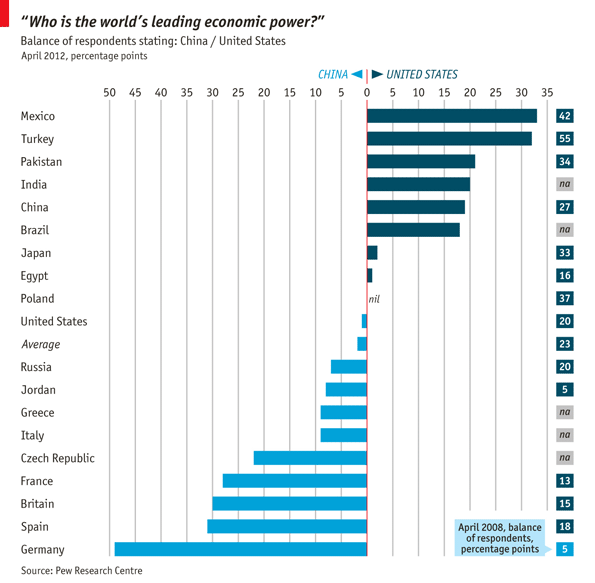
More countries are saying that China is world’s leading economic power |
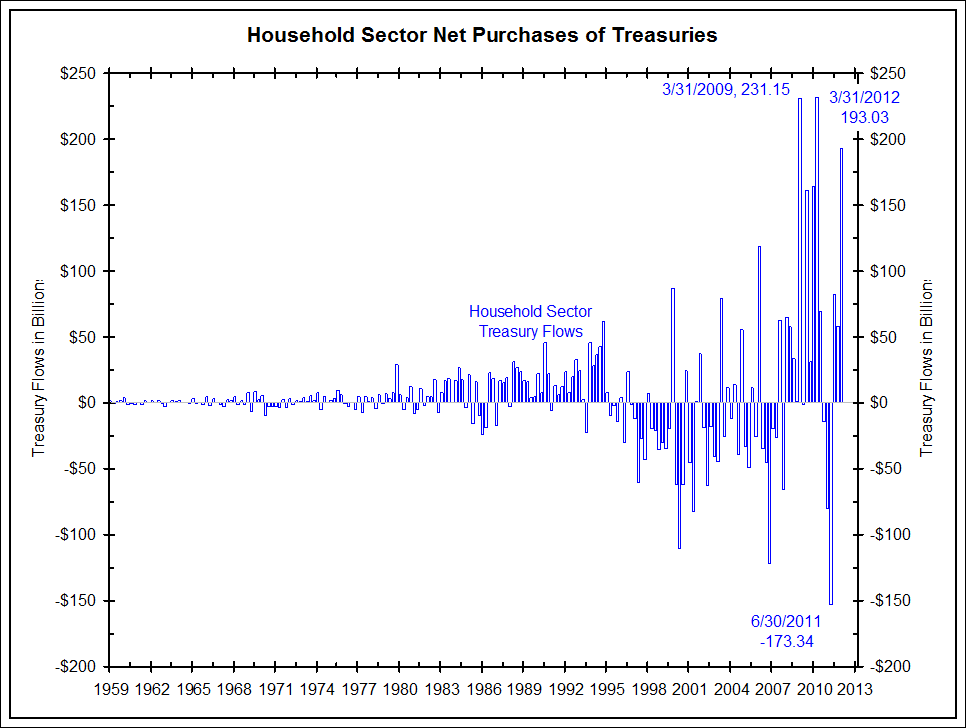
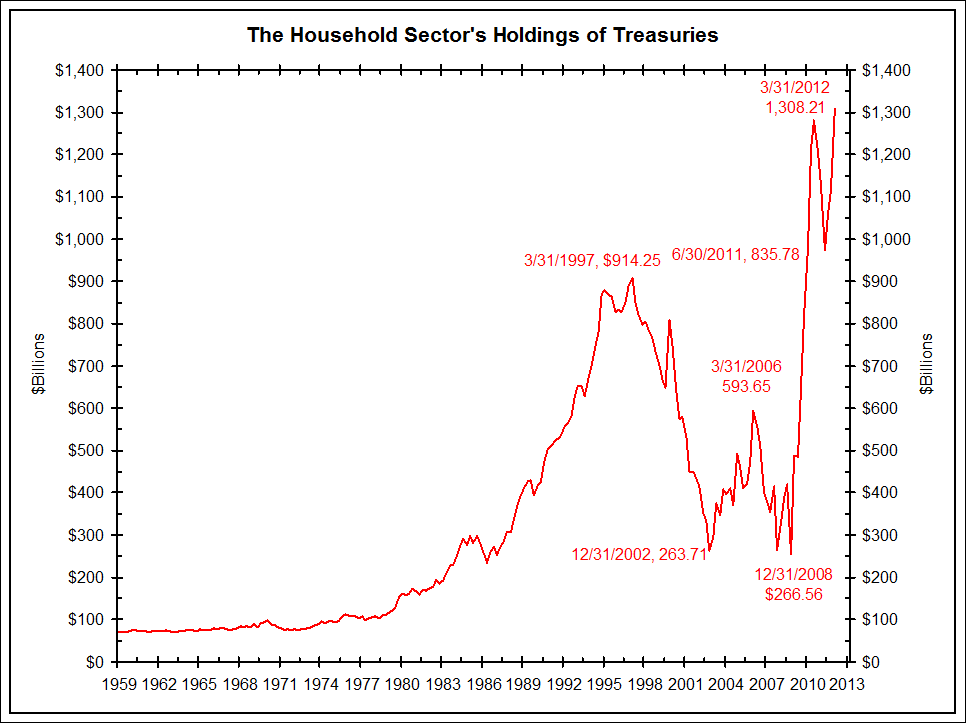
| What Is A “Household” And Why Are They Buying Treasuries? Posted: 15 Jun 2012 05:45 AM PDT CNBC – Guess Who's Buying All the Bonds? (It's Not the Fed) Comment With U.S. Treasury issuance skyrocketing over the past couple years, yields at new all-time lows and talk of a bond bubble rife, we are often asked, "Who is buying all this Treasury debt?" While the story above correctly points to households as a major purchaser in recent quarters, it incorrectly describes this group as "mom and pop." Below is an updated description of households as categorized in the Federal Reserve's flow of funds report Domestic Investors – Households As the charts below show, households' holdings of Treasuries have grown more than threefold since December 2008 despite net sales of $173 billion in Q2 2011. While it may seem to make sense to attribute these flows to "mom and pop" given the category's name, this would be inaccurate. As we explained last year: We must first lay out the definition of households from the flow of funds report (page 12): For most categories of financial assets and liabilities, the values for the household sector are calculated as residuals. That is, amounts held or owed by the other sectors are subtracted from known totals, and the remainders are assumed to be the amounts held or owed by the household sector. For example, the amounts of Treasury securities held by all other sectors, obtained from asset data reported by the companies or institutions themselves, are subtracted from total Treasury securities outstanding, obtained from the Monthly Treasury Statement of Receipts and Outlays of the United States Government, and the balance is assigned to the household sector. To be clear, the "household sector" is misnamed. It is the residual account with a fancy name. So given this, what does it mean when the residual account soars? We would suggest that it means there is a measurement problem. In this case, the Federal Reserve cannot "find" the buyers of Treasuries thanks to the exploding deficit. They correctly assume that the buyer exists (otherwise the market would not exist) and therefore place the "missing" buying in the residual account. Since this account is called the "household sector", we all assume that "mom and pop" bought this sum. If "mom and pop" were really the end buyers we would expect to see similarly booming numbers from the mutual fund industry. However, as we will detail in part 2 of this post tomorrow, mutual fund purchases are a somewhat insignificant portion of domestic buying. Our guess is the domestic buyer is a leveraged carry trader, a mutual fund, a brokerage subsidiary or other group that does not have its own category so it gets "dumped" into the default category of "households." Click to enlarge:
Conclusion While the default category of "households" chipped in with almost $200 billion of Treasury purchases during Q1 2012, do not assume this means "mom and pop" are soaking up the Treasury's increased issuance. According to the flow of funds categorization, households are simply a residual category for all the net purchases which do not fit into one of the Federal Reserve's other pre-defined categories. Tomorrow we will detail the net purchases of many of these other categories, from foreigners to mutual funds and the Federal Reserve. Source: Bianco Research |
| Posted: 15 Jun 2012 05:34 AM PDT I am trying to reorient myself after a manic week of markets, mayhem and news flow. The market up and downs have been sloppy. I find myself unconvinced of any short term move in either direction. We are bouncing around on rumors of possible future interventions and collapses in over there. None of these moves have much in the way of conviction. Be back shortly . . . |
| New York City Party: Hip-Hop Map of NYC Posted: 15 Jun 2012 05:00 AM PDT |


| You are subscribed to email updates from The Big Picture To stop receiving these emails, you may unsubscribe now. | Email delivery powered by Google |
| Google Inc., 20 West Kinzie, Chicago IL USA 60610 | |



0 comments:
Post a Comment