


The Big Picture |

- Greek “final exit polls” suggest a New Democracy/Pasok coalition
- Traders Psychological Profile
- ECB rate cut likely coming soon
- Fascinating Mortgage & Housing Data Points
- Richard Saul Wurman: Gadfly of Information Architecture
- Basel rules likely to be watered down
- Measuring the Universe
- 10 Sunday Reads
| Greek “final exit polls” suggest a New Democracy/Pasok coalition Posted: 17 Jun 2012 12:43 PM PDT In spite of (very likely) serious public opposition, the Japanese PM, Mr Noda has authorised the restart of 2 nuclear reactors, which will ease fears over electricity shortages this summer, especially in Kansai, an economically important region in Japan. Japanese imports of energy, following the complete closure of the nuclear power stations, have had a material impact on Japans trade balance, as well. With these 2 nuclear power stations restarted, a few other restarts are likely, if public opinion can be controlled. The energy complex may well be adversely impacted by the news; Is there going to be a “soft military coup” in Egypt. The FT states that Mr Samesh Ashour (the head of the civilian council advising Egypt’s military rules) has reported that the generals will issue a declaration, which sets out a prospective political map for Egypt. The declaration will set up a constituent assembly which will be mandated to draft a constitution within 3 months. New Parliamentary elections will then be held, in which candidates can compete in all constituencies. The FT adds that the proposals could lead the way for the return to Parliament of individuals linked to the former regime; There are numerous conflicting views on Russia floating around, at present. Informed observers allege an increase in the rape and pillage, the rationale being that Putin’s supporters know that he needs them much more now, given the increasing opposition, and will exploit the situation to extract (huge) sums from the country – indeed even larger than before. The Central Bank is not wedded to a strong Ruble, which will allow the State some flexibility in terms of spending, though inflation is not under control. It is estimated that Russia needs a US$117 oil price to balance its budget. However, Russia’s income from energy is based on the US$ price of oil, whilst their spending is clearly in Rubles, which provides some flexibility in budgetary matters if the Ruble declines, which it has. In addition, Russian construction projects are gearing up for the forthcoming events (winter Olympics and the football world cup), which is yet another (increasing) source of opportunity for the insiders, allegedly. However, history has proven that a totally unpredictable event spoils the party. Whatever, capital flight out of Russia will increase – after all, why take the risk, a number of Russians say to themselves; Greek “final exit polls” (please remember these are Greek “final exit polls”) suggest that New Democracy and Syriza and Pasok will have 159 seats in the 300 seat Parliament. The important point is to win, as the party with the most votes gets an additional 50 seats in Parliament. Its still pretty close but it looks from the “final exit polls” that there will be a sigh of relief in equity markets tomorrow. OK, the Greeks may be granted some minor concessions – will it be enough?. The Greeks have been ill served by their corrupt, incompetent (I can go on and on, and…..) politicians and are now paying the consequences. You could argue that the Greeks should have demanded reforms in the past and, in addition, should have not played along with the system. However, the vast majority of Greeks are in no doubt now that Greece needs to reform. Can they enact the much needed reforms – with the present bunch of politicians, I very much doubt it and the views of the newcomers, Syriza, are clearly absurd. That’s my real problem. Germany does not want Greece to exit the Euro (at present), as it does not want to crystallise a problem, which could force Germany to agree to policy measures in the EZ, too early. It wants to keep the pressure on countries in the EZ to reform, including much needed structural and labour reforms. Will the Greeks be amenable to such changes, which will be painful – once again, I’m sorry to say, I very much doubt it. I hope I’m wrong, for the sake of the Greeks, but……..; Chancellor Merkel, probably annoyed that President Hollande had met with German centre left opposition leaders earlier last week, took a swipe at France last Friday. She compared the improving productivity in Germany, as opposed to France and, in addition, repeated that the EZ needed a number of fiscally strong countries and not just Germany. Furthermore, France is opposed to oversight of their budget (France will need a 2/3rd majority in Parliament to effect constitutional changes, such as allowing oversight of its budget, by the way), a key Merkel demand and Hollande has suggested that he would renegotiate the fiscal compact, though will stick to the fiscal targets !!!!. She is also concerned about France’s credit rating – a French downgrade puts more pressure on others, in particular Germany. With Monsieur Hollande’s unrealistic agenda and the totally opposite vision being proposed by Mrs Merkel, I cant see this spat being resolved quickly. In addition, Hollande has promised a lot and, with a (likely) majority (with other party support) in the National Assembly suggested by exit polls following today’s elections, will be expected to deliver. The Socialists already control the Upper House. France’s policy actions are going to be the crucial issue for the EZ. The French economy is dependent on consumption, defence and auto’s. Hmmmm. I continue to be bearish on France. Whilst France will benefit from a reduction in interest rates by the ECB and quite possibly QE, I have to say, I’m pretty cautious, to say the least, on France and, in particular, French medium, though in particular, long term sovereign bonds. (Source CNBC). Finally, the French are known to take to the streets to protest; The Greek “final exit poll” suggests that a coalition will be formed between New Democracy and Pasok – it looks as if Greeks thought again, when alone in the ballot booth and moved away from Syriza. Will the expected coalition be able to deliver, even with marginally better terms from the EZ – well I think its odds against. Having said that, those who believe that a prospective Greek exit from the Euro will be a “Lehman’s moment” are way off mark, in my humble view. Contagion issues are important, but, if the situation deteriorates, the EZ will just have to pull on the policy levers and Central Banks will need to provide as much liquidity as is necessary, most likely in a coordinated way. I suspect that if Greece exits the Euro, the much more serious issue is that Germany will face losses (as will other EZ countries), which will make them think even harder about offering help to other EZ countries in the future, though I believe they will. Having said that the Greek “final exit polls” and I stress these are Greek “final exit polls”, suggest that Germany (and others) do not have to face that situation at present. Kiron Sarkar 17th June 2016 |
| Posted: 17 Jun 2012 10:30 AM PDT Paul Farrell observes that 95% of traders don’t make it. 80% of all day traders lose money. One study found active investors turn over their portfolios excessively (258% annually) but made less than 12% on their money. Passive buy-and-hold investors with only 2% portfolio turnover had significantly better returns. And, most day traders suffer negative health consequences from their hyper active market moves. To find out what your trading instincts mean — to grade your own Traders Psychological Profile — answer the following questions Yes or N:
Add up the number of Yes answers. Farrell notes that if your total number of "yes" answers is six or more, then day trading is too stressful and risky for you. The alternative to active trading is intelligent asset allocation. At the very least, he advises that you segregate your "untouchable" retirement money . . .
Source: |
| ECB rate cut likely coming soon Posted: 17 Jun 2012 07:00 AM PDT BN news is reporting that most of the membership of the ECB is becoming more comfortable with cutting the deposit rate (the rate the ECB pays banks for parking money with them) from .25% to zero in order to encourage banks to use their money elsewhere such as in the interbank lending market. If the ECB does move, they will also likely cut their benchmark rate of 1.0% by a like amount. Draghi this morning hinted as such when he said “there is no inflation risk in any euro area country.” With central bank interest rates as low as they are, this move would be more symbolic than anything. The ECB next meets on July 5th and will likely cut rates then but they and others are shooting blanks at this point. |
| Fascinating Mortgage & Housing Data Points Posted: 17 Jun 2012 06:38 AM PDT My Washington Post column got rolled over until next week (caused by a few snafus on my side and theirs). There are some fascinating details within the column, and since it won’t be published for a few days, I wanted to share them with you. Here is an early look:
With that as a background, I spoke with ace housing analyst Laurie Goodman of Amherst Securities. Goodman dazzled me with several astonishing statistics. Let’s briefly look at two of these:
This truly amazing data point represents a very sad fact of the housing market. Once a homeowner falls that far behind in their mortgage, the odds are that they will never catch up. (Mortgage mods are likely to fail at an exceedingly high rate as well). Nearly all of these 2.8 million homes are likely to be some sort of distressed sale — short sale, auction, walkaway or foreclosure. The bottom line is it means we are looking at a minimum of another 3 million homes going into foreclosure (or some variant) over the next few years. Beyond the coming wave of foreclosures, credit availability is another factor holding housing activity down:
In other words, one in five people who held or qualified for a mortgage not too long ago would not today. The 90 days delinquency on their credit reports prevents them from qualifying for a new mortgage. This is a very significant data point to the idea of a housing turnaround. Why? Based on this delinquency alone, nearly all of these borrowers — about 9 million current homeowners — would be unable to qualify for bank loan today. That is 9 million potential home buyers who are effectively barred from the market due to their credit scores. Removing that many people as potential home buyers amounts to a a huge reduction in demand. Its not a surprise that Goodman is not expecting a quick housing recovery. She notes an "L" shaped recovery is the most likely outcome. In hr opinion, Home prices have 3-5% more price downside. The, and are likely to stay flat for another 3-5 years to come. |
| Richard Saul Wurman: Gadfly of Information Architecture Posted: 17 Jun 2012 05:59 AM PDT THE world is held back−unable to even know itself−due to a lack of standards, argues Richard Saul Wurman, a noted architect and creator of the TED conference, during an interview with Kenneth Cukier, the data editor of The Economist, to kick off the Economist 2012 conference Ideas Economy: Information 2012 conference on June 5th in San Francisco (full video above). “No two cities in the world do their maps to the same scales, with the same legends; there is no agreed upon way for doing a border around a city,” he says. At a sprightly 77 years, Mr Wurman is the author of scores of books on technology and design, and is credited with having coined the term “information architect”. During the interview, he was true to his eccentric, irascible self, which has inspired many to his causes:
|
| Basel rules likely to be watered down Posted: 17 Jun 2012 05:30 AM PDT What do you do with a totally failed Finance Minister. Well, you “promote” him, off course. Mr Pranab Mukherjee, the Indian finance minister, is likely to become the next Indian President (a largely ceremonial position, admittedly), as a reward for his “excellent stewardship” of the Indian economy !!!! – the Indian economy is collapsing, by the way. Well that’s India for you and that’s why the country will under perform, in spite of its huge underlying strengths. We all wait for the outcome of the Greek elections this Sunday. Whilst I believe that New Democracy will poll the most votes (with Syriza second), the real question is whether they can form a coalition. One of my readers suggested that a coalition was unlikely and, I must admit, it does indeed look tricky. A failure to form a coalition would be the worst outcome. A Syriza win will result, in my humble view, in almost certain coordinated Central bank action and a coalition formed around a win by New Democracy a bit of a relief rally – not sure how long it will last though I must admit. Will the Greeks have to have yet another election, if a coalition cannot be formed – possibly, but I would have thought not. Another technocrat Government – well possibly, but will achieve little to nothing. Clearly greater uncertainty in my view, but that uncertainty will force the EZ (read Germany) to come up with a solution far, far sooner than they would otherwise have had to. As a result, the inability to form a coalition suggests bad news initially, which could well force some Central Bank policy action though, more importantly, with the EZ coming out with much needed policy action sooner than otherwise – good news. The Italian Government has announced measures (which it “says” amounts to E80bn), for home improvements, tax breaks to hire workers, funding of urban development projects and corporate R&D. In addition the government stated that it would raise some E10bn through the sale of State assets. With debt to GDP of around 120%, a weakening economy, which has contracted by -0.8% in the first Q (and with no prospects for growth) and some E1.96tr in government debt, Mr Monti is increasingly coming under pressure to act to stimulate the Italian economy. However, this announcement is no game changer. In addition Italian companies are materially under capitalised (much to do with the Byzantine cross holdings) and which remains a serious problem; The IMF warns that Ireland may find it difficult to access the international capital markets next year (even though the country has met its budget targets) given the crisis in the EZ, suggesting that the country will require a further bail out. Portugal will definitely need a second bail out in the next few months. With the IMF now accepting that Spanish budget deficit targets are, in effect, pie in the sky, Spain will have to seek a bail out. In addition, the proposed E100bn to recap Spanish banks ain’t going to enough Seniors. Where’s the money coming from. The ESM. Hmmmm Think again and stop messing around – the ESM needs a banking licence; Interestingly, the IMF has backed the Irish governments proposal to reschedule approximately E30bn of promissory notes – the Irish government has to repay 1/10th of the E30bn each year, which will require further spending cuts and/or tax increases – clearly insane. Too true, the EZ/ECB are being absurd. In addition, the IMF reports that some kind of fix is necessary for mortgages linked to the ECB interest rate, which is resulting in huge loses for Irish banks. Once again, too true. Finally, the IMF is pushing for the EZ to recap banks directly, rather than through the state – which increases the debt to GDP. Germany is resisting. Ultimately Germany/ECB will have to change its mind; Bloomberg reports that the ECB could well reduce interest rates below 1.0% (a virtual certainty, in my humble view) and in addition to reduce the deposit rates to zero from 25bps, to discourage banks from depositing funds with them. Mr Draghi stated that there was “no inflation risk in any Euro-area country” and that inflation was well anchored yesterday, a clear signal that he intends to reduce the current 1.0% ECB benchmark interest rate, most likely by 25bps, initially, though it could well go even lower. As previously reported, the ECB is just waiting for the outcome of the Greek general elections before acting. However, once interest rates hits, in effect, zero, what do they do next – QE? – personally, I think there is a much better than 50/50 probability of QE in the EZ in due course; US industrial production fell by -0.1% in May, much weaker than April’s (slightly revised lower) +1.0% gain and lower than the gain of +0.1% expected. The slowdown in Brazil is clear for everyone to see. Yesterday, Brazil’s President Mrs Dilma announced yet another stimulus package amounting to R$20bn, in the form of loans to the BNDES, the Brazilian State development bank. With interest rates down to a record low of 8.5% (will be reduced even further) in response to a likely contraction of GDP in April (the first since 2009) and declining industrial activity and investment, Brazil’s economy is the worst performer of the BRIC’s, though the others are in no great shape either. Remember those who promoted “decoupling”…………Analysts are reducing their estimates of GDP growth this year to around 2.5% – personally, I would be surprised if Brazil achieved 2.0%, unless there is a major global stimulus programme. International regulators look as if they will water down the Basel rules designed to improve the safety of the financial sector, fearing that tougher requirements at present will exacerbate the EZ crisis. The WSJ reports that regulators may allow banks to count their holdings of gold and equities towards bank capital in respect of “liquidity coverage ratios”. Previously, essentially only Government bonds and cash were deemed acceptable. The watered down rules (if implemented) could, however, reduce banks demand for government bonds and may increase their willingness to buy equities and gold. In spring this year, the Basel Committee estimated that banks globally would require an additional E1.76tr of eligible assets if the liquidity ratio came into effect immediately. Banks are scaremongering it must be said. Mervyn King stated, “In current exceptional conditions, where central banks stand ready to provide extraordinary amounts of liquidity against a wide range of collateral, the need for banks to hold large liquid asset buffers is much diminished”. The UK, together with Switzerland, have been amongst the strongest supporters of the proposed Basel rules remaining in force – indeed, the Swiss have their own “finish” – however, it seems like the UK is shifting. A watering down of the rules will clearly make the banks more risky; Outlook First we have the results of the Greek (and remember the French) general and parliamentary elections this Sunday. Then the G20, followed by the EU Heads of State meeting on 28/29th June. Great – lots of clap trap from politicians to look forward to !!! On balance, I will continue to be long the equity markets, whilst uber cautious to negative EZ bonds (ECB interest rates cuts likely though) – shorting equities is dangerous in my humble view, as Central Banks will have to flood the system with liquidity in the event of a problem. In addition, the need for policy action for the EZ is coming pretty soon – the interminable delays are way past their sell by date. A great deal of you remain (lets be polite) highly sceptical – certainly can understand it, but…… Just as an aside, I write this blog on the basis that it reflects more a Global Macro Hedge Fund with monthly reporting requirements, rather than a long only, long term, buy and hold fund. Have a great weekend. Kiron Sarkar 16th June 2012 |
| Posted: 17 Jun 2012 05:00 AM PDT by Royal Observatory Greenwich Plus 1 month 2 weeks ago This is the film from our micro exhibition ‘Measuring the Universe: from the transit of Venus to the edge of the cosmos’. If you can make it to Greenwich then come and see the exhibition – its on from 1 March–2 September 2012 and its absolutely FREE!
Measuring the Universe from Royal Observatory Greenwich on Vimeo. |
| Posted: 17 Jun 2012 04:15 AM PDT Pour yourself a cup of Joe, and enjoy some steaming hot Sunday morning reads . . .
What are you reading?
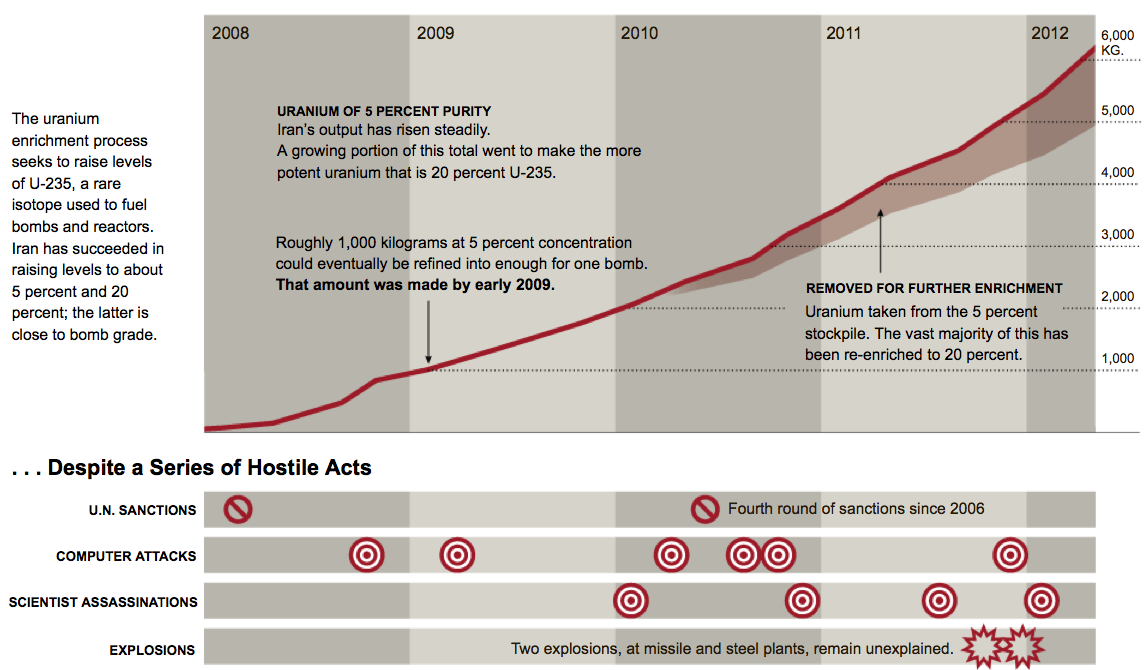
Iranian Nuclear Progress |
| You are subscribed to email updates from The Big Picture To stop receiving these emails, you may unsubscribe now. | Email delivery powered by Google |
| Google Inc., 20 West Kinzie, Chicago IL USA 60610 | |



0 comments:
Post a Comment