.

{2} GoogleTranslate (H)

English French German Spanish Italian Dutch Russian Portuguese Japanese Korean Arabic Chinese Simplified

Our New Stuff

{3} up AdBrite + eToro

Your Ad Here

Friday, September 28, 2012

The Big Picture

The Big Picture


10 Thursday PM Reads

Posted: 27 Sep 2012 01:30 PM PDT

My afternoon train reading:

• Plunge in Goods Orders May Restrain U.S. Expansion (Bloomberg)
• Are financial advisers worth their fee? (Market Watch)
• Credit Swaps – A Travesty of a Mockery of a Sham (CFO)
WTF? Fidelity’s stock funds eclipsed by bond and money market assets (Reuters)
• The “dividend tax” cliff approaches: Implications for stocks (Musings on Markets)
• Cellphones Are Eating the Family Budget (WSJ)
• Why Twitter Is Already Bigger Than Facebook (Forbes)
• Apple-Google Maps Talks Crashed Over Voice-Guided Directions (All Things D) see all Apple had over a year left on Google Maps contract, Google scrambling to build iOS app (The Verge)
• How the brain filters bad news (Guardian)
Hilarity ensues:  My Name is Joe Biden and I'll Be Your Server (New Yorker)

What are you reading?


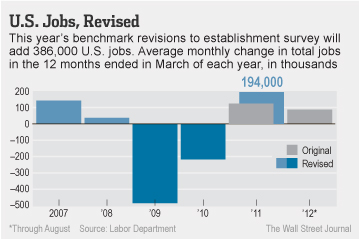
Nearly 400,000 More Jobs Added Than First Thought

Source: WSJ

Fictitous NYC TV Sitcom Real Estate

Posted: 27 Sep 2012 11:30 AM PDT

Awesome graphic from Jonathan Miller:


click for full size graphic


1CO2000A0925

The Wisdom Of A Short Seller

Posted: 27 Sep 2012 10:00 AM PDT

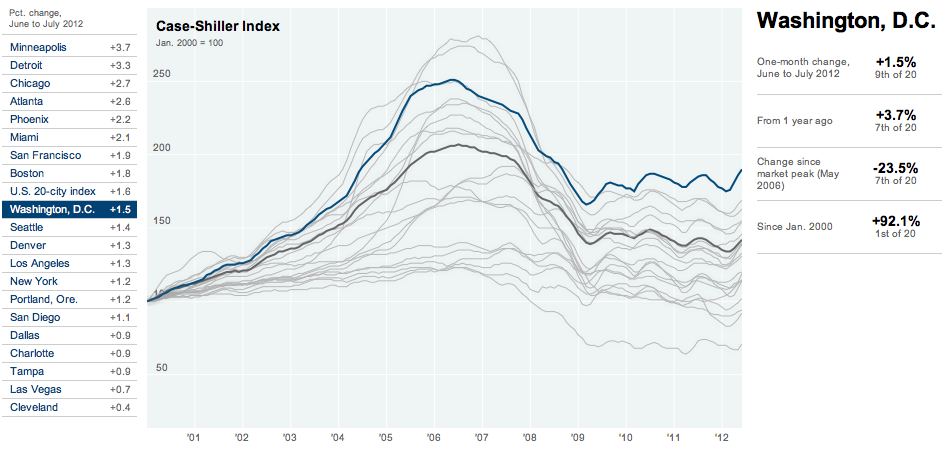
Housing’s Rise and Fall in 20 Cities

Posted: 27 Sep 2012 09:00 AM PDT

Click for interactive chart:

Source: NYT


Source: WSJ


10 Thursday AM Reads

Posted: 27 Sep 2012 07:00 AM PDT

My morning reads:

• Signs that bond market finally has topped (Market Watch)
• Why I Agonize About The Zero Bound (Tim Duy’s Fed Watch) see also Fighting Recession the Icelandic Way (Bloomberg)
• Bair Details Inside Story of Regulatory Clash Over Basel III (American Banker)
• Beyond Wall St., Curbs on High-Speed Trades Proceed (NYT)
see also SEC Looks for the ‘Kill Switches’ (WSJ)
• The “Rule of 20″ Equity Valuation Method (News To Use)
• More on That Housing "Recovery" (Pragmatic Capital) but see Housing deal of a lifetime (Scott Grannis)
• Hey, Big Saver! (NYT)
• Why Your Brain Is Irrational about Obama and Romney (Scientific American) see also Jude Wanniski’s Electoral Model Points To An Obama Landslide (Forbes)
• The RIM video that will make you squirm (Fortune)
• Help measure the world: 9.26 through 10.2.2012 (Human Face Of Big Data)

What are you reading?
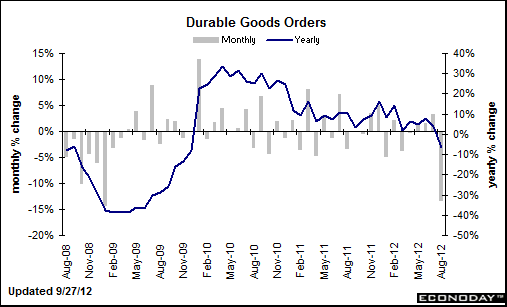
Durable Goods Orders Tank

Source: Barron’s

Claims/Durables goods

Posted: 27 Sep 2012 05:08 AM PDT

Positively, Initial Jobless Claims fell to 359k from 385k last week. It was well below expectations of 375k and the lowest since early July. It brings the 4 week average down to 374k from 379k and while the Labor Dept said the data included “very minor activity” related to the aftermath of hurricane Issac, it had almost no impact on the national figure. Continuing Claims fell by 4k and Extended Benefits were lower by 2k. Bottom line, while one week doesn’t make a trend, the pace of firings took somewhat of a break on the week. This says nothing however about any pick up in hiring at least for now with business visibility still cloudy.

Negatively, Durable Goods orders in Aug fell a sharp 13.2%, well below estimates of a drop of 5% as volatile nondefense aircraft orders basically fell to zero. Ex transports, orders were down 1.6% instead of an expected gain of .2%. Non defense capital goods ex aircraft orders however were up by 1.1% BUT July was revised to a decline of 5.2% from a drop of 3.4%. Shipments, which get directly plugged into GDP, fell 3% after a 1.9% gain in July. And, because of a .6% gain in inventories, the inventory to shipments ratio rose to 1.67 from 1.61, the most since Nov ’11. Bottom line, putting aside the huge drop in aircraft orders and 10.9% drop in vehicles/parts orders after a 12.1% rise in July, core cap ex while up in Aug is only barely off its lowest level since Feb ’11.

John Lloyd: What’s invisible? More than you think

Posted: 27 Sep 2012 05:00 AM PDT

Nature’s mysteries meet tack-sharp wit in this hilarious mix of quips and fun lessons, as comedian, writer and TV man John Lloyd plucks at the substance of several things not seen. (A clever animation adapted from Lloyd's 2009 TEDTalk.)

Investing & Trading Rules, Aphorisms & Books (Fall 2012)

Posted: 27 Sep 2012 04:00 AM PDT

Back in 2011, I pulled together a full run of Trading Rules & Aphorisms.

It turned out to be a worthwhile exercise, and so I began updating this semi annually. This is a list of my favorite traders, analysts, economists and investors views’ on what to do — and what not to do — when it comes to markets.

This is the latest updated version of my:

Trading & Investing Rules, Aphorisms & Books

Livermores Seven Trading Lessons

Bob Farrell's 10 Rules for Investing

James Montier’s Seven Immutable Laws of Investing

Richard Rhodes’ 12 Trading Rules

John Murphy's Ten Laws of Technical Trading

Six Rules of Michael Steinhardt

• David Merkel: The Eight Rules of My Investing

Art Huprich's Market Truisms and Axioms

DENNIS GARTMAN'S NOT-SO-SIMPLE RULES OF TRADING

Lessons from Merrill Lynch

Louis Ehrenkrantz' 7 Golden Rules for Investing

Rosie's Rules to Remember

In Defense of the "Old Always” (Montier)

Lessons Learned from 37 Years of Futures Trading

Richard Russell’s The Power of Compounding

The golden rules of investing (India)

25 Common Sense Money Tips


If you have any suggestions for any good lists of rules I may have missed, please link to them in comments. If they are worthy, they will get added tot he list.

After this run, I plan on updating this list 2x per year . . .


My own trading rules and favorite Trading Books are after the jump

My (Ritholtz) own rules

10 Errors and Checklist for Investors

Lessons the Guys Who Wrote Dow 36,000 Should Have Learned

Rules for Shorting

15 Inviolable Rules for Dealing with Wall Street

10 Psychological, Valuation, Adapative Investing Rules

The Zen of Trading


Then go to these books — they cover trading and markets generally:

Jack D. Schwager: Stock Market Wizards : Interviews with America's Top Stock TradersStock Market Wizards : Interviews with America's Top Stock Traders by Jack D. Schwager

Schwager interviewed market legends at the height of their success. What makes the book so worthwhile are the consistent themes that evolve from currency traders, mutual fund managers, commodities traders, hedge fund managers. Regardless of what is being traded, there are related motifs that run throughout.

What results is not a "How to trade" book; instead, it is a book about "How to think about trading."

Charles D.  Ellis: The Investor's Anthology: Original Ideas from the Industry's Greatest MindsThe Investor's Anthology: Original Ideas from the Industry's Greatest Minds by Charles D. Ellis

Instead of interviewing famed investors, Ellis gathered their best writings into one collection. He ends up with a series of short chapters by luminaries of days gone by. There is something worthwhile on just about every page. This is another favorite worth rereading every few years.

Maggie Mahar: Bull: A History of the Boom and Bust, 1982-2004Bull: A History of the Boom and Bust, 1982-2004, What drove the Breakneck Market — and What Every Investor Needs to Know About Financial Cycles by Maggie Mahar

The best book about the 1982-2000 market, bar none. There are a surprising number of lessons buried in these pages that will reward the careful reader. I found it both fascinating and informative.

Richard D. Wyckoff: How I Trade and Invest in Stocks and Bonds (Contrary Opinion Library)

How I Trade and Invest in Stocks and Bonds by Richard Wycoff

Quite simply, this is one of my favorite books on the markets and investing. The fact that it is from 1923 is totally irrelevant.

Another good book is When to Sell by Justin Mamis. Published in 1970s, it is filled with good observations about developing a sell strategy.

If you want some book ideas for Technicals, have a go at these:

Technical Analysis of the Financial Markets by John J. Murphy.
Technical Analysis from A to Z by Steven B. Achelis;
Encyclopedia of Chart Patterns by Thomas N. Bulkowski;
Japanese Candlestick Charting Techniques by Steve Nison;

Don't think you need a full reference library; any pair of these books should do.

Last, there are a full run of books here:

Reading Is Fundamental

More Reading Ideas

The Big Interview: Sheila Bair

Posted: 27 Sep 2012 03:00 AM PDT

Former FDIC chairman Sheila Bair tells WSJ Heard on the Street reporter Rolfe Winkler she feels Treasury Secretary Tim Geithner skewed the banking bailout to the needs of Citigroup and that she favors breaking up the big banks, and calls out Andrew Ross Sorkin for his mancrush on Timothy Geithner.


9/25/2012 4:04:48 PM24:19

.

0 comments:

Post a Comment

previous home Next

{8} chatroll


{9} AdBrite FOOTER

{8} Nice Blogs (Adgetize)