


The Big Picture |

- Sir John Templeton 16 Rules For Investment Success
- What’s It Like to Start a Hedge Fund?
- Durable Orders Potential Recession Warning, WSJ Intellectual Dishonesty (Again)
- Tuned: 535hp BMW M3 Monticello Motorpark
- 10 Weekend Reads
- The Emerging Headache of QE3
| Sir John Templeton 16 Rules For Investment Success Posted: 29 Sep 2012 11:00 AM PDT Interesting set of rules from legendary investor John Templeton:
Complete explanation after the jump
No. 1 INVEST FOR MAXIMUM TOTAL REAL RETURN
No. 2 INVEST—DON'T TRADE OR SPECULATE
No.3 REMAIN FLEXIBLE AND OPEN-MINDED ABOUT TYPES OF INVESTMENT
No. 4 BUY LOW
No. 5 WHEN BUYING STOCKS, SEARCH FOR BARGAINS AMONG QUALITY STOCKS
No. 6 BUY VALUE, NOT MARKET TRENDS OR THE ECONOMIC OUTLOOK
No. 7 DIVERSIFY. IN STOCKS AND BONDS, AS IN MUCH ELSE, THERE IS SAFETY IN NUMBERS
No. 8 DO YOUR HOMEWORK OR HIRE WISE EXPERTS TO HELP YOU
No. 9 AGGRESSIVELY MONITOR YOUR INVESTMENTS
No.10 DON'T PANIC
No. 11 LEARN FROM YOUR MISTAKES
No. 12 BEGIN WITH A PRAYER
No.13 OUTPERFORMING THE MARKET IS A DIFFICULT TASK
No. 14 AN INVESTOR WHO HAS ALL THE ANSWERS DOESN'T EVEN UNDERSTAND ALL THE QUESTIONS
No.15 THERE'S NO FREE LUNCH
No. 16 DO NOT BE FEARFUL OR NEGATIVE TOO OFTEN
Source: |
| What’s It Like to Start a Hedge Fund? Posted: 29 Sep 2012 09:32 AM PDT Prosiris Capital Management’s Founder and CIO Reza Ali talks about starting a hedge fund and his investment strategy. He speaks on Bloomberg Television’s “Money Moves.”
|
| Durable Orders Potential Recession Warning, WSJ Intellectual Dishonesty (Again) Posted: 29 Sep 2012 08:00 AM PDT Invictus (@TBPInvictus) here with a few random observations for your Saturday enjoyment while you sip your second cup of java. ~~~~ If you’re a subscriber to David Rosenberg’s Breakfast With Dave, you might have seen the chart below, which I posted Thursday on Twitter, in Friday’s note (share and share alike, I always say):
A break of this magnitude in Durables – that’s ex-aircraft – has in the past been a harbinger of of recession and a downturn in payrolls (I’ve used private payrolls, excluding government). BR laid out a similar warning on decaying economic conditions yesterday, offset only by the strength of monetary policies. Two caveats on this:
On a related note, business activity fell into contractionary territory (ISM-Chicago, grey bars) for the first time in three years:
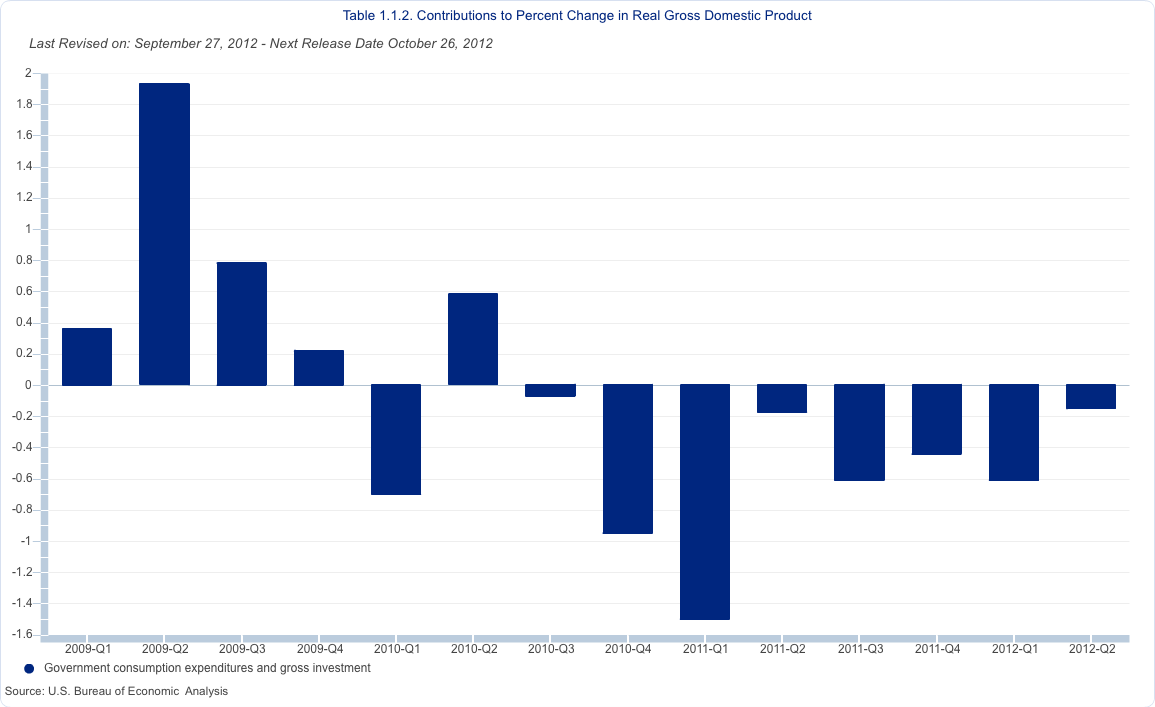
Another revision to GDP (down to 1.3 percent) was released on Thursday, and I note the following: Government spending has been a drag on GDP for what I believe is a record eight consecutive quarters:
For better (govt contributes to) or worse (govt detracts from), government is part of the GDP equation. One of the reasons we’ve gotten a string of crappy GDP prints is the fact that government continues to be a drag. This is indisputable. We can debate and discuss the appropriate role of government, but we cannot deny that it’s been a drag on GDP for the past two years. Again – and this is not my first go-round on this type of intellectual dishonesty – the WSJ recently ran a misleading chart which was, not surprisingly, the work of the Heritage Foundation:
Misleading & Intellectually Dishonest Chart, from WSJ OpEd via Heritage
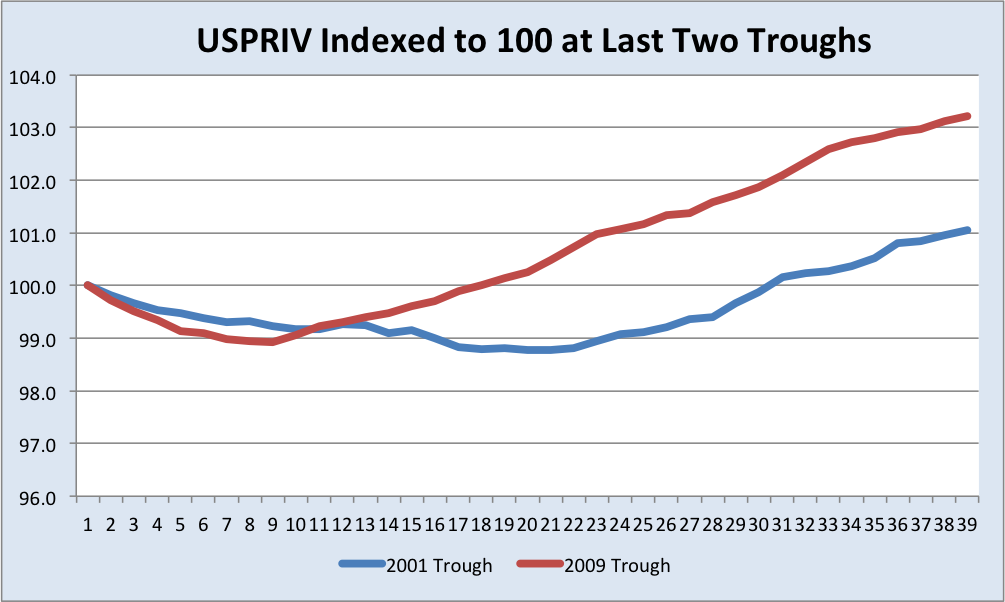
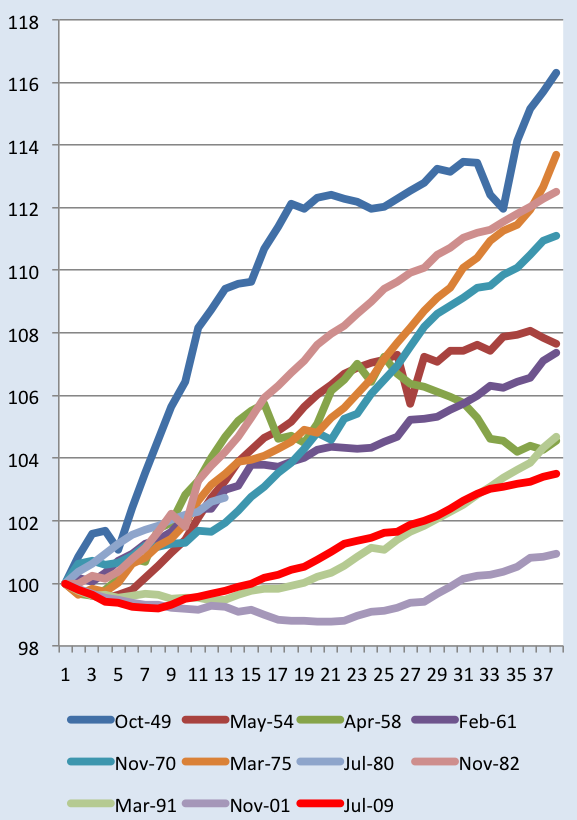
Note to the Journal (and Heritage): We measure recessions from economic peaks and recoveries from economic troughs (as determined by the NBER). This is not controversial. When you claim this is “the slowest recovery since the 1960s” while pegging your chart to the period “before the recession began 55 months ago,” you are (deliberately) misleading your (ever-dwindling) readership, just as you were the first time I called you out on it 18 months ago. Perhaps in the future, you can find a better model of economic analysis than Niall Ferguson. The fact, as I’ve repeatedly demonstrated, is that this is not the slowest jobs recovery since the 1960s. In fact, the last jobs recovery was slower than this one:
Here’s what an honest chart would look like (not much chance we’ll be seeing this anytime soon from the Journal). Note in terms of private sector job creation — one of the WSJ’s favorite recovery metrics — the present post credit crisis recovery is mediocre, but hardly the worst in post war history. In fact, its better than even the so-called Bush Boom which the Journal used to be so found of touting.
An Intellectually Honest Look at Private Payrolls During Recoveries I’m sure I’ll be addressing this issue again in the not-too-distant future. Sadly, while misinformation like this is SOP for Heritage, it’s been disappointing to watch the Journal – once a top-flight publication – slowly lose its credibility under the Murdoch empire umbrella. To conflate “recession” and “recovery” – to use them interchangeably – takes either monumental ignorance of economic terms or a deliberate desire to mislead. Neither holds the Journal in particularly good stead.
Previously: It Was the Best of Times. It Was the Worst of Times. Yup., Sept. 2010 |
| Tuned: 535hp BMW M3 Monticello Motorpark Posted: 29 Sep 2012 05:00 AM PDT Tuned goes to Monticello Motor Club to visit the Turner Motorsport race team, who have brought us two cars: Their 535-horsepower, all-motor Frozen M3 street project car, and the 2011 Continental Tire Series Championship-winning E92 M3 Race Car driven by Bill Auberlin and Paul Dalla Lana. We learn the importance of having your street car tuned by a company that goes out and wins races every weekend, and that on the track, horsepower is far from everything. Turner Motorsport’s 535 hp Frozen Gray BMW M3 and Championship |
| Posted: 29 Sep 2012 04:45 AM PDT Some longer form articles to start your weekend:
What’s on your tablet?
QE Chatter and Equities |
| Posted: 29 Sep 2012 03:00 AM PDT The Emerging Headache of QE3
The Fed’s latest quantitative easing may cause problems for countries grappling with inflation and should prompt China to press ahead with economic reforms
The Fed has promised to purchase US$ 40 billion worth of mortgage-backed securities (MBS) per month until it is satisfied with the economy. By all accounts an unemployment rate above 7 percent is not satisfactory to the Fed. Its own analysis doesn’t expect the unemployment rate to fall below 7 percent in two years. That suggests that QE3 will last for over two years, and the total amount of MBS purchases will exceed $1 trillion, more than QE1′s US$ 1 trillion. Through its purchases of MBS, the Fed provides direct support to the housing market and banks. The housing market is still wobbly. No economic recovery can be strong without a strong housing market. The Fed’s purchases will narrow the spread between the treasury yield and housing financing cost. The 10-year treasury yield is 1.8 percent. If the mortgage interest rate is decreased to such a level, it provides ample refinancing opportunity, which alleviates the debt burden for the heavily indebted household sector. The United States’ household sector is US$ 12.9 trillion in debt, down nearly US$ 1 trillion from the peak, partly through bankruptcies. The pressure for reducing the debt is considerable. It is a major factor in keeping the economy weak. Through decreasing the interest burden, QE3 is likely to lessen the deleveraging pressure. The United States’ household real estate value has declined by 30 percent from the peak in 2006. The current aggregate value of US$ 16 trillion is slightly above 100 percent of GDP and still high by historical standards. If the market adjusts naturally, it may well fall another 30 percent. The Fed’s actions so far have decreased its decline. QE3 is likely to continue this support. However, the artificial support can’t reverse the trend. It merely allows the nominal GDP to grow while keeping housing value stable. It cushions the downturn, but also saps the recovery strength. The Fed is unhappy with the strength of the economic recovery. It has itself to blame. The monetary and fiscal stimulus prevented a thorough cleansing of the inefficient economic activities that built up during the bubble economy. The economy didn’t reach its natural bottom in the downturn. Therefore, the upturn is weak too. Many unproductive economic activities still take up a significant chunk of resources. Finance and health care, in particular, are still highly inefficient and take up nearly one-fourth of the economy. The Fed’s monetary policy cannot substitute for structural reforms. QE3 will not create a strong economy. Stagflation in Emerging Economies In anticipation of QE3, commodity prices, especially oil and agricultural commodities, have surged. The most direct path from QE to inflation is through commodities. This inflation angle hits emerging economies and low-income people hard. The share of commodities in the consumption basket declines with income. Hence, developed economies are less affected than emerging economies when the prices of commodities rise. Emerging economies already suffer from slowing growth and sticky inflation. QE3 may force emerging economies to tighten their monetary policy despite weakening growth. In the inflation calculation, the U.S. economy comes out ahead of others. Its natural gas price is exceptionally low due to the shale gas boom. Its economy is shifting to gas from oil. Hence, it suffers much less from rising oil prices than during QE1. The United States is a net exporter of agricultural commodities. While there is an internal distribution issue, the United States as a whole benefits from food inflation. Because it is less inflation prone and benefits from inflation as a whole, the Fed won’t waver on QE3 despite inflation rising around the world. During QE1 there was a huge wave of hot money flowing into emerging economies. There was only a trickle during QE2. Hot money is unlikely to be significant during QE3. The reason is bad fundamentals in emerging economies. The QE1 hot money created a huge bubble in emerging economies. It has weakened the fundamentals there. Inflation, bad loans and a deflating property bubble are afflicting emerging economies. Hot money does not flow to sick economies. The emerging economies are already in a stagflationary situation. QE3 is pushing them further in that direction. The stock markets in emerging economies have performed poorly relative to the United States’. This divergence will likely continue during QE3. Indeed, the relative underperformance of emerging market stocks may escalate capital outflow in emerging economies, triggering financial crises like in 1998. Escalating Protectionism The Obama administration is filing a complaint against China at the WTO over autos and auto part subsidies. That action is obviously part of presidential election politics. Even though the administration can claim credit for saving General Motors, employment in the industry is considerably lower than a decade ago, partly due to import competition. The Obama camp wants to preempt the Romney side on this issue. The irony is that, while the Obama administration claims credit for saving GM, China actually did. GM sold 2.5 million vehicles in China in 2011. Moreover, these cars were sold at high prices. China probably has accounted for over 100 percent of GM’s profits over the past five years, i.e., it is losing money elsewhere. While the auto example seems purely political, protectionism is likely to rise and soon. QE3 may increase demand in the United States, especially for housing related goods. However, the demand is likely to be met with imports, mainly from China. In addition, China is suffering from overcapacity in most industries. An export push is quite likely. The reactions in Europe and the United States would be very negative. Multinational companies have led globalization, as they can influence politics in the demand countries. The debt crises of the past years are changing politics in Western economies. Corporate influence is waning as a result. Protectionism may follow. Amplifying Uncertainty The Fed has been complaining that the corporate sector, while sitting on record levels of cash, is not investing as much as it should. Hence, the employment situation doesn’t improve as much it could, which keeps demand weak and justifies the cautious investment attitude. The Fed believes that this “vicious” cycle can be broken through its policy. A major goal of QE3 is to convincing the corporate sector that the Fed will deliver a good economy through unlimited QE. If the corporate sector believes that the Fed will succeed, it should invest now, which would create a virtuous cycle. QE3 is partly a confidence trick; if the market believes, it is self-fulfilling. I doubt that the Fed will succeed in the confidence trick. QE creates its own uncertainty. Ben Bernanke is a follower of Milton Friedman, who famously remarked: “Inflation is always and everywhere a monetary phenomenon in the sense that it is and can be produced only by a more rapid increase in the quantity of money than in output.” The Fed reassures us that, when inflation becomes a problem, it will take back the excess money to stop it. However, such an act would trigger a massive recession. The promise may not be credible, i.e., the Fed may accommodate it and let all the QE money become inflation. The binary nature of the QE eventuality is a huge uncertainty. Keeping cash may be the best choice for businesses. Even though the investment process may create a virtuous cycle, it may not last. The Fed’s subsequent tightening could cause a massive recession and losses for businesses stuck with overcapacity. Hence, it doesn’t make sense to invest even though business could be good in the short term. Financial investors are responding to the uncertainty in extreme fashion. Some are holding bonds despite near zero interest rates because they believe that the Fed would crack down on inflation. Some are holding gold to hedge against the scenario that the Fed would accommodate. Hence, the gold price screams inflation, while bond prices say deflation. Such extreme and opposed views among investors cannot be good for the global economy. Inflating Bubble The Fed’s QE has already created a bubbly situation in Internet stocks. Private equity is another QE-related bubble. Agricultural commodities could become a big bubble this time. The global economy remains weak. QE3 won’t change that. Hence, industrial commodities are unlikely to become a bubble again. Indeed, industrial commodities may continue to deflate. For example, I think that the iron ore price could fall to US$ 50 per ton from a recent high of US$ 190. The spike in copper prices may not last either. The price of oil can go higher, as Saudi Arabia controls all the excess capacity and won’t increase production even if price goes up another 20 percent. The price of gold may go very high this time. QE3 is like a river. The flow may be small for any given day, but it adds up over time. As competing commodities cannot inflate due to weak demand and oversupply, the liquidity into gold could be far bigger than in QE1 and QE2. If agricultural commodities become a bubble this time, which I think is likely, it could trigger global political crises. The effect of QE1 on food prices was an important factor in triggering the Jasmine Revolutions in the Middle East. QE3 has the potential to propel food prices to even higher levels. The fundamentals in the emerging economies are worse than during QE1. High food prices will have bigger impact also. If food riots occur in Africa and South Asia, the Fed is partly to blame. China and Reform The continuing outperformance of the U.S. stock market may increase China’s capital outflow. If the U.S. property market begins to rise again, the outflow may become a torrent, triggering a banking crisis in China. There is an urgency for China to become more attractive for international and domestic capital. The returns on capital in China are very low and getting lower. Measures to boost GDP won’t change the situation. In the past five years, land appreciation has been the main source of profit. This bubble economy is deflating. The property market in tier-three cities has virtually crashed. The situation is spreading to tier-two cities. The suspension of property construction, due to collapsing sales, is the main factor in China’s economic weakness now. There are many efforts by the government and property industry to cover up the situation. Such efforts are surely to backfire. China urgently needs to cut taxes to improve demand and increase the effective returns on capital. It is possible that the United States will eventually boom with capital redistributing from China to it. The economies of China and the United States may move in opposite directions. Who goes up depends on relative attractiveness. If China doesn’t want to suffer a crisis, it must reform and become more attractive than the United States.
Source: |



| You are subscribed to email updates from The Big Picture To stop receiving these emails, you may unsubscribe now. | Email delivery powered by Google |
| Google Inc., 20 West Kinzie, Chicago IL USA 60610 | |



0 comments:
Post a Comment