


The Big Picture |

- Risks from Flooding to Numerous U.S. Nuclear Facilities
- You Suck At PowerPoint (2)!
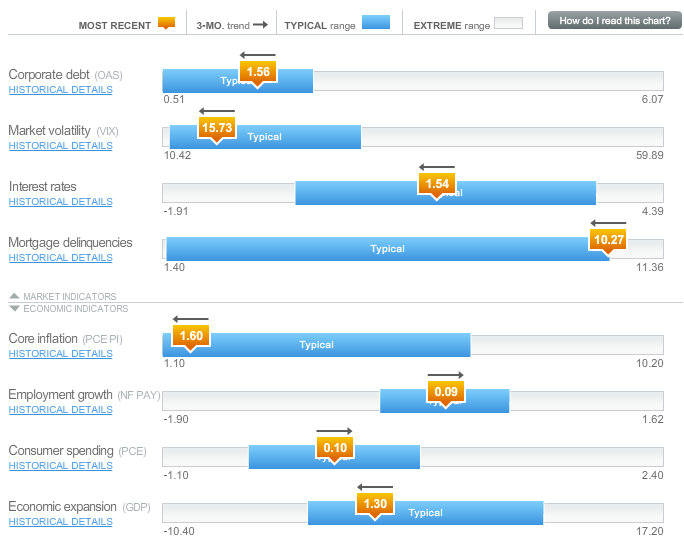
- State of the Economy
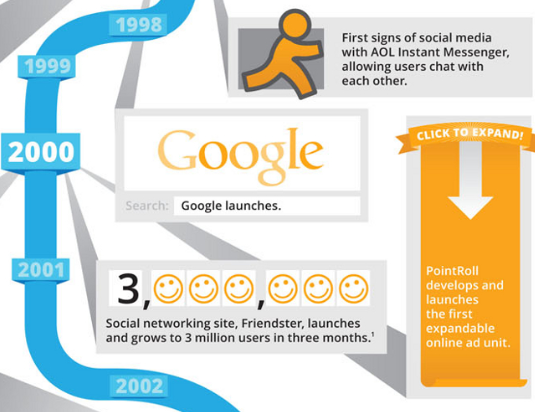
- The Evolution of Digital Advertising
- Don’ts & Do’s
- Three Peaks and a Domed House (2012 version)
- Buy Italy and Sell France?
- All The Money The Government Is Printing This Year, In One Graphic
- The Realist
- Fed can’t print earnings growth/Europe/Asia
| Risks from Flooding to Numerous U.S. Nuclear Facilities Posted: 23 Oct 2012 10:30 PM PDT NRC Whistleblowers: Risk of Nuclear Melt-Down In U.S. Is Even HIGHER Than It Was at FukushimaNumerous American nuclear reactors are built within flood zones:
Numerous dam failures have occurred within the U.S.:
Reactors in Nebraska and elsewhere were flooded by swollen rivers and almost melted down. See this, this, this and this. The Huntsville Times wrote in an editorial last year:
An engineer with the NRC says that a reactor meltdown is an "absolute certainty" if a dam upstream of a nuclear plant fails … and that such a scenario is hundreds of times more likely than the tsunami that hit Fukushima :
Huffington Post reported last month:
Huffington Post notes today:
Other Comparisons Between Dangers In U.S. and FukushimaThere are, in fact, numerous parallels between Fukushima and vulnerable U.S. plants. A Japanese government commission found that the Fukushima accident occurred because Tepco and the Japanese government were negligent, corrupt and in collusion. See this, this and this. The U.S. NRC is similarly corrupt. The operator of the Fukushima complex admitted earlier this month that it knew of the extreme vulnerability of its plants, but:
The U.S. has 23 reactors which are virtually identical to Fukushima. Most American nuclear reactors are old. They are aging poorly, and are in very real danger of melting down. And yet the NRC is relaxing safety standards at the old plants. Indeed, while many of the plants are already past the service life that the engineers built them for, the NRC is considering extending licenses another 80 years, which former chairman of the Tennessee Valley Authority and now senior adviser with Friends of the Earth's nuclear campaign David Freeman calls "committing suicide":
Indeed, the Fukushima reactors were damaged by earthquake even before the tsunami hit (confirmed here). And the American reactors may be even more vulnerable to earthquakes than Fukushima. Moreover, the top threat from Fukushima are the spent fuel pools. And American nuclear plants have fuel pool problems which could dwarf the problems at Fukushima. And neither government is spending the small amounts it would take to harden their reactors against a power outage. The parallels run even deeper. Specifically, the American government has largely been responsible for Japan's nuclear policy for decades. And U.S. officials are apparently a primary reason behind Japan's cover-up of the severity of the Fukushima accident … to prevent Americans from questioning our similarly-vulnerable reactors.
|
| Posted: 23 Oct 2012 02:30 PM PDT |
| Posted: 23 Oct 2012 01:00 PM PDT |
| The Evolution of Digital Advertising Posted: 23 Oct 2012 11:30 AM PDT |
| Posted: 23 Oct 2012 10:30 AM PDT Don't make an album if you're an actor or actress. Nobody is waiting for it and if you're not willing to go on tour for years you'll get a ton of (paid-for) publicity and no sales. And if you're that damn good and can't say it in a single, don't start. Or keep it as a hobby. Don't go to see "Argo." It's so typically Hollywood you'll wince, down to the revolutionaries following the plane down the runway as it takes off (and if you think this requires a spoiler alert, let me really blow your mind… You're gonna go to sleep and wake up tomorrow! You're gonna eat too! Whew!) Do go see "Smashed." No one will. This is TV done right. But on the big screen. And that's like putting your kiddie show on Cinemax, however good it might be, it's the wrong place. Do sign up for Twitter. But don't tweet if you don't want to. But if you do tweet, make it personal, not self-promotional. I went here and did this and feel that, as opposed to buy my this or buy my that. Don't mistake publicity for success. Just because people can read about it everywhere, see it on TV, that does not mean anybody cares. Don't ask to mail a CD. Do ask if you can send a link. Sending a CD makes you feel good, but it's rarely listened to. You've got a chance someone will click and listen to your music via a link. Because it's much easier. But don't expect them to listen to more than five seconds. Yup, that's how long you've got to hook someone. Don't blame the listener, blame the plethora of entertainment options. We're limited in time and we only care about the best. Don't get excited about the Stones' 50th. It will only encourage them. Don't read Neil Young's biography. Well, you're already not. It's self-indulgent, all about the money. Just because you can play music that does not mean you can write a book. Do listen to each and every Alec Baldwin "Here's The Thing" podcast. Because the level of discourse is high in a world that is too often shooting low and you'll learn something. Robert Osborne, host of Turner Classic Movies, was working at the Greek Theatre box office when he got his job at the "Hollywood Reporter." This was after he had been on TV and under contract to Desilu. David Brooks is funny, and explains why he's a conservative better than Rush Limbaugh or anybody on Fox News. Do talk about Palladia. The new MTV. Sans the bells and whistles of VJs, etc, you end up with just the music. And in hi-def, it works. Don't stay at home and watch on YouTube instead of going to the gig, it's the same visuals, the same music, but a completely different experience. Don't go to work at the label. There's no upward mobility. If you want to start in the music business, become an agent. Don't boast about how little sleep you get. It just makes you appear a trend-whore and stupid. All the recent studies say almost everybody needs close to eight hours a night. If you're not getting it, you're not being creative. Yup, that's what it takes to have great ideas and execute them, sleep! Do educate yourself on banking, not only titans like Goldman Sachs and J.P. Morgan, but hedge funds and private equity. This is the enemy. If you don't know him, you and society are worse off for it. It's like living in the sixties and not being informed on the Vietnam War. And once everybody got informed, a huge swath of the population was against it. Don't make the mistake of thinking just because you like something, somebody else will. If you want to maintain your credibility, don't recommend that which people will not like. Don't believe just because Gaga is one of the biggest stars today that she'll be one of the biggest stars tomorrow. Touring is a victory lap at her level. It all comes down to the music. Can she record more great stuff? Do not think since "Jagged Little Pill" was so great, Alanis Morissette has anything left to say that you've got to hear. Do not think electronic music is a fad. Because then you're like Geffen Records, which thought rap was a fad, didn't sign any and went out of business. Do know that Showtime did not become the new HBO overnight. Success takes time. To find your way, to build an audience. Nobody lives forever. The greatest threat haunting the powers-that-be in today's music business is death. The sphere is rife with opportunity. Because of the aged infrastructure. Or as Warren Miller so sagely put it, "Every hundred years, all new people." Do know that access is king. Just like distribution. You might abhor electronic books, but a digital store, containing all available works at your fingertips, is good for readers and society. Do know there's no longer such a thing as a rare recording. Everything's available online. Maybe not in a physical format, but you can hear it. Collecting is just sport today. Do know the vinyl "revolution" has a sell-by date. It's comparatively tiny and will be eradicated once higher quality downloads/streaming become available. Which could take years, because of slow broadband. What kind of screwed up world do we live in where people can get the same speed on their phone (LTE) as they can at home (broadband.) One in which there are no government incentives to speed broadband up. Higher broadband delivers a stronger economy. Just ask the South Koreans. Don't think Ticketmaster is the enemy. Acts are. Don't believe ticket prices will come down. There's a shortage of good acts you want to see and income inequality means there's always someone willing to overpay to say they were inside. Don't think Apple is forever. Music, when done right, can be forever. Not commerce, not gadgets and industrial products. Don't listen when an artist says his latest work is his best. He's got no perspective and he's just trying to sell it. Don't think the label is your friend. Don't think just because an album entered high on the chart it's a success. Look to see if it's still selling a year from now. If not, it's almost irrelevant.
~~~ – http://www.twitter.com/lefsetz – http://www.lefsetz.com/lists/?p=subscribe&id=1
Don't sign with a label unless you truly believe you cannot do it yourself. And do you see yourself as that inadequate? |
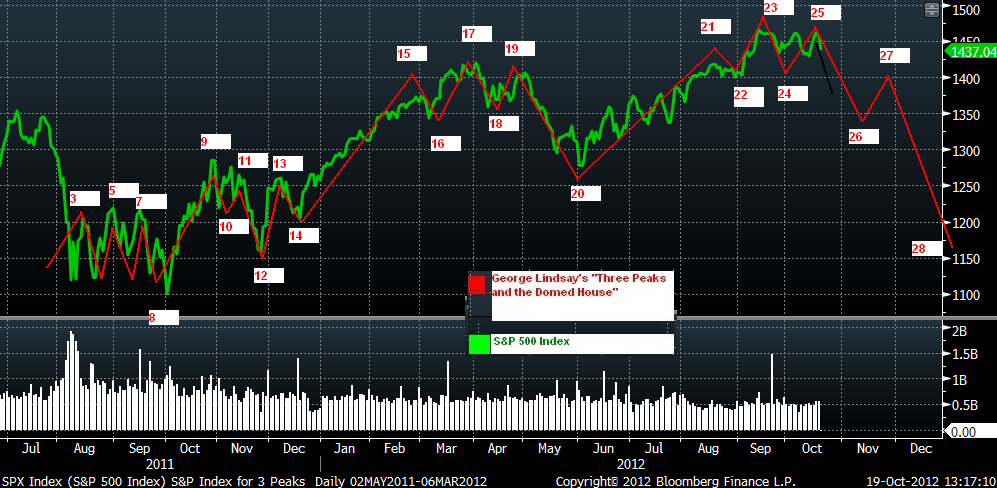
| Three Peaks and a Domed House (2012 version) Posted: 23 Oct 2012 08:30 AM PDT TP&tDH
Some friends who are technicians are all hot & bothered by the above 3 Peaks and a Domed House pattern. As I have said in the past, I have no idea what the long term track record of this pattern is is; I saw some good calls of TP&tDH in 2000, and bad calls of such in 2003 and 2005. I present the above chart without opinion other than to say it is interesting.
Previously: Three Peaks and the Domed House redux (December 3rd, 2004) See also: |
| Posted: 23 Oct 2012 07:30 AM PDT Japanese inflation data to be released this week should confirm that core consumer prices declined in September, for the 5th consecutive month. The BoJ’s goal is to raise inflation to 1.0% – no chance, based on current policies. Next week (30th), the BoJ will announce its decision. There is speculation that the BoJ will revise down its economic projections for 2012 and 2013. It will also announce its forecast for 2014. Given the pressure it is under, speculation mounts that the BoJ will increase its asset purchase programme and, in addition, announce other measures to ease monetary policy. If the above proves true, the Yen should continue to decline. For full disclosure purposes, I am short the Yen; Bloomberg reports that Chinese industrial companies profits have declined by -6.2% in August Y/Y, the largest decline this year and the 5th consecutive monthly drop. Excess capacity is the main problem, with little being cut to date. Investors have treated the Rosneft deal for TNK-BP with a great deal of suspicion, mostly because of their aversion to anything Russian. BP shares continue to decline. Personally, I believe that Russia, given its problems, will have to be more accommodating to foreign investors (at least for the moment) and that the deal concluded by BP may actually be better than currently perceived; Numerous negative comments on Italy by analysts – in my view misplaced. Yes there is political uncertainty, but if anyone seriously believes that the Italian population will vote for a comedian (who polls suggest has 25% of the votes) in a real poll, well…………Monti is doing better and Berlusconi is fading – his chances of staying in his job are getting better. Sure things could change, but Italy is progressing, unlike France which is going the other way. Italy will not side with France – Monti knows he needs to get closer to Merkel/Germany. Buy Italian bonds and sell equivalent French? – radical idea, I know, but………; The Bank of Spain reports that Spanish Q3 GDP contracted by -0.4% (-0.7% forecast), similar to Q2, or -1.7% Y/Y, the 5th consecutive Q’rly decline. The BoS added that demand had risen ahead of a sales tax increase in September, though expects demand to decline further in Q4. Employment fell by -4.5% in Q3 Y/Y. They added that taxation revenues were declining and that the government would need to make more cuts. They estimate that the 2012 budget deficit will be -7.3%, as opposed to the -6.3% target. The BoS added that the governments 2013 GDP estimate was “very ambitious” - diplomatic terminology for its compete rubbish French business confidence indicator came in at 85 in October, as opposed to 90 expected and 90 in September. The production outlook indicator came in at -56, as opposed to -50 expected and -52 in September. France’s woes continues; UK mortgage approvals rose in September, to 31.175k, from 30.683 in August. In addition, mortgage lending rose materially to £347mn. Unsecured credit rose to £346mn in September, from £133mn in August. The data suggests that the UK economy is improving; President Obama won the TV debate last night. A CNN post reports that the President won by 48% to 40%. The striking issue was Governor Romney’s agreement on most of the Presidents foreign policy strategy. In addition, the Governor, seemed to change his mind on a number of issues – quite extraordinary and I would have thought dangerous, as he lays himself open to being charged as a flip flopper. Having said that, intrade has marginally reduced its forecast for President Obama to win to 61%; Outlook Asian markets closed lower, with European markets weaker. US futures suggest a weaker open, though surprisingly, US markets bounced back to flat/slightly higher yesterday having been much lower – could not understand why. December Brent is weaker at US$109.10 – needs to be below US$100. Gold is also weaker at US$1712, and copper continues to decline. The Euro, well hallelujah, its weaker at US$1.3030, with the Yen under pressure, as well. Pretty boring day. I continue to remain deeply concerned about the lack of urgency in recapping European banks, though markets seem to have shrugged this off !!!. In addition, there are no real positive developments to buy the market – as a result, downside risks prevail. US earnings and, in particular, revenues together with forecasts/forward looking statements continue to disappoint. I remain particularly cautious. Kiron Sarkar 23rd October 2012 |
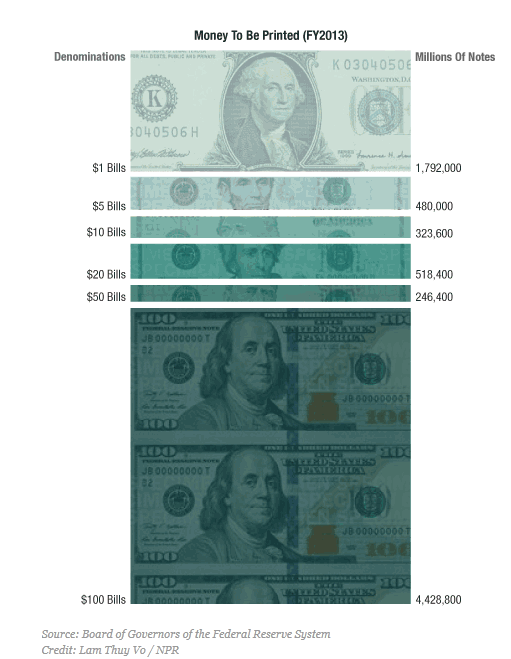
| All The Money The Government Is Printing This Year, In One Graphic Posted: 23 Oct 2012 06:00 AM PDT
Source: |
| Posted: 23 Oct 2012 05:30 AM PDT On the eve of this evening's US presidential debate and with two weeks to go before the election, we thought it would be fitting to publicly endorse our favorite candidate – the Realist. The political dynamic of our time may be reduced to intense operational pragmatism posing as extreme social idealism. Election and appointment processes have become highly institutionalized and very specific in calculating odds. This explains the ever-narrowing window of acceptable public rhetoric. In this hyper self-conscious, real-time, meta social environment, public language or innuendo that threatens a generally accepted framework of expectations risks sudden castigation by society and its media…and risks political defeat. One might argue that what was once a necessary improvement of decorum – increased political correctness by those on the public stage that influence and hopefully reflect a more aware, inclusive, and tolerant society – has morphed into a political imperative for stage management and policy setting. The business of politics, like the business of commercial enterprise, now relies very much on not surprising or upsetting a defined constituency.
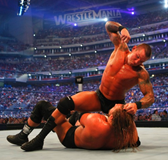
Our politicians and policy makers are thus trained and instructed to play the odds, to stay on script, and to continually appeal to their bases. Only once loyalties from the low-hanging fruit are locked-in may they then try to extend support among independents – comprised in their eyes as nettlesome "brain dead" voters without the good sense to pay attention until the election draws nigh and nettlesome objective voters that don't get the joke (those that actually pay attention to issues and do not hear enough substance during the campaigns to persuade them either way). It would be a tough course for thoughtful and courageous policy makers to navigate. So tough, in fact, that only the hyper-political need apply. As a result, public policy and the people picked to craft and execute it have become anodyne. The impact of the consequent politically-correct policies on the disaggregated governed seems both ironic and predictable: increasing economic and social instability. Our leaders are dividing us with idealism and conquering us with vote counting. And yet…we all know it's fake. The whole affair smacks of pro wrestling. Be that as it may, it would seem the best bet, in fact the only logical bet for investors, is to continue wagering on the rational short-term best interests of power – not necessarily those currently in power or those that want to take it from them. Nothing else matters, practically speaking. All promises and articulated intentions not fully aligned with their short-term interests should be thought of as hollow rhetoric meant for their part-time peeps looking to wave their flags for a winning team every four years. As it relates to US economic policy, the presidential election matters very little (as Mr. Schumer says, the Fed has become the "only game in town"). As we have written, the most politically expedient way to de-leverage banks and households so that economic activity can increase is through currency dilution, not by permitting long periods of austerity. The Fed as an institution will keep printing at the behest of politicians and major banks (its shareholders) until there is publicly recognized inflation. After all, managing inflation expectations has long been the explicit target of central bankers across all self-identifying conservative and liberal administrations. Below we divide economic observers into two categories, Realists and Nominalists, in the current environment: 1) Realists – those who advocate for the expansion of exchange value of the aggregate money stock via an increase in the value of each monetary unit (deflationists) 2) Nominalists – those who advocate for the expansion of exchange value of the aggregate money stock via an increase in the number of monetary units (inflationists) The great divide seems to be properly delineated on most fronts: 1) Unlevered savers, wage-earners, the 99%, etc. are all Realists (unknowingly perhaps). They benefit from a rising exchange value of the currency unit (i.e. they are structurally long the currency unit) 2) Bankers, unreserved leveragers of all stripes and those that benefit from leveraging are Nominalists. They are either monopoly producers and distributors of fiat currency or direct beneficiaries of the process as levered entities (i.e. they are structurally short the exchange value of the currency unit) President Obama, Governor Romney and Chairman Bernanke are proven Nominalists (implying most of the electorate is unaware or indifferent as to the purchasing power of their wages and savings). This further implies that regardless of the election outcome, inflation will be the accepted manner of de-leveraging to be pursued. *** A recent IMF working paper called "The Chicago Plan Revisited" [1] is making its way to our in-box because it discusses a return to fully-reserved banking systems – a policy for which we have long strongly advocated. The paper discusses replacing the current monetary arrangement – using unreserved private bank system credit as money – with money directly sponsored and distributed by federal governments. We would see such an action as an important first step towards lasting economic solvency and sustainability. We have argued formally since 2006 that unreserved bank credit inflation/deflation and the bubbles/resource misallocations it promotes are more injurious to the workings of the real economy than generally recognized. As it stands in the current regime, "money" is lent into existence by banking systems and it needs not reserves. This creates a shortage of actual money in the economy relative to the amount of credit extended and debt assumed (i.e. leverage). The imposition of rules that would require banks to lend only the media that they can source is a foundation for economic stability and efficient resource allocation, in our view. There is a catch to this proposition however, which, if left unchecked, would ensure its demise: there would be no check on government spending. In other words, technically the fiscal agent (i.e. the federal government) could itself spend money into existence with no objective restraint. If past is prologue, this would ensure a swift end to the monetary system. We would argue there would have to be one of three restraints and/or conditions imposed to ensure ongoing credibility of the scrip: 1) Gold would need to float freely and not be taxed, as it is today, so that it offers an unadulterated safe-haven savings outlet for those who fear the eventual diminution of purchasing power (thereby acting as a natural disciplinary threat to fiscal profligacy), or; 2) A gold standard would need to be imposed and honestly maintained (perhaps using the devaluation and re-pegging we have often described), or; 3) The fiscal/monetary agent would have to suppress the flow of capital into safe-haven assets thought by nervous savers to offer better prospects for future purchasing power retention than traditional financial/leveraged assets (e.g. precious metals, scarce resources and operating utilities). Nevertheless, the mere existence of the IMF paper seems to acknowledge that significant monetary change is likely. Perhaps that is the real takeaway?
[1] International Monetary Fund; "The Chicago Plan Revisited"; Jaromir Benes and Michael Kumhof; August 2012; http://www.imf.org/external/pubs/ft/wp/2012/wp12202.pdf Source: QBAMCO |
| Fed can’t print earnings growth/Europe/Asia Posted: 23 Oct 2012 05:08 AM PDT Central bank money printing can only suspend reality for so long as we’ve seen time and again that economic growth is not driven by ever cheaper money when deleveraging and policy incompetence rule the day. At least until the Nov election, the earnings story will continue to drive markets as it has since the Monday after the FOMC EQE (endless QE) news. In Europe, not surprisingly, the Bank of Spain said the Spanish economy contracted for the 5th straight quarter in Q3 by .4% q/o/q. Also, Moody’s downgraded 4 Spanish regions with Andalucia now junk and the other 3 further into junk. French business confidence in Oct fell 5 pts from Sept to the lowest since Aug ’09. Spanish bonds are trading lower but the 2 yr yield is still below 3% for now. In Asia, the Hong Kong Monetary Authority intervened again, buying US$’s to maintain their peg. |



| You are subscribed to email updates from The Big Picture To stop receiving these emails, you may unsubscribe now. | Email delivery powered by Google |
| Google Inc., 20 West Kinzie, Chicago IL USA 60610 | |



0 comments:
Post a Comment