


The Big Picture |

- More of What You Missed at The Big Picture Conference
- 10 Mid-Week PM Reads
- FOMC Statements: Side-By-Side
- FOMC Takes a Breather
- Live Fireside Chat Today with Todd Harrison, Minyanville
- No change at the FED
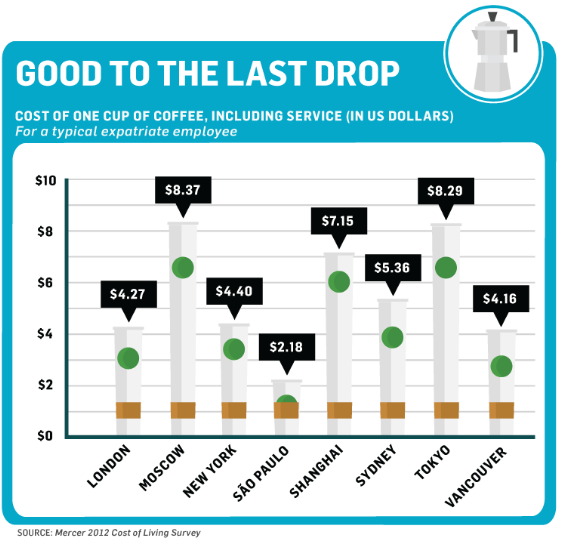
- Cost of Living Varies Widely
- Ritholtz Sees “Major Cyclical Correction”
- Dylan Grice: The Bull Case for Safe Havens
- New Home Sales best since Apr ’10 but…
| More of What You Missed at The Big Picture Conference Posted: 24 Oct 2012 07:46 PM PDT Bloomberg Radio Broadcast live from The Big Picture Conference. Hear Barry’s take on how he chooses speakers for the event.
click for videos |
| Posted: 24 Oct 2012 01:30 PM PDT My afternoon train reads:
What are you reading?
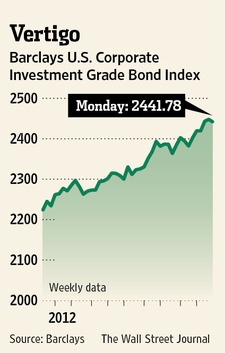
Corporate Bond Prices Slip as Investors Fret
|
| Posted: 24 Oct 2012 01:00 PM PDT The Fed released the minutes of the recent meetings earlier and had a few noticeable differences from last month. Household spending has advanced a bit more quickly, but growth in business fixed investment has slowed. To see a side-by-side comparison of the FOMC minutes, click below
Source: http://www.horowitzandcompany.com http://www.thedisciplinedinvestor.com |
| Posted: 24 Oct 2012 12:30 PM PDT The FOMC released a statement that was almost identical to the one given in Sept. The only very modest change of note was their reference to inflation where they said “inflation recently picked up somewhat, reflecting higher energy prices” even though they followed with “longer term inflation expectations have remained stable. In Sept, they said “inflation has been subdued, although the prices of some key commodities have increased recently.” Everything else was a non event as the Fed took a breather after their moves in Sept. One more point on the FOMC, the Dec meeting will be of more interest as they will likely discuss what they will do with the year end expiration of Operation Smother the Yield curve Part 2. It’s unlikely they extend it again as they are running short of short end paper to sell but they may embark on QE4 which would entail the outright purchases, again, of longer term US Treasuries in conjunction with the buying of more MBS. The winner of the election will likely influence the decision no matter how apolitical the Fed says they are. |
| Live Fireside Chat Today with Todd Harrison, Minyanville Posted: 24 Oct 2012 12:15 PM PDT
The Buzz & Banter Fireside Chat is Back! Join us today, at 4:15 p.m. EDT, when Todd Harrison will be joined by none other than Barry Ritholtz for an in-depth, no-holds-barred discussion about the most important issues facing the economy and stock market – including the fiscal cliff, the US Presidential election, and the slowdown in China. If you’re not familiar with Barry, he serves as CEO and Director of Research at Fusion IQ, a quantitative research firm. Barry also runs The Big Picture, one of the most influential financial blogs, and in 2009 authored Bailout Nation, one of the definitive books covering the Wall Street bailouts. The rules for this event are the same as they always are – no softball questions, no commercial breaks, and no mindless sound bites. Our Fireside Chats are all about delivering meaningful commentary that will help you make better investment decisions. Click here to Register for the Live Webcast. ~~~ If you have a question for Todd or Barry, we encourage you to email us at buzz@minyanville.com. |
| Posted: 24 Oct 2012 12:01 PM PDT The Australian trimmed mean gauge of core prices rose by +0.7%, in Q3, Q/Q, slightly higher than the +0.6% expected, or 2.6% Y/Y, higher than the +2.2% expected. Analysts expect the RBA to cut rates in November, though the slightly higher inflation data has reduced expectations somewhat. There will, however, be a rate cut this year. The A$ improved on the news, but I continue to believe that it will decline in coming months and I remain short; The HSBC Chinese flash PMI index came in at 49.1 in October, better than the 47.9 in September. New orders, export orders and the output components improved. Better demand from the US and Christmas orders were the reasons attributed for the rise. Prices seem to have bottomed and, indeed, are rising, suggesting that PPI and CPI will rise; Reuters report that 1/4 of Japanese companies are rethinking their investment plans in China and may well shift future production elsewhere. Japanese and Chinese officials met secretly to discuss the spat over the South Chinese Islands, the ownership of which is contested by both countries. Reports circulate that the EZ will give Greece a further 2 years (until 2016) to meet their budget deficit targets – to reduce the deficit to 3.0% of GDP. The privatisation schedule has been delayed, with the government intending to raise E8.8bn by the end of 2015. In addition, it looks as if the Troika and Greece have reached agreement on labour reforms. Greek debt to GDP rose to 150.5% at the end of Q2, up from 136.9% at the end of Q1. Its going to be interesting to see the reaction of MP’s in the Bundestag to the proposed 2 year extension. The official German position is that they are waiting for the Troika’s report, but it looks as if a deal has been done;
The Italian Consumer Confidence Index came in at 86.4 in October, in line with expectations, and marginally higher than the 86.2 in September; The Spanish PM, Mr Rajoy is taking about easing the country’s budget deficit targets. Well, they are not going to make them anyway. However, he did not discuss whether Spain would request aid from the EFSF/ESM. It looks as if Andalusia is going to request more aid from central authorities; The important German IFO confidence index fell to 100.0 in October (101.6 expected), from 101.4 in September and the lowest for 2 1/2 years. The decline was the 6th consecutive drop and the lowest reading since February 2010. The current conditions component declined to 107.3, from 110.3 in September, whilst expectations component was unchanged at 93.2. The Bundesbank reported that 3rd Q German GDP would surprise to the upside, though the 4th Q would be weak. The IFO institute suggested that domestic consumption was still holding up and that the crisis had not hurt consumers. They added that the German economy will stagnate in Q4. Finally, the IFO institute stated that there was no reason for the ECB to cut interest rates – well a number would disagree with that view. The German finance ministry expects a balanced budget in 2013; Mr Draghi defended his proposals to buy short term debt of countries that request aid to a number of German politicians. He argued that the reason was to fix a broken transmission mechanism. He also warned that deflationary forces were a greater concern than inflation in certain countries in the EZ- interesting. By all accounts, Mr Draghi made a persuasive case, though the normal opponents will not change their mind; The French PM has warned that unemployment rose in France in September – no great surprise and unfortunately is expected to increase further; EZ composite (manufacturing and services) PMI declined by more than expected in October. The composite index came in at 45.8, the lowest for 3 years, from 46.1 in September and below the forecast of 46.5. The EZ services PMI rose marginally to 46.2, from 46.1, though the manufacturing PMI declined to 45.3, from 46.1 and lower than expectations of 46.5. German services PMI declined to 49.3, from 49.7; German manufacturing PMI declined to 45.7 from 47.4 and well below expectations of 48.0; German composite PMI came in at 49.2, lower than the 48.1 reported in September; French services PMI came in at 46.2, from 45.0 previously and expectations of 45.0; French manufacturing PMI came in at 43.5, as opposed to 42.7 previously and 44.0 expected; French composite PMI rose to 44.8 in October, from 43.2 in September; The Governor of the BoE has warned that its policy actions (QE) was reaching its limits in terms of effectiveness and that the UK economy was performing somewhat worse than expected. However, analysts expect the BoE to increase its QE programme, from the current level of £375bn; President Obama’s chances of winning the US Presidential election have declined materially to just over 56%, according to Intrade.This looks as if it is going to be a really tight race; US new home sales for September rose by 5.7% to 389k on an annual basis, slightly better than the forecast of 385k and 368k previously and the highest rate for 2 years. Y/Y, new home sales have risen by +27.1% and the median price of a new home is up by +11.7%, with the average price up +14.5%. Apart from sales in the mid west (which were down -37.3% – looks like an anomaly), purchases of new homes rose by double digit percentages. New home supply declined to just 4.5 months, from 4.7 months in August, the lowest since October 2005. The US residential property market continues to improve, fuelled by low mortgage rates; US manufacturing PMI came in at 51.3, slightly lower than the 51.5 expected and 51.1 previously; The FED reports that economic activity has continued to expand at a moderate pace in recent months. It will continue with operation twist until the year end and reiterated that rates will be kept on hold until mid 2015. No other changes and the announcement contained no real surprises; Outcome Asian markets closed mainly lower, though European markets closed mainly higher. US markets are flat. December Brent is down to US$107.89 and gold at US$1704, with copper also lower – bearish. The Euro is weaker against the US$ at US$1.2963, though the A$ stronger given the higher inflation data, with the Yen flat. If, as looks to be the case, Greece is given a further 2 years to meet its budget targets, why not Spain and Portugal and…. The targets will have to be revised as they will, in any event, be missed. The market is awaiting Spain to request a bail out, though Rajoy continues to dither – will he wait for the Catalonian elections – based on his inaction, he may well try, unless markets dictate otherwise – not positive for markets. US markets will await the outcome of the Presidential elections. Earnings, especially revenues are weaker and forward looking statements are cautious, so no real help from there. I continue to believe that events in China and Europe will drive markets. I remain cautious. Kiron Sarkar 24th October 2012 |
| Posted: 24 Oct 2012 11:30 AM PDT |
| Ritholtz Sees “Major Cyclical Correction” Posted: 24 Oct 2012 09:12 AM PDT
Fusioniq's Ritholtz Sees `Major Cyclical Correction' (Audio) Barry Ritholtz, chief executive officer of Fusioniq, says “earnings are beginning to contract” and a recession may be ahead. Ritholtz talks with Bloomberg’s Ken Prewitt and Tom Keene on Bloomberg Radio’s “Bloomberg Surveillance.” Click for Audio
~~~
|
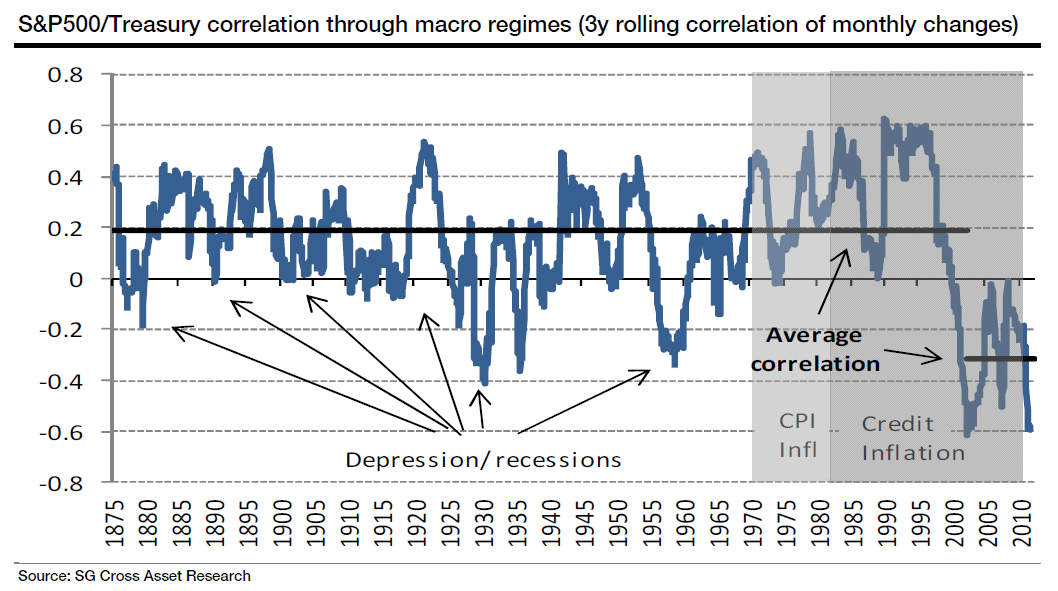
| Dylan Grice: The Bull Case for Safe Havens Posted: 24 Oct 2012 08:45 AM PDT click for larger graphic
Dylan Grice makes the case that “over time, what's good for the currency and for government finances (bonds) should be good for the rest of the economy (equities) and vice versa.” The problem is that the last ten years were an outlier, and that goverment bonds have benefited from their “safe haven” status:
Given this outlier status, Investors need to be on the lookout for when government securities lose their safe haven status.
click for larger graphic
Source: |
| New Home Sales best since Apr ’10 but… Posted: 24 Oct 2012 07:30 AM PDT New Home Sales were essentially in line with expectations over the Aug/Sept timeframe as Sept was 4k better at 389k annualized while Aug was revised lower by 5k to 368k. At 389k, it’s the highest level since the tax credit boosted month in April ’10. While homes for sale rose by 2k to 145k, the offset from the increase in sales sent the months supply down to 4.5 from 4.7, the lowest since Oct ’05 and below the 20 yr average of 5.7. Sales rose in the Northeast, South and West. The median home price was $242,400, an increase of 11.7% y/o/y but down 3.2% sequentially. As I’ve said with previous housing data out over the past few weeks, there is no question we’ve seen improvement that hopefully is long lasting but we again must put these housing levels into full perspective. While New Home Sales are 42% off the lows seen in Feb ’11, they still remain 72% below the bubble highs and are just back to where they were at the trough of 1966, 1970, barely above the one seen in the recession of ’81/’82 and still below the bottom in the ’90/’91 recession. On one hand we of course have a long runway ahead for improvement but on the other hand all we’ve seen so far is a well deserved bounce off an historic crash with the pace of gains likely more in fits and starts rather than straight lines. |





| You are subscribed to email updates from The Big Picture To stop receiving these emails, you may unsubscribe now. | Email delivery powered by Google |
| Google Inc., 20 West Kinzie, Chicago IL USA 60610 | |



0 comments:
Post a Comment