


The Big Picture |

- Panzner Insights
- (Not so) Golden Rules About Investing (& Not Investing)
- WSJ/NBC Pollsters Discuss the Debate Results
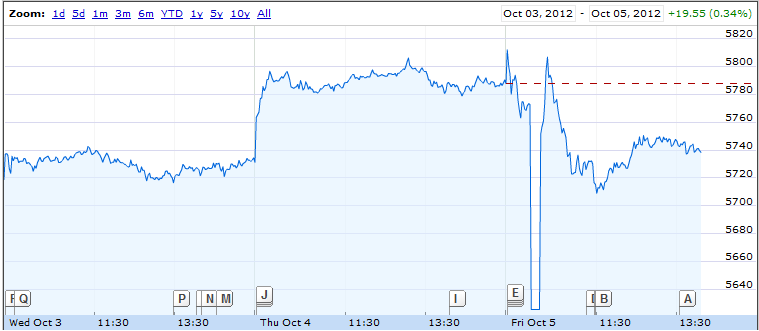
- India’s Flash Crash
- Ritholtz’s Rules of Investing (part I)
- 10 Weekend Reads
| Posted: 06 Oct 2012 02:14 PM PDT After almost six years, 2,200 posts, and eight million page views, I’m moving on from posting regular updates at Financial Armageddon so I can devote my energies to my new members-only website called Panzner Insights, where I’ll be focusing on markets, economics, and geopolitics. Here is a post from the new site. Thanks, Michael ~~~ Housing: Plenty of Reasons to Be Pessimistic(Source) There's plenty of debate about—and money riding on—the question of whether we are in the midst of a sustainable recovery in the housing market. Nobody knows for sure, of course, but there are plenty of reasons to be pessimistic. For one thing, the supply of homes, in terms of what is currently on the market and what is potentially for sale whether or not prices rebound further—the so-called shadow inventory—remains significant relative to demand, even though data from the National Association of Realtors (NAR) shows that inventories of existing homes are back to where they were eight years ago. Aside from the question of whether developments that have occurred since then—including the fact that their are more ways to sell property than by going through a broker—have distorted the inventory calculation, the composition of sales has changed from what it was. Nowadays, a much greater share of transactions are in the "distressed" category than before the bubble burst. Given that more than 20 percent of sales are foreclosures and short sales makes the current ratio look healthier than it is in comparable terms. Needless to say, shadow inventory is far greater than it was during the go-go years, when people were happy to remain long despite a booming market. With prices having fallen sharply since then, we now have a situation akin to those seen in other post-collapse markets: Holders can turn seller on a heartbeat as prices move closer to what they paid or owe on their mortgages. Given that more than 20 percent of mortgagees are underwater, that represents a sizable overhang. The tide of past, present, and future foreclosures—actual and de facto—has also left lenders with substantial holdings of "real estate owned" (REO) properties that will undoubtedly be offered for sale at some point. These are not voluntary investments being held for the long-term; they are unwanted assets that are costing money by the day to finance and maintain. According to HousingWire, nearly half of mortgage giant Fannie Mae's REO holdings are unable to reach the market at present. It's not just about supply, however. Demand is significantly less than it used to be for a variety of reasons, most notably because it is much harder to get financing now than it was when the property market was booming. Despite some recent loosening of credit conditions and ultra-low mortgage rates, anecdotal and other reports make it clear that lenders are generally unwilling to grant loans except on stringent terms to the highest quality borrowers. But even if you discount the fact that traditional home buyers are having a difficult time borrowing the money they need to buy a home, it's apparent that other factors, including societal shifts, are undermining demand—and will likely continue doing so for the foreseeable future. Number one among them are economic conditions in the post-crisis era, which are having an adverse affect on prospective homeowners' willingness and ability to take the plunge. A structurally weak employment market, where temporary and low-paid services jobs comprise the lion's share of the jobs being created and where the odds of finding another, better paying, and more secure opportunity are low, is not the catalyst for people to step up and make what could be the biggest investment of their lives. Demographic factors are also playing a role. The upheavals of the past decade or so have reaffirmed the truism that growing older means trading down and taking less risk. And while ultra-low interest rates have pushed some of those who survive on their savings to invest in something other than a bank CD, real estate is definitely not the investment of choice. At the same time, broader societal changes, including more people living alone and more single-parent households, is undercutting demand for what has traditionally been a nuclear family-oriented investment. Perspectives about what really matters are evolving as well, especially among the younger generation. Whereas in the past the milestones of getting married, buying a car, and acquiring a home represented the natural progression of things when children reached adulthood, priorities have changed. A recent Bloomberg report noted that 4G wireless telephones trumped V-8 cars for the 80 million U.S. consumers born from 1981 to 2001. Meanwhile, the still-ailing post-crisis economy has convinced a growing number of young people to embrace "the age of frugality." In addition to shifting preferences, many of those who are at the lower end of the demographic scale already have a big financial burden hanging around their necks, which precludes them from taking on other big commitments like a mortgage—that is, student loans. Aside from the fact that, for many graduates, these obligations are far higher than they were, proportionally speaking, even a decade ago, the prospect of being in the hole for as far as the eye can leave a lasting impression on impressionable individuals. Policy-making in Washington and by the Federal Reserve further underscore doubts about taking big risks that might backfire. While the latter keeps reassuring everyone that it has matters under control and that interest rates will remain low for years to come, given how many promises they and other authorities have broken over the past several decades, it's not surprising that people are hesitant to count on that on those assertions going forward. Lastly and perhaps most importantly, demand is being undermined by broader-scale mood swings. People are beginning to accept that it isn't necessary to own your own home, nor is it necessarily a long-term goal. That might seem like heresy in a country where property ownership has been viewed as a God-given right, but when you consider that in economic powerhouse Germany the share of residential property accounted for by rentals is more than 60 percent in most states and 90 percent in the capital, Berlin, it's not all that strange. In sum, while it is easy to focus on the traditional indicators of supply and demand and start believing that the long-awaited recovery in the property market has arrived at last, the fact is that much has changed in the wake of the events of the past decade, a development that is likely to weigh on prices for many years to come. |
| (Not so) Golden Rules About Investing (& Not Investing) Posted: 06 Oct 2012 12:00 PM PDT After last week’s Rules frenzy, Cassandra Does Tokyo sent this in. Enjoy: ~~~ Trolling the blogosphere, it seems to be the season for sharing one’s so-called Golden Rules of Investing. So here goes…
|
| WSJ/NBC Pollsters Discuss the Debate Results Posted: 06 Oct 2012 10:44 AM PDT Veteran pollsters Bill McInturff and Fred Yang join D.C. Bureau for a hard analysis of whether Mitt Romney’s debate performance will make a dent in the polls. Photo: Associated Press Romney at Debate ‘Better Than Anyone Since 1984′ |
| Posted: 06 Oct 2012 10:00 AM PDT
Hey look, its not just the US’s capital market that have been hollowed out by HFT — India’s as well. Not quite a 1000 Dow points, but keep working on it — you’ll get there!
|
| Ritholtz’s Rules of Investing (part I) Posted: 06 Oct 2012 07:00 AM PDT Each year on the Big Picture, the blog I call home, I update my top trading rules and aphorisms. It's a collection I have gathered over the years of my favorite trader, analyst, economist and investor viewpoints on what — and what not — to do when it comes to investing in the capital markets. Whenever I publish a list like this, someone invariably asks: "You have been at this for 20 years (and you seem to like numbered lists), what have you learned over that time?" Fair enough. You could probably cobble together my guide from what I've written for The Washington Post. Let me save you the trouble. Here is the first half of my dozen rules for investing. (Come back next time for the rest.)
In conclusion, investors need to fully understand the challenges that face them: Capital markets are about making the best probabilistic decisions using imperfect information about an unknowable future. Sometimes you have an embarrassment of riches to select from; other times you are choosing the "least-worst" option. Either way, you will never have perfect information that allows you to bet on a sure thing. There is no magic elixir. ~~~ Ritholtz is chief executive of FusionIQ, a quantitative research firm. He is the author of "Bailout Nation" and runs a finance blog, the Big Picture. You can follow him on Twitter: @Ritholtz. For previous Ritholtz columns, go to washingtonpost.com/business. |
| Posted: 06 Oct 2012 04:00 AM PDT Some longer form reads to start off your weekend:
What are you doing this weekend?
Poll: Does China Represent More of an Economic Threat or Opportunity |

| You are subscribed to email updates from The Big Picture To stop receiving these emails, you may unsubscribe now. | Email delivery powered by Google |
| Google Inc., 20 West Kinzie, Chicago IL USA 60610 | |



1 comments:
It is a well executed post. I like the diagram most. It is a helpful informative post. Thanks for sharing this great information.
Post a Comment