


The Big Picture |

- Friday Night Flash Mob: Star Wars
- Weekly Eurozone Watch
- Succinct Summation of Week’s Events (11/9/12)
- Trailer: Post-Election Economy
- Post-Election Markets
- Yardeni: Beware 2nd Terms
- Three Peaks and a Domed House Revisited
- Karl Rove’s Math
- 10 Friday AM Reads
- Yet more can kicking on Greece
| Friday Night Flash Mob: Star Wars Posted: 09 Nov 2012 03:08 PM PST On the 1st of October the WDR Radio Orchestra mingled with the crowds on Cologne Wallrafplatz and surprised with well-known tones from a galaxy far, far away…. The WRO cherishes all kinds of good music, counting Operettas and Jazz, Rock and Pop, film and video game music to its repertoire. |
| Posted: 09 Nov 2012 02:30 PM PST Key Data Points
(click here if charts are not observable) |
| Succinct Summation of Week’s Events (11/9/12) Posted: 09 Nov 2012 12:30 PM PST Succinct summation of week’s events: Positives:
Negatives:
|
| Trailer: Post-Election Economy Posted: 09 Nov 2012 12:00 PM PST |
| Posted: 09 Nov 2012 11:32 AM PST Post-Election Markets
There is some post-election clarity. Markets are presently ignoring it. "The Supreme Court of Monetary Policy" is the Federal Reserve of the United States. It has seven governors and twelve presidents. The seven governors and the president of the Federal Reserve Bank of New York vote on Monetary Policy all the time; the other eleven presidents rotate. Four of the eleven presidents vote at any one time. The decision-making authority is the Federal Open Market Committee (FOMC) with twelve voters at any one time. Let’s count the votes. Seven governors and president Obama controlling the appointments. The Democratic majority in the Senate confirms them. In fact, Obama’s support in the Senate has grown. The threat of filibuster, or blockage by Senators, has been reduced. The monetary policy of the US during the Obama administration is the Bernanke policy. Bernanke has clearly established a long-term policy of next-to-zero, short-term interest rates AND exceptionally and persistently low longer-term interest rates. Bernanke has delivered precisely the policy he promised. He has had the majority votes of his board and many of the presidents supporting him. Although Bernanke is willing to tolerate dissenting votes and has had as many as three FOMC members oppose a policy move, the majority and the overwhelming, established position of the Federal Reserve is Bernanke’s policy. Bernanke’s term will end a year after the inauguration of our re-elected president, but the Bernanke policy will continue. The successor appointees to the Federal Reserve Board of Governors will be made by the president who appointed most of the present board and who fully supports the very-low-interest-rate policy. What is clear from the election outcome is that the interest-rate policy of the US is likely to be defined for the entire Obama second term. Markets are ignoring this idea. They do not want to accept a very-low-interest-rate policy for a protracted period of time. Markets are also ignoring the fact that the same policy is in play in nearly all major mature economies of the world. In some of those economies, the interest rates are negative. In others, they are near zero. In nearly all cases, the long-term interest rate is somewhere between one and two percent. In some cases, it is less than one percent. When you price financial assets, hard assets, real estate, precious metals, or any type of assets, you must compare the expected return of the particular investment with the riskless return you can obtain from high-grade sovereign debt. We see high-grade sovereign debt, be it US dollar in US Treasuries, euros in German sovereign debt, yen in Japanese sovereign debt, the British pound in British sovereign debt, or the currencies of Sweden or Switzerland or Singapore. Wherever you look, the interest rates on riskless, highest-grade sovereign debt are very low. Note that in the US the high-grade tax-free money market fund in your account pays 0.01%. The high-grade taxable money market fund also pays 0.01%. We expect this low-rate environment to translate into very aggressively rising stock prices in the next few years. We expect high-grade bond interest rates to remain low and perhaps go lower. The bond buyer index of high-grade GO tax-free bonds hit a new low yield today. We expect real estate to commence and accelerate a recovery. That already is starting to happen in certain places. You can buy a house in the US, and your residential mortgage interest rate is somewhere around three percent. If you use an adjustable rate mortgage for seven years you are financing your house at a two-handle. We are not now, nor have we ever been, perennial bulls or perennial bears. In our lifetime, we have been both bullish and bearish. Right now the situation is setting up to be extraordinarily bullish. With these low interest rates expected to be in place for many years, opportunities are presenting themselves in the high-grade taxable fixed income arena. There is a yield above four percent. It is not going to stay there forever. It is going to go lower. In the high-grade, tax-free arena there is a yield of about three percent. It is not going to stay there forever. It is going to go lower. Both of those yields, taxable and tax-free, in well-selected and researched securities are higher than the treasury yields. The treasury yields are going to go lower. Those who have been ringing their hands about the big inflation, rising interest rates, weakening dollar, fiscal cliff, tax policy, and the election rhetoric have missed markets. They now have an entry opportunity if they did not take advantage of it in the past. We see high-grade, tax-free bonds as a bargain. We are buying those bonds for our clients. We are selecting and reviewing each and every credit very carefully. The same is true in the taxable fixed-income arena and in the stock markets selectively around the world and in the US. For the US, we have taken up our expectations for the S&P 500 Index. We were projecting somewhere around 1,400 to 1,500 at year-end 2012. Our intermediate-term projection was 2,000 on that index at the end of this decade. We think it will be higher. We expect earnings next year from the S&P to be somewhere around $100. They may be low – $97 or $98 – or they may be high – $103 or $105. They will be somewhere around $100, plus or minus a couple of dollars. At the end of this decade we will witness a 20-trillion-dollar US economy. It will generate profits and grow at a gradually accelerating rate when you extend the GDP to the end of the decade. So, grow the economy very slowly (1.5 to 2 percent) and have a low rate of inflation. Take the S&P earnings out of the profits of that economy, and the range at the end of the decade is somewhere between $125 and $140. That makes the US stock market cheap. Cumberland’s job is not to manage policy or politics. Our job is to manage portfolios. Cumberland’s portfolios are fully invested, and we expect they will do well over the next few years. Let me close with one final comment that is personal. The election rhetoric, nastiness, and meanness may continue or be over; in my view, it is likely to continue since that is part of our present-day America. Either way, the election is over. The antics of people like Jack Welch, Donald Trump, and Ann Coulter did not help their candidate. Their offensive and mean comments were not Romney’s comments, but they hurt him. The Governor Romney that I met seems like a decent man with an abiding sense of personal faith. His beliefs include community philanthropy. This leads me to the final thought today. The political system that we have is the one that we must live with. I do not like the system and wish it were otherwise. I do not like the meanness. I despise it. Coulter’s use of the word retard was particularly offensive and disgusting. Readers may note that the Peter Demirali memorial scholarship fund will be assisting individuals with "developmental disabilities. The beneficiaries are people who seek dignity through work. Those details will be announced shortly. ~~~ David R. Kotok, Chairman and Chief Investment Officer, Cumberland Advisors |
| Posted: 09 Nov 2012 11:30 AM PST
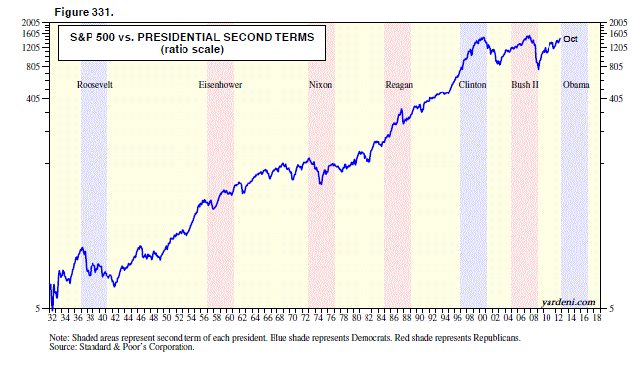
Doc Ed points out that second presidential terms are not especially kind to equities. Presidential first terms of the past 11 elected presidents starting with Franklin D. Roosevelt were up an average of 50%. However, S&P500 only rose 16% during the second terms of the past six presidents who were re-elected. There are problems with this being a small sample set, but it is an interesting anecdotal observation nonetheless.
Hat tip Pensions & Investments
Source: |
| Three Peaks and a Domed House Revisited Posted: 09 Nov 2012 09:30 AM PST click for larger graphic
Doug Kass gives us a new look at George Lindsay’s pattern (above). Doug adds: “I typically dismiss charts like this but so many subscribers have asked me to update the configuration of George Lindsay’s “Three Peaks and a Domed House.”
|
| Posted: 09 Nov 2012 09:16 AM PST Karl Rove disputes Fox News’ Ohio electoral math, Megyn Kelly goes for a stroll, and Bill O’Reilly pronounces the election a victory for people who want stuff. “Or as we call it, Arithmatic” Post Democalypse 2012 – America Takes a Shower – Karl Rove’s Math |
| Posted: 09 Nov 2012 07:30 AM PST My morning reads:
What are you reading?
Corporate Tax Twist
|
| Yet more can kicking on Greece Posted: 09 Nov 2012 07:01 AM PST The RBA reduced its 2013 growth forecast to between +2.25% to 3.25%, from a previous forecast of 2.75% to 3.25%. CPI is expected to come in at 2.0% next year, in line with previous estimates. The A$ declined below US$1.04 – currently US$1.0368. Waited too long to increase my short; Japan is seeking to strengthen military ties with the US, in response to the spat with China over the ownership of certain disputed islands in the South China seas. The Defence Minister, Mr Satoshi Morimoto has called for changes in the guidelines of its military co-operation agreement with the US. The US is not keen to get too closely involved in the dispute over the islands, but it does have a military pact with Japan. Mrs Clinton stated that whilst the US takes no position over the sovereignty of the islands, they do fall under the US-Japan mutual defence treaty. The Chinese actions are resulting in Japan becoming more nationalistic, which is not what China wants. Indeed Chinese actions have alarmed all its neighbours, who are seeking closer cooperation with the US; A string of positive Chinese economic data today, as was hinted at by Chinese officials yesterday: It does not look as if the EZ finance ministers will agree to provide Greece with the additional tranche of bail out funds, amounting to E31.5bn on the 12th November. Mr Schaeuble stated “I do not see how we can take the decision already next week”. However, some E5bn of Greek bills are due for repayment on the 16th November and the ECB is resisting pressure to roll this over. The most likely outcome is that funds will be provided to meet this repayment, as the EZ wants to avoid a technical default. With the IMF proposing a haircut on bail out funds already provided to Greece by EZ countries (strongly resisted by the EZ countries) and, in addition warning that the existing debt burden is unsustainable, the EZ are trying to fudge the issue by alleging that the maximum debt to GDP sustainability percentage is 125% of GDP, rather than the previous maximum of 120%. Indeed, the previous maximum of 120% was set as it was the debt to GDP percentage of Italy, rather than for any other rational reason. This comedy/tragedy continues. The ECB has volunteered to hand over any “profits” it makes on Greek bonds owned by it which will have some impact on overall debt (but not enough), but yesterday Draghi made it quite clear he “was done” with Greece. As a result, its over to the EZ politico’s and we all know what that means – yet more chaos. The bottom line is that Greece will have to restructure its debts ie default, even if interest rates are cut and they are given a 2 year extension to meet their targets. Furthermore, even though Greece passed the E13.5bn of further austerity measures yesterday, it will never meet these targets. The Bundestag must vote on the new measures once agreed, which could well be a problem for Mrs Merkel. Her cunning plan is to kick this particular can down the road, or at least until after the German general election in September 2013 – not going to happen, Mrs M. The EZ is now floating the idea that a resolution of Greece will take until the year end !!!!! Comments by Fitch suggest that they are considering downgrading Spain to below investment grade – its going to happen pretty soon, by Fitch or the other agencies. However, the Spanish PM continues to dither. Spanish bond yields are rising Mr Rajoy; French September industrial output declined by -2.7% M/M, much worse than the -1.0% expected and +1.5% previously. The UK September trade deficit came in at -£2.70bn, better than the -£3.20bn expected and -£4.31bn in August. Should help revise 3rd Q UK GDP marginally higher, as was the case with yesterdays better US trade data; The UK’s BoE is to transfer income from gilts bought under its QE programme, to the UK Treasury. The UK Treasury will use the proceeds to reduce the stock of outstanding debt, increasing the amount of money in the economy. The amount of income involved is expected to be £35bn by March next year. The BoE did not increase its QE programme yesterday, but these measures are nothing but QE. The BoE will retain the principle on maturing bonds, the 1st of the maturities coming in March 2013. Gilt yields declined on the news. However, this is pure money printing; Mrs Merkel and Mr Cameron failed to agree on the EU budget. Italian press suggest that the meeting which is due on the 22/23rd November to discuss the budget will be cancelled. Mr Cameron will face severe criticism from his own party and the opposition if he agrees to anything more than a freeze of the EU’s budget. This one is not going to be easy, to say the least; Outcome Asian markets closed lower following weaker US markets yesterday. European markets opened modestly weaker, though have sold off through the day. Futures suggest that US markets will open lower. I remain negative on equity markets – just too much uncertainty out there. Having said that, I do believe that a deal will be reached on the fiscal cliff in the US, at least with respect to the majority of the potential downside. Cant see any respite for the Euro in particular and remain short against the US$. Too early to short the Yen, in my view, but will be watching carefully in coming weeks. Kiron Sarkar 9th November |



| You are subscribed to email updates from The Big Picture To stop receiving these emails, you may unsubscribe now. | Email delivery powered by Google |
| Google Inc., 20 West Kinzie, Chicago IL USA 60610 | |



0 comments:
Post a Comment