


The Big Picture |

- Why Obama Chose Big Banks Over Debtors
- Debt Limit-Fiscal Cliff-Stock Market
- Using Social Media To Cover For Lack Of Original Thought
- Global Trend Indicators (11/25/12)
- Abe retreating from policy to curtail BoJ’s independence
- Hurricane Sandy Kite Surfing in Aruba
- 10 Sunday Reads
- Japan: The Old Weigh On the Young and the Economy
| Why Obama Chose Big Banks Over Debtors Posted: 25 Nov 2012 10:30 PM PST Top Economists Told Obama that Economic Recovery Required a Reduction In Private Debt, But Obama and His Economic Team Chose the Big Banks InsteadWe've extensively documented that too much private household debt is killing our economy. While Ben Bernanke and other economists who are running our economic policy literally believe that the amount of private debt doesn't matter and isn't even important to quantify, economists at the "central banks' central bank" – the Bank of International Settlements – and many other leading economists say that high levels of private debt create a tremendous drag on the economy. And Obama can't plead ignorance. Business Insider notes today:
The Washington Post reported yesterday:
So why didn't the Obama administration accept the proposals to reduce homeowner debt? The Post notes:
In other words, the government chose the big banks over the little guy, dooming both. The administration – under the false banner of "homeowner relief" – simply threw money at the big banks to "foam the runway" so they wouldn't suffer a crash landing. As some of the leading modern economists argue, forcing big banks, bondholders and other creditors to write down some of their bad debts is the only way out of our economic malaise. We need a debt jubilee. |
| Debt Limit-Fiscal Cliff-Stock Market Posted: 25 Nov 2012 03:30 PM PST Debt Limit-Fiscal Cliff-Stock Market
Debt limit is a term that creeps into the political lexicon every so often; it happens when America's legal borrowing limit reaches its congressionally-set upper bound. Since the US nearly always runs an annual deficit, it has to confront congressionally-approved borrowing limits. Congress persistently acts in the worst interest of the country by using the debt limit as an excuse for brinksmanship confrontational politics. The debt-limit debate is a charade. Everyone who understands it knows that. The US has been a borrower for nearly two centuries. It has never defaulted. But we do use this congressionally-introduced fiction to exacerbate political animosity. We are about to reach our debt limit again and witness another debt-authorization fight. Fiscal cliff is another fiction. We do not need to have expiration dates on legislation, tax policy, or spending mechanisms. Congress designs them to mature immediately following a national election. Again, this is a charade created by the scoundrels that we elect to serve us in Washington. In fact, Democrats and Republicans agree on this one. They coalesce into a common threat to us by purposefully choosing termination dates that follow hard on the heels of elections. They exploit the short memory span of the distracted American electorate. Shame on us for having such short memories. Now, we will witness both the debt-limit and fiscal-cliff debates; both charades are in play. Why aren’t Americans furious about this game that is being played at their expense? American voters don’t want this charade, and they know the uncertainty caused by it is harmful to them. We could chastise Congressional representatives, senators, and the White House and its advisors, each and every time they engage in these shenanigans. We don't. American voters, CEOs, Wall Street investors, and the working public could make that chastisement a consistent, intense, and vitriolic affair. We don't. Our so-called leaders could be told, “I am sick and tired of you manipulating the political process in order to create a crisis that hurts me. If this nonsense does not stop, you will not be able to convince me to be loyal to you because I am a Republican. You will not be able convince me to be loyal to you because I am a Democrat. You will not be able to convince me that you are responsible in the execution of your public office. Instead, you will have become my enemy. Therefore, I will vote you out. My most important political mission will be to get rid of incumbents like you who create a crisis when none is necessary." We could say that. We don't. Winston Churchill said, “It has been said that democracy is the worst form of government except all the others that have been tried.” Churchill also said, “You can always count on Americans to do the right thing – after they’ve tried everything else.” Sir Winston was correct. We hope your Thanksgiving holiday was a good one. It provided America with Black Friday, football games, traditional turkey cuisine and our custom of familial gathering. 150 million of us moved around to visit the rest of us. We have enjoyed our uniquely American tradition. Now we must get back to business. We will soon approach year-end, with its next round of holidays and celebration of a new year. Between now and then, we will watch the Washington charades play out. Will we remain distracted and voiceless as our lame and lame-ducked leaders continue these charades? Sad to say, this writer thinks we will be too silent. Our greatness as a country is that we move on in spite of our government. We thrive, not because of Washington but by overcoming it. We succeed because half of our US economy is privately owned and independently managed. That's right; over half the GDP comes from small business. The majority of jobs are created by those firms. When it comes to publicly owned business, the US stock market realizes the world is not coming to an end. Market agents and investors recognize that the Federal Reserve’s policy is firmly in place, that we will not permanently go over the fiscal cliff, and that we will not default despite the debt limit charade. Markets are beginning to accept that the Fed will keep interest rates extraordinarily low for a number of years. During that time the US GDP will grow from the present level of $16 trillion to about $20 trillion by the end of the decade. The key drivers of that growth will be in services. But we will also see a "kick" coming from housing recovery and energy sector expansion. American growth will slowly morph from tepid to robust. Remember: this will take several years. The recognition of these facts will send the stock market higher, maybe much higher, maybe very much higher. We have continued to be fully invested and are likely to be in that mode during an extended bull market run. We expect the S&P 500 Index to close above 2,000 before the end of this decade. The Index is about 1400 now. We expect the S&P 500 Index earnings to rise from the present level of about $100 to a level of $125-$140 by the decade's end. Any surprise is likely to be on the upside. If we are close to being right with our forecast, US stocks are cheap. Now let's move to a lighter note. After our recent “Tocqueville Affair” we decided to try to confirm the sources of quotes for those who are interested. Our assistant, Samantha Houston, confirmed the first Churchill quote on the following websites: http://www.quotationspage.com/quote/364.html http://www.brainyquote.com/quotes/quotes/w/winstonchu164161.html http://forum.wordreference.com/showthread.php?t=2089993 . She confirmed the second quote on the following websites: http://www.brainyquote.com/quotes/quotes/w/winstonchu135259.html http://www.searchquotes.com/quotation/You_can_always_count_on_Americans_to_do_the_right_thing_-_after_they’ve_tried_everything_else./60836/ . ~~~~ David R. Kotok, Chairman and Chief Investment Officer, Cumberland Advisors |
| Using Social Media To Cover For Lack Of Original Thought Posted: 25 Nov 2012 03:00 PM PST The world’s most successful companies know that social media is a powerful marketing tool, and Cameron Hughes knows how to make social marketing even more effective: by never injecting an ounce of effort into it. |
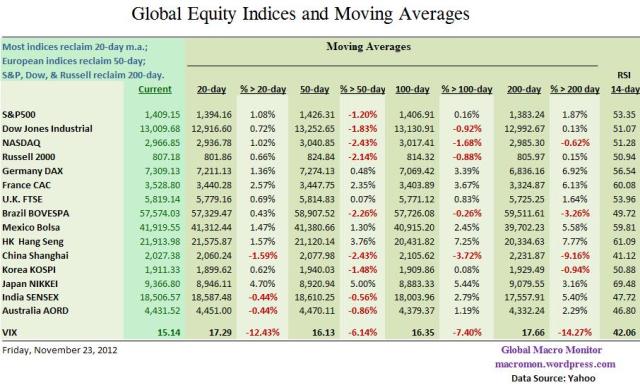
| Global Trend Indicators (11/25/12) Posted: 25 Nov 2012 12:00 PM PST |
| Abe retreating from policy to curtail BoJ’s independence Posted: 25 Nov 2012 05:30 AM PST Mr Abe, the expected next PM of Japan, proposes to introduce measures to increase inflation to 2.0% (down from a range of 2.0% to 3.0% previously suggested), though he is backing off from previous calls to curb the BoJ’s independence. Well, Japan has suffered from deflation for 2 decades and a bout of inflation is the traditional way that governments use to get out of a debt trap, which Japan surely is in. However, Barclays report that interest costs on accumulated government debt amounts to 25% of the Japanese budget at present, with 10 year JGB’s yielding 1.0% at present. If 10 year JGB yields rise to the Mr Abe’s proposed inflation target of 2.0%, the interest cost on accumulated government debt will exceed total expected tax revenue of Yen 42.3tr. I believe, we can call that a definite Oops. Me thinks that Mr Abe better start working on Plan B, and then Plan C and, ultimately, Plan INFINITY. Mr Abe’s has toned down a number of his radical and Yen negative policies, though the Yen may weaken further, given the uncertainty and the current momentum – likely until the general elections on 16th December and shortly thereafter, until the good and the great are forced to rethink. Thereafter, well that depends on the policies enacted by the new Japanese government. However, if Japan continues to post a current account deficit, the Yen should weaken further. A credit downgrade is also a distinct possibility; The Chinese have yet to abolish a state imposed system of control of their population named “Hukou”, which is a record of household registration required by law and which, in effect, restricts freedom of travel. Broadly, the system categories individuals as either “rural” or “urban” workers. A rural worker who moves to a city, which is happening more and more and no longer is blocked, does not have the same rights as an urban registered Chinese citizen. In particular, rural workers do not have access to medical, educational and other important benefits if they move from the country to the cities, something the Chinese authorities are encouraging. The system has been widely discredited, though the Chinese authorities have not, as yet, changed it. There are reports however, that trial schemes may be started in certain smaller cities to study the impact of its cessation. Clearly a flood of people massing into the most popular cities such as Shanghai, Beijing or Guangzhou will stretch resources initially, but in the longer term will be beneficial to the Chinese economy; The New York Times reports today that a regulatory win by Ping An, the major Chinese insurance company, has resulted in Premier Wen’s family, who have a material investment in the company, amassing a fortune. Premier Wen allegedly was one of 2 parties (the other being the BoC) involved in relaxing the rules in favour of Ping An which, as a result, has gained materially. This story follows up from a report that members of Premier Wen’s family have amassed a fortune whilst he has been Premier. The Chinese blocked the web site of the New York times and other media (Bloomberg), once the initial story broke – cant see that changing following this report. However, the report has been widely disseminated in the country. Chinese authorities have raised concerns about massive corruption in the country, though anecdotal reports suggest that corruption is so entrenched that it will be impossible to curtail; The Indian government is the latest to object to the Chinese including disputed territories in “maps” of China contained in their passports. Japan, Vietnam, the Philippines and Taiwan have also objected. India has a territorial dispute with China over the state of Arunachal Pradesh and its northern Aksai Chin region. In 1962, India and China fought a war over this issue. This extremely silly policy will just force numerous Asian countries to strengthen cooperation with the US and increase defence spending, which clearly is totally against Chinese interests. It also stokes nationalist sentiment in China and other Asian countries increasing tensions, which may well prove difficult to control. Indeed, it could destabilise the current regime in China. Think again boys – I’m not being sexist, there are no women on the 7 member standing committee of the Chinese Politburo, the key decision taking committee in China, by the way; Counter intuitively, Israeli press suggests that the real victors of the Gaza military campaign was Hamas and the Egyptian President Mr Morsi. The journalists argue that Hamas has been elevated to a future negotiating partner, possibly ahead of the Palestinian Authority. In addition, Mr Morsi’s status has been elevated to an important player in the Middle East, as he helped to put the ceasefire in place. Personally, Mr Morsi’s problems in his own country (he has issued a decree which has made all his decisions immune to legal challenge, until a new assembly is elected, which has caused much political strife in the country) suggest that he may well have other issues to contend with. However, Hamas has been able to insert a clause in the ceasefire agreement which, at least partially, lifts the blockade on Gaza, imposed by Israel in 2006 and, in addition, is claiming “victory”. The really important issue is that the Israeli PM, Mr Netanyahu faces a general election on 22nd January and the results will reveal all; Certain investors (Hedge Funds?) have been piling into Greek bonds – there are some E60bn of Greek bonds outstanding, held by private investors. The 10 year bond is trading around 35cents on the Euro, having doubled in price recently on speculation that the EZ will allocate some E10bn to buy back Greek bonds at a discount to par - a price of between 30cents to 35 cents on the Euro has been rumoured. Whilst a debt buy back at a discount will reduce the overall level of outstanding debt of Greece, it will not make a significant dent in the overall level of Greek debt. Furthermore, with the price of Greek bonds having doubled, the EZ may well reconsider – one alternative is that they could reduce the size of a buy back programme. A deal on Greece is likely, as is a debt buy back at present, though at these levels, Greek bonds look like a particularly risky investment in my humble view, given their underlying value is close to ZERO. We should know whether investors who have participated in this cunning plan? will be rewarded, or not, this Monday?. Hot off the press, Greek newspapers suggest that a final decision might not be reached tomorrow and that a final decision will have to wait until 3rd December – well it is the EZ, boys and girls !!!!; There has been an enormous amount of “chatter” over today’s vote in the Spanish region of Catalonia. Whilst the Catalan “independence” parties are likely to win, can they actually achieve independence. Personally, I don’t see it as feasible. The EU will not want to encourage succession, given other regions in the EZ are talking about it too, which they will if they recognise an independent Catalonia – no one in the EU/EZ wants additional problems at the moment, given the current crisis in the EZ. In any event, the Spanish central authorities have to agree to allow Catalonia to have a referendum on independence, which they wont. Furthermore, the Economist reports that over 35% of Catalonia’s trade (I’ve seen much higher numbers) is with Spain !!!!! However, a more independently minded Catalonia will pose financial headaches for Madrid, as Mr Rajoy may well have to offer certain financial concessions to the region – yet another unaffordable problem for Mr Rajoy; The talks to discuss the E1tr EU budget for the period 2014/20 collapsed as expected, though the difference being discussed is thought to amount to only E30bn. The expected bogeyman, the UK PM, was not isolated as was thought would be the case. Mr Cameron’s position was supported by other EU paymasters, namely the Germans, Dutch and Swedes, with countries that wanted increased spending, namely France, Spain and Italy on the other side of the debate. Recently German press has highlighted the excessive spending by the EU, on guess who – themselves – and its in Mrs Merkel’s political interest to force the EU to cut back on its number of personnel, together with their excessive remuneration and benefits – a key demand by the UK PM, Mr Cameron. Observes report that there was a definite coolness between Mrs Merkel and the French President Mr Hollande – no great surprise and expect relations to deteriorate further, in particular as the French economy continues to decline. An unnamed EU official stated “They (Merkel/Hollande) pay lip-service, they do shadow dancing, but they don’t cross the bridge”; The German Council of Economic Advisers have criticised additional domestic spending measures announced by Mrs Merkel last week. The Council is important as it serves as the unofficial advisor to the German Federal government. In aggregate, Mrs Merkel announced additional spending measures amounting to some E4.75bn, by supporting stay-at-home mothers, relieving Germans from paying a quarterly fee for visits to the doctor and some spending on transport infrastructure. After all, Mrs Merkel is facing a general election next September and her coalition is clearly supportive of the measures. The Council warns that the current strength of revenues is likely to weaken in coming months and that spending will rise as the cost of unemployment benefits will rise, as employment declines from current record levels. Essentially, the Council believes that the Germany’s economy will weaken – they predict GDP of +0.8% for this year and next, the same as the German governments forecast for this year, but lower than the 1.0% forecast for next. Under the German “debt brake” law, Germany must achieve a balanced budget by 2016, though are trying to reach the break even target by 2014 – a plan which may be prove difficult to achieve. However, most of us would believe that the idea of trying to achieve a balanced budget earlier than necessary, whilst the world is in the worst economic and financial crisis for well over a 100 years would be absurd, but the German’s, to give them the credit, practice what they preach. Having said that, with elections coming up, Mrs Merkel (who is not the archetypal German politician) will play the politician and open up the purse, somewhat; There have been a number of purchases of distressed assets in Ireland by private equity groups, with more deals likely in coming months. Some US$400mn of transactions were concluded last week and a number of private equity groups are focusing on some US$50bn of non-core assets which banks are likely to dispose of. The number of private equity transactions in the EZ have been limited, to say the least, as banks do not want to recognise losses, given their weak capital ratios. Regulators have in effect, allowed banks to carry these “assets” at vastly inflated values. However, a number of UK banks (Lloyds, in particular) are planning to exit Ireland and are selling their portfolios. The Irish, Allied Irish bank is also disposing certain distressed assets. Private equity groups are also benefiting from the availability of leverage in respect of Irish assets as banks recognise the improving economic position of the country. (Source FT); Initial indications suggest that US consumer spending, starting on Black Friday, will exceed expectations reports the Consumer Federation of America. The National Retail Federation reports that holiday sales will rise by +4.1%, though lower than the +5.6% increase in 2011. Anecdotal evidence supports the more optimistic view; Outlook US markets closed at their highs with the Dow back over 13K, though volumes were anemic. Indeed, US markets had their best weekly rally since June. The Euro rose on expectations of a deal in respect of Greece (on Monday) and looks as if it has further to go, especially if a deal on Greece is reached. Both Gold and Oil rose (to US$1752 and US$111.40 respectively) on a weaker US$ and “better” economic news from China and the EZ. Whilst I had expected markets to rebound from their oversold levels and had bought financials and energy stocks in anticipation (not enough unfortunately), the speed of its rise, together with its level of appreciation has been far greater than I had expected, I must admit, though on very low volumes – unconvincing. Yes, traditionally, this is a good time for markets, but are markets expecting too much?. A deal on Greece is expected this Monday, which if it happens will be Euro and market positive. However, following today’s teleconference between EZ finance ministers, there are reports that a final decision will be taken on 3rd December, at the regular EZ finance ministers meeting. There are some indications that talks between Republicans and Democrats over the US fiscal cliff are not going to be as smooth a ride as currently believed by the markets. There is a serious possibility that, for presentational purposes, a “fix” will occur though only after the deadline of 31st December. That uncertainty could well undermine markets towards the year end. I don’t yet feel its time to reduce positions, but am cautious and will not increase my equity exposure at this stage. Kiron Sarkar 25th November 2012 |
| Hurricane Sandy Kite Surfing in Aruba Posted: 25 Nov 2012 05:00 AM PST While we were getting slammed with Hurricane Sandy in the NorthEast, a group of adrenalin junkies decided to head to Playa Linda and ride her dark walls. Strong side-offshore winds provided epic conditions.
Hurricane Sandy Session from Oli Berlic on Vimeo. Track: Collect Call – Adventure Club Remix |
| Posted: 25 Nov 2012 04:30 AM PST Some Sunday morning brunch reading:
Whatcha eatin’ for Sunday Brunch?
> |
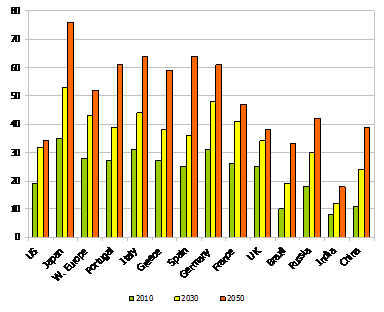
| Japan: The Old Weigh On the Young and the Economy Posted: 24 Nov 2012 10:30 PM PST Japan's Population Now So Old That Sales Of Adult Diapers Exceed Those For BabiesAs we noted in 2009, Japan has an incredibly old population … which will put an increasingly heavy burden on the economy:
Business Week gives an update:
Given its quickly-aging population, Japan will have a hard time competing with younger countries like China, Brazil or India. Here's China:
Brazil has a much younger age demographic. And India's is even younger than Brazil's. |


| You are subscribed to email updates from The Big Picture To stop receiving these emails, you may unsubscribe now. | Email delivery powered by Google |
| Google Inc., 20 West Kinzie, Chicago IL USA 60610 | |



0 comments:
Post a Comment