


The Big Picture |

- U.S. Economic Confidence Index
- Ritholtz: Sell-Off Is Wall Street’s `Hissy Fit’
- 10 PM Wednesday Reads
- Post Election, Pre-2013 Special Dividends?
- California Ballot Proposition Round-up
- 10 AM Wednesday Reads
- The View from the UK: President Obama reelected
- My market diary
- Lessons from 2012 Presidential Election
- MoneyBombs & Politics
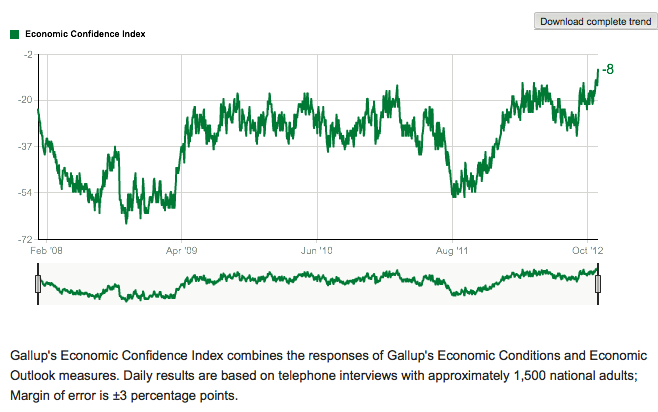
| U.S. Economic Confidence Index Posted: 07 Nov 2012 06:15 PM PST I suspect this chart’s improvement helped the incumbent quite a bit. some of the more observant of you may notice the spurts from August 2011 (QE2) as well as September 2012 (QE3) . . .
U.S. Economic Confidence Index |
| Ritholtz: Sell-Off Is Wall Street’s `Hissy Fit’ Posted: 07 Nov 2012 02:51 PM PST On today’s “Street Fighter,” Fusion IQ’s Barry Ritholtz and Barclays’ Michael Gapen talk about the market sell-off. They speak on Bloomberg Television’s “Street Smart.”
|
| Posted: 07 Nov 2012 01:30 PM PST My afternoon train reads:
What are you reading?
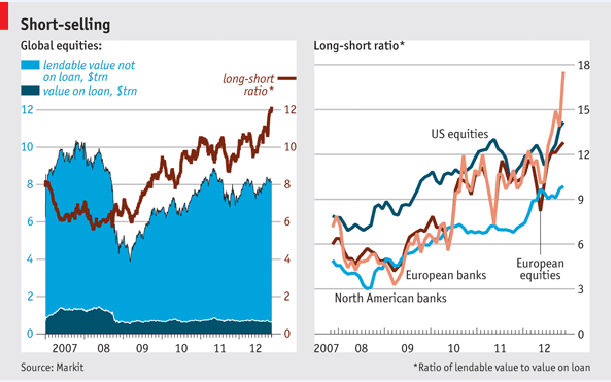
The long and short of it |
| Post Election, Pre-2013 Special Dividends? Posted: 07 Nov 2012 11:04 AM PST Interesting discussion in the office today with some of our analytical team: Will any of the cash rich companies who have been sitting on the fence about issuing dividends reconsider their positions? What about a one time special cash dividend before the tax rates go up next year? Think of companies like Apple (AAPL), Berkshire (BRK’a), Google (GOOG), Exxon Mobil (XOM) and Microsoft (MSFT). I am sure others have thought about this previously; its nothing new, but it is intriguing. What might the impact of this distribution be on the economy? Do keep in mind that many dividend paying companies are held in tax deferred accounts. |
| California Ballot Proposition Round-up Posted: 07 Nov 2012 09:15 AM PST From Jess Bachman and Visual.ly, comes this California round up of ballot initiatives. click for ginormous graphic
|
| Posted: 07 Nov 2012 07:30 AM PST My morning reads:
What are you reading?
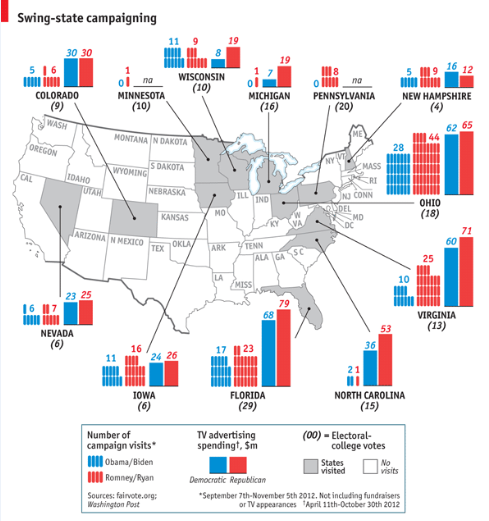
Romney Outspent Obama in Florida Virginia Ohio Iowa |
| The View from the UK: President Obama reelected Posted: 07 Nov 2012 07:07 AM PST The governor of the BoJ, Mr Shirakawa emphasises the need to end deflation. Well great, but do something about it. However, he resigns in April next year and the policy is likely to have to wait for the new governor. Interestingly, the head of the opposition LDP party, Mr Abe reiterated his call for the BoJ to ease until inflation hit 3.0% – the current BOJ policy is for inflation to rise to 1.0%. In addition, Mr Abe stated that if he came into power he would consider revising legislation which guaranteed the BOJ’s independence and allow the government to dictate central bank policy !!!!. More importantly, Mr Abe has signalled that the LDP would not link the passage of the budget legislation from the timing of the next general elections; Will inflation rise in China in coming months. Bloomberg reports that the 3 month Shibor rate has risen by around 25 bps in the past month, suggesting that further easing policies may not be possible. Chinese monetary policy remains effectively “linked” to US monetary policy (which will continue to ease) as the Yuan is still “managed”, with reference to the US$. A rise in inflation (due to higher food and energy prices) will be a significant problem for the new Chinese leadership; The Greek Parliament is to debate the austerity measures today. Further aid is dependent on Greece passing the austerity measures, which is expected, though only by a very slim majority; The EU has forecast that the Italian economy will decline by -2.3% this year and by -0.5% next, lower than forecasts by the Italians; Spanish September non seasonally adjusted industrial output declined by a massive -11.7% M/M, as opposed to -2.5% in August. Y/Y, output declined by -7.0%, much lower than -3.0% expected and a revised -2.5% in August. The decline was the 13th consecutive monthly decline and the lowest since April 2012. However, the Spanish PM continues to dither; Even German economic forecasts have been reduced. Germany’s “wise men”, a 5 man team of economic advisers, report that German GDP will grow by just +0.8% this year (in line with the EU’s forecast released today and as compared with their previous forecast of +1.7%) and next, with a low point (negative growth?) this Q. A weaker Germany may result in the country introducing more pro-growth policies, especially as Mrs Merkel faces a general election next September; German September industrial production (seasonally adjusted) came in at -1.8% M/M, much worse than the -0.7% expected and -0.5% in August, which is yet another confirmation the recent weaker economic data, other than domestic consumption, which to date is holding up, though for how long; The EU has forecast that the French economy will grow by +0.4% next year (half that forecast by the French) – personally, I expect the French economy to decline next year, especially if current policies are maintained. They added that whilst France should achieve its budget deficit target of -4.5% of GDP this year, it will be higher than the -3.0% next year (-3.5% expected). Personally, I believe that France will find it near impossible to meet even the -3.5% budget deficit forecast next year, based on current EZ policies. I continue to believe that France is the real big problem in the EZ, far more so than Italy (similar to Spain) – so long as the Italians deal with their political issues; The EU forecasts that 2012 GDP will contract by -0.25% this year, with the EZ to decline by -0.4%. The EZ’s 2013 forecast has been slashed to just +0.1%, from +1.0% previously - still too optimistic, based on current policies. Inflation is expected to decline to +1.8% in 2013, in line with previous forecasts, with 2012 inflation at +2.5%, rather than +2.4% previously. They have raised the Spanish budget deficit to -8.0%, much higher than the -6.3% target. Basically, a much weaker EZ economy in 2013 – why is anyone surprised. Indeed, unless policies change, a much worse outcome is likely; The European Court of Auditors reported, once again, the the EU made material errors in spending, amounting to 3.9% of its budget. The report will add to the pressure to limit the EU’s budget and will be good news for the Euro sceptics. The UK, in particular, wants a freeze (at worst) in the EU’s budget and the UK PM has little flexibility, given the recent Parliamentary vote (non binding) that he must obtain a cut in the EU budget, let alone a freeze. There is an increasing possibility that the UK will have a referendum as to its continued participation in the EU; The UK PM meets Mrs Merkel today to try and agree on the EU budget ahead of the 22/23rd November meeting. The EU has proposed a rise of 6.0% in its 2014 to 2020 budget (they have suggested that EU countries cut back on their budgets, by the way), though Mr Cameron wants a freeze, at worst. The Germans have proposed that the EU budget is limited to 1.0% of the EU’s GDP; President Obama has won (including the popular vote – by some 2mn, at present), with the Senate under Democratic control (up 2 seats) and the House controlled by the Republicans (down 5 seats). The vote in Florida is yet to be announced. The bookies were correct. The immediate issue is for the President to deal with the “fiscal cliff” and he has to concentrate on the US economy this time around. I believe that some compromise is likely, which will mitigate its effects. Fitch has warned that the US could lose its AAA rating, if the fiscal issues are not resolved; Interestingly, California passed proposition 30, which involves an increase of taxes, both sales taxes and income tax on those who earn above US$250k, by between 1% to 3.0%, to raise US$6bn. The budgets of state schools will be maintained. Recently, a number of senior US businessmen have suggested that the budget deficit needs to be fixed through a combination of spending cuts and tax increases. Cant see any other way; Outlook Asian markets closed flat to higher, with European markets having opened higher are now much lower, given the string of bad European economic data. US futures suggest a much lower open as well, following the much weaker European economic data. The Euro having climbed to well above US$1.2850, is trading well below US$1.28 at present (US$1.2752), given the much gloomier economic data. However a positive vote by the Greek Parliament on the austerity measures tonight (likely) should result in a rebound of the Euro – I will watch carefully – after all they are the Greeks !!!!. Gold is up at US$1723, though Brent is off its highs at US$110.33. The German’s plan of continuing to push austerity is unsustainable. As you know, I expect more pro growth policies, quite possibly as early as Q1 next year. The impact of fiscal multipliers is worsening the fiscal position of countries including Greece, Spain and Portugal and arguably France. This nonsense has to end. The clear downturn in Germany may well be the trigger for a change in policy. We await the outcome of the Greek Parliament’s vote on the proposed austerity measures – the current view is that it will squeak through, though remember it is Greece. Tomorrows ECB meeting is unlikely to reveal much. Kiron Sarkar 7th November 2012 |
| Posted: 07 Nov 2012 04:57 AM PST Review of my personal market diary over the past few months: 1)The Fed, ECB, BoE, BoJ and SNB will continue to print huge amounts of money, CHECK. 2)Earnings growth globally is slowing with GDP and we’ve seen the peak in profit margins, CHECK. 3)Election is over, DC doesn’t change, taxes are going up at exactly the wrong time, CHECK. An entry today: 1)stop saying “Uncertainty” as the only thing that is certain is uncertainty. 2)stop saying “fiscal cliff” as until market based solutions come to medicare, medicaid and social security, the can will get kicked all over the place and well passed any supposed ‘deal’ in the next two months. 3)Oh yeah, stop saying “kicking the can down the road.” Bottom line, the stock market correction is not over, earnings will continue to slow, higher taxes of any kind in 2013 will bring a US recession, central banks will print more money (but can’t prevent a cyclical bear market after the near 3 yr bull run) and 2013 will be the most challenging both economically and from a market perspective that we’ve seen in a few yrs. Stagflation here we come is my call. Buy the flation and sell the stag. |
| Lessons from 2012 Presidential Election Posted: 07 Nov 2012 04:19 AM PST I am always on the look out for lessons that I can apply to investing and business. This post-election morning is not any different. Let’s take a look at some of the more interesting aspects of the election season, and try to discern what lessons there are, for investors and others to learn:
I may try to expand this later . . . |
| Posted: 07 Nov 2012 02:57 AM PST This video of the Boston metropolitan area reveals the geographic distribution of political donations made by individuals throughout 2012. On the Boston map, Individual donors flicker as a point that corresponds to the address they reported to the FEC. The size of the point corresponds to the amount of money given to a candidate. The first type occurs when many small donations are given on the same day to a candidate. We call this a grassroots moneybomb. The second are bursts of extremely large donations, that take advantage of campaign finance laws and allow individuals to donate more than the traditional $5,000 limit. We call this the Joint Committee moneybomb. A grassroots moneybomb appears on January 19th, when Elizabeth Warren engages the wider Boston community. She received money from over 200 people, collecting $90,000. We see contributors throughout Newton, Jamaica Plain, and Belmont, as well as Cambridge and the Back Bay. This puts her at the top of our rankings for the day. On August 31st, we see a grassroots moneybomb supporting Obama from Harvard employees. We see a different type of moneybomb on June 1st, when two employees of Bain Capital donate over $145,000 to Mitt Romney, the founder of that company. Individuals donating to these Joint Fundraising Committees are able to direct the first few thousand dollars to officially go to the candidates but the remaining money is rerouted to the national party and then various state committees, typically in battleground states. The loophole that circumvents the traditional limit is used by both parties. However, in Boston, the Republicans receive more money in the form of these donations over $5,000. This suggests that the new rules of the game may be benefitting Republicans more than Democrats. |


| You are subscribed to email updates from The Big Picture To stop receiving these emails, you may unsubscribe now. | Email delivery powered by Google |
| Google Inc., 20 West Kinzie, Chicago IL USA 60610 | |



0 comments:
Post a Comment