


The Big Picture |

- What Perplexes Me About Gun Deaths in the USA . . .
- How Helpful Are Concealed Weapons?
- 10 Wednesday PM Reads
- Google Ventures for 2012
- S&P 500 in 2012
- 10 Wednesday AM Reads
- 2012 Holiday Retail Sales Disappoint
- Kill the “fiscal cliff” instead of the Economy
- Here’s the Thing: SNL’s Paula Pell
- Ted Koppel: “Fox News is Bad for America”
- Bank Debt in Europe: “Are Funding Models Broken?”
- No Good Deals–No Bad Models
| What Perplexes Me About Gun Deaths in the USA . . . Posted: 26 Dec 2012 04:15 PM PST The latest gun news has started a dialogue on the subject, and hopefully it will have a healthy resolution. I have been having discussions with numerous friends, including a large number of (lawful) gun owners. My view is that having a firearm in your home is both a right and a privilege. Personally, I would treat all guns like cars and all owners like drivers — we should register every gun like an automobile, and license and insure each owner like we do drivers. There are other issues worth discussing — what to do about all of the illegal guns in the US, how to deal with automatic weapons with high bullet count clips. There is also an issue with how poorly we seem to be coping with mental health problems in America. That seems to be is a rational place to begin the conversation. But a few things perplex me about this: Why are gun-related death rates in the US so much higher than in similar countries — i.e., economically successful democracies? When we look at fire-arm related deaths per capita, the US is far ahead of other, similar nations. The United States has 10.2 gun deaths per 100,000 people. That is about 8X the death rate of comparable countries (list after the jump) — and please do not compare the USA to El Salvador, Swaziland or Mexico. We rank 9th overall, and are the 1st modern or weatern nation on the list. I know the USA is culturally different, and a much younger nation versus most of Europe or Japan. Still, the difference is perplexing . . .
Economically successful nations, gun related per capita deaths per 100,000 population
Japan 0.07
|
| How Helpful Are Concealed Weapons? Posted: 26 Dec 2012 02:00 PM PST The controlled study documented in these videos show that concealed carry permit holders are fooling themselves if they think they will be able to react effectively to armed aggressors. Most CCW holders won’t even be able to un-holster their gun. They will more likely be killed themselves or kill innocent bystanders than stop the aggressor. For more details, see “Unintended Consequences: Pro-Handgun Experts Prove That Handguns Are a Dangerous Choice for Self-Defense.” http://www.vpc.org/studies/unincont.htm. Part One ~~~ Part Two |
| Posted: 26 Dec 2012 01:30 PM PST My afternoon reading:
What are you reading?
Venture Capital to Suppress Its Appetite for Risk in 2013 |
| Posted: 26 Dec 2012 11:30 AM PST |
| Posted: 26 Dec 2012 09:00 AM PST click for ginormous graphic
Interesting graphic from the WSJ showing sector and key stock performance:
Full article is linked below . . .
Source: |
| Posted: 26 Dec 2012 07:00 AM PST My morning reads:
What are you reading?
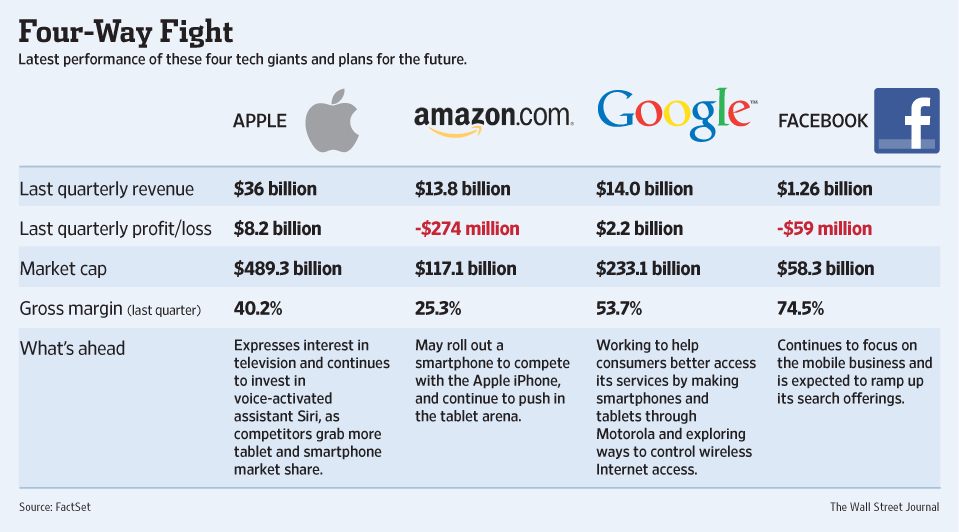
Apple vs. Google vs. Facebook vs. Amazon |
| 2012 Holiday Retail Sales Disappoint Posted: 26 Dec 2012 05:48 AM PST We are still weeks away until we get all of the hard data about the holiday retail sales season, but the early numbers are trickling in. It appears that it was not a very merry Shopmas. We certainly did not see the 13% the National Retail Federation claimed was occurring this season. Some of the early data:
The WSJ reports that there were lots of discounting going on as well; this is a double whammy, suggesting soft sales and pressure on margins. Its still early, and the data could in theory improve. We should hear from retailers starting next week. We get ICSC-Goldman Store Sales at 7:45AM on January 8th, and the Retail Sales report will be released January 15th at 8:30AM. I’ll keep watching the retail sale data as it trickles out — but its safe to say that the ridiculous NRF claim of a spending increase of 13% was utter, unmitigated nonsense. (Do they exist solely to embarrass journalists?). More to come in the New Year. . .
Previously: Black Friday's Media Hall of Shame (November 28th, 2012) November Sales Disappoint; What Happened to Black Friday's 13%? (November 30th, 2012)
Sources: Economy Weighs on Shoppers in Final Holiday Dash to Mall |
| Kill the “fiscal cliff” instead of the Economy Posted: 26 Dec 2012 05:30 AM PST Kill the "fiscal cliff" instead of the Economy
Everyone now agrees that the so-called "fiscal cliff" is a stupid policy that threatens our economy and our people. Everyone agrees why the "fiscal cliff" is stupid – it inflicts austerity at a time when it is likely to throw the nation into a gratuitous recession. Causing a recession leads to increased unemployment and a larger budget deficit. We have all seen austerity force the Eurozone into a gratuitous recession in which Italy, Spain, and Greece have Great Depression levels of unemployment. Here's the short version of why austerity is a self-destructive response to the Great Recession. A recession occurs when demand to purchase goods and services falls and the economy contracts, causing increased unemployment. This simultaneously causes tax revenues to fall and government expenditures for programs like unemployment compensation to increase. The fall in revenues and increase in expenses causes the federal budget deficit to grow rapidly. Austerity is a policy of raising taxes and/or cutting governmental spending for the purported purpose of cutting the deficit. If one raises overall taxes in response to the Great Recession the result is a reduction in private sector demand. If one cuts governmental spending the result is a reduction in public sector demand. The result of reducing private and public sector demand in the recovery phase from the Great Recession, where overall demand is already grossly inadequate, is to throw the nation back into recession or even a depression. That causes the budget deficit to grow. A policy of austerity undertaken under the claim that it will reduce the deficit causes a gratuitous recession that leads to a massive loss of wealth, far higher unemployment, and in increased deficit. That is why austerity is a policy that is the self-destructive economic analogy to the medical insanity of bleeding patients. We have known that austerity is an idiotic response to a severe crisis for 75 years. The U.S. was in the midst of a strong recovery from the Great Depression until FDR's neo-liberal economists convinced him in 1937 that is was essential that the U.S. adopt an austerity program to reduce the federal deficit. Austerity forced our economy back into a Great Depression. It was only the stimulus of federal spending in World War II that brought the U.S. out of the depression. During World War II and for the remainder of that decade the ratio of debt-to-GDP was at or near historically record levels. The result was the greatest industrial expansion in history, full employment (including a massive influx of women), strong economic growth, and sharply declining deficits and debt-to-GDP ratio because the growth led to large increases in revenue and the low unemployment greatly reduced spending on the unemployed. We also defeated the Axis powers, created Social Security and the GI Bill, and began an extraordinary expansion of our housing stock to house the baby boom. We learned many lessons from the catastrophic failure of austerity and the extraordinary success of stimulus in this era. The U.S. adopted a fiscal system of "automatic stabilizers." These are counter-cyclical (they push in the opposite direction of the business cycle) fiscal effects that are designed into the system and do not require new legislation once the recession or inflation begins. The result of these automatic stabilizers has been to reduce the severity and duration of recessions. Indeed, studies show that the larger the national governmental role in the economy, the less volatile the economy. This makes sense because the stabilization function should be more effective if the stabilizers are larger relative to the economy. Unfortunately, these sensible counter-cyclical policies that make theoretical and common sense and have repeatedly worked in the real world were forgotten by many due to a campaign of deficit hysteria funded by Pete Peterson, a Republican billionaire financier who has made it his mission in life to destroy the safety net. His ultimate goal is to privatize social security so that Wall Street can receive hundreds of billions of dollars in fees investing our retirement funds. I've explained in a prior column how the fiscal cliff was created through an insane bipartisan deal in August 2011. The fiscal cliff was always a terrible job-destroying idea that also began to unravel the safety net by cutting Medicare. Everyone involved in creating the fiscal cliff acted irresponsibly and inhumanely in seeking to inflict austerity, cause a recession, and unravel the safety net. What is forgotten, however, in discussions of the idiocy of creating the fiscal cliff is that it was part of a broader bipartisan deal intended to inflict even more self-destructive austerity and even greater damage to the safety net. The fiscal cliff was an act of idiocy in pursuit of a policy of depravity called "the Grand Bargain" that was actually the Grand Betrayal. The bipartisan madness has increased since the August 2011 budget deal. Today, the parties are simultaneously screaming (1) that the fiscal cliff is a disaster because it imposes austerity and will cause a recession and (2) that it is essential that we agree to a Grand Betrayal that will inflict even greater austerity and cause an even more severe recession. Indeed, the Grand Betrayal mandates austerity over a decade so it is likely to cause and/or deepen multiple recessions. The Republican and Democratic variants of the Grand Betrayal are doubly destructive and inhumane because they cut the safety net. President Obama wants to begin to unravel the safety net and cut social programs even though an overwhelming majority of Democrats oppose it and even though doing so will inflict even greater austerity. That will cause a deeper recession and likely make the deficit larger, so it is as nonsensical as it is cruel. During this this entire financial farce I have been unable to get the dominant media to make the most obvious point. Since we all agree that austerity (the fiscal cliff) is a terrible idea that will cause a recession and likely increase the deficit we must logically conclude that all variants of the Grand Betrayal are austerity programs that must be defeated in order to prevent a recession that is likely to increase the deficit. We should all be opposing any cuts in the safety net because they would inflict austerity. An overwhelming majority of Democrats and a majority of Republicans also oppose cuts in the safety net as inhumane. So why don't the Democrats and Republicans stop trying to do a deal that will inflict austerity? Why not simply repeal the Budget Act of August 2011? That would kill the fiscal cliff. Repeal would kill austerity, prevent the recession, save the safety net, increase growth, and shrink the deficit. All versions of the Grand Betrayal (Republican and Democratic) inflict austerity, are likely to cause a recession, begin to unravel the safety net, destroy growth, and increase the deficit. Under the same logic we should be able to agree on two related actions – renew the extension of long-term unemployment compensation and renew the moratorium on collecting the payroll tax. These policies are superb counter-cyclical programs and have the added advantage of reducing human misery and inequality. Republicans and Democrats have agreed in the past on the desirability of both actions.
~~~
Bill Black is the author of The Best Way to Rob a Bank is to Own One and an associate professor of economics and law at the University of Missouri-Kansas City. He spent years working on regulatory policy and fraud prevention as Executive Director of the Institute for Fraud Prevention, Litigation Director of the Federal Home Loan Bank Board and Deputy Director of the National Commission on Financial Institution Reform, Recovery and Enforcement, among other positions. Bill writes a column for Benzinga every Monday. His other academic articles, congressional testimony, and musings about the financial crisis can be found at his Social Science Research Network author page and at the blog New Economic Perspectives. Follow him on Twitter: @williamkblack |
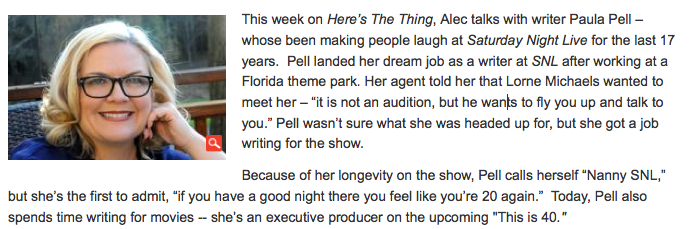
| Here’s the Thing: SNL’s Paula Pell Posted: 26 Dec 2012 05:00 AM PST
|
| Ted Koppel: “Fox News is Bad for America” Posted: 26 Dec 2012 04:00 AM PST The big thing you have to admire about Ted Koppel is that he won’t be bullied into saying anything that isn’t the truth, be it about the news or about a supposed-news organization like Fox ‘News’. While appearing on Bill O’ Reilly’s show, he basically lambastes the network for not being a true news network and brands them a ‘business’ — nothing more, nothing less. Koppel notes that ideological news is bad for America – from wherever the ideology stems. He notes that there is no question when watching FoxNews where the ideological bent comes from. Further, he chastises O’ Reilly for pretending to be a real news anchor, especially when he goes so far as to remind O’ Reilly “Once upon a time, you and I thought journalism was a calling…” instead of just a business. Then, when O’Reilly says the difference between FoxNews and MSNBC is that Fox does HARD NEWS, you can almost sense Koppel is going to break out in a loud laugh. He is kinder and more thoughtful in his response than that, but you know he must be thinking it. Feeling it. From his gut. Koppel doesn’t have any problem with a business being a business, whether for entertainment or politics, but he refuses to fall in with the FoxNews opinion that they are either REAL news or anything remotely close to it. In his final commentary on the network, responding to Bill O’Reilly’s suggestion that he thinks he is doing something noble, he gives Bill a kiss-off right to his face. |
| Bank Debt in Europe: “Are Funding Models Broken?” Posted: 26 Dec 2012 03:00 AM PST |
| Posted: 26 Dec 2012 03:00 AM PST |


| You are subscribed to email updates from The Big Picture To stop receiving these emails, you may unsubscribe now. | Email delivery powered by Google |
| Google Inc., 20 West Kinzie, Chicago IL USA 60610 | |



0 comments:
Post a Comment