.

{2} GoogleTranslate (H)

English French German Spanish Italian Dutch Russian Portuguese Japanese Korean Arabic Chinese Simplified

Our New Stuff

{3} up AdBrite + eToro

Your Ad Here

Monday, October 28, 2013

The Big Picture

The Big Picture


Stephen Hawking’s Big Ideas Made Simple

Posted: 28 Oct 2013 03:00 AM PDT

No time to read Stephen Hawking’s A Brief History of Time? In just two and a half minutes, Alok Jha explains why black holes are doomed to shrink into nothingness then explode with the energy of a million nuclear bombs, and rewinds to the big bang and the origin of the universeâ?
Guardian

Hat tip Farnam Street

Monetary Policy with Asset-Backed Money

Posted: 28 Oct 2013 02:00 AM PDT

AQR Capital’s Cliff Asness

Posted: 27 Oct 2013 04:00 PM PDT

Leverage. Derivatives. Shorting. The three “dirty words” of finance, according to this week’s guest, became a regular part of our vocabulary after the 2008 financial crisis, but how can investors get back to “clean” investing principles? Our Financial Thought Leader this week is Cliff Asness, Managing and Founding Principal of AQR Capital Management, a global investment management firm which runs hedge funds, mutual funds, and a diversified collection of investment strategies. In this rare interview, he’ll discuss the three legs of his “investment stool” and the tools we can use to diversify our portfolios.

The Future of Work

Posted: 27 Oct 2013 02:00 PM PDT

In today's knowledge-based, global economy, leveraging internal and external talent has never been more important. Read on to see the future of the open talent economy.

by Achievers

Makers and Takers

Posted: 27 Oct 2013 08:00 AM PDT

@TBPInvictus here.

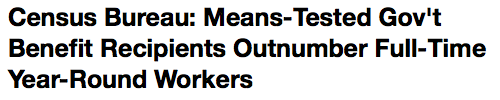
An IBD editorial picks up on a story originally run over at CNS News. Here’s the lede at CNS (emphasis mine):

(CNSNews.com) – Americans who were recipients of means-tested government benefits in 2011 outnumbered year-round full-time workers, according to data released this month by the Census Bureau. They also out-numbered the total population of the Philippines.

There were 108,592,000 people in the United States in the fourth quarter of 2011 who were recipients of one or more means-tested government benefit programs, the Census Bureau said in data released this week. Meanwhile, according to the Census Bureau, there were 101,716,000 people who worked full-time year round in 2011. That included both private-sector and government workers.

That means there were about 1.07 people getting some form of means-tested government benefit for every 1 person working full-time year round.


Screen Shot 2013-10-26 at 2.33.52 PM


Screen Shot 2013-10-26 at 2.33.36 PM


Putting aside whatever relevance the population of the Philippines might have, the point being driven home here is clear – the takers outnumber the makers. We’ve become a society of good-for-nothing moochers who have turned the social safety net into a hammock and all want to live off government largesse (notwithstanding occasional GOP claims about Americans being the hardest working people on the planet).

CNS and IBD would have their audiences believe that the two groups – “year-round full-time workers” (makers) and “recipients of means-tested government benefits” (takers) – are separate and distinct.

The CNS/IBD conservative world view looks like this, where the two groups are mutually exclusive:


Screen Shot 2013-10-27 at 9.43.07 AM


In fact, nothing could be further from the truth, as was reported earlier this year by the Center on Budget and Policy Priorities (this piece focused on the Supplemental Nutrition Assistance Program – SNAP):

The overwhelming majority of SNAP recipients who can work do so.  Among SNAP households with at least one working-age, non-disabled adult, more than half work while receiving SNAP — and more than 80 percent work in the year prior to or the year after receiving SNAP.  The rates are even higher for families with children — more than 60 percent work while receiving SNAP, and almost 90 percent work in the prior or subsequent year.

The number of SNAP households that have earnings while participating in SNAP has been rising for more than a decade, and has more than tripled — from about 2 million in 2000 to about 6.4 million in 2011. The increase was especially pronounced during the recent deep recession, suggesting that many people have turned to SNAP because of under-employment — for example, when one wage-earner in a two-parent family lost a job, when a worker's hours were cut, or when a worker turned to a lower-paying job after being laid off.

And there’s this from the UC Berkeley Labor Center:

Nearly three-quarters (73%) of enrollments in America’s major public benefits programs are from working families. But many of them work in jobs that pay wages so low that their paychecks do
not generate enough income to provide for life’s basic necessities.

Finally, as was widely reported just recently, a McDonald’s internal human resources line suggested an employee explore applying for the very benefits the GOP is apoplectic about dismantling. This from the LA Times:

Nancy Salgado has worked at McDonald's for 10 years and struggles to support her children with a wage that keeps her under the poverty line.

So she called the fast-food behemoth's employee hotline, known as McResources, in hopes of finding help making ends meet.

But instead of getting any company assistance, the McDonald's operator suggested Salgado try food pantries, federal food stamps and Medicaid.

The conversation – which was recorded and released to the public Wednesday by labor advocacy group Low Pay Is Not Ok – comes as attention is growing around the taxpayer burden of so many low-paid workers in the fast-food industry.

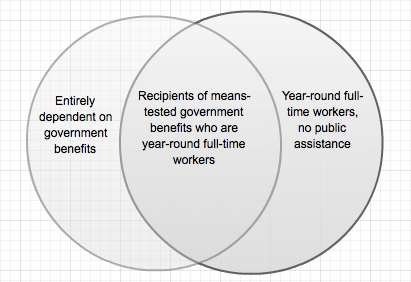
In the reality-based world, where the two groups are not mutually exclusive, things actually look like this:


Screen Shot 2013-10-27 at 10.04.25 AM

[NOTE: This is a simple rendering, not to any scale,  not based on any specific data.]


So, there are two points to be made here:

  1. There is huge overlap between “year-round full-time workers” and “recipients of means-tested government benefits,” and even organizations as blinded by ideology as CNS and IBD should recognize as much.
  2. The American taxpayer – through the various safety net programs mentioned – effectively supplements the unlivable wages provided by companies like McDonald’s which is, I suppose, “increasing shareholder value” by outsourcing part of its employees’ incomes to SNAP and other taxpayer-funded programs. If such companies paid their employees a livable wage, said employees would, I’m sure, be delighted at the prospect of not being on public assistance. Hence, if the GOP wants to slash the social safety net, it must consider agreeing to a raise in the minimum wage. You can’t have it both ways – advocating for no minimum wage and then bemoaning the number of people seeking assistance.

And, for the record, I reject the notion that we’ve become a “nation of whiners” suffering through a “mental recession.”

Shame on IBD and Terrence Jeffrey.


10 Sunday Reads

Posted: 27 Oct 2013 04:00 AM PDT

Good Sunday morning. Some intellectual stimulation to prevent your brain from atrophying over the weekend:

• This is no time to get off the equity train (FT) but see Stock market’s continuing climb worries some Wall Street experts  (LA Times)
The Never List: Never sell a service that you cannot deliver. Never work for someone who isn’t as smart as you are. Never work for or with people with a lesser moral code than your own.  (TRB)
• Eugene Fama, King of Predictable Markets (NYT)
Dan Gross: Amazon Stock May Be Up, but the Company Still Doesn't Make Any Money (Daily Beast)
• Does Studying Economics Breed Greed? (Psychology Today) see also Economists are horrible people, study says (Salon)
• Japan's Yankee genius, the greatest scientist you’ve never heard of (New Statesman)
• Apple’s big iPad problem: How do you convince owners to upgrade when their old machines work just fine? (Yahoo)
• David Byrne: Will Work for Inspiration. (Creative Time Reports)
• 39 Ways to Live, and Not Merely Exist (Dumb Little Man)
• Finding Time to Read (Farnam Street)

Whats for brunch?


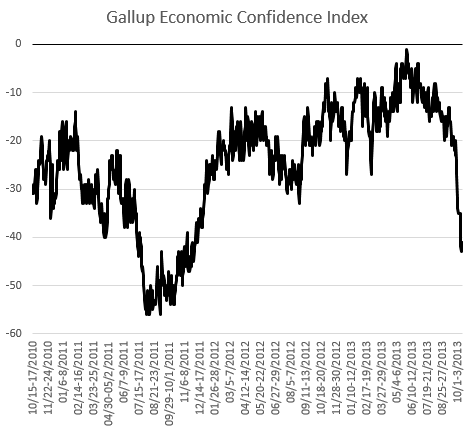
Consumer sentiment took a huge hit in October
gallup-econ-confidence
Source: Reuters


.

0 comments:

Post a Comment

previous home Next

{8} chatroll


{9} AdBrite FOOTER

{8} Nice Blogs (Adgetize)