


The Big Picture |
- Succinct Summation of Week’s Events (11/29/13):
- Ignore the Black Friday “Giant Hypefest & Consumer Orgy”
- No, David Rosenberg’s Bullishness Was Not “Purchased for $3M”
- 10 Black Friday AM Reads
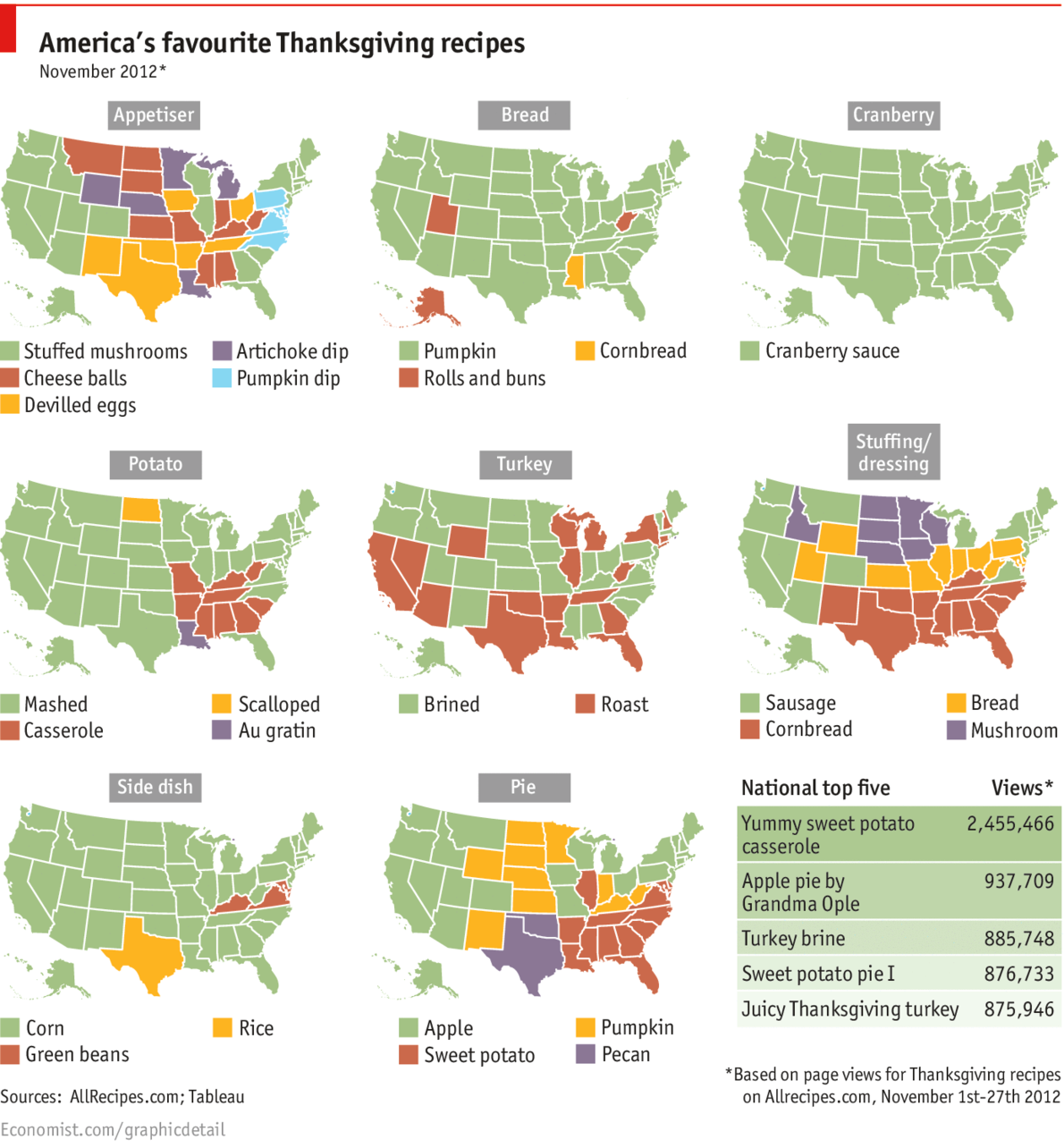
- Here’s What You Probably Ate Yesterday (by Region)
- Charlie Pellett, Voice of New York Subway
| Succinct Summation of Week’s Events (11/29/13): Posted: 29 Nov 2013 12:30 PM PST Succinct Summation of Week's Events: Positives:
Negatives:
|
| Ignore the Black Friday “Giant Hypefest & Consumer Orgy” Posted: 29 Nov 2013 10:00 AM PST
|
| No, David Rosenberg’s Bullishness Was Not “Purchased for $3M” Posted: 29 Nov 2013 07:00 AM PST I was going to write a long point-by-point rebuttal to a Zero Hedge post about David Rosenberg that is factually erroneous, biased, defamatory and just plain wrong; instead, I will offer my correction. Before proceeding further, my disclosure: I have known Rosenberg personally for a decade or so, and professionally for much longer. I consider Rosie a close friend. He presented at our annual Big Picture Conference last October 2012. We frequently disagree on economics, politics and markets; we rarely disagree about wine. I am also familiar with his current contract. Rosenberg’s deal is detailed in Gluskin Sheff‘s regulatory filings. Its no secret that he makes a lot of money — about $3m per year. That is the going rate for a strategist/economist of his stature. He was Merrill’s Lynch‘s grand poobah for almost a decade, ends up on all sorts of lists of most influential Canadians, etc. That Gluskin Sheff was on anyone’s takeover radar is due in no small part to Rosenberg dramatically raising the firm’s profile (They ended up selling a big chunk of the firm). Regardless, Rosie get paid market value for what he does; (its no secret amongst strategists that Gluskin matched another offer from a competitor). What the Globe and Mail got wrong, and what ZH then completely distorted, was the basis of that package. Breakfast with Dave, the daily research product Rosenberg puts out, has nearly 3000 subscribers paying $1,000 per year. That alone allows the company to pay Rosenberg’s cost. Sweet deal? The Globe and Mail got it ass backwards – Gluskin Sheff is the one with the absurdly sweet deal. Rosenberg costs GS almost nothing. His pay is generated by his own work product, even if it isn’t structured that way formally. GS then flies him all over North America and the rest of the world meeting institutional and retail clients. A top economist for essentially free is a damned good deal. (GS: Let me know if I can take him off of your hands) As to Zero Hedge’s error — his more or less $3M deal has been in place since July 2011. He gets paid the same whether he is bullish or bearish. The actual subscription info to Breakfast with Dave suggests that clients have been paying for his bearish perspectives. As the Wall Street Journal detailed earlier this year, clients actually turned on Rosie for flipping bullish, cancelling subscriptions. The change is posture — first telegraphed in mid 2012 — has not earned him any money, and probably cost him some. But to me, the most revealing aspect of Zero Hedge’s hit piece is the opening sentence: “In early 2013, many were mystified when one of the most vocal deflationists, and hence stock market bears, David Rosenberg, turned furiously bullish.” Except anyone who pays attention to equity prices — they were not mystified: Year to date, the S&P500 is up more than 25% and the Nasdaq is up more than 30%. What is mysterious is that no actual market performance so much as enters the discussion. The most revealing thing I can write about the piece is that nowhere does Zero Hedge bother to admit that Rosenberg’s call was 1) Correct and 2) Made money for clients. How can you make a big deal over a change in market posture but omit that its been right? When your biases are such that it is unimaginable that anyone could legitimately change their views on the markets, you have cognitive issues that will hurt your ability to navigate markets. But when that hubris leads you to conclude someone disagreeing with your market posture is only due to a monetary payoff, that is cognitive dissonance writ large. Zero Hedge owes David Rosenberg an apology. |
| Posted: 29 Nov 2013 06:00 AM PST My Black Friday shopping day reads:
Continued here |
| Here’s What You Probably Ate Yesterday (by Region) Posted: 29 Nov 2013 05:00 AM PST |
| Charlie Pellett, Voice of New York Subway Posted: 29 Nov 2013 03:00 AM PST Charlie Pellett is a veteran news anchor and reporter for Bloomberg Radio. He is based in New York City. Pellett joined Bloomberg in 1992, serving as a member of the original Bloomberg Radio and Bloomberg Television anchor teams. Pellett’s voice has been designated as the official “voice” of the New York City subway system. Every day, riders can hear him imploring them to “stand clear of the closing doors.” |
| You are subscribed to email updates from The Big Picture To stop receiving these emails, you may unsubscribe now. | Email delivery powered by Google |
| Google Inc., 20 West Kinzie, Chicago IL USA 60610 | |



0 comments:
Post a Comment