


The Big Picture |
- Why Does the Minimum Wage Have No Discernible Effect on Employment?
- White House Panel Slams NSA, Says Mass Spying Is Unnecessary
- 10 Midweek PM Reads
- Just How Big Is Walmart?
- Morgan Housel: A Conversation With Barry Ritholtz
- 10 Midweek AM Reads
- Always Low Wages? Wal-Mart’s Other Choices
- How Overheated Is the Art Market? Maybe Not So Much
- Everything is a Remix: The iPhone
- Former NSA Official: “We Are Now In A Police State”
| Why Does the Minimum Wage Have No Discernible Effect on Employment? Posted: 19 Dec 2013 02:00 AM PST |
| White House Panel Slams NSA, Says Mass Spying Is Unnecessary Posted: 18 Dec 2013 10:30 PM PST Even Commission Which Obama Created Says We Should Rein In the NSA … and Shouldn't Blindly Trust Government
The White House panel on NSA spying released its report today, slamming mass surveillance and vindicating what critics have been saying all along. Specifically, the commission set up by President Obama – formally known as the Review Group on Intelligence and Communications Technologies – found (page 104):
The panel recommends that National Security Letters be reviewed by a real court before being approved (page 93):
And the Commission says that the government should stop industrial espionage … and undertake manipulation of financial systems (page 221):
Indeed, economic advantage has always been one of the main reasons for spying. As one of the commissioners – former counter-terrorism czar Richard Clarke – told the New York Times, the government shouldn't do things just because they can:
The 9/11 Commission chairs agree. As Senator Patrick Leahy said today on the Senate floor:
|
| Posted: 18 Dec 2013 02:30 PM PST Here’s what I’m looking through on the ride home today:
What are you reading?
|
| Posted: 18 Dec 2013 11:30 AM PST |
| Morgan Housel: A Conversation With Barry Ritholtz Posted: 18 Dec 2013 06:30 AM PST |
| Posted: 18 Dec 2013 06:00 AM PST Here's what I'm reading on the way to the office:
Continues here |
| Always Low Wages? Wal-Mart’s Other Choices Posted: 18 Dec 2013 05:15 AM PST Yesterday, we looked at the benefit to McDonald’s of having its workers subsidized by state and federal aid. Today, its Wal-Mart's turn. Recall our discussion last month on the related subject of “How McDonald’s and Wal-Mart Became Welfare Queens.” We learned that employees of these two companies are often the largest recipients of aid in their states. McDonald’s recently found itself in the spotlight courtesy of its "McResource" line — the company help line that helps its poverty-level, full time employees enroll in various welfare programs. A recording of that McResource line sparked outrage, driving this issue into public view. More recently, Wal-Mart's holiday public-relations headache began when a Canton, Ohio, store decided to hold a food drive for needy local families for the holidays. What made this a PR nightmare was that the needy families were full time Wal-Mart employees who were working in the store holding a food drive. Thus, our questions over the arc of these columns about some of the largest retailers in America — Wal-Mart is the single largest private employer in the country; McDonald’s, the largest fast food chain – are simply this: Continues here |
| How Overheated Is the Art Market? Maybe Not So Much Posted: 18 Dec 2013 04:00 AM PST
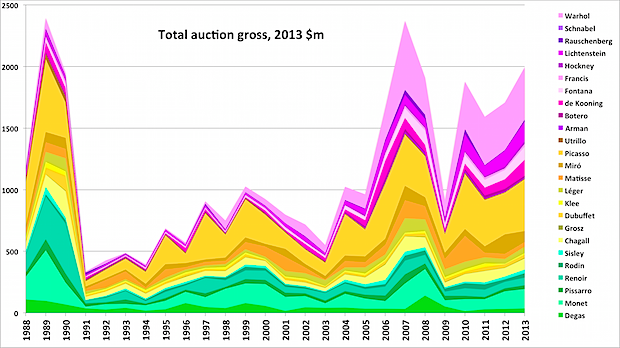
Earlier this week, Felix Salmon did a sensible thing. Instead of fulminating against the rising prices of the art market and declaring it a bubble that must necessarily burst, he asked the good people at Artnet—the very folks who brought price transparency to the art market—to produce a chart for him of 25 top artists he selected and their overall auction sales from 1988 to present. What he discovered in this self-described “unscientific” exercise is that the the market for those particular artists, when adjusted for inflation, remains lower than either the 1989 peak or even the 2007 peak that followed. A good sport, Salmon concluded that the inevitable art market crash may not be imminent even if it remained certain. This little inquiry was good as far as it went but it didn’t really go far enough. In the first instance, the art market is always a bubble if your definition of a bubble is when assets trade for exchange values disconnected from their economic value. Since art has no economic value, the art market is always and ever a bubble. If scare words are useful, we might as well call the art market what it is, a pyramid scheme. Art is only valuable if there are two more people coming after you who want to buy it for more than you paid, inflation or no. Why is that worth saying? Because it raises another way to look at the art market in terms of overall spending on works of art. Katherine Markley, the high priestess of Artnet’s data created a chart of Artnet’s gross auction data over the past quarter century. Remembering that the numbers grow not only with the volume of dollars spent upon art but with the number of auction houses from which Artnet collects data, here is a chart of gross recorded sales that we’ve adjusted for inflation (so any errors are my own.)
It’s easy to see that after a long fallow period, the market began to advance in 2006. Then, it barely looked back. See that dip in 2009, it is nearly the same inflation-adjusted level as 1990. Again, that’s probably because Artnet covered many more auction houses by 2009 than it had in 1990 and those global auction houses were seeing more money spent on art, even in the midst of a credit crisis. That spike in 2011? It’s the Chinese auction houses going through the roof. We’re now all aware that good number of those reported sales were never, in fact, completed. Nonetheless, the chart seems to support the idea that more buyers are coming in behind those who entered the market in the last generation. Demand would seem to be continuing to grow. That offers a counter-theory of the art market: growing global wealth is going into art and artifacts that were previously not valued monetarily. Another way to look at what’s being spent on art is to see what’s happening to average prices. This is a very raw measure that we asked Artnet to provide, simply divide the total dollar volume by the total number of lots. It won’t tell you a lot but it does give a sense of whether the growth in auction volume is a product of excess liquidity—in which case, a stable number of items would become increasingly valuable (not unlike gold)—or whether the growth is the result of shift toward placing greater value on cultural objects. The average price chart, adjusted for inflation, suggests the latter. After the crash of the 1989-90 peak, average lot prices stabilized. They rose again as the latest art boom took off but seem to be reverting to a new mean for this era’s art market. Even this year’s exceedingly strong numbers don’t pull the average price out of register. The chart doesn’t show it but the $45k figure would only raise the graph back to 2011′s not-too-scary levels. Are art prices very strong? Yes. Could they be too strong and indicated a pull-back in the market? Sure. In fact, many in the market would like to see that happen for a number of reasons. The art market could crash next year as the gold market has this year. But it doesn’t look to be in a crazy pattern reminiscent of the worst years in 1989-90.
|
| Everything is a Remix: The iPhone Posted: 18 Dec 2013 03:00 AM PST |
| Former NSA Official: “We Are Now In A Police State” Posted: 17 Dec 2013 10:30 PM PST 32-year NSA Veteran Who Created Mass Surveillance System Says Government Use of Data Gathered Through Spying "Is a Totalitarian Process"Bill Binney is the high-level NSA executive who created the agency's mass surveillance program for digital information. A 32-year NSA veteran widely regarded as a "legend" within the agency, Binney was the senior technical director within the agency and managed thousands of NSA employees. Binney has been interviewed by virtually all of the mainstream media, including CBS, ABC, CNN, New York Times, USA Today, Fox News, PBS and many others. Last year, Binney held his thumb and forefinger close together, and said:
But today, Binney told Washington's Blog that the U.S. has already become a police state. By way of background, the government is spying on virtually everything we do. All of the information gained by the NSA through spying is then shared with federal, state and local agencies, and they are using that information to prosecute petty crimes such as drugs and taxes. The agencies are instructed to intentionally "launder" the information gained through spying, i.e. to pretend that they got the information in a more legitimate way … and to hide that from defense attorneys and judges. This is a bigger deal than you may realize, as legal experts say that there are so many federal and state laws in the United States, that no one can keep track of them all … and everyone violates laws every day without even knowing it. The NSA also ships Americans' most confidential, sensitive information to foreign countries like Israel (and here), the UK and other countries … so they can "unmask" the information and give it back to the NSA … or use it for their own purposes. Binney told us today:
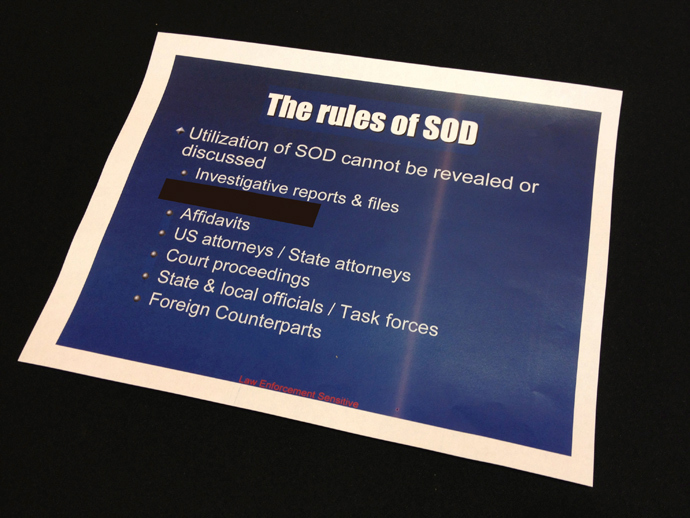
Here are the two slides which Binney pointed us to:
(Source: Reuters via RT) We asked Binney a follow-up question:
Binney responded:
(See this for background on the five eyes.) View past discussions between Washington's Blog and Binney here, here, here and here. |







| You are subscribed to email updates from The Big Picture To stop receiving these emails, you may unsubscribe now. | Email delivery powered by Google |
| Google Inc., 20 West Kinzie, Chicago IL USA 60610 | |



0 comments:
Post a Comment