.

{2} GoogleTranslate (H)

English French German Spanish Italian Dutch Russian Portuguese Japanese Korean Arabic Chinese Simplified

Our New Stuff

{3} up AdBrite + eToro

Your Ad Here

Wednesday, January 1, 2014

The Big Picture

The Big Picture


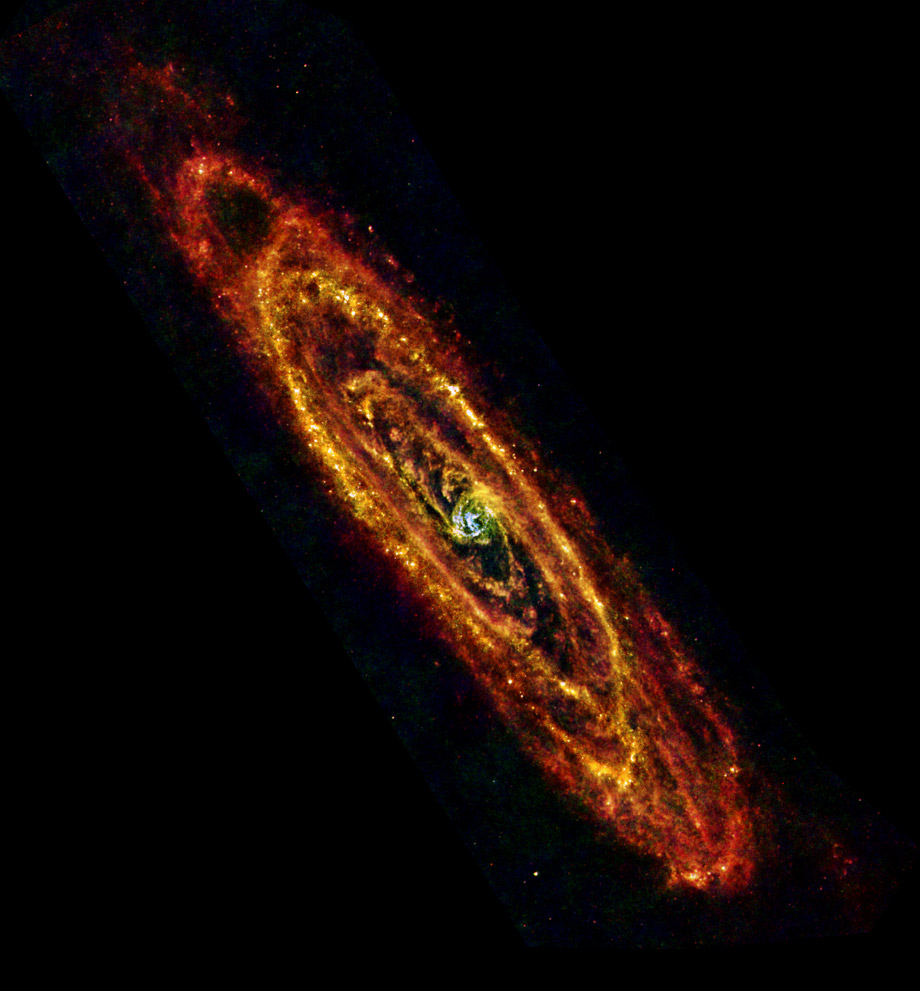
The Cold, Fiery, Dusty Arms of Andromeda

Posted: 01 Jan 2014 02:00 AM PST

Click for a larger photo.

Source: Slate

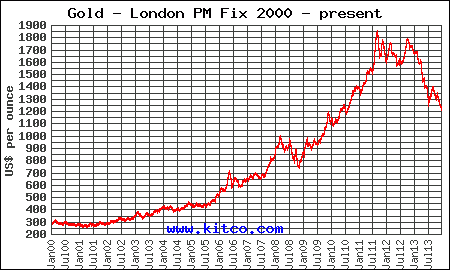
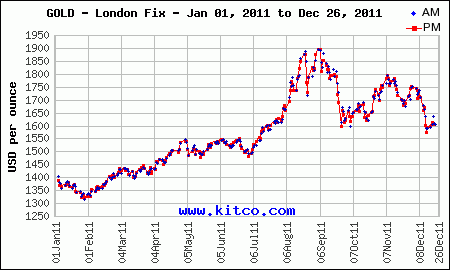
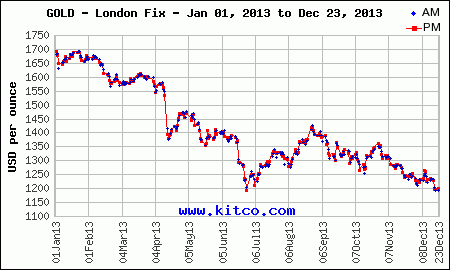
Gold Charts: 2000-Present, 2011, ’12, ’13

Posted: 31 Dec 2013 12:30 PM PST

This is from a bigger project I am working on.

I found it interesting that even thought Gold hit its peak in 2011, it did not have a negative year until 2013:


2000-2013

~~~

2011

2012

2013

Huprich: Wisdom Comes in the Smallest of Packages.

Posted: 31 Dec 2013 08:00 AM PST

We previously published Art Hurpichs’ Market Truisms and Axioms back in 2011.  Art is a CMT with Day Hagan Asset Management, and he returns with an updated set of Stock Market Rules to Remember.

Enjoy.

~~~

As you are reading this, we are in the process of moving our "youngest" to Virginia, as he prepares for life on his own. One of my parting words was "Experience is gained by learning from your own mistakes; wisdom is gained by learning from the mistakes of others…"

Consistent with this and as we move into the last week of 2013 and approach 2014, I am reflecting on the lessons learned over a 30-year time period on Wall Street. While many of the insights shown below are personal experiences, and some insights were gleaned from others, they still bear repeating. I hope you enjoy reading the following insights as much as I did compiling them:

• Technical analysis is a windsock, not a crystal ball. It is a skill that improves with experience and study. Always be a student, there is always someone smarter than you!

• "Thou Shall Not Trade Against the Trend."

• Let volatility work in your favor, not against you.

• Watch what our "Politicos" do, not say.

• Markets tend to regress to the mean over time.

• Emotions can be the enemy of the trader and investor, as fear and greed play an important part of one's decision making process.

• Portfolios heavy with underperforming stocks rarely outperform the stock market!

• Even the best looking chart can fall apart for no apparent reason. Thus, never fall in love with a position but instead remain vigilant in managing risk and expectations. Use volume as a confirming guidepost.

• When trading, if a stock doesn't perform as expected within a short time period, either close it out or tighten your stop-loss point.

• As long as a stock is acting right and the market is "in-gear," don't be in a hurry to take a profit on the whole position, scale out instead.

• Never let a profitable trade turn into a loss and never let an initial trading position turn into a long-term one because it is at a loss.

• It's not the stocks that you sell that go higher that matters, it's the stocks you don't sell which go lower, that do.

• Don't think you can consistently buy at the bottom nor sell at the top. This can rarely be consistently done.

• Don't buy a stock simply because it has had a big decline from its high and is now a "better value;" wait for the market to recognize "value" first.

• Don't average trading losses, meaning don't put "good money" after "bad."

• Your odds of success improve when you buy stocks when the technical pattern confirms the fundamental opinion.

• We can’t control the stock market. The very best we can do is to try to understand what the stock market is trying to tell us. As I like to say, "Overweight Statistical Probability. Underweight Emotion!"

• Understanding mass psychology is just as important as understanding fundamentals and economics.

• When investing, remain objective. Don't have a preconceived idea or prejudice. Said another way, "the great names in our business … the Paul Tudor Joneses; the Steve Cohens; the Andy Halls; the George Soros'…all have this same trait: the ability to shift on a dime when the shifting time comes."

• Any dead fish can go with the flow. Yet it takes a strong fish to swim against the flow. In other words, what seems "hard" at the time is usually, over time, right.

• Don't make investment or trading decisions based on tips. Tips are something you leave for good service.

• Where there is smoke, there is fire – bad news is usually not a one-time event, more usually follows.

• To the best of your ability, try to keep your priorities in-line. Don't let the "greed factor" that Wall Street can generate outweigh other, and just as important, areas of your life. Balance the physical, mental, spiritual, relational, and financial needs of life.

Finally, I want to offer a heart-felt "thank you" to those who are clients. We value your trust and support. To those who are not clients, we welcome the opportunity to speak with you of how we can be of assistance.

Art Huprich, CMT
Chief Market Technician
Day Hagan Asset Management

10 New Year’s Eve Day AM Reads

Posted: 31 Dec 2013 06:00 AM PST

Good New Year’s Eve morn. Here’s what I’m reading on the last day of the year:

•Bloomberg markets two-fer:
…..-Dow Climbs to Record, Poised for Best Year Since 1996 (Bloomberg)
…..-Gold Declines on Way to Worst Year Since 1981 as Silver Drops (Bloomberg)
• America in 2013, as Told in Charts (NY Times)
• Behavioral Resolutions for Behavioral Investors (Psy-Fi Blog) see also 10 financial resolutions you can actually keep (Washington Post)
• Winners of 2013: Boring Investors (WSJ)
• The 2014 Stock Market: What the Charts Say (Barron’s) see also The S&P 500: How High Can It Go? (Barron’s)
• My Three Goals for 2014 (Reformed Broker)
• Dear Quartz, maybe it’s you that needs new glasses and a map. 2013 was not a lost year for tech (Giga Omsee also 2013: The Year in Apple and Technology at Large (Daring Fireball)
• The Best Cars We Drove in 2013 (And a Few We Wish We Hadn’t) (Wired)
• Dave Barry's Review of 2013, the Year of the Zombies (Washington Post)
• 14 Quotes To Inspire Your New Year’s Resolutions For 2014 (BuzzFeed)

What are you doing tonight?


Inexpensive Stocks Take Lead in Rally

Source: WSJ

My Annual Predictions for the Coming Year, 2014 Edition

Posted: 31 Dec 2013 04:30 AM PST

Here are my forecasts for 2014, guaranteed to not be wrong:

Category Forecast
Dow Jones Industrials No idea
S&P500 WTF are you asking me for?
10 Year Bond Could not fathom a guess
Emerging Markets Who knows?
Fed Fund Rates Haven't a clue
US Housing Market That’s a really good question
Inflation Not a clue
GDP Yes, we will probably have a GDP
Unemployment Thhhhpppptttt?
ECB Rates $%^&*!
Growth in China XXXX
European Sovereign Debt Hmmm, interesting . . .
2014 Election outcome HTF should I know?
Abenomics & Japan Domo Arigato
Possibility of Recession in 2014 Possibility & Probability are 2 different things

That's the most honest set of predictions you will read this season.

(This was part of a prior piece I wrote for Bloomberg earlier this month)

Business Behaving Badly

Posted: 31 Dec 2013 03:45 AM PST

Despite having to paying millions or even billions of dollars in fines, many companies look at the payments as just the cost of doing business.

See also: A Year of Corporate Fines

What is the Impact of Fukushima on Wildlife in American NorthWest?

Posted: 31 Dec 2013 02:00 AM PST

Seals, Sea Lions, Polar Bears, Bald Eagles, Sea Stars, Turtles, King and Sockeye Salmon, Herring, Anchovies and Sardines In The Western Part of North America All Suffering Mysterious Diseases At the Same Time.

Is it Radiation from Fukushima?

We've previous documented that seals, sea lions, polar bears, sea stars, turtles, sockeye salmon, herring, anchovies and sardines on the West Coast of North America are all suffering mysterious diseases … which are killing many.

We've asked whether this is related to massive releases of radiation from Fukushima. Update.

Sadly, we can now add other wildlife to the list.

EneNews reports:

Los Angeles Times, Dec. 29, 2013: Bald eagles are dying in Utah — 20 in the past few weeks alone — and nobody can figure out why. [...] Many suffered from seizures, head tremors and paralysis [...] Many of the eagles were brought to the mammoth Wildlife Rehabilitation Center of Northern Utah [...] Within 48 hours, most were dead. [...] State wildlife specialists are baffled. For weeks, officials have sent birds for necropsies [...] At first, the agency's disease scientists guessed the illness could be encephalitis, which is caused by the West Nile virus, but later ruled out that possibility. [...] Officials suggest the die-off is possibly connected to the deaths of thousands of eared grebes that began in Utah in November. [...] Officials still don't know why the shore birds became sick. [...] Officials at the Wildlife Rehabilitation Center have their own theories. Some point to radiation from Japan after the 2011 meltdown at the Fukushima Daiichi nuclear power plant. [...] A call from Idaho shed new light: A wildlife official said bald eagles there were also getting sick, suggesting the birds were arriving in Utah already in bad health.

Buz Marthaler, Wildlife Rehabilitation Center of Northern Utah co-founder: "It's just hard to have your national bird in your arms, going through seizures in a way it can't control — when you can see it's pain but don't know what's happening to it. As a human being, you just have problems with that. And when you lose one, it just grabs your heart. [...] In an average year, we might get one or two, but we've received nine so far, and five of those have died. The other four are still in our care. [...] We aren't ruling out anything."

***

Washington Post, Dec. 30, 2013: [...] "This is really concerning to us," says [Leslie McFarlane, the wildlife disease program coordinator for the state's Division of Wildlife Resources]. She has been program coordinator for 10 years and describes the recent deaths as "very unusual." [...] The symptoms noted in the recent spate of deaths—and the broad geographical area in which they have cropped up—are what has officials concerned.

Listen to the public news service report here

In a second article, EneNews notes:

Juneau Empire, Dec. 29, 2013: [...] the king [chinook] salmon — has fallen from its throne. [...] Alaska has seen unprecedented declines in recent years [...] scientists like Joe Orsi and Jim Murphy, both fisheries research biologists with the National Oceanic and Atmospheric Administration, are digging deeper into [...] the cause of the startling downward trend. [...] When asked about the potential impact Fukushima may be having on king salmon stocks in the Gulf of Alaska and elsewhere in the state, Orsi would not comment. "I've been told to refer you to the (Environmental Protection Agency)," he said, "Because I'm not an expert on the topic." Calls and emails to the EPA were not returned in time and digging on the federal agency's site revealed no current information on radiation from the Fukushima disaster. The last posted monitoring results occurred in June of 2011.

Unfortunately, the American and Japanese governments are doing everything they can to cover up the severity of the Fukushima disaster.  Indeed, anytime government or big corporations screw up, the government works to cover it up … instead of actually fixing the problem. And see this.

EneNews continues:

Bellingham Herald, Dec. 5, 2013: "[...] we see from test fisheries that the Chinook numbers returning to the Fraser River system were at a record low," explained Ken Balcomb, executive director and principal investigator for The Center for Research and a science advisor to the whale watch association. [...] [An] alarming decrease of an important identified food resource [...]

Islander Sound, Dec. 25, 2013: [A] dismal return of Chinook salmon to the Fraser River.

Salmon Fishing in British Columbia, Canada: There are two major salmon runs of Chinook that are targeted by anglers; the Fraser river [and] Harrison River.

December 2013: Previously unpublished map from gov't scientists shows Fukushima plume already at Alaska coast (PHOTO)

November 2013: CBC Headline: Radiation from Fukushima arrives on Alaska coast — University scientists concerned — "Is the food supply safe?… I don't think anyone can really answer that"

September 2013: US Gov't: Alaska island "appears to show impacts from Fukushima" — "Significant cesium isotope signature" detected — Scientists anticipate more marine life to be impacted as ocean plume arrives (VIDEO)

.

0 comments:

Post a Comment

previous home Next

{8} chatroll


{9} AdBrite FOOTER

{8} Nice Blogs (Adgetize)