.

{2} GoogleTranslate (H)

English French German Spanish Italian Dutch Russian Portuguese Japanese Korean Arabic Chinese Simplified

Our New Stuff

{3} up AdBrite + eToro

Your Ad Here

Thursday, January 2, 2014

The Big Picture

The Big Picture


Clues to Future Snowden Leaks Found In His Past

Posted: 01 Jan 2014 10:30 PM PST

Work for Covert NSA Facility at University of Maryland May Be Hint

Only a tiny fraction of Snowden's documents have been published.

What's still to come?

We believe one hint comes from Snowden's past as a security specialist at one of one the NSA's covert facilities at the University of Maryland.

Pre-Crime and the NSA

We reported in 2008:

A new article by investigative reporter Christopher Ketcham reveals, a governmental unit operating in secret and with no oversight whatsoever is gathering massive amounts of data on every American and running artificial intelligence software to predict each American's behavior, including "what the target will do, where the target will go, who it will turn to for help".

The same governmental unit is responsible for suspending the Constitution and implementing martial law in the event that anything is deemed by the White House in its sole discretion to constitute a threat to the United States. (this is formally known as implementing "Continuity of Government" plans). [Background here.]

As Ketcham's article makes clear, these same folks and their predecessors have been been busy dreaming up plans to imprison countless "trouble-making" Americans without trial in case of any real or imagined emergency.  What kind of Americans? Ketcham describes it this way:

"Dissidents and activists of various stripes, political and tax protestors, lawyers and professors, publishers and journalists, gun owners, illegal aliens, foreign nationals, and a great many other harmless, average people."

Do we want the same small group of folks who have the power to suspend the Constitution, implement martial law, and imprison normal citizens to also be gathering information on all Americans and running AI programs to be able to predict where American citizens will go for help and what they will do in case of an emergency? Don't we want the government to — um, I don't know — help us in case of an emergency?

Bear in mind that the Pentagon is also running an AI program to see how people will react to propaganda and to government-inflicted terror. The program is called Sentient World Simulation:

"U.S defense, intel and homeland security officials are constructing a parallel world, on a computer, which the agencies will use to test propaganda messages and military strategies.Called the Sentient World Simulation, the program uses AI routines based upon the psychological theories of Marty Seligman, among others. (Seligman introduced the theory of 'learned helplessness' in the 1960s, after shocking beagles until they cowered, urinating, on the bottom of their cages.)

Yank a country's water supply. Stage a military coup. SWS will tell you what happens next.

The sim will feature an AR avatar for each person in the real world, based upon data collected about us from government records and the internet."

The continuity of government folks' AI program and the Pentagon's AI program may or may not be linked, but they both indicate massive spying and artificial intelligence in order to manipulate the American public, to concentrate power, to take away the liberties and freedoms of average Americans, and — worst of all — to induce chaos in order to achieve these ends.

PBS Nova reported in 2009:

The National Security Agency (NSA) is developing a tool that George Orwell's Thought Police might have found useful: an artificial intelligence system designed to gain insight into what people are thinking.

With the entire Internet and thousands of databases for a brain, the device will be able to respond almost instantaneously to complex questions posed by intelligence analysts. As more and more data is collected—through phone calls, credit card receipts, social networks like Facebook and MySpace, GPS tracks, cell phone geolocation, Internet searches, Amazon book purchases, even E-Z Pass toll records—it may one day be possible to know not just where people are and what they are doing, but what and how they think.

The system is so potentially intrusive that at least one researcher has quit, citing concerns over the dangers in placing such a powerful weapon in the hands of a top-secret agency with little accountability.

Known as Aquaint, which stands for "Advanced QUestion Answering for INTelligence" [which is run by the Intelligence Advanced Research Projects Activity (IARPA)], part of the new M Square Research Park in College Park, Maryland. A mammoth two million-square-foot, 128-acre complex, it is operated in collaboration with the University of Maryland. "Their budget is classified, but I understand it's very well funded," said Brian Darmody, the University of Maryland's assistant vice president of research and economic development, referring to IARPA. "They'll be in their own building here, and they're going to grow. Their mission is expanding."

***

In a 2004 pilot project, a mass of data was gathered from news stories taken from the New York Times, the AP news wire, and the English portion of the Chinese Xinhua news wire covering 1998 to 2000. Then, 13 U.S. military intelligence analysts searched the data and came up with a number of scenarios based on the material. Finally, using those scenarios, an NSA analyst developed 50 topics, and in each of those topics created a series of questions for Aquaint's computerized brain to answer. "Will the Japanese use force to defend the Senkakus?" was one. "What types of disputes or conflict between the PLA [People's Liberation Army] and Hong Kong residents have been reported?" was another. And "Who were the participants in this spy ring, and how are they related to each other?" was a third. Since then, the NSA has attempted to build both on the complexity of the system—more essay-like answers rather than yes or no—and on attacking greater volumes of data.

"The technology behaves like a robot, understanding and answering complex questions," said a former Aquaint researcher. "Think of 2001: A Space Odyssey and the most memorable character, HAL 9000, having a conversation with David. We are essentially building this system. We are building HAL." A naturalized U.S. citizen who received her Ph.D. from Columbia, the researcher worked on the program for several years but eventually left due to moral concerns. "The system can answer the question, 'What does X think about Y?'" she said. "Working for the government is great, but I don't like looking into other people's secrets.

A supersmart search engine, capable of answering complex questions such as "What were the major issues in the last 10 presidential elections?" would be very useful for the public. But that same capability in the hands of an agency like the NSA—absolutely secret, often above the law, resistant to oversight, and with access to petabytes of private information about Americans—could be a privacy and civil liberties nightmare. "We must not forget that the ultimate goal is to transfer research results into operational use," said Aquaint project leader John Prange, in charge of information exploitation for IARPA.

Once up and running, the database of old newspapers could quickly be expanded to include an inland sea of personal information scooped up by the agency's warrantless data suction hoses. Unregulated, they could ask it to determine which Americans might likely pose a security risk—or have sympathies toward a particular cause, such as the antiwar movement, as was done during the 1960s and 1970s. The Aquaint robospy might then base its decision on the type of books a person purchased online, or chat room talk, or websites visited—or a similar combination of data. Such a system would have an enormous chilling effect on everyone's everyday activities—what will the Aquaint computer think if I buy this book, or go to that website, or make this comment? Will I be suspected of being a terrorist or a spy or a subversive?

World Net Daily's Aaron Klein reported in June:

In February, the Sydney Morning Herald reported the Massachusetts-based multinational corporation, Raytheon – the world's fifth largest defense contractor – had developed a "Google for Spies" operation.

Herald reporter Ryan Gallagher wrote that Raytheon had "secretly developed software capable of tracking people's movements and predicting future behavior by mining data from social networking websites" like Facebook, Twitter, and Foursquare.

The software is called RIOT, or Rapid Information Overlay Technology.

Raytheon told the Herald it has not sold RIOT to any clients but admitted that, in 2010, it had shared the program's software technology with the U.S. government as part of a "joint research and development effort … to help build a national security system capable of analyzing 'trillions of entities' from cyberspace."

In April, RIOT was reportedly showcased at a U.S. government and industry national security conference for secretive, classified innovations, where it was listed under the category "big data – analytics, algorithms."

Jay Stanley, senior policy analyst for the ACLU Speech, Privacy and Technology Project, argued …  that among the many problems with government large-scale analytics of social network information "is the prospect that government agencies will blunderingly use these techniques to tag, target and watchlist people coughed up by programs such as RIOT, or to target them for further invasions of privacy based on incorrect inferences."

"The chilling effects of such activities," he concluded, "while perhaps gradual, would be tremendous."

Ginger McCall, attorney and director of the Electronic Privacy Information Center's Open Government program, told NBC in February, "This sort of software allows the government to surveil everyone.

"It scoops up a bunch of information about totally innocent people. There seems to be no legitimate reason to get this, other than that they can."

As for RIOT's ability to help catch terrorists, McCall called it "a lot of white noise."  [True ... Big data doesn't work to keep us safe.]

The London Guardian further obtained a four-minute video that shows how the RIOT software uses photographs on social networks. The images, sometimes containing latitude and longitude details, are "automatically embedded by smartphones within so-called 'exif header data.'

RIOT pulls out this information, analyzing not only the photographs posted by individuals, but also the location where these images were taken," the Guardian reported.
Such sweeping data collection and analysis to predict future activity may further explain some of what the government is doing with the phone records of millions of Verizon customers. [Background here.  It may also explain why the NSA is collecting nearly 5 billion cell location records every day, all over the world.]

***

"In the increasingly popular language of network theory, individuals are "nodes," and relationships and interactions form the "links" binding them together; by mapping those connections, network scientists try to expose patterns that might not otherwise be apparent," reported the Times.  [Background here.]

In February 2006, more than a year after Obama was sworn as a U.S. senator, it was revealed the "supposedly defunct" Total Information Awareness data-mining and profiling program had been acquired by the NSA.

The Total Information Awareness program was first announced in 2002 as an early effort to mine large volumes of data for hidden connections.

What does all of this have to do with Edward Snowden?

Aaron Klein reports that Snowden might have worked at the NSA's artificial intelligence unit at the University of Maryland:

Edward Snowden, the whistleblower behind the NSA surveillance revelations, told the London Guardian newspaper that he previously worked as a security guard for what the publication carefully described as "one of the agency's covert facilities at the University of Maryland."

***

Brian Ullmann, the university's assistant vice president for marketing and communications, was asked for comment. He would not address the query, posed twice to his department by KleinOnline, about whether the NSA operates covert facilities in conjunction with the university.

Ullmann's only comment was to affirm that Snowden was employed as a security guard at the university's Center for the Advanced Study of Languages in 2005.

Calling Snowden a "security guard" is like calling James Bond a "bouncer".  Snowden was a highly-prized expert at finding the NSA's security vulnerabilities in order to protect the agency's computer systems from malicious hackers.

Snowden may know a tremendous amount about – and have taken many documents regarding – the NSA's dystopian plans for a Big Bro, pre-crime computer system.

Postscript:  If we're right, we urge that these documents be pushed towards the front of the release queue by the journalists holding the documents leaked by Snowden … as they would be central to the NSA's true plans and visions.

We would also urge the release of any documents regarding NSA's involvement – if any - in financial manipulation or  false flags to be published quickly, as these would be vital for our information and understanding as a free people.

Understanding Time: A Long Term Perspective

Posted: 01 Jan 2014 12:00 PM PST

click for ginormous version
Perspective on Time
Source: Mayra Artes via Visual.ly


A different and perhaps more easily readable version of this is here . . .


Click for complete visualization

Timelines+1
Source: Wait but why:


All 10 Stock Sectors Post Gains in Big Year

Posted: 01 Jan 2014 09:00 AM PST

click for interactive graphic

Source: WSJ

Take Responsibility for Your Stock Losses

Posted: 01 Jan 2014 06:00 AM PST

I wrote this a decade ago, and if you keep only one resolution this year, this is the one it should be. It will open a cascade of improvements for your finances . . .


Take Responsibility for Your Stock Losses
Barry Ritholtz
RealMoney.com, April 12, 2005


“He who blames others has a long way to go on his journey. He who blames himself is halfway there. He who blames no one has arrived.”

– Chinese proverb


In the first installment of “The Apprenticed Investor,” we discussed why investors should expect to be wrong, and most importantly, having appropriate plans for what to do when you are wrong.

That column gave you two lessons disguised as one. Hidden within was a second, subtler message. It is so obvious, yet so ignored by investors: You are ultimately the only person responsible for your investments.

Apprenticed Investor: Take Responsibility for Your Stock Losses

That sounds pretty straightforward, but for some reason it seems to be a problem in our society. Few want to take responsibility for their actions or situation, if they can avoid it.

Think I’m exaggerating? Every kid who does poorly in school gets diagnosed with ADHD. We are fat because of McDonald’s (MCD). There are shootings because of TV violence.

In sum, it’s easier to pass the buck than to admit the truth.
Bad Excuses for Poor Investments

At times, the excuse-making from investors is even worse. Over the years, I have heard every complaint imaginable for why losses occur. Inevitably, these gripes go something like this: “It’s not my fault but the fault of”:

The analyst analyst who recommended it.
The banker who did the deal.
CNBC, which hyped it.
The talking head who loved it.
My brother-in-law, who got a hot tip on it.


I’ve heard people complain about their broker’s broker bad advice, the lousy execution they got, and how a market maker market-maker or specialist specialist hurt their trade. Other kvetches? Management stinks, insiders insider-trading are dumping shares, regulators are overzealous. Margin calls margin-call did it. Or was it the president’s policies or congressional gridlock or Chinese imports? Really, who can trade when the economic data are cooked, and the “Plunge Protection Team” counters your best positioning?

I’ve overheard people complain that they lost money because Alan Greenspan raised, lowered and/or left rates unchanged. Oh, and Eliot Spitzer, too.

Well, folks, I’ve got some bad news for you. None of those are the reason any of you lost money. The dirty little secret is much simpler. You lost money because you bought a stock, and that stock went down, and then you sold it. Period, end of discussion.

Buying high and selling low is a lousy investment strategy. Worse is buying high and not selling at all as (paper) losses mount. Think of Lucent (now Alcatel-Lucent (ALU)) or Sun Microsystems (JAVA) or Nortel (NT), or the slew of stocks that went to zero. Too many people rode ‘em all the way down, rather than admit a mistake and take responsibility.

You see, with responsibility comes a natural tendency toward planning. If you buy without a plan in place for when things go south — when your original thesis turns out to be wrong — then you are at fault.

Sorry to be the bearer of this bad news, but the sooner you start accepting that simple truth, the better off you will be.

Why? Because all of the excuses above are foreseeable events that only investors (and fools) fail to anticipate. Analysts can be wrong, TV is about ratings, insiders sell, and talking heads talk. Is that a surprise? Hey, guess what? The Fed federal-reserve-system raises and lowers rates, the FDA pulls drugs, and attorneys general prosecute.

Review some of the aforementioned complaints, and you will see how foolish they sound. Now try this one: I lost money because I made a bad investment. I lost a lot of money because I made a bad investment without a contingency plan for when things went wrong.

Here’s the only excuse I would accept from an investor: Aliens from Alpha Centauri landed on earth and gave a huge technological secret to the rival of the company whose stock you own. OK, when that happens, you are excused. Short of that, everything else is your own responsibility.
Priorities and Homework

Excuses are just a sign of how lazy we all are (me too), including boredom and procrastination (guilty). If we are going to be investors, then we must do all the heavy lifting that’s called work. If it were easy and painless, then everyone would be a fabulous and wealthy investor. But it’s not, so you have to outwork and outhustle the next guy.

Recall that Michael Jordan didn’t initially make his high school basketball team. After that, he swore he would never be outworked by anyone ever again. He went on to become the greatest player ever. There’s a lesson in that.

We all know guys who can recall every baseball stat of their favorite team off the top of their heads; win-loss records, slugging percentage, ERA. Ask them about the top five holdings of their mutual funds mutual-fund, and they look at you as if you have two heads.

Some people spend more time investigating the purchase of a refrigerator than they do a stock or mutual fund. You have to wonder why people put more time into planning their next vacation than they do their retirement. A vacation is two weeks long; a retirement can be 20 years. There is something wrong with the math here.
The Freedom of Responsibility

Not to get all Zen on you, but once you accept this, there is a certain exhilaration in the concept. Suddenly, planning for your own retirement takes on a different hue. You become more focused, motivated and excited about learning.

Short cuts (i.e., stock tips) make you laugh. When other traders whine about their bad luck/the Fed/market makers, you can snicker to yourself at how they are fooling themselves.

As the magnitude of the awesome responsibility of taking control — and responsibility — sets in, it tends to sharpen the mind. It is empowering.

I think Spider-Man may have gotten it backwards: With responsibility comes great power.


This column was originally published on April 12, 2005.

10 New Year’s Day Reads

Posted: 01 Jan 2014 05:30 AM PST

Happy New Year.  Here’s what I’m reading to start 2014:

• In 2013 I Learned That… (Reformed Broker)
• The Single Greatest Predictor of Future Stock Market Returns (Philosophical Economics)
• Here it is: the worst investment of 2013 (Quartz)
• Statistics Done Wrong (Alex Reinhart)
• The Economy's Secret Success in 2013 (Daily Beast)
• Interest rates on mortgages for pricey homes have dropped below those on smaller mortgages (WSJsee also Jumbo mortgages now carry cheaper rates than traditional loans (CNN)
• Inside TAO: Documents Reveal Top NSA Hacking Unit (Spiegel)
• Car companies are picking sides between Apple and Google (Washington Post)
• A Stream of Music, Not Revenue (NY Times)
• The new era of the New York skyscraper (Felix Salmon)

What’s up for the New Year?


Winners of 2013: Boring Investors

Source: WSJ


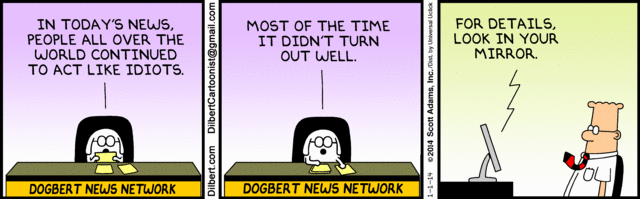
DNN: In Today’s News . . .

Posted: 01 Jan 2014 04:43 AM PST


208487.strip
Source: Dilbert
 

.

0 comments:

Post a Comment

previous home Next

{8} chatroll


{9} AdBrite FOOTER

{8} Nice Blogs (Adgetize)