


The Big Picture |
- Bull Market Needs One Thing to Keep Going
- Is the Tide Turning Back?
- Intelligence Agencies Have Gone Rogue, With No Oversight
- 10 Mid-Week PM Reads
- Where Would Winter Temperatures Place Your City in the US?
- Attention Suckers: Send Us Your Money!
- 10 Midweek AM Reads
- What Makes Candy Crush So Addictive?
- Sun Rises Over North Pole for 1st time in 6 months
| Bull Market Needs One Thing to Keep Going Posted: 27 Mar 2014 03:00 AM PDT | ||||||||||||||
| Posted: 27 Mar 2014 02:00 AM PDT Is the Tide Turning Back?
Economic activity improved for the world during the second half of 2013 as year-over-year growth ticked up to 3 percent with acceleration in advanced economies. Advanced and emerging economies contributed evenly (Chart 1).[1] Headline consumer price index inflation increased to 3.4 percent year over year in January 2014 due to a pickup in emerging economies—a 1.4 percentage-point increase from January 2013 to reach 5.6 percent. Inflation in advanced economies excluding the U.S. remains around 1.3 percent year over year. Downside risks to the outlook for 2014 continue. Data released since January have heightened concern over softer-than-expected growth, and geopolitical developments in Ukraine have also increased macro risks. Slowing Growth in China May Hinder Structural ReformsFiscal problems in China have grown as stimulus has increasingly become dependent on local government investment. China's National Audit Office data indicate that local government debt and guarantees increased to 17.9 trillion yuan as of midyear 2013 from 10.7 trillion at the end of 2010. Total renminbi loan growth (14.2 percent year over year in February) is running well above nominal gross domestic product growth and is possibly contributing to a rise in real estate prices since 2013. Monetary policy has progressively shifted toward moderating credit growth and reducing excessive risk-taking behavior, while gradually removing government controls on the financial system. The reform agenda laid out in the Third Plenum of the Central Committee of the Communist Party (November 2013) is ambitious in scope (Table 1). China has pursued this path incrementally, taking steps to relax the one-child policy and promote rapid internationalization of the renminbi and even proposing the partial privatization of some state-owned enterprises. Table 1
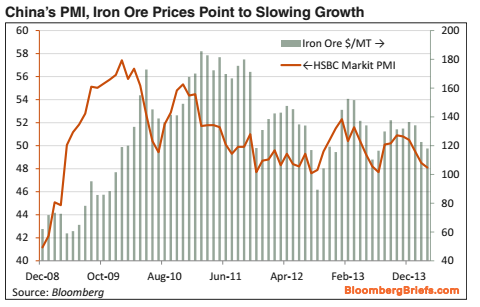
SOURCE: Authors' assessment based on publicly available reports as of March 17, 2014. Since January, China has expanded its support facilities for the most liquidity-constrained banks in response to recent spikes in interbank rates (Dec. 23 and Jan. 20) and has weakened its implicit guarantee on financial products—even allowing the onshore default of Shanghai Chaori Solar Energy on March 6. Regarding exchange rate policy, China widened the renminbi's intraday trading band against the U.S. dollar to +/-2 percent on March 17, accompanied by a 1.5 percent onshore depreciation since Feb. 17.[2] Economic performance in China has missed expectations in the first two months of 2014 on industrial production, manufacturing purchasing managers indexes, fixed-asset investment and retail sales. The eye-popping export decline of 18.1 percent in February, while partly seasonal, raised warning flags about the strength of the external sector. At a press conference following the recent National People's Congress annual meeting on March 13—at which a 7.5 growth target was set for 2014[3]—Premier Li Keqiang admitted that due to weaker-than-expected data, the Chinese economy faces "challenges" in 2014. Questions have arisen about the direction of macro policy for the year and the speed of reform if economic activity continues to show signs of sliding below the official target. Vulnerabilities Appear Broad Based Among Emerging EconomiesIn some emerging economies, currencies appear under pressure and capital outflows have increased since May 2013, coinciding with the announcement of possible Federal Reserve tapering. Currencies under downward pressure either depreciate or require policy intervention to be sustained. Chart 2 illustrates the magnitude of currency pressure buildup using an indicator that accounts for the actual depreciation of the currency and the impact of policy interventions.[4] Historically, episodes of currency stress are preceded by periods of sustained and unusually large current account deficits—current account reversals and large capital outflows can result in large exchange rate corrections. Chart 2 (lower right quadrant) shows that downward currency pressures have also affected some emerging economies with current account surpluses. The combination of external vulnerabilities and broad domestic weakness—such as structural impediments to sustained growth and political uncertainty—in some emerging economies may result in further exchange rate correction to bring about external and internal rebalancing. It could also mean tighter domestic financial conditions if authorities defend their currencies. Financial conditions might be constrained further as advanced economies begin to scale back monetary accommodation, pushing world interest rates upward. Structural impediments in many of these emerging economies could partly account for their sluggish growth since the last global recession. Based on the growth rates achieved, lower trend growth during the recovery seems increasingly likely (Chart 3). This has implications for future growth prospects but also means current projections of economic slack could be overstated, which is consistent with the buildup of inflationary pressures that most of these emerging economies have been experiencing. Increased inflation could further erode their external competitiveness and heighten policy risks as emerging economies pursue multiple, often conflicting objectives (sustaining growth, supporting the currency, restraining inflation). Financial Conditions in Advanced Economies Remain a ConcernIn advanced economies, the monetary policy stance remains accommodative, while fiscal consolidation continues, though at a moderated pace. Downside risks to the outlook in Japan and the euro area come from lower-than-expected inflation. This increases the burden of debt in real terms and raises real interest rates. Japan's bold experiment with monetary easing in 2013 drove the yen down—providing a short-lived economic boost—and helped push up inflation. But concerns remain whether the 2 percent target has been fully incorporated into inflation expectations. Across the euro area, private sector credit growth remains weak, partly due to the pullback in nonfinancial corporate lending in both the core (-0.4 percent year over year in January 2014) and the periphery (-7.4 percent) (Chart 4). This has been a restraining factor on inflation, investment and overall growth. Bank lending has been stifled in part by increased regulatory burdens (the implementation of Basel III in 2014) that warranted deleveraging to meet capital and liquidity requirements. The rollout of the Single Supervisory Mechanism in the euro area requires a balance-sheet assessment and stress test of banks—the European Central Bank (ECB) comprehensive assessment—prior to the ECB assuming its full supervisory powers in November 2014. Further efforts to reduce risk exposure, raise capital and deleverage are likely still needed, weighing on the availability of credit and the growth and inflation outlook. Restraints on the Global EconomyDevelopments in Ukraine may have implications for commodities markets, lead to trade disruption and increase macro uncertainty. Downside risks to the outlook also come from the perceived softness in China's economy, developments in emerging economies (such as currency stress and sluggish growth), policy hurdles and low inflation in addition to new regulatory burdens in advanced economies. —Adrienne Mack and Enrique Martínez-García
Notes
| ||||||||||||||
| Intelligence Agencies Have Gone Rogue, With No Oversight Posted: 26 Mar 2014 06:00 PM PDT
In 2007, reporter Charles Davis asked then-Chairman of the Senate Intelligence committee – Jay Rockefeller – about clandestine U.S. operations against a foreign government. Here's the exchange (listen to the minute plus recording or just listen to the 20-second money quote): DAVIS: Reports quote administration officials as saying this is going on and it's being done in a way to avoid oversight of the Intelligence Committee. Is there any way— ROCKEFELLER: They'll go to any lengths to do that, as we've seen in the last two days [during hearings on FISA]. DAVIS: Is there anything you could do in your position as Chairman of the Intelligence Committee to find answers about this, if it is in fact going on? ROCKEFELLER: Don't you understand the way Intelligence works? Do you think that because I'm Chairman of the Intelligence Committee that I just say I want it, and they give it to me? They control it. All of it. ALL of it. ALL THE TIME. I only get - and my committee only gets - what they WANT to give me. This is shocking … but not new. The NSA was created in secret … and Congress wasn't even notified. During the Vietnam war, the NSA spied on two prominent politicians: Senators Frank Church and Howard Baker. Church was the chairman of the committee investigating wrongdoing by the NSA and other intelligence agencies. Reuters notes:
The White House has also withheld 9,400 documents from the Senate's CIA torture investigation. The Washington Times reported in 2006 that – when high-level NSA whistleblower Russell Tice offered to testify to Congress about this illegal spying – he was informed by the NSA that the Senate and House intelligence committees were not cleared to hear such information:
(And see this.) Former high-level NSA executive Bill Binney points out how absurd that statement is:
It was widely reported in 2009 the CIA had hidden a major program from Congress. To this day, Congress members get more information about NSA spying from reading the newspaper than they get in classified NSA briefings. Congressman Justin Amash said that the NSA would only divulge information in classified briefings if Congress guessed at the right questions:
A senior staffer for the Chair of the Senate Intelligence Committee – one of the biggest apologists for NSA spying- confirms Amash's statement:
In other words, the intelligence agencies are rogue. Congress Not Informed that the Constitution Was More Or Less SuspendedBut perhaps the most dramatic example of the Executive branch wholly stonewalling Congress occurred when Dick Cheney implemented "Continuity of Government" plans on 9/11. This created a "shadow government" which largely sidelined Congress and suspended the Constitution. But Congress wasn't even informed. As CBS pointed out, virtually none of the Congressional leadership knew that Continuity of Government ("COG" for short) had been implemented or was still in existence as of March 2002:
CNN reported:
Indeed, the White House has specifically refused to share information about Continuity of Government plans with the Homeland Security Committee of the U.S. Congress, even though that Committee has proper security clearance to hear the full details of all COG plans. Specifically, in the summer 2007, Congressman Peter DeFazio, on the Homeland Security Committee (and so with proper security access to be briefed on COG issues), inquired about continuity of government plans, and was refused access. Indeed, DeFazio told Congress that the entire Homeland Security Committee of the U.S. Congress has been denied access to the plans by the White House. (Or here is the transcript). The Homeland Security Committee has full clearance to view all information about COG plans. DeFazio concluded: "Maybe the people who think there's a conspiracy out there are right". University of California Berkeley Professor Emeritus Peter Dale Scott points out that – whether or not COG plans are still in effect – the refusal of the executive branch to disclose their details to Congress means that the Constitutional system of checks and balances has already been gravely injured:
Postscript: Whistleblowers allege that the intelligence agencies are blackmailing Congress. In any event, the courts don't have any oversight over the intelligence agencies either:
| ||||||||||||||
| Posted: 26 Mar 2014 01:30 PM PDT My sick at home reading:
What are you reading?
| ||||||||||||||
| Where Would Winter Temperatures Place Your City in the US? Posted: 26 Mar 2014 11:30 AM PDT
| ||||||||||||||
| Attention Suckers: Send Us Your Money! Posted: 26 Mar 2014 08:00 AM PDT
Caveat Emptor, baby! With Facebook acquiring virtual-reality company Oculus, one of the all time great sucker plays — the "Jumpstart Our Business Startups Act," signed by President Barack Obama on April 1, 2012 — has been revealed as the massive bait-and-switch it is. (The JOBS Act? Hows that for a misleading title?) It is relatively uncommon for the chairperson of the SEC to object to new deregulation, but when new laws are thought to be anti-investor, it’s no surprise. Regardless of strenuous objections from Mary Schapiro and others, the JOBS Act became law, making it all-too-easy for companies to raise money. It was more of the same radical deregulation that helped cause the financial crisis. This was not about making markets work more smoothly, but rather, an extreme form of "smash & grab" capitalism. Bill Black called it a "recipe for fraud." But Professor Black was wrong — it’s not a fraud, it's a scam. You see, fraud involves something where there is a violation of the law; no rules appear to have been broken here. This is how the JOBS Act is supposed to work: Let people make dumb decisions on their own, without any protection. A scam on the other hand, is when people are legally duped out of their money. Continues here. | ||||||||||||||
| Posted: 26 Mar 2014 07:00 AM PDT I am home with a nasty headcold, one I hope goes away quickly:
| ||||||||||||||
| What Makes Candy Crush So Addictive? Posted: 26 Mar 2014 05:30 AM PDT It’s a game with more than 500 levels that pulls your emotional triggers. It seduces, provides instant satisfaction, frustrates, amuses and knows how to get you to keep on playing. 32 percent of players say they have ignored family and friends and even left children stranded at school while engaging with those blinking jelly beans. We look at why are so many people are hooked on Candy Crush. | ||||||||||||||
| Sun Rises Over North Pole for 1st time in 6 months Posted: 26 Mar 2014 03:30 AM PDT |




| You are subscribed to email updates from The Big Picture To stop receiving these emails, you may unsubscribe now. | Email delivery powered by Google |
| Google Inc., 20 West Kinzie, Chicago IL USA 60610 | |



0 comments:
Post a Comment