


The Big Picture |
- QE: When and How Should the Fed Exit?
- 10 Thursday PM Reads
- States with the Most Negative Equity in Residential Real Estate
- Searching for water on Ganymede
- Tales of the Death of Hedge Funds Have Been Greatly Exaggerated
- 10 Thursday AM Reads
- What If Apple Products Were Their Own Companies?
- The Stability of Prime Money Market Mutual Funds: Sponsor Support from 2007 to 2011
| QE: When and How Should the Fed Exit? Posted: 25 Jul 2014 02:00 AM PDT |
| Posted: 24 Jul 2014 01:30 PM PDT My afternoon train reads:
What are you reading?
ECB Moves to Spur Inflation Jump Started Bonds, Deals |
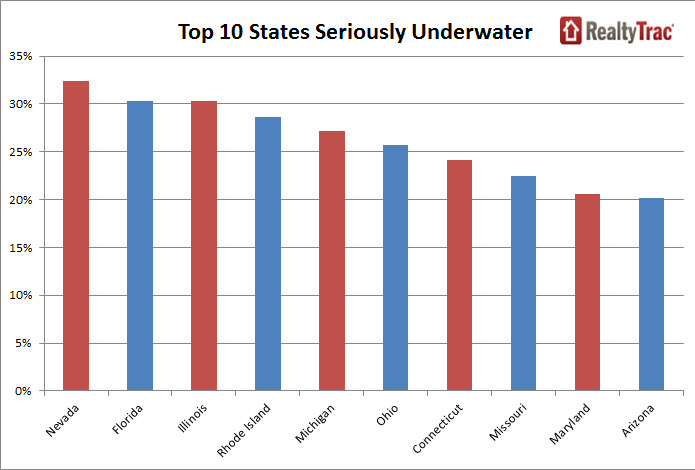
| States with the Most Negative Equity in Residential Real Estate Posted: 24 Jul 2014 11:30 AM PDT
Each quarter, RealtyTrac releases its "Home Equity and Underwater Report." According to RealtyTrac’s data, "9.1 million U.S. residential properties were seriously underwater.” Mortgages that are “seriously underwater” exceed a property’s value by at least 25 percent. They also account for 17.2 percent of all properties with a mortgage. That number decreased slightly (0.2 percent) in the second quarter. In the second quarter of 2012, there were 12.8 million properties that were "seriously underwater” — 29 percent of all homes with a mortgage
|
| Searching for water on Ganymede Posted: 24 Jul 2014 09:30 AM PDT
|
| Tales of the Death of Hedge Funds Have Been Greatly Exaggerated Posted: 24 Jul 2014 07:00 AM PDT During the past few months, we have posted a few words here on the quandary that is hedge funds. One such effort was titled "The Hedge-Fund Manager Dilemma," and it explored the public's fascination with the hedge-fund crowd. The next, "Why Investors Love Hedge Funds," looked at why, despite stunning underperformance during the past decade, so much money was still flowing to the hedge funds. Now, we are seeing early signs that some institutional investors are losing patience. Case in point: California Public Employees’ Retirement System. The Wall Street Journal noted that the pension fund is looking to reduce hedge-fund holdings by as much as 40 percent. "Public pensions from California to Ohio are backing away from hedge funds because of concerns about high fees and lackluster returns." Although this might be a rational response to issues of costs and performance, I would hasten to add that this is only anecdotal evidence. When we look at data such as money flows, it suggests hedge funds are continuing to pull in cash at an astounding pace. The hedge-fund-industrial complex now commands more than $3 trillion in assets. That is up from $2.04 trillion in 2012, and a mere $118 billion in 1997. Calpers has a reputation for being a thought leader in the institutional-investment world. I have spoken with various pension funds and foundations over the past few years, and while the issue of hedge funds is under discussion, there is no consensus. Based on what various folks in the U.S. and Europe say, there still is great interest in hedge funds. Many investors are more than willing to forsake beta (returns that match the market) in the mad pursuit of alpha (above-market returns). Still, this looks like it might be the start of something interesting. Continues here |
| Posted: 24 Jul 2014 06:00 AM PDT My morning train reads (continues here):
|
| What If Apple Products Were Their Own Companies? Posted: 24 Jul 2014 03:30 AM PDT Slate‘s Jordan Weissmann puts Apple’s product lines into perspective versus other large companies (Tech or not). iPhone revenues alone eclipse that of either software behemoth Microsoft or online retail giant Amazon. Businessweek (September 2013):
Consider these two product lines:
Truly insane.
iPad as well: |
| The Stability of Prime Money Market Mutual Funds: Sponsor Support from 2007 to 2011 Posted: 24 Jul 2014 02:30 AM PDT |




| You are subscribed to email updates from The Big Picture To stop receiving these emails, you may unsubscribe now. | Email delivery powered by Google |
| Google Inc., 20 West Kinzie, Chicago IL USA 60610 | |



0 comments:
Post a Comment