.

{2} GoogleTranslate (H)

English French German Spanish Italian Dutch Russian Portuguese Japanese Korean Arabic Chinese Simplified

Our New Stuff

{3} up AdBrite + eToro

Your Ad Here

Sunday, August 17, 2014

The Big Picture

The Big Picture


Hitchcock’s Cameos. All of them.

Posted: 16 Aug 2014 05:00 PM PDT

From each of the following: The Lodger (1927), Easy Virtue (1928), Blackmail (1929), Murder! (1930), The Man Who Knew Too Much (1934), The 39 Steps (1935), Sabotage (1936), Young and Innocent (1937), The Lady Vanishes (1938), Rebecca (1940), Foreign Correspondent (1940), Mr. & Mrs. Smith (1941), Suspicion (1941), Saboteur (1942), Shadow of a Doubt (1943), Lifeboat (1944), Spellbound (1945), Notorious (1946), The Paradine Case (1947), Rope (1948), Under Capricorn (1949), Stage Fright (1950), Strangers on a Train (1951), I Confess (1953), Dial M for Murder (1954), Rear Window (1954), To Catch A Thief (1955), The Trouble With Harry (1955), The Man Who Knew Too Much (1956), The Wrong Man (1956), Vertigo (1958), North By Northwest (1959), Psycho (1960), The Birds (1963), Marnie (1964), Torn Curtain (1966), Topaz (1969), Frenzy (1972), Family Plot (1976).


Hat tip Dangerous Minds


Lefsetz: Digital Presence

Posted: 16 Aug 2014 02:00 PM PDT

1. DIGITAL HOME

A. Wikipedia

Your goal is to be big enough to have a Wikipedia page. It’s the first place newbies go to learn about you. It’s got the imprimatur of authority, people believe what they read, however inaccurate the details may be. We live in an information age and what we want most is information. Where the act was formed, how you got your name, who the band members are and your discography, including chart placements.

It’s best if there’s personal information, who you’re dating, who you’re married to. People want to know you.

However, beware of filling out your page by yourself. One can tell when pages are written by those whose pages they are. They go on just a bit too long, there’s too much detail, whereas fans have a different tone, somewhat reverential and completist in a different fashion. After you read someone’s Wikipedia page you should still want more.

B. Website/Facebook page/Bandcamp page, etc.

If you don’t have a Wikipedia page, because you haven’t got enough traction, buy your name and establish a page at that URL. It’s got so much more gravitas than a Facebook page. You want to let people know you’re for real, that you invested some money, that you’re in it for the long haul, anybody can have a Facebook page, it tends not to be taken seriously.

Of course, if you’re big enough to have a Wikipedia page, you need your own website and a Facebook page. Once again, on your website, you need to provide information. Like tour dates. And lyrics. And it’s best if there’s a constant flow of information, so people will come back. And don’t put up a paywall, if people believe they can’t get it all for free, they’re not going to become enamored of you.

2. YOUTUBE

America’s radio station and record store all rolled up into one.

All your cuts should be up there. Don’t have any fan clips taken down. Just monetize those that appear. The smaller the act, the more important it is to post videos on a regular basis. Of covers. Maybe even of you talking to your audience. But if you’re talking, make it brief, you’re a musician not an orator and if you go on too long chances are people will get bored, or wonder who these clips are made for.

3. SPOTIFY

Don’t bitch about payments, put your music up. All of it.

And you might as well put it up on the rest of the services, like Rdio, Deezer and Beats, but know that only one will triumph in the long run, it’s the way of the web, there’s only one Google, one Amazon and one Facebook. People gravitate to where everybody else is. Spotify does not have to win, but one streaming service will.

4. SOUNDCLOUD

Gets more ink/press/talk than it deserves, but it is true that the younger generation goes there. Put your stuff up. But know to cover the above bases first.

5. iTUNES AND AMAZON

Buying is so aughts. The teens are not about ownership but access. Sure, make your stuff available for purchase, but that’s not where the money is, certainly not in the future. Sure, being number one delivers some bragging rights, but it means less than ever before. Today it’s about fanbase and money. Don’t get caught up in charts. Don’t get caught up in smoke and mirrors. So much of what you see hyped gets no traction, never mind not making any money. That’s a fool’s errand, playing the popularity game.

If you make it, your fans will make you more popular, they will spread the word, continuously, which news sites never will. News sites are all about the new. They’re voracious predators that will squeeze you dry one day and forget about you the next. Use news to make a splash, but it’s meaningless unless fans become aware of you, embrace you and tell everybody else about you.

6. SOCIAL MEDIA

People want to interact with you, but don’t get caught up in believing the social media game is either necessary or important.

The bottom line is social media is mostly about making the hoi polloi, consumers, fans, feel important. They’re the ones that are posting and looking for attention. You want to give them enough info so they’ll post about you, but your personal Twitter account doesn’t mean much unless you’re a worldwide superstar, and so often that doesn’t mean much, because those people don’t have time to post themselves.

So you want a Facebook page. Don’t feel pressured to post on it yourself, let your minions do so.

And you want a Twitter account. It’s great if you post, but Twitter can be a huge time-sucker that pays few dividends. Better to practice your instrument than to live on Twitter.

7. GOSSIP

Paris Hilton established the paradigm, Kim Kardashian perfected it. Gossip is a career unto itself, which is why so many of its practitioners are famous for nothing else. So beware of the gossip columns unless that’s your primary game, they make musicians look small, which is why Kanye is faltering.

8. NEWS SITES

Press releases are irrelevant unless you’re truly a star and your tour is canceled or you kicked out a band member or you signed a movie deal. However, for the past couple of years, it’s better if you share this info yourself on one of your own sites. It makes the bond to your fans so much clearer.

9. PERIPHERAL SITES

Just because it’s available that does not mean anybody will see it. Sure, stream your album on NPR, if it’s available absolutely everywhere else, otherwise it looks like you’re playing in a walled garden, one where most people are unaware of you.

It comes down to Google. When I Google your name, what comes up?

Hopefully your personal website and then your Wikipedia page, or vice versa.

Right now there’s nowhere to go where all of your online presence is listed, which is why the major sites are so important. Sure, some fans might get past the first page of Google, but most don’t get past the first two HITS! Everything I want to know about you should come up there. If not, your team is not doing it right.

10. FADS

The longer we live in the Internet age, the more things stay the same.

It comes down to the art. The music and then the video.

And there’s so much information, that it helps to have money to make an initial impression, to get the ball rolling.

And then it’s about being available absolutely everywhere so if someone’s interested in you, they can experience you.

Don’t overthink it. Don’t release a single from your album every week. We’re on information overload, we can’t keep paying attention, the only ones who do are the hardest core of fans.

Beyonce had it right. Announce and release simultaneously, all of it. Because the truth is very little lasts. So you want the benefit of the splash. You want to sell while you’re promoting. And if you’re lucky, you’ll get traction.

Market manipulation is history.

You do it in an obvious way. And you make your fans happy. They are the ones who will grow you, it’s very hard to get someone who’s not concerned to be so. So much is hyped every day that people don’t have time to click through and check you out. The plethora of information might get them to your Wikipedia page, to YouTube, which is why you must have a presence there, but the truth is the power lays in the hands of those you’ve already converted, they will not stop talking about you, they will implore others to check you out.

Which is why it’s so important to focus. When someone spreads the word, make sure one track stands above. That’s one great thing about Spotify, they list the tracks in order of popularity. Always put yourself in the shoes of the know-nothings. If they get bitten, how can they enter your universe? Make it complicated, require multiple clicks, more Googling, and they won’t make the effort.

Meanwhile, keep feeding your fans. You’ve got two trains running, making those already converted happy and entrancing new people, and don’t confuse the two. Don’t wait so long to put out new material that the hard core fan is frustrated and moves on. And don’t think that the newbie is interested in anything more than the single.

But if someone is interested, they should be able to go online and go down the rabbit hole into your career. They should be able to spend hours researching, learning and listening. And you’ve got to make it easy for them to do this, by not only being everywhere, but pointing to what they should devour first. You don’t take someone to their first French restaurant and insist that they eat the snails. Start out with the killer onion soup, then maybe the duck. If they like that they’ll sample the foie gras and keep talking about you.

Then again, food’s got a whole network devoted to it, where the personalities shine but the food trumps and triumphs.

So many in music have lost the plot. Not only does MTV not focus on music, so many musicians are focused on their brand, their stardom and sponsorships. Put the music front and center. If you hew to this mantra the rest will follow.


~~~


Visit the archive:   http://lefsetz.com/wordpress/

@Twitter  http://www.twitter.com/lefsetz

If you would like to subscribe to the LefsetzLetter

Why Long-Term Investors Beat Short-Term Traders

Posted: 16 Aug 2014 08:30 AM PDT

No matter what, the long-term investor comes out ahead of the short-term trader
Barry Ritholtz
Washington Post, August 10, 2014


Last time, we looked at why traders are at an almost insurmountable disadvantage against investors due to short-term capital gains taxes. Many of you wrote in to note several factors that would have allowed the active trader to narrow the gap against the long-term investor. A few of you asked how likely it was that a trader would outperform by that margin year after year. This week, I want to review those issues readers raised, looking to see how they affected our competition between the long-term indexer and the short-term trader.

Spoiler alert: The issues to which I gave short shrift did improve the performance of the trader, but not nearly enough to narrow the gap between the two. Let's look at the details.

There are three factors I oversimplified or overlooked: The first is the tax loss carry forward. This was the biggest issue raised by readers and the one that had the single biggest impact on the net performance of the trader's account.

As readers noted, the IRS allows losses from past years to be carried forward, reducing the tax bite in outlying years following a big down year such as 2008 or '09. This will narrow the gap between our two competitors. For the two to see similar performance net of taxes, the trader need only outperform the benchmark index by about 30 percent instead of the 40 percent we discussed. A challenging bogey to be sure, but less so than I originally stated.

Second, several people raised the issue of dividends working for the investor but not for the trader. I elected to ignore them for traders in my comparison and ended up understating the trader's performance ever so slightly. An account that is trading equities actively, with relatively short holding periods, may or may not be a holder of record when a dividend is issued in any given quarter. And when a stock goes ex-dividend, its share price typically drops by the amount of the dividend, making it a wash to shorter-term traders. Some readers who trade actively noted that they had healthy dividend incomes each year and had the tax filings to prove it. However, the amounts involved relative to the investor were minor.

Consider that an investor who held on to the Standard & Poor's 500-stock index for the year of 2013 captured a dividend yield of a little over 2 percent. I assumed traders missed at least half of that, as they were buying and selling stocks. They then paid taxes on what they did collect. We are left with a likely gain of plus or minus 1 percent, and I suspect for many active traders, it's closer to zero than 1 percent. I discounted the dividend to traders entirely, as it's not especially significant to the total performance. I am going to stay with that call.

The third factor several of you pointed out, which is significant, was that the long-term investor still owed taxes on their gains. Assuming the portfolio was not in an IRA or 401(k) or other tax-advantaged structure, long-term capital gains are owed. Our passive index investor is likely to owe a 20 percent capital gains tax when cashing out. Keep in mind, however, that this investor typically draws down 4.5 percent per year in retirement. Their tax bite is going to be at its lowest level in their lifetime during retirement. Given modern life spans, they can also expect to benefit from continuing appreciation of their passive portfolios during their 20-plus years of retirement.

These taxes will narrow that gap, but it is offset by potential gains over the retirement period. The extent of the offset depends on how much the market gains over that 20-year period. Active traders do not garner that benefit (unless they roll their trading accounts over into a broad index). Note that I assume none of you plan to spend your golden years watching the market tick by tick and jumping in and out of stocks.

In our theoretical competition, if the issues raised by readers are resolved in the trader's favor, the gap between the two is narrowed. Losses carried forward reduce the disadvantage to the trader, dividends help ever so slightly and taxes owed by the investor reduce his net gains. Let's assume that all ties go to the runner: If we were to be aggressive in our assumptions favoring the trader, all the benefits of those issues raised by readers to the active portfolio reduce the outperformance by the indexer. But it is still substantial, as the active trader "only" has to outperform the S&P 500 by 25 percent instead of 40 percent.

Those were the issues raised by traders who challenged my underlying premise. Readers who were sympathetic to my argument raised different but just as important questions. Three issues from the investor side were: 1. How likely was it that any trader was going to beat the market in any given year? 2. By how much was that trader likely to beat the market? 3. What are the odds the trader would beat the market 20-plus years in a row?

These questions get to the heart of the active vs. passive debate. The data is terribly unfavorable to the active trader by an immense margin. Indeed, the math of active management is daunting.

Let's use mutual fund performance as our stand-in for active traders. Data from Morningstar and Vanguard shows that in any given year, 20 to 30 percent of active managers can outperform their benchmarks. Note that this is usually by a few percent, and not the 25 percent we have discussed.

But that's for only one year. Where things get interesting is what happens when we look at consecutive years. For any manager who outperforms in a given year, only 1 in 10 will continue to outperform in two of the next three years. In other words, 10 percent of our original outperformers — about 3 percent total — can keep their streak alive for three consecutive years. Over five years, only 1 in 33 of our original alpha generators keeps the winning streak going. Once we figure in their costs and fees, it works out to be less than 1 percent — 1 in 100 — who manage a net outperformance of a few basis points a year.

Perhaps the best-known winning streak of all time has been that by Legg Mason's Bill Miller. Over 15 years (1991-2005) his Capital Management Value Trust (LMVTX) outperformed the S&P 500. Note that this period included two Middle East wars, the dot-com crash and the housing boom. Miller, a deep-value manager, saw his streak end when the housing boom busted and the credit crisis crushed the financial sector (LMVTX had concentrated exposure to that sector). The fund went from the top 1 percent of all mutual funds to the bottom 1 percent over the ensuing years.

Hence, our thought experiment requires us to begin with what has proved to be an impossibility: beating the market by a substantial percentage for an unprecedented number of years.

I may have somewhat overstated some of the tax disadvantages of the active trader vs. the passive indexer. But the bottom line remains the same: Short-term taxes that are paid — and therefore not compounded over the decades — take a huge bite out of a portfolio. That assumes you are a terrific trader. But the odds are that you are not. Forget alpha, or market beating returns. Most people don't even achieve beta, which is market matching returns. In the real world, the win goes to the passive indexer.

~~~

Ritholtz is chief investment officer of Ritholtz Wealth Management. He is the author of "Bailout Nation" and runs a finance blog, the Big Picture. Twitter: @Ritholtz.

MiB: Jim Chanos, Kynikos Associates

Posted: 16 Aug 2014 06:45 AM PDT

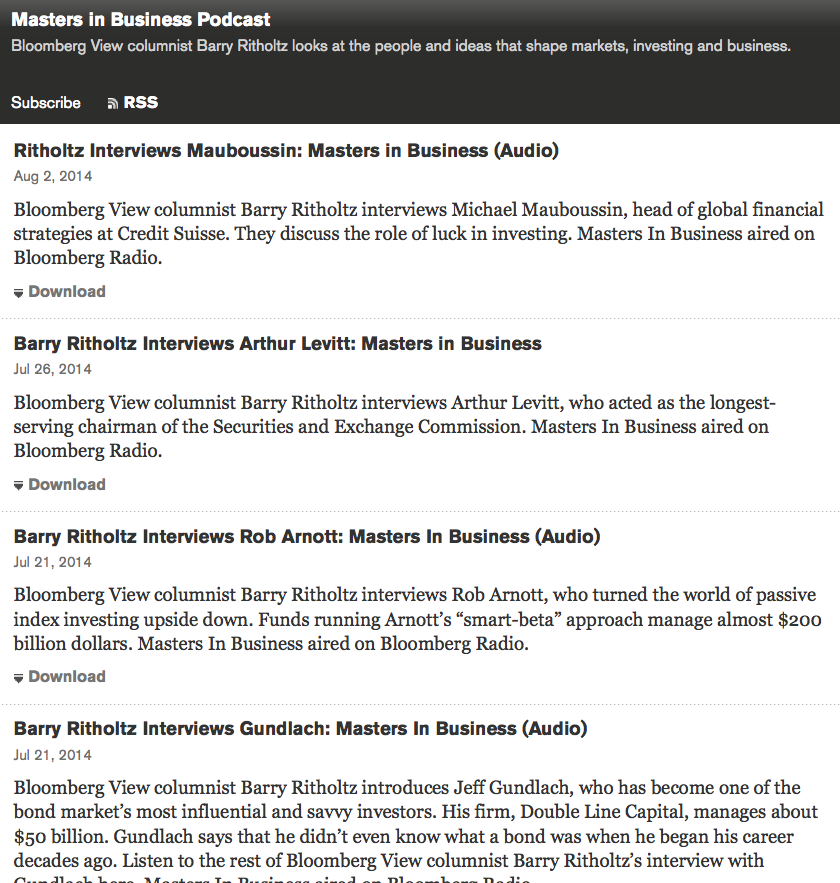
This week’s Masters in Business Radio show is on at 10:00 am and 6:00 pm on Bloomberg Radio 1130AM and Siriux XM 119. Our guest is famed short seller and hedge fund manager Jim Chanos.

You can listen to live here.

All of the past Podcasts are here and at Soundcloud and coming soon to Apple iTunes.


Mib PC


10 Weekend Reads

Posted: 16 Aug 2014 04:30 AM PDT

Happy weekend! Settle into your favorite easy chair, pour yourself some coffee, and enJoy our long form reads:

• When She Talks, Banks Shudder (NY Times)
• Inside YouTube’s Fame Factory (Fast Company) see also YouTube Stars More Popular Than Mainstream Celebs Among U.S. Teens (Variety)
• Potato Salad: By the Numbers (Kickstarter)
• When data becomes dangerous: Why Elon Musk is right and wrong about AI (GigaOm)
• Israel, Gaza, War & Data (Medium)
• Stop predicting the future. Leave that to the robot who’s going to steal your job. (The Guardian) see also AI, Robotics, and the Future of Jobs (Pew Research)
• You’re 16.  You’re a Pedophile.  You Don’t Want to Hurt Anybody. What Do You Do Now? (Medium)
• What happened to the art of an overhand curveball? (Sports On Earth)
• The Beatles at Candlestick in 1966: An oral history from the fans (SF Gate)
• Playboy Interview: George Carlin (Longform)

What’s up for the weekend?


Banks, Financial Firms Load Up On Cheap Debt

Source: WSJ


Mauldin: Bubbles, Bubbles Everywhere

Posted: 16 Aug 2014 03:00 AM PDT

Bubbles, Bubbles Everywhere
By John Mauldin
August 15, 2014


Easy Money Will Lead to Bubbles
Excess Liquidity Creating Bubbles
Humans Never Learn
Anatomy of Bubbles and Crashes
A Few Good Central Bankers
Jack Rivkin at His Best
Dallas, San Antonio, and Washington DC


The difference between genius and stupidity is that genius has its limits.
– Albert Einstein

Genius is a rising stock market.
– John Kenneth Galbraith

Any plan conceived in moderation must fail when circumstances are set in extremes.
– Prince Metternich

I’m forever blowing bubbles, Pretty bubbles in the air
They fly so high, nearly reach the sky, Then like my dreams they fade and die
Fortune’s always hiding, I’ve looked everywhere
I’m forever blowing bubbles, Pretty bubbles in the air
Burr and Campbell


You can almost feel it in the air. The froth and foam on markets of all shapes and sizes all over the world. It's exhilarating, and the pundits who populate the media outlets are bubbling over. There's nothing like a rising market to lift our moods. Unless of course, as Prof. Kindleberger famously cautioned (see below), we are not participating in that rising market. Then we feel like losers. But what if the rising market is … a bubble? Are we smart enough to ride it high and then bail out before it bursts? Research says we all think that we are, yet we rarely demonstrate the actual ability.

My friend Grant Williams thinks the biggest bubble around is in complacency. I agree that is a large one, but I think even larger bubbles, still building, are those of government debt and government promises. When these latter two burst, and probably simultaneously, that will mark the true bottom for this cycle now pushing 90 years old.

So, this week we’ll think about bubbles. Specifically, we’ll have a look at part of the chapter on bubbles from Code Red, my latest book, coauthored with Jonathan Tepper, which we launched late last year. I was putting this chapter together about this time last year while in Montana, and so in a lazy August it is good to remind ourselves of the problems that will face us when everyone returns to their desks in a few weeks. And note, this is not the whole chapter, but at the end of the letter is a link to the entire chapter, should you desire more.

As I wrote earlier this week, I am NOT calling a top, but I am pointing out that our risk antennae should be up. You should have a well-designed risk program for your investments. I understand you have to be in the markets to get those gains, and I encourage that, but you have to have a discipline in place for cutting your losses and getting back in after a market drop.

There is enough data out there to suggest that the market is toppy and the upside is not evenly balanced. Take a look at these four charts. I offer these updated charts and note that some charts in the letter below are from last year, but the levels have only increased. The direction is the same. What they show is that by many metrics the market is at levels that are highly risky; but as 2000 proved, high-risk markets can go higher. The graphs speak for themselves. Let's look at the Q-ratio, corporate equities to GDP (the Buffett Indicator), the Shiller CAPE, and margin debt.

We make the case in Code Red that central banks are inflating bubbles everywhere, and that even though bubbles are unpredictable almost by definition, there are ways to benefit from them. So, without further ado, let's look at what co-author Jonathan Tepper and I have to say about bubbles in Chapter 9.

Easy Money Will Lead to Bubbles and How to Profit from Them

Every year, the Darwin Awards are given out to honor fools who kill themselves accidentally and remove themselves from the human gene pool. The 2009 Award went to two bank robbers. The robbers figured they would use dynamite to get into a bank. They packed large quantities of dynamite by the ATM machine at a bank in Dinant, Belgium. Unhappy with merely putting dynamite in the ATM, they pumped lots of gas through the letterbox to make the explosion bigger. And then they detonated the explosives. Unfortunately for them, they were standing right next to the bank. The entire bank was blown to pieces. When police arrived, they found one robber with severe injuries. They took him to the hospital, but he died quickly. After they searched through the rubble, they found his accomplice. It reminds you a bit of the immortal line from the film The Italian Job where robbers led by Sir Michael Caine, after totally demolishing a van in a spectacular explosion, shouted at them, "You're only supposed to blow the bloody doors off!"

Central banks are trying to make stock prices and house prices go up, but much like the winners of the 2009 Darwin Awards, they will likely get a lot more bang for their buck than they bargained for. All Code Red tools are intended to generate spillovers to other financial markets. For example, quantitative easing (QE) and large-scale asset purchases (LSAPs) are meant to boost stock prices and weaken the dollar, lower bonds yields, and chase investors into higher-risk assets. Central bankers hope they can find the right amount of dynamite to blow open the bank doors, but it is highly unlikely that they'll be able to find just the right amount of money printing, interest rate manipulation, and currency debasement to not damage anything but the doors. We'll likely see more booms and busts in all sorts of markets because of the Code Red policies of central banks, just as we have in the past. They don't seem to learn the right lessons.

Targeting stock prices is par for the course in a Code Red world. Officially, the Fed receives its marching orders from Congress and has a dual mandate: stable prices and high employment. But in the past few years, by embarking on Code Red policies, Bernanke and his colleagues have unilaterally added a third mandate: higher stock prices. The chairman himself pointed out that stock markets had risen strongly since he signaled the Fed would likely do more QE during a speech in Jackson Hole, Wyoming, in 2010. "I do think that our policies have contributed to a stronger stock market, just as they did in March of 2009, when we did the last iteration [of QE]. The S&P 500 is up about 20 percent plus and the Russell 2000 is up 30 percent plus." It is not hard to see why stock markets rally when investors believe the most powerful central banker in the world wants to print money and see stock markets go up.

Investors are thrilled. As Mohamed El-Erian, chief executive officer at Pacific Investment Management Company, said, "Central banks are our best friends not because they like markets, but because they can only get to their macro objectives by going through the markets."

Properly reflected on, this is staggering in its implications. A supposedly neutral central bank has decided that it can engineer a recovery by inflating asset prices. The objective is to create a "wealth effect" that will make those who invest in stocks feel wealthier and then decide to spend money and invest in new projects. This will eventually be felt throughout the economy. This "trickle-down" monetary policy has been successful in creating wealth for those who were already rich (and for the banks and investment management firms who service them) but has been spectacularly a failure in creating good jobs and a high-growth economy. The latest quarter as we write this letter will be in the 1 percent gross domestic product (GDP) range.

And to listen to the speeches from the majority of members of the Federal Reserve Open Market Committee, their prescription is more of the same. Indeed, when Bernanke merely hinted this summer that QE might end at some point, something that everyone already knows, the market swooned and a half-a-dozen of his fellow committee members felt compelled to issue statements and speeches the next week, saying, "Not really, guys, we really are going to keep it up for a bit longer."

We've seen this movie before. In the book When Money Dies, Adam Fergusson quotes from the diary of Anna Eisenmenger, an Austrian widow. In early 1920 Eisenmenger wrote, "Speculation on the stock exchange has spread to all ranks of the population and shares rise like air balloons to limitless heights. … My banker congratulates me on every new rise, but he does not dispel the secret uneasiness which my growing wealth arouses in me … it already amounts to millions." Much like after the initial Nixon Shock in the 1970s, stock prices rise rapidly when a currency weakens and money supply grows. Not surprisingly, the 1970s led to bubbles in commodities.

This chapter will show how to spot bubbles when they form, how to profit from them, and how to avoid the dire consequences when they burst.

Excess Liquidity Creating Bubbles

As we write Code Red, stock prices are roaring ahead. In fact, many asset classes are looking like bubbles from our cheap seats. (While we expect a correction at some point, when the Fed or the Bank of Japan creates money, it has to go somewhere.)

One area that stands out as particularly bubbly is the corporate bond market. Investors are barely being compensated for the risks they're taking. In 2007, a three-month certificate of deposit yielded more than junk bonds do today. Average yields on investment-grade debt worldwide dropped to a record low 2.45 percent as we write this from 3.4 percent a year ago, according to Bank of America Merrill Lynch's Global Corporate Index. Veteran investors in high-yield bonds and bank debt see a bubble forming. Wilbur L. Ross Jr., chairman and CEO of WL Ross & Co. has pointed to a "ticking time bomb" in the debt markets. Ross noted that one third of first-time issuers had CCC or lower credit ratings and in the past year more than 60 percent of the high-yield bonds were refinancings. None of the capital was to be used for expansion or working capital, just refinancing balance sheets. Some people think it is good there is no new leveraging, but it is much worse. This means that many companies had no cash on hand to pay off old debt and had to refinance.

One day, all the debt will come due, and it will end with a bang. "We are building a bigger time bomb" with $500 billion a year in debt coming due between 2018 and 2020, at a point in time when the bonds might not be able to be refinanced as easily as they are today, Mr. Ross said. Government bonds are not even safe because if they revert to the average yield seen between 2000 and 2010, ten year treasuries would be down 23 percent. "If there is so much downside risk in normal treasuries," riskier high yield is even more mispriced, Mr. Ross said. "We may look back and say the real bubble is debt."

Another bubble that is forming and will pop is agricultural land in many places in the United States (although agriculture in other countries can be found at compelling values). The bubble really started going once the Fed started its Code Red policies. Land prices in the heart of the Corn Belt have increased at a double-digit rate in six of the past seven years. According to Federal Reserve studies, farmland prices were up 15 percent last year in the most productive part of the Corn Belt, and 26 percent in the western Corn Belt and high plains. Iowa land selling for $2,275 per acre a decade ago is now at $8,700 per acre. As you can see from Figure 9.2, the increase in farmland prices beats almost anything the United States saw during the housing bubble. A lot of banks in the Midwest will have problem with their lending.

Why are we seeing so many bubbles right now? One reason is that the economy is weak and inflation is low. The growth in the money supply doesn't go to driving up prices for goods like toothpaste, haircuts, or cars. It goes to drive up prices of real estate, bonds, and stocks.

Excess liquidity is money created beyond what the real economy needs. In technical terms, Marshallian K is the difference between growth in the money supply and nominal GDP. The measure is the surplus of money that is not absorbed by the real economy. The term is named after the great English economist Alfred Marshall. When the money supply is growing faster than nominal GDP, then excess liquidity tends to flow to financial assets. However, if the money supply is growing more slowly than nominal GDP, then the real economy absorbs more available liquidity. That's one reason why stocks go up so much when the economy is weak but the money supply is rising.

It is also why stock markets are so sensitive to any hint that the Fed might ease off on QE. Real players know how the game is played. You can listen to the business media or read the papers and find hundreds of "experts" saying that stock prices are rising based on fundamentals. You can take their talking points and change the dates and find they are essentially the same as 1999 and 2006–2007. (More on the implications of this in Part II when we talk about investing.)

The rise in real estate, bonds, and stocks does not count toward any inflation measures. On the desk in his office at Princeton, Einstein once had the words "not everything which can be measured counts, and not everything which counts can be measured." Inflation happens to be one of the things that counts but can't be measured (except in very narrow terms). Excess liquidity flows from asset class to asset class. As you can see from Figure 9.3, booms and busts around the world happen whenever central banks tighten or loosen monetary policy.

Humans Never Learn

Financial bubbles happen frequently. In the 1970s, gold went from $35 to $850 before crashing. In the 1980s, the Japanese Nikkei went from 8,000 to 40,000 before losing 80 percent of its value. In the 1990s, the Nasdaq experienced the dot-com bubble and stocks went from 440 to 5,000 before crashing spectacularly in 2000. The Nasdaq lost 80 percent of its value in less than two years. Many housing bubbles over the past decade in the United Kingdom, United States, Ireland, Spain, and Iceland saw house prices go up 200 and even 500 percent and then lose over half their value in real terms.

The U.S. market has had frequent crashes: 1929, 1962, 1987, 1998, 2000, and 2008. Every time, the bubble was driven by different sectors. In 1929, radio stocks were the Internet stocks of their day. In 1962, the electronic sector crashed. The previous year, most electronic stocks had risen 27 percent, with leading technology stocks like Texas Instruments and Polaroid trading at up a crazy 115 times earnings. In 1987, the S&P had risen more than 40 percent in less than a year and over 60 percent in less than two years. In 1998, it was strong expectation on investment opportunities in Russia that collapsed. In 2000, the Internet bubble was so crazy that companies with no earnings and often no real revenues were able to go public, skyrocket, and then crash. Eventually, in all bubbles fundamental values re-assert themselves and markets crash.

Economists and investors have spilled a lot of ink describing bubbles, yet central bankers and investors never seem to learn and people get caught up in them. Peter Bernstein in Against the Gods states that the evidence "reveals repeated patterns of irrationality, inconsistency, and incompetence in the ways human beings arrive at decisions and choices when faced with uncertainty."

What is extraordinary is how much bubbles all look alike. The situations were similar in many ways. In the 1920s, the financial boom was fueled by new technologies such as the radio that supposedly would change the world. In the 1990s, the stock market rose on the rapid adoption of the Internet. Both technologies were going to fundamentally change the world. Stocks like RCA in the 1920s and Yahoo in the 1990s were darlings that went up like rockets. Figure 9.4 plots the two charts against each other. The similarities and timing of market moves are uncanny.

If you look at Figure 9.5, you can see the gold bubble in the 1970s. (Some academics have noted that the surge in gold prices closely followed the increase in inflation in the late 1970s, reflecting its value as a hedge against inflation. When inflation fell in the 1980s, gold prices followed. So it is an open question whether gold in the 1970s should be considered a bubble.)

Fast-forward 10 years, and you can see from Figure 9.6 that the bubble in the Japanese Nikkei looked almost exactly the same.

Bubbles happen again and again. The same basic ingredients are found every time: fueled initially by well-founded economic fundamentals, investors develop a self-fulfilling optimism by herding that leads to an unsustainable accelerating increase in prices. And each time people are surprised that a bubble has happened. As billionaire investor George Soros once said about financial cycles: "The only surprise is that we are always surprised."

For example, the corporate bond market appears to be in another bubble. "We have a hyper-robust bond market right now," Dallas Fed President Richard Fisher, a former investment manager, said in an interview. These robust markets are part of the Fed’s policy intent, he said, but the credit market jump has put him on guard for a new destabilizing credit boom. "You don't sit on a hot stove twice."

Economists and investors, though, repeatedly sit on hot stoves. Economic researchers have managed to create bubbles in laboratories. Economist Reshmaan N. Hussam and his colleagues not only managed to create bubbles once, they managed to bring the same subjects back in for the same experiment and still managed to reproduce bubbles. It didn't matter if people were given fundamental information regarding what was available or not. It didn't matter how financially sophisticated the participants were either: corporate managers, independent small business people, or professional stock traders. No one was immune from re-creating bubbles.

It seems that everyone is born a sucker. As humans, we developed our instincts dodging lions and chasing antelopes on the African savannah over hundreds of thousands of years. Now it seems we chase asset prices. It is as if we are hard-wired to respond to movement in what market we are following. The conclusion from repeated experiments shows that it doesn't matter if people live through one bubble or even two, they'll likely fall for bubbles again. The smarter people learn from bubbles. But they don't learn to avoid them; they participate again and simply think they're smart enough to know when to get out. This has been showed many times in trading experiments conducted by Vernon Smith, a professor at George Mason University who shared in the 2002 Nobel Prize in Economics. As Smith said, "The subjects are very optimistic that they'll be able to smell the turning point. They always report that they're surprised by how quickly it turns and how hard it is to get out at anything like a favorable price."

Anatomy of Bubbles and Crashes

There is no standard definition of a bubble, but all bubbles look alike because they all go through similar phases. The bible on bubbles is Manias, Panics and Crashes, by Charles Kindleberger. In the book, Kindleberger outlined the five phases of a bubble. He borrowed heavily from the work of the great economist Hyman Minsky. If you look at Figures 9.7 and 9.8 (below), you can see the classic bubble pattern.

(As an aside, all you need to know about the Nobel Prize in Economics is that Minsky, Kindleberger, and Schumpeter did not get one and that Paul Krugman did.)

Stage 1: Displacement

All bubbles start with some basis in reality. Often, it is a new disruptive technology that gets everyone excited, although Kindleberger says it doesn't need to involve technological progress. It could come through a fundamental change in an economy; for example, the opening up of Russia in the 1990s led to the 1998 bubble or in the 2000s interest rates were low and mortgage lenders were able to fund themselves cheaply. In this displacement phase, smart investors notice the changes that are happening and start investing in the industry or country.

Stage 2: Boom

Once a bubble starts, a convincing narrative gains traction and the narrative becomes self-reinforcing. As George Soros observed, fundamental analysis seeks to establish how underlying values are reflected in stock prices, whereas the theory of reflexivity shows how stock prices can influence underlying values. For example, in the 1920s people believed that technology like refrigerators, cars, planes, and the radio would change the world (and they did!). In the 1990s, it was the Internet. One of the keys to any bubble is usually loose credit and lending. To finance all the new consumer goods, in the 1920s installment lending was widely adopted, allowing people to buy more than they would have previously. In the 1990s, Internet companies resorted to vendor financing with cheap money that financial markets were throwing at Internet companies. In the housing boom in the 2000s, rising house prices and looser credit allowed more and more people access to credit. And a new financial innovation called securitization developed in the 1990s as a good way to allocate risk and share good returns was perversely twisted into making subprime mortgages acceptable as safe AAA investments.

Stage 3: Euphoria

In the euphoria phase, everyone becomes aware that they can make money by buying stocks in a certain industry or buying houses in certain places. The early investors have made a lot of money, and, in the words of Kindleberger, "there is nothing so disturbing to one's well-being and judgment as to see a friend get rich." Even people who had been on the sidelines start speculating. Shoeshine boys in the 1920s were buying stocks. In the 1990s, doctors and lawyers were day-trading Internet stocks between appointments. In the subprime boom, dozens of channels had programs about people who became house flippers. At the height of the tech bubble, Internet stocks changed hands three times as frequently as other shares.

The euphoria phase of a bubble tends to be steep but so brief that it gives investors almost no chance get out of their positions. As prices rise exponentially, the lopsided speculation leads to a frantic effort of speculators to all sell at the same time.

We know of one hedge fund in 1999 that had made fortunes for its clients investing in legitimate tech stocks. They decided it was a bubble and elected to close down the fund and return the money in the latter part of 1999. It took a year of concerted effort to close all their positions out. While their investors had fabulous returns, this just illustrates that exiting a bubble can be hard even for professionals. And in illiquid markets? Forget about it.

Stage 4: Crisis

In the crisis phase, the insiders originally involved start to sell. For example, loads of dot-com insiders dumped their stocks while retail investors piled into companies that went bust. In the subprime bubble, CEOs of homebuilding companies, executives of mortgage lenders like Angelo Mozillo, and CEOs of Lehman Brothers like Dick Fuld dumped hundreds of millions of dollars of stock. The selling starts to gain momentum, as speculators realize that they need to sell, too. However, once prices start to fall, the stocks or house prices start to crash. The only way to sell is to offer prices at a much lower level. The bubble bursts, and euphoric buying is replaced by panic selling. The panic selling in a bubble is like the Roadrunner cartoons. The coyote runs over a cliff, keeps running, and suddenly finds that there is nothing under his feet. Crashes are always a reflection of illiquidity in two-sided trading—the inability of sellers to find eager buyers at nearby prices.

Stage 5: Revulsion

Just as prices became wildly out of line during the early stages of a bubble, in the final stage of revulsion, prices overshoot their fundamental values. Where the press used to write only positive stories about the bubble, suddenly journalists uncover fraud, embezzlement, and abuse. Investors who have lost money look for scapegoats and blame others rather than themselves for participating in bubbles. (Who didn't speculate with Internet stocks or houses?) As investors stay away from the bubble, prices can fall to irrationally low levels.

A Few Good Central Bankers

Space suggests we need to cut it off there. You can read the rest of the chapter here. I invite you to visit the Code Red website to get the book.

Jack Rivkin at His Best

Earlier this year I shared with you a tremendous resource from my friend and Altegris CIO Jack Rivkin. Since joining Altegris in December, Jack has been offering commentary about global economic and political events, trends, investing, and alternative investments in his "CIO Perspectives" at Altegris.com. If you were able to read some of his articles, you know that he has been remarkably accurate in his predictions for the first half of the year. I highly recommend you take a moment to read his recent Mid-Year Update, which offers a valuable look at an eventful last six months and his expectations for the second half of 2014 and beyond as we get closer to the end of QE .

For more reading from Jack, I suggest his piece on the opportunities for investing in credit, "The Illiquidity Premium." Qualified investors interested in learning more can register for the Mauldin Circle to get access to the exclusive Altegris private placement platform.

Dallas, San Antonio, and Washington DC

I am enjoying my respite from travel. Right now I'm not scheduled to get on a plane until the middle of September, when I go to the Texas Hill Country near San Antonio for the Casey Research Summit, which you should check out if you're looking for a great conference this fall.

I did work in a quick trip to Washington DC at the end of the month; but now I'm home again for a spell, although partners and friends are beginning to notice that I have some time in my schedule, and I'm sure that New York will have to appear on my schedule at least once in the next two months.

We celebrated my mother's 97th birthday party last night here at the apartment, and many of her friends and family showed up. My brother told me she had been focused on the party for the last month or so, and she was certainly happy with everything last night. Her regular nurses (who come to her home to see her) told me that she is getting visibly weaker, and I was already seeing that; but she was certainly "all there" for her party. There were a few poignant moments. "I would hug you, but I can't make my arms work," she told Tiffani. And indeed she has lost much of her arm movement. The ambulance service brought her in on a stretcher and moved her around the apartment to visit with her friends.

I have to confess the evening made a bit of an emotional impact on me, as I realized when I was going to bed that evening. I really lost my desire to have a conversation, lost in my own thoughts. Mother is "only" some 32.867 years older than I am, and unless there are some significant advantages in biotechnological medicine, I may not make it past 100, either. So the final future was brought home in a fairly stark way. Perhaps, I thought to myself, part of the reason that I so strongly believe in a biotechnological revolution happening in my lifetime is that I want/need it to happen. But then, I considered again the data that tell me it really is happening, and I got up the next morning to go dance with The Beast (my trainer) at 8:15.

Sunday I go to deep East Texas to visit the weekend home/ranch of my good friend Monty Bennett. Monty grew up in the hotel business and runs a large hotel REIT and associated companies. He gives me insights into the hotel business, and we talk macro. Turns out he is an economics junkie, and I am part of his "fix." I keep running into successful businessmen who also pay attention to macroeconomics and how it affects the business cycle of their particular worlds. The hotel gig is about as countercyclical as you can get. While that makes intuitive sense, it does require a certain type of contrarian nature to be successful at hotel investing. And that nature becomes suspicious of bubbles. So we have some fodder for an interesting conversation this week as we drive through Monty's ranch, which is really an international wildlife preserve. He has all sorts of exotic deer and sheep and such from all continents of the world – ibex, gemsbok, sable antelope, red kangaroos, and something called a Barasingha deer, which I really hope to see. And all sorts of sheep that I have only read about and seen in National Geographic magazines.

Have a great week. And enjoy each and every moment you have.

Your enjoying his summer analyst,

John Mauldin

subscribers@mauldineconomics.com

.

0 comments:

Post a Comment

previous home Next

{8} chatroll


{9} AdBrite FOOTER

{8} Nice Blogs (Adgetize)