


The Big Picture |
- The Role of Oil Price Shocks in Causing U.S. Recessions
- Rare Midsize Black Hole
- 10 Wednesday PM Reads
- The Cash Behind the Super PACs
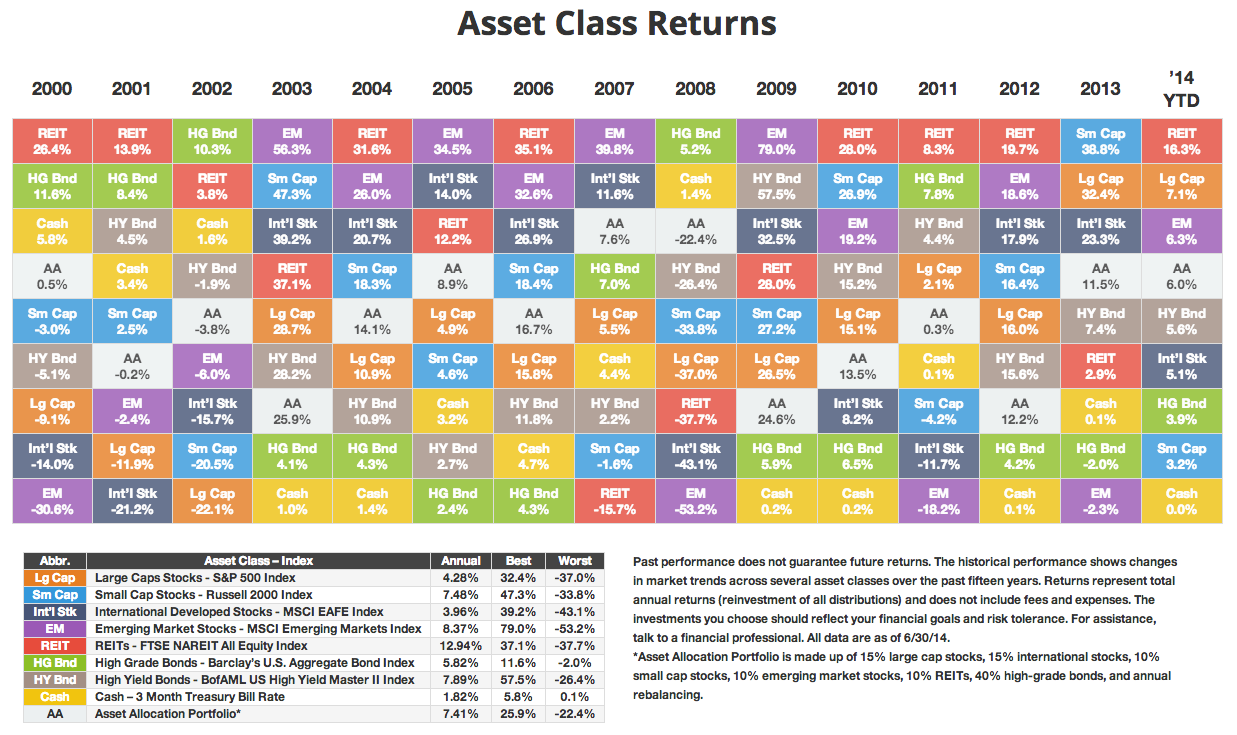
- Annual Asset Class Returns
- 10 Wednesday AM Reads
- Best & Worst Trades of All TIme
- John Oliver on Police Militarization
| The Role of Oil Price Shocks in Causing U.S. Recessions Posted: 21 Aug 2014 02:00 AM PDT |
| Posted: 20 Aug 2014 05:00 PM PDT NASA: Astronomers from the University of Maryland, College Park (UMCP) and NASA’s Goddard Space Flight Center have uncovered rhythmic pulsations from a rare breed of black hole in archival data from NASA’s Rossi X-ray Timing Explorer (RXTE) satellite. The signals provide compelling evidence that the object, known as M82 X-1, is one of only a few midsize black holes known. Dying stars form modest black holes measuring up to around 25 times the mass of our sun. At the opposite extreme, most large galaxies contain a supermassive black hole with a mass tens of thousands of times greater. Just as drivers traveling a highway packed with compact cars and monster trucks might start looking for sedans, astronomers are searching for a middle range of the black hole population and wondering why they see so few.’
M82 X-1 is the brightest X-ray source in Messier 82, a galaxy located about 12 million light-years away in the constellation Ursa Major. While astronomers have suspected the object of being a midsize, or intermediate-mass, black hole for at least a decade, estimates have varied from 20 to 1,000 solar masses, preventing a definitive classification. Working with Mushotzky and Strohmayer, UMCP graduate student Dheeraj Pasham sifted through about 800 RXTE observations of M82 in a search for specific types of brightness changes that would help pin down the mass of the X-ray source. As gas streams toward the black hole it piles up into a disk around it. Friction within the disk heats the gas to millions of degrees, which is hot enough to emit X-rays. Cyclical intensity variations in these X-rays reflect processes occurring within the disk. Scientists think the most rapid changes occur near the inner edge of the disk on the brink of the black hole’s event horizon, the point beyond which nothing, not even light, can escape. With such close proximity to the black hole, the effects of Einstein’s general relativity come into play, resulting in X-ray variations that repeat at nearly regular intervals. Astronomers call these signals quasi-periodic oscillations, or QPOs, and have shown that for black holes produced by stars, their frequencies scale up or down depending on the size of the black hole. When astronomers study X-ray fluctuations from many stellar-mass black holes, they see both slow and fast QPOs, but the fast ones often come in pairs with a specific 3:2 rhythmic relationship. For every three flashes from one member of the QPO pair, its partner flashes twice. The combined presence of slow QPOs and a faster pair in a 3:2 rhythm effectively sets a standard scale that gives scientists a powerful tool for establishing the masses of stellar black holes. A decade ago, Strohmayer and Mushotzky showed the presence of slow QPO signals from M82 X-1. In order to apply the tried-and-true relationship used for stellar-mass black holes, the researchers needed to identify a pair of steady fluctuations exhibiting the same 3:2 beat in RXTE observations. By analyzing six years of data, they located X-ray variations that reliably repeated about 3.3 and 5.1 times each second, just the 3:2 relationship they needed. This allowed them to calculate that M82 X-1 weighs about 400 solar masses — the most accurate determination to date for this object and one that clearly places it in the category of intermediate-mass black holes. This video is public domain and can be downloaded at: http://svs.gsfc.nasa.gov/goto?11625 Like our videos? Subscribe to NASA’s Goddard Shorts HD podcast: http://svs.gsfc.nasa.gov/vis/iTunes/f… Or find NASA Goddard Space Flight Center on Facebook: http://www.facebook.com/NASA.GSFC Or find us on Twitter: http://twitter.com/NASAGoddard |
| Posted: 20 Aug 2014 01:30 PM PDT My afternoon train reads:
What are you reading?
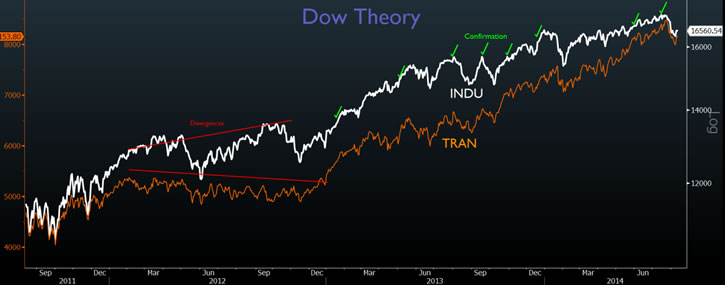
What Dow Theory Says Now
|
| The Cash Behind the Super PACs Posted: 20 Aug 2014 12:00 PM PDT
|
| Posted: 20 Aug 2014 09:30 AM PDT
Have a look a the chart above (click on the chart for a larger interactive version). This chart ranks the past 15 years of returns for eight major asset classes (large-cap stocks, small-cap stocks, developed-market stocks, emerging-market stocks, real estate investment trusts, high-grade bonds, high-yield bonds and cash). We can divide these categories even further but we’ll use these for now. What you should take away from the chart is how difficult it is to predict the best-performing asset class in any given year. To choose the right class consistently is almost impossible. |
| Posted: 20 Aug 2014 06:30 AM PDT It's the middle of the week and we’re approaching the end of the summer. Have no fear, though, our expertly-curated morning train reads are here to help you: (continues here):
|
| Best & Worst Trades of All TIme Posted: 20 Aug 2014 04:30 AM PDT Nice graphic showing the 10 greatest — and worst — trades of all time. The lure of these outsized billion dollar wins seems to affect the psychology of many investors and traders, looking for that one giant score.
click for full infographic This is a huge data set — click (and then again) to see the full size graphic.
click for ginormous infographic |
| John Oliver on Police Militarization Posted: 20 Aug 2014 03:00 AM PDT In the wake of the shooting of Michael Brown in Ferguson, MO, John Oliver explores the racial inequality in treatment by police as well as the increasing militarization of America's local police forces. |



| You are subscribed to email updates from The Big Picture To stop receiving these emails, you may unsubscribe now. | Email delivery powered by Google |
| Google Inc., 20 West Kinzie, Chicago IL USA 60610 | |



0 comments:
Post a Comment