.

{2} GoogleTranslate (H)

English French German Spanish Italian Dutch Russian Portuguese Japanese Korean Arabic Chinese Simplified

Our New Stuff

{3} up AdBrite + eToro

Your Ad Here

Wednesday, September 3, 2014

The Big Picture

The Big Picture


The Declining U.S. Reliance on Foreign Investors

Posted: 03 Sep 2014 02:00 AM PDT

The Declining U.S. Reliance on Foreign Investors
Thomas Klitgaard and Preston Mui
Liberty Street Economics, August 20, 2014


The United States has been borrowing from the rest of the world since the mid-1980s. From 2000 to 2008, this borrowing averaged over $600 billion per year, which translates into U.S. spending exceeding income by almost 5.0 percent of GDP. Borrowing fell during the recent recession, as would be expected, and then rebounded with the recovery. Since 2011, however, borrowing has trended down and fell to 2.4 percent of GDP in 2013, the smallest amount as a share of GDP since 1997. A reduced dependency on foreign funds can be viewed as a favorable development to the extent that it reflects an improvement in the fiscal balance to a more easily sustainable level. However, it also reflects the lackluster recovery in residential investment, which is one reason the economy has yet to get back to its full operating potential.

The amount borrowed from the rest of the world is measured by the current account balance, which is the broadest measure of cross-border transactions. As seen in the chart below, the United States was spending substantially above its income before the recession, to the tune of 5.8 percent of GDP in 2006. The amount of borrowing fell during the recession and started to rebound in 2010, but borrowing has since trended down.

U.S. Borrowing from Abroad

A nation's foreign borrowing is the difference between domestic saving and investment spending. Consider simplified national accounting identities with income allocated to consumption or saving and spending allocated to consumption or investment. Dropping out consumption from both identities shows that the difference between spending and income is the same as the difference between saving and investment spending, with the gap determining whether a country is lending to or borrowing from the rest of the world. That is, a country borrows from the rest of the world when it does not save enough to finance its own investment spending. From this perspective, the United States is borrowing less because the difference between saving and investment spending is shrinking.

Saving is not easy to measure. One approach is to use the current account balance and GDP data on investment spending to back out a measure of domestic saving. As seen in the next chart, U.S. borrowing declined during the recession because investment spending fell more than saving. Both saving and investment spending then recovered, with the level of external borrowing rising from 2.6 percent of GDP in 2009 to 3.0 percent in 2010. Since then, however, saving has been rising faster than investment spending.

Investment Spending and Saving

Breaking out gross investment spending into its major components in the chart below shows that overall spending is being held back relative to pre-recession levels by construction spending, with almost all the shortfall due to residential construction. Other private investment spending on equipment and software is back to pre-recession levels as a share of GDP. Government investment spending is also a contributing factor, although the gap with pre-recession levels is not large as a share of GDP.

Investment Spending by Component

GDP data include a measure of saving that breaks down gross saving into personal, business, and government components. As seen in the next chart, the business component, which consists largely of undistributed profits and depreciation, is roughly twice as large as personal saving. Both rose as a share of GDP in 2009-10 and remain above pre-recession levels, even after trending down recently.

Gross Saving by Component

The recent upswing in total gross saving is driven by the volatile government component, which is defined as current receipts less current expenditures minus depreciation. The chart below shows that the gap between revenue and adjusted expenditures widened dramatically from 2007 to 2010. Expenditures in dollar terms continued to grow during the recession at near the pace set in previous years, but the drop in GDP caused expenditures to rise as a share of GDP. The dollar growth in expenditures then slowed in 2010 and eased to very modest rates in 2011 through 2013, so that the recovery in GDP caused expenditures as a share of GDP to fall. The large drop in receipts as a share of GDP during the recession is due in part to the payroll tax cut; the end of the tax cut at the beginning of 2013 brought current receipts as a share of GDP closer to pre-recession levels.

Government Saving

Improvements in government saving can reduce private saving, particularly in the case last year when the tax-rate hike left less income to be saved. Personal saving did indeed fall last year, but its decline, equal to 1.5 percent of GDP, was not enough to offset the 2.6 percent of GDP increase in government saving.

It needs to be noted that the GDP measure of saving in 2013 is higher than the measure derived from current account and investment spending data seen in the second chart of this post. The difference is substantial, with the GDP measure having U.S. borrowing falling to 1.3 percent of GDP last year instead of 2.4 percent. Revisions will hopefully reduce this disagreement and clarify the extent and the causes of the drop in U.S. borrowing.

Disclaimer
The views expressed in this post are those of the authors and do not necessarily reflect the position of the Federal Reserve Bank of New York or the Federal Reserve System. Any errors or omissions are the responsibility of the authors.


Klitgaard_thomas
Thomas Klitgaard is a vice president in the Federal Reserve Bank of New York's Research and Statistics Group.

Mui_preston
Preston Mui is a senior research analyst in the Bank’s Research and Statistics Group.

Mass Surveillance Violates U.S. Law

Posted: 02 Sep 2014 10:30 PM PDT

UN High Commissioner: Mass Surveillance Violates International Law … and Snowden Should NOT Be Prosecuted

Despite the fancy footwork of government lawyers, mass surveillance undoubtedly violates the U.S. Constitution.   See this, this and this.

After all:

Moreover:

  • When these judges raised concerns about NSA spying, the Justice Department completely ignored them

Indeed, the NSA itself admitted that similar surveillance which it conducted in the 1970s was probably illegal:

During the Vietnam war, the NSA spied on two prominent politicians – Senators Frank Church and Howard Baker – as well as critics of government policy Muhammad Ali, Martin Luther King, and a Washington Post humorist.

A recently declassified history written by the NSA itself called the effort "disreputable if not outright illegal."

(And that's just surveillance.  The NSA might also be involved in dirtier tricks.)

Mass Surveillance Violates International Law

The U.N high commissioner for human rights released a report this week saying that mass surveillance may violate international law.   EFF summarizes:

The report is issued in response to a resolution passed with unanimous approval by the United Nations General Assembly in November 2013. That resolution was introduced by Brazil and Germany and sponsored by 57 member states.

***

Forget The "Haystack"

The report issues a powerful condemnation of the "collect-it-all" justification that an infinitely large "haystack" of personal data must be accumulated in order to find the needles. The report points out that few "needles" that have been uncovered, and that in any event:

Mass or "bulk" surveillance programmes may thus be deemed to be arbitrary, even if they serve a legitimate aim and have been adopted on the basis of an accessible legal regime. In other words, it will not be enough that the measures are targeted to find certain needles in a haystack; the proper measure is the impact of the measures on the haystack, relative to the harm threatened; namely, whether the measure is necessary and proportionate.

The second part of that passage, emphasis added, is critical: it gives guidance that the proper measure of a mass surveillance program is not its effectiveness in a vacuum, but whether the surveillance is both necessary and proportionate.

Metadata Matters

EFF has long called for moving beyond the fallacy that information about communications is somehow inherently less privacy-sensitive than the communications themselves.

***

The report agrees, debunking the argument that "interception or collection of data about a communication, as opposed to the content of the communication, does not on its own constitute an interference with privacy." It argues, "From the perspective of the right to privacy, this distinction is not persuasive" The aggregation of information commonly referred to as 'metadata' may give an insight into an individual's behaviour, social relationships, private preferences and identity that go beyond even that conveyed by accessing the content of a private communication."

Monitoring Equals Surveillance

Much of the expansive state surveillance revealed in the past year depends on confusion over whether actual "surveillance" has occurred and thus whether human rights obligations apply. Some suggest that if information is merely collected and kept but not looked at by humans, no privacy invasion has occurred. Others argue that computers analyzing all communications in real-time for key words and other selectors is not "surveillance" for purposes of triggering legal protections again, unless the analysis is by human eye.

[But the U.N.] report makes clear that:

"any capture of communications data is potentially an interference with privacy and, further, that the collection and retention of communications data amounts to an interference with privacy whether or not those data are subsequently consulted or used. Even the mere possibility of communications information being captured creates an interference with privacy, with a potential chilling effect on rights, including those to free expression and association."

(Again, emphasis added.)

Mandatory Data Retention Is Unnecessary and Disproportionate

EFF has long held that government mandated data retention impacts millions of ordinary users, compromising the online anonymity that is crucial for whistle-blowers, investigative journalists, and others engaging in political speech.

The report calls data retention mandates unlawful, saying:

Mandatory third party data retention, a recurring feature of surveillance regimes in many States, where Governments require telephone companies and Internet service providers to store metadata about their customers' communications and location for subsequent law enforcement and intelligence agency access appears neither necessary nor proportionate."

Shut the Backdoor: Re-use of Data

As EFF has noted here,here and in the legal background to the 13 Principles , many national frameworks lack "use limitations," allowing data collected for one legitimate aim, to be subsequently used for others.

The report also emphasized that point. The report explained that the absence of effective use limitations has been exacerbated since September 11, 2001, with the line between criminal justice and protection of national security blurring significantly. The resultant sharing of data between law enforcement agencies, intelligence bodies and other State organs risks violating Article 17 of the Covenant on Civil and Political Rights, because surveillance measures that may be necessary and proportionate for one legitimate aim may not be so for the purposes of another.

No Secret Law

EFF has long held that the basis and interpretation of surveillance powers must be on the public record, and that rigorous reporting and individual notification (with proper safeguards) must be required.

***

The report agreed:

Secret rules and secret interpretations even secret judicial interpretations of law do not have the necessary qualities of "law". Neither do laws or rules that give the executive authorities, such as security and intelligence services, excessive discretion; the scope and manner of exercise of authoritative discretion granted must be indicated (in the law itself, or in binding, published guidelines) with reasonable clarity. A law that is accessible, but that does not have foreseeable effects, will not be adequate. The secret nature of specific surveillance powers brings with it a greater risk of arbitrary exercise of discretion which, in turn, demands greater precision in the rule governing the exercise of discretion, and additional oversight.

Human Rights Law Does Not Discriminate For "Foreigners"

This new report underscore the value that the UN places on "measures to ensure that any interference with the right to privacy complies with the principles of legality, proportionality and necessity regardless of the nationality or location of individuals whose communications are under direct surveillance."

Again this position is supported by our previous submissions, available here and here and here. In the words of the report:

If a country seeks to assert jurisdiction over the data of private companies as a result of the incorporation of those companies in that country, then human rights protections must be extended to those whose privacy is being interfered with, whether in the country of incorporation or beyond. This holds whether or not such an exercise of jurisdiction is lawful in the first place, or in fact violates another State's sovereignty.

We have seen precisely these questions raised, and not always answered satisfactorily, in cases like the demands to Twitter for information on Wikileaks supporters or Chevron's demands for email data to Twitter, Google and Yahoo.

Right to an Effective Remedy and Notification

Quite impressively, the report lays out four characteristics that effective remedies for surveillance-related privacy violations must display. Those remedies must be "known and accessible to anyone with an arguable claim."  This means that notice is critically important, and that people must be to challenge the legality of the surveillance program without having to prove that their particular communication was monitored or collected.

EFF has always said that the notification principle is essential in fighting illegal or overreaching surveillance. Individuals should be notified of authorization of communications surveillance with enough time and information to enable them to appeal the decision, except when doing so would endanger the investigation at issue.

The report continues, stressing the importance of a "prompt, thorough and impartial investigation"; a need for remedies to actually be "capable of ending ongoing violations"; and noting that "where human rights violations rise to the level of gross violations…as criminal prosecution will be required".

No Tech Backdoors

EFF has said no law should impose security holes in our technology in order to facilitate surveillance. Diminishing the security of hundreds of millions of innocent people who rely on secure technologies in order to ensure surveillance capabilities against the very few bad guys is both overbroad and short-sighted.

The report supports that conclusion, stating that: "The enactment of statutory requirements for companies to make their networks "wiretap-ready" is a particular concern, not least because it creates an environment that facilitates sweeping surveillance measures."

Company Complicity

Finally, the report addresses the issue of when companies should and should not assist states with technology or with access to user data—and what obligations those companies have when there is an overreach.

The Guiding Principles clarify that, where enterprises identify that they have caused or contributed to an adverse human rights impact, they have a responsibility to ensure remediation by providing remedy directly or cooperating with legitimate remedy processes.

The responsibility to respect human rights applies throughout a company's global operations regardless of where its users are located, and exists independently of whether the State meets its own human rights obligations.

***

From the report:

International human rights law provides a clear and universal framework for the promotion and protection of the right to privacy, including in the context of domestic and extraterritorial surveillance, the interception of digital communications and the collection of personal data.

The U.N. High Commissioner on Human Rights – Navi Pillay – also said this week that Snowden should not be prosecuted:

Those who disclose human rights violations should be protected. We need them. And I see some of it here in the case of Snowden, because his revelations go to the core of what we are saying about the need for transparency, the need for consultation of all, as what we say, 'multi-stakeholders,' everybody concerned. So we do owe it to him for drawing our attention to this issue.

10 Tuesday PM Reads

Posted: 02 Sep 2014 02:30 PM PDT

My afternoon train reads:

• There’s No Need for Investors to Fear September (WSJ)
• Stocks Are Red Hot. Investors Are Cold Sober (Bloomberg) see also Safety Dance (Reformed Broker)
• 100 to 1 in the stock market (Seeking Wisdom)
• The Incredible Shrinking Airline Seat Has a Back Story (Bloomberg View)
• Google’s Self-Driving Cars Still Face Many Obstacles (MIT Technology Review) see also U.S. Utilities Push the Electric Car (WSJ)
• US shale: What lies beneath (FT)
• Buying Insurance After a Disaster Strikes (A Wealth of Common Sense)
• The invasion of Ukraine, in maps, satellite photos, and video (Quartz)
• Paul Shaffer’s Life With Letterman (Daily Beast)
• Listomania — Over 1,200 fun facts organized by lists (Boing Boing)

What are you reading?


China Is Awash in Grain Crops

Source: WSJ


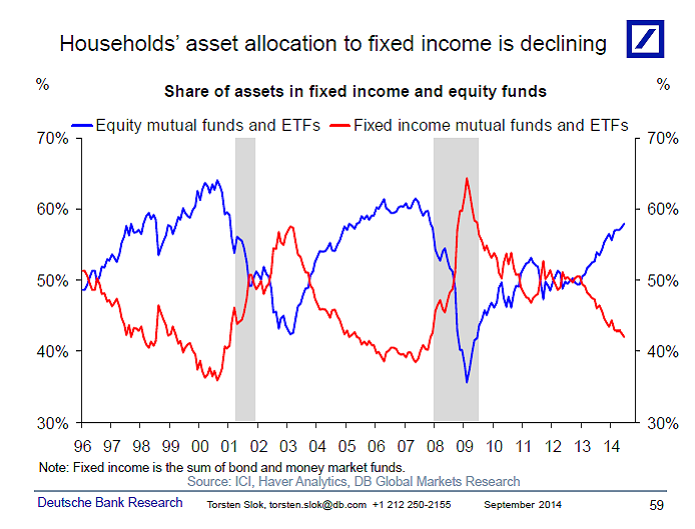
Household Rotation from Fixed Income to Equities

Posted: 02 Sep 2014 11:30 AM PDT

iUXTAMlaK7Ys


Today's chart comes to us from Torsten Slok, the chief international economist at Deutsche Bank AG.

While rumors of an institutional rotation — selling equities and buying fixed income — swirl, we see the opposite behavior from households.

Continues here


Masters in Business: James O’Shaughnessy

Posted: 02 Sep 2014 09:00 AM PDT

James O'Shaughnessy of O'Shaughnessy Asset Management got his start in finance almost by accident: He was asked by a pension fund to review the performance of their various asset managers. Analyzing the investments by their quantitative characteristics, he reverse-engineered each of the portfolios, determining a more efficient and better-performing version of each one. Thus began his career in finance as a quant.

O'Shaughnessy came to the attention of the rest of the financial world as the author of “What Works On Wall Street.” The book, now in its fourth edition, is a quantitative look at the various investment strategies that have and haven’t been successful during the past century. Today, he is the chairman and chief executive officer of O'Shaughnessy Asset Management, which runs almost $7 billion dollars in client money.

You can stream the podcast on SoundCloud, or download it and find previous podcasts here.

Next week, we speak with David Rosenberg, formerly Merrill Lynch's North American chief economist, now strategist and economist at Gluskin Sheff in Toronto.


10 Tuesday AM Reads

Posted: 02 Sep 2014 04:15 AM PDT

Welcome back my friends to the linkfest that never ends: Its the first work day back since Summer ended, but we have you covered  (continues here):

• For stocks, September can be the cruelest month. (WSJ)
• Why is the Shiller CAPE so High? (Philosophical Economics)
• Size Matters (Barron’s)
• The strategic flight (TRB) see also A Global Passive Benchmark with ETFs and Factor Tilts (GesaltU)

Continues here


.

0 comments:

Post a Comment

previous home Next

{8} chatroll


{9} AdBrite FOOTER

{8} Nice Blogs (Adgetize)