


The Big Picture |
- Oil-Part 1
- 10 Monday PM Reads
- Muni Mania: A Timeline
- No, Black Friday Sales Were Not Down 11%
- 10 Monday AM Reads
- Tracking Inside Info in ‘Fight Club’ Ring
| Posted: 02 Dec 2014 02:00 AM PST Oil-Part 1
Every so often we get a shock from the oil patch. Sometimes the price spikes (1973-4 saw a quadrupling) and sometimes plummets (a drop from $115 to under $70 in this year of 2014). This downward price shock is large enough to force change. Bullets follow. 1. Someone's income is someone else's expense. Losers are those who were dependent on rising or steady oil prices. Winners are those who benefit from lower oil prices and lower prices for all the things whose cost is driven in part by the cost of oil. 2. High-yield bonds dependent on higher energy prices are now at greater risk. Therefore bond analysis must separate energy-dependent flows supporting bonds from those that are not tied to the Energy sector. 3. The composition of the US economic recovery since 2009 has a large growth component sourced in the Energy sector renaissance in our country. Some part of that component is now going to stop growing. Other parts will defer capital expenditures. The falling price of oil in the US has now reached levels where many properties and activities function below the marginal cost of production. Facilities lose money while they try to stay in business. This will assuredly trigger retrenchment in the Energy sector. 4. Company by company, entity by entity, and trust by trust – all need to be analyzed separately. Their capital structures require examination to determine if they have hedged themselves with futures contracts. How have they protected themselves from oil price volatility? Some are hedged for years. They have a fixed selling price for the next long period of time. Others are unhedged. Investors now must do serious homework and take nothing for granted. 5. 2015 may be an entry point for those who are underweight in Energy. The sector will experience rapid volatility. Some entities will reach washed-out pricing. They may be purchasable at the right (cheap) price under current circumstances. A drop in the oil price from $115 to under $70 is monumental. In the geopolitical arena, the ramifications are also monumental. Budgets of many foreign countries are coming under duress. Civil unrest is unlikely to increase in those countries due to their inability to fund subsidies that have acted to bribe the population. We look for more geopolitical turmoil worldwide and regime change in some countries. In others, dictators suppress the population with machine guns, so the unrest is below the surface until it explodes. There is one more dynamic set in motion in circumstances like this. The strongest of the currencies and most durable of the economies get stronger and more durable. We expect a continual increase of capital flows into the US. America is the safest of havens in the world. These flows are bullish for US stocks and high-grade bonds, as global agents from throughout the world safety seek safety. Lastly, US policy could take advantage of these opportunities to strengthen America and make it more independent and self-sufficient. Achieving that goal, however, depends on political agreement. Therein is our country's weakness. The White House, the Senate, and the House of Representatives, Democrats and Republicans, still have not found a way to set aside partisan poison so that they can act cohesively for the benefit of our country. Our biggest risk comes from the stymied political sector. Meanwhile, Main Street and Wall Street will enjoy the lower gasoline prices and the lower energy price dividend resulting from a global oil glut. We remain bullish on US stocks and constructively barbelled or hedged in the bond market. David R. Kotok, Chairman and Chief Investment Officer |
| Posted: 01 Dec 2014 02:30 PM PST My afternoon train reads:
What are you reading?
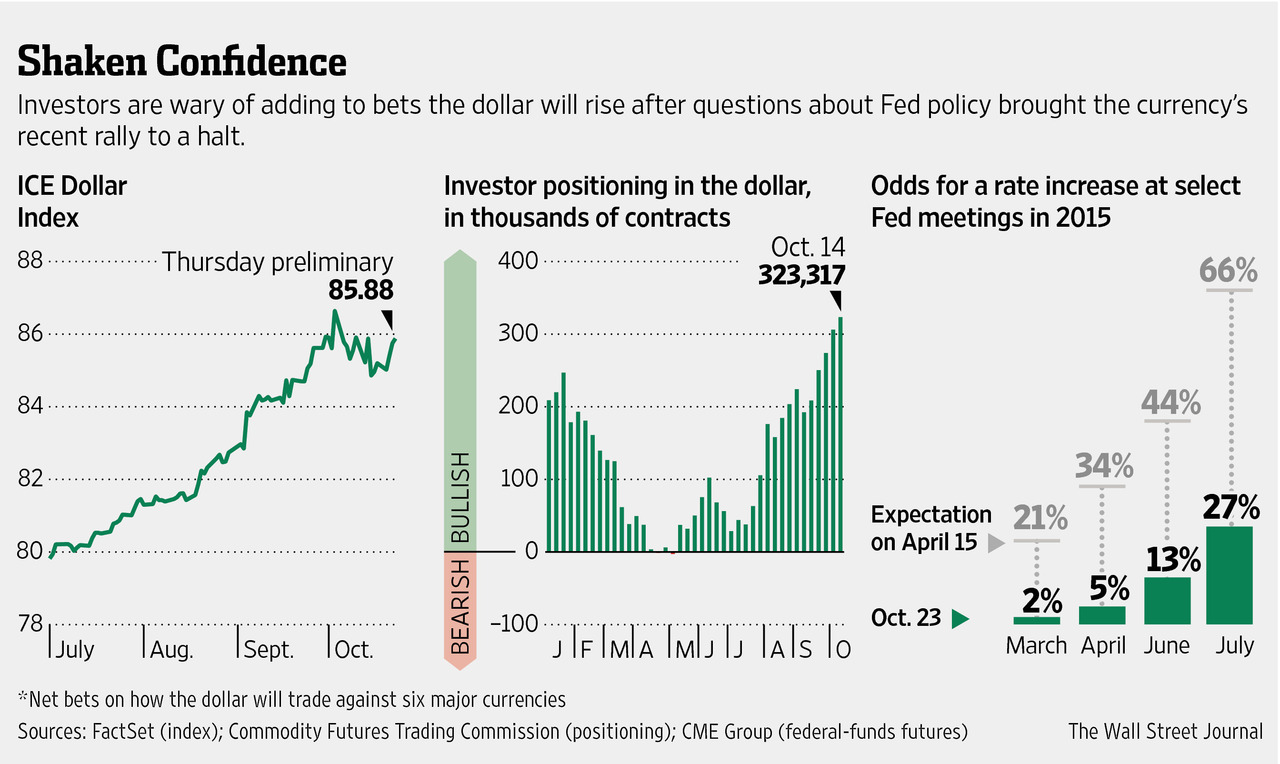
Dollar Bulls Slow the Stampede
|
| Posted: 01 Dec 2014 10:00 AM PST
|
| No, Black Friday Sales Were Not Down 11% Posted: 01 Dec 2014 07:00 AM PST The New York Times headline declared, "Thanksgiving Weekend Sales, at Stores and Online, Slide 11 Percent." Not to be outdone, the Wall Street Journal reported, "'Black Friday' Fades as Weekend Retail Sales Sink." And — to prove I’m not playing favorites — Bloomberg News noted that, “Black Friday Fizzles With Consumers as Sales Tumble 11%.” Please repeat the following, once again with gusto: We don’t know what Black Friday sales were, not yet. And we certainly don’t know what the impact of the actual number will be on final holiday retail data. How did we get these numbers, which almost by definition are wrong? It is a combination of a retail trade group that cares little for accurate economic data, a terrible survey methodology and a naive and lazy news media, which seems to believe its role is to mindlessly repeat whatever nonsense is peddled by the aforementioned trade group. Let's start with the National Retail Federation (NRF), which surveyed 4,600 consumers on Nov. 28-29. Based on that, the NRF concluded that holiday weekend sales were "estimated to have dropped 11 percent, to $50.9 billion, from $57.4 billion last year." Note the use of decimals, which indicates both precision and that the NRF has a sense of humor. I have been critiquing this foolishness each year since 2005. As we noted last week in “Retailing’s Black Friday Hoax,” the NRF forecasts have an abysmal track record: "Every year, I exhort investors to ignore this data series. It has no correlation to actual retail sales, tells us nothing about retail profits and gives us no insight into the holiday season."
|
| Posted: 01 Dec 2014 04:50 AM PST Back from the holidays, five pounds heavier. Our morning train reads however, remain the same lean 10 bullet points you have come to know and love:
|
| Tracking Inside Info in ‘Fight Club’ Ring Posted: 01 Dec 2014 03:00 AM PST From Bloomberg Graphics:
|


| You are subscribed to email updates from The Big Picture To stop receiving these emails, you may unsubscribe now. | Email delivery powered by Google |
| Google Inc., 1600 Amphitheatre Parkway, Mountain View, CA 94043, United States | |



0 comments:
Post a Comment