


The Big Picture |

- Open Thread: Sequester/Deficit/Spending/Taxes?
- 10 Thursday PM Reads
- Taleb: Inorganic Policy, Fragile Banking
- Real Delivery: Presenting as Yourself
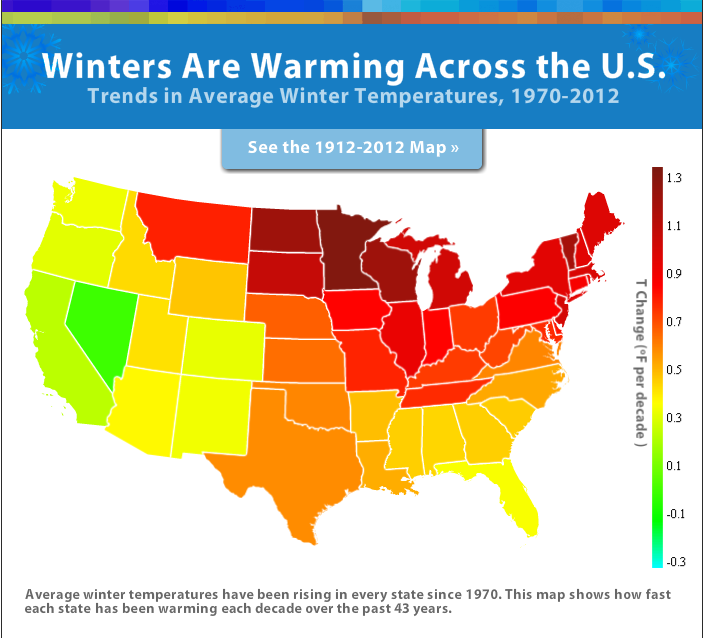
- Winter Warming Accelerated Since 1970
- Timeline of Cyber-Attacks from China
- EZ manufacturing and services data disappoints
- 10 Thursday AM Reads
- How Under Reserved is BAC?
- Whatever It Takes
- Astroseismology Finds Smallest Planet Outside Solar System
- What’s Wrong with the Financial Services Industry?
| Open Thread: Sequester/Deficit/Spending/Taxes? Posted: 21 Feb 2013 04:30 PM PST Hey, guess what? Its time for one of our patented new & improved Open Threads. Let’s get right to the good stuff, with these 5 questions:
What say ye?  |
| Posted: 21 Feb 2013 02:00 PM PST My afternoon train reads:
What are you reading?
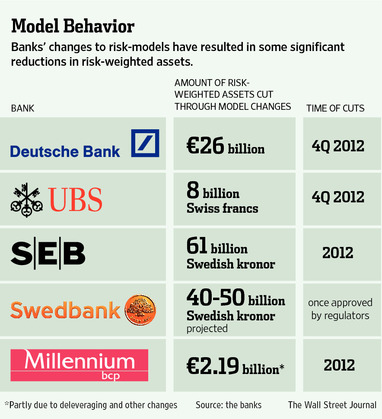
European Banks Move to Boost Health Gauge  |
| Taleb: Inorganic Policy, Fragile Banking Posted: 21 Feb 2013 02:00 PM PST Nassim Nicholas Taleb, a New York University professor and author of “The Black Swan” and “Antifragile: Things That Gain From Disorder,” talks about financial markets, the banking industry and fiscal policy. He speaks with Erik Schatzker and Sara Eisen on Bloomberg Television’s “Market Makers.” Bloomberg Feb. 19 2013  |
| Real Delivery: Presenting as Yourself Posted: 21 Feb 2013 12:00 PM PST Presentation delivery is often the most important yet the least tended to leg of the Presentation Ecosystem (Duarte 2008). In this presentation, I share with you my tips for presentation delivery success: REAL (Readiness, Engagement, Authenticity, and Lasting Impression). Note: This deck blends the delivery ideas of Nancy Duarte and Garr Reynolds.
Chiara Ojeda + Follow  |
| Winter Warming Accelerated Since 1970 Posted: 21 Feb 2013 11:30 AM PST Rates of warming (°F per decade) for average winter (Dec.-Feb.), 1970-2012. Click image to enlarge.
Wow . . .
As per our prior discussion of comments, I am looking to identify people who do not belong at this site. Have fun!  |
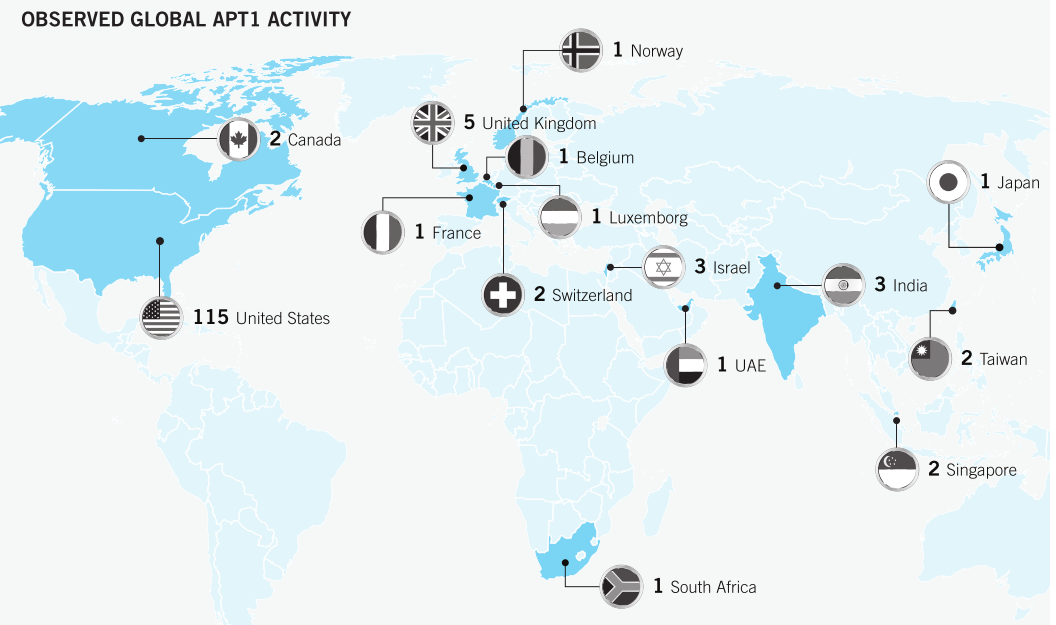
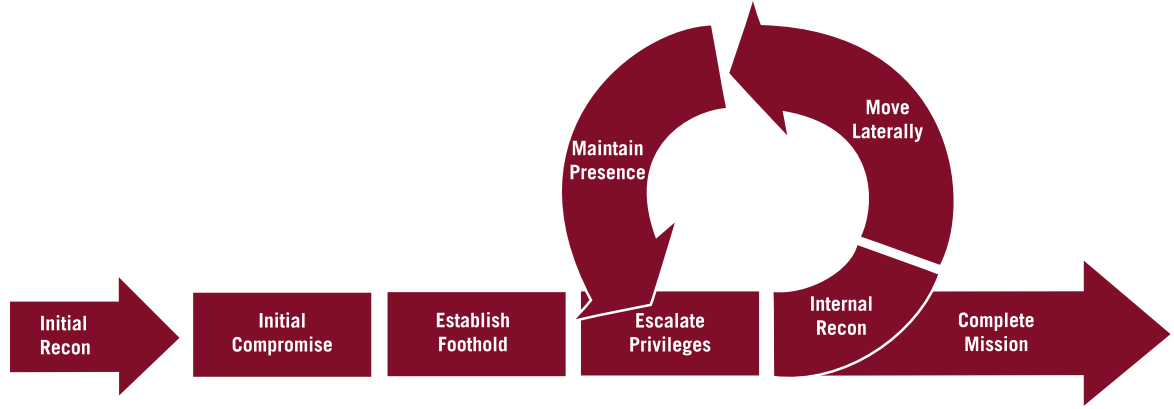
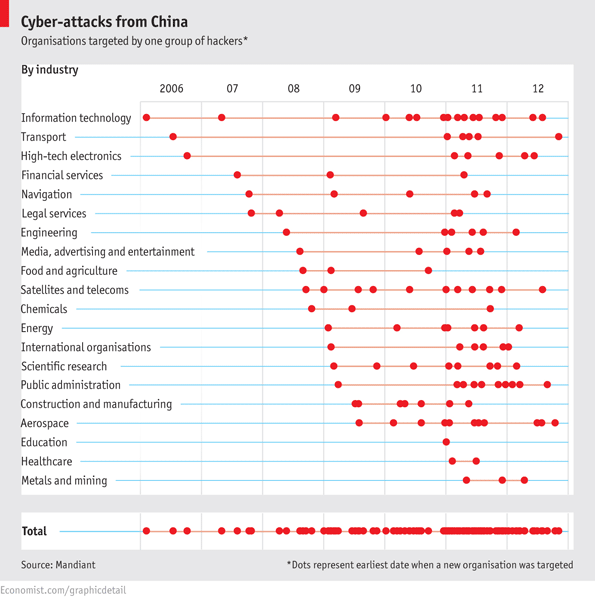
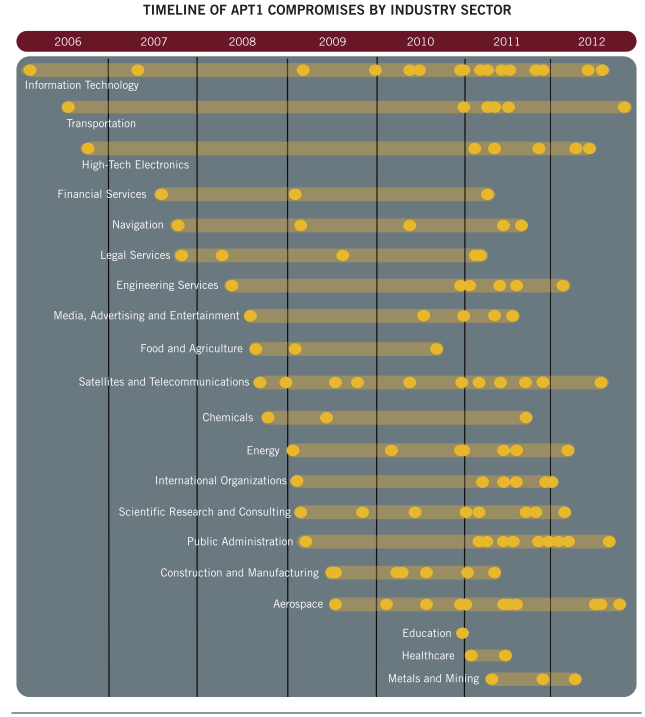
| Timeline of Cyber-Attacks from China Posted: 21 Feb 2013 09:00 AM PST From Mandiant, a US cyber-security consultancy, comes some damning accusations on China’s corporate espionage:
Attack Lifecycle Model
More charts after the jump
Hack-attack
 |
| EZ manufacturing and services data disappoints Posted: 21 Feb 2013 07:55 AM PST Kiron Sarkar is starting a subscription service for his newsletter, commencing on Monday 25th February 2013. Until then, his newsletters will remain free of charge. As his newsletters will remain free of charge until Friday 22nd February, the subscription process on his website www.sarkargm.com will only be open from 4.00pm GMT on Friday 22nd February ie after he sends out the last free newsletter. Please check out Kiron’s new website. A job well done. http://sarkargm.com/ The Japanese PM, Mr Abe, is visiting the US and is to meet President Obama. Clearly, the tensions with China and the nuclear test by N Korea will be on the agenda, as will Japan's economic policy and the proposed Trans-Pacific Partnership. Interesting comment by Mr Abe. He stated that the Chinese have a "deeply ingrained" need to promote conflict with Japan and other Asian countries, as a way to bolster the Chinese Communist party and to distract the population from other issues. Clearly he's right, but its punchy stuff. Also of interest is the fact that PM Abe will take along Mr Takehiko Nakao, according to Bloomberg. Who's he you ask – well he's Japan's currency chief. A bit of explaining to be done, do you think?; Chinese authorities have told local authorities to "decisively" curb real estate speculation. Chinese markets tanked on the news (see below); Chinese equity markets (the Shanghai Composite) closed nearly 3.0% lower today (the largest decline since November 2011) on fears that the PBoC will embark on a tightening cycle and, in addition, on reports that the Chinese government had instructed local authorities to implement measures to curb speculation in the residential property sector. The PBoC have hinted recently that inflation was becoming a problem. In addition, Chinese authorities are thinking about limiting credit to the residential property market and, in addition, tax 2nd and 3rd homes etc. Uncertainty = Lower equity markets. In addition, inflation in China looks likely to accelerate – materially?. While a number of the "property restrictions" are a rehash of previous policies, I do think that the recent rally of the Chinese equity markets looks "fragile" – for a while, at least. S&P warn that over investment in China could lead to an economic contraction in due course. However, S&P have raised its outlook for Chinese residential developers to stable from negative. Different interpretations of S&P's comments are floating around. Reuters reports that the PBoC Central Bank Governor Mr Zhou may stay on and, in particular, help to make the Chinese financial system more market-orientated, together with transforming the Yuan into a global currency – good news, if true, but the Yuan has a long way to go; The P5+1 nations are expected to make another approach to Iran, according to Bloomberg, quoting unidentified sources. Probably explains the weaker oil market. Talks are scheduled to resume on the 26th February. Negotiations with Iran over its nuclear programme have gone on and on and….; The Russian Central Bank Governor, Mr Sergey Ignatyev, stated that nearly US$50bn was transferred out of Russia illegally in 2012, more than half of which may have been controlled by a single group of people. Wow. If its from a single group of well organised people, the authorities must have known about it. The remarkable admission, given his position (though he is to retire in June), will create "waves" in Moscow.The near US$49bn that Mr Ignatyev speaks about is roughly 2.5% of Russia's GDP. Brave man Mr Ignatyev: S&P warns that the risk of Cyprus defaulting is "material and rising". There is a political game being played in respect of Cyprus. The EU/Germans clearly do not like the former Communist regime (who are crazy) and want a regime change, which, in all probability, they will get this weekend following the 2nd round of the Presidential elections. In addition, the German's do not want to be accused of aiding and abetting alleged money laundering/tax evasion by Russians using Cypriot banks – Cypriot banks, by the way, are BUST. Mrs Merkel needs the opposition to help push through legislation re a number of issues concerning the EZ. A number in her party and her coalition partners oppose bailouts, in particular. The Russian authorities are looking to help out Cyprus – the big issue is how the Russian authorities explain that to their public, as it will help alleged money launderers, tax evaders etc. Some kind of temporary fix to bide Cyprus over, until after the September German general elections seems the most likely political option, though if there is a threat of a debt restructuring (to make Cypriot debt sustainable, as demanded by the IMF), the threat of contagion spreading across the EZ becomes real. Tricky, indeed, very tricky situation. In my opinion, its always the small countries, which are ignored, which come and bite you in the ….; EZ February manufacturing and services PMI declined by more than expected. The EZ February composite index (both manufacturing and services) declined to 47.3, from 48.6 in January and well below the reading of 49.0 expected. The EZ services PMI declined to 47.3 in February, from 48.6 in January, the fastest decline in 10 months. The EZ manufacturing index fell marginally to 47.8, from 47.9 in January and lower than the 48.5 expected. The composite index for both Germany and France came in lower than expected. Germany's services PMI declined to 54.1 in February, from 55.7 in January and below the 55.5 expected, the fastest decline since August. The manufacturing index did rise to a positive 50.1 however, from 49.8 in January, though was below the 50.5 expected. The real culprit for the overall material decline was (you guessed it) France. The French services index fell to 42.7 in February, from 43.6 in January and lower than the 44.5 expected, though the manufacturing index did rise to 43.6, from 42.9 in January, though below the 43.8 expected. However, consumption is the major driver of the French economy and, as a result, the French services index is more important; Dutch data was also poor, with consumer confidence (seasonally adjusted) coming in at -44, in February, worse than the -35 in January. The January unemployment rate rose to 7.5% M/M, higher than December's 7.2%. The Dutch house price index declined by -9.6% Y/Y in January, worse than the -6.3% in December. I continue to believe that Holland, like the UK, will be downgraded this year. Holland is, for the moment, rated AAA; The FOMC minutes raises the issue as to whether the FED will reduce, possibly even end, its QE programme. Previous statements suggested that the FED would continue with its asset purchase programme until there was a "substantial improvement in the labour market" – the minutes released yesterday casts some doubt on that. "Many participants expressed concern about the potential costs and risks arising from further asset purchases". Hmmmm, many !!!!. The minutes also report that a review of the asset purchase programme will take place at the 19/20th March FED meeting, which suggests that the subsequent minutes will be uber important. My friends at Brown Brothers Harriman remind me that Bernanke (who clearly is in favour of more QE) has never been outvoted and is unlikely to be. Whatever, the issue is that uncertainty has now crept in, which is negative for markets – indeed, US markets declined yesterday, following the release of the minutes and the US$ strengthened; Interesting announcement by the US. The White House has threatened to use "diplomatic measures", together with trade policies, to target countries allegedly involved in hacking. Whilst China was not mentioned, the statement was clearly directed towards the country. These policies are clearly needed given the mounting computer attacks originating from a number of countries around the world. Congress is putting increasing pressure on President Obama to act on this matter, as well. This looks as if it will get serious. Clearly if the EU followed (as is likely, in due course), it will become more effective; US January CPI came in unchanged (+1.6% Y/Y), as opposed to the +0.1% expected and unchanged in December. Core CPI (ex food and energy) came in at +0.3% (+1.9% Y/Y), slightly higher than the +0.2% expected. Nothing to get worried about, for the moment. US initial jobless claims came in at +362k, slightly higher than the +355k expected. The less volatile 4 week moving average came in at +361k, as opposed to +353k before. Continuing claims came in at +3.148mn, slightly lower than the 3.150mn expected; Outlook Asian markets closed materially weaker, following the prospect that the FED may refrain from its asset purchase programme earlier than expected and the prospect that China would place curbs on their residential property sector. European markets are also sharply lower, with the Italian MIB down over -2.5% . US markets, having closed at their lows yesterday, look to open up lower, though not by as much as I had expected. The Euro is being beaten up – currently US$1.3203, having been over US$1.34 yesterday. The Yen, well its strengthening and is currently at Yen 93.27 against the US$. Some are asking whether the bout of Yen weakness is over – I believe that we need to wait for the appointment of the new BoJ governor and gain an understanding of the fiscal and monetary policies that the BoJ/government will employ, but……………In any event, I'm glad I've closed my major Yen short. Sterling, though, is stronger against the US$ and is at US$1.5252 – better government borrowings numbers, though this reflects the inclusion of "profits" on the BoE's holdings of gilts bought as part of the Sterling 375bn QE programme and just too much of a selloff recently. Spot gold is up marginally at US$1570, with April Brent at US$113.91 and whilst over US3 lower than its previous highs, its still too high for a number of struggling economies. Commodities generally were sold off yesterday and are sharply lower. US existing home sales data and the Philly Fed come out later today. Basically a risk off day, with bonds doing better (the US 10 year is below 2.0%), equities worse and the US$ better – the US$ index hit a 5 month high. I continue to be cautious to negative of equity markets, in particular in the short term. Kiron Sarkar 21st February 2013 ~~~ Important Notice This newsletter will become a fee based subscription service, starting on Monday 25th February 2013 at www.sarkargm.com To avoid potential subscribers from subscribing too early, while the newsletter remains free of charge, (which will be the case up to and including Friday 22nd February), the subscription process will only be open from 4.00pm GMT (11.00am EST) onwards, on Friday 22nd February, ie after the last free newsletter is sent out.
 |
| Posted: 21 Feb 2013 07:00 AM PST My morning reading materials:
What are you reading?
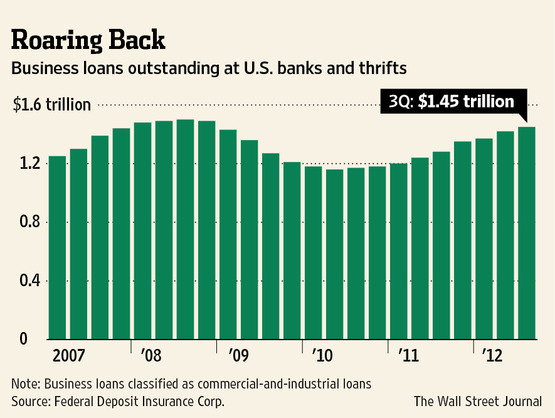
Business Loans Flood the Market  |
| Posted: 21 Feb 2013 06:30 AM PST Via Manal Mehta: Bank of America is trying to settle $108 billion of losses with a $8.5bn settlement. This "settlement" forms the basis for BAC's private label putback reserves. If deal doesn't go through, there's a HUGE problem for BAC as it would be severely under-reserved. From the transcript: MR. ROLIN: I'm handling motion sequence number 30, which is the RRMS Advisors…That expert's name was Brian Lin, L-I-N, and the firm that he worked for is RRMS Advisers. …the trustee, in reviewing the Lin reports, turned a blind eye to fundamentally flawed expert analyses. And if the trustee didn't scrutinize Mr. Lin's people, somebody has to. We believe we have to… But for Mr. Lin, who's got over a million dollars' worth of billing records, for Mr. Lin, none of those have been turned over. Your honor, the trustee delegated to RRMS the function of determining these two critical issues, the reasonable settlement amount and the servicing agreement. And the trustee did not evaluate it itself. There is a small bit of testimony. Mr. Reilly asks Ms. Lundberg "Do you know what, if anything, was done by the trustee to evaluate losses to the certificate holders arising out of Countrywide's violation of reps and warranties?" She says "Outside of consulting with RRMS, I'm not aware of anything else." There's other testimony that confirms this. The trustee delegated lock, stock and barrel the entire process in evaluating the settlement amount…to a third party. That's the trustee's evaluation. And there's no question that the trustees evaluation is at issue in this case and is relevant to the Court's final determination of good faith and the other issues identified in the proposed final order and judgment. You can't del[egate]—you can't take a trustee task, delegate it to a third party, say only what the trustees did is relevant but whatever this third party did you can't have all of that information. That is the trustee's investigation. It simply delegated to somebody else. The RRMS methodology for coming up with the damages amount is about this funnel. They take the original balance of the loans, put all of the loans and all of the covered trusts and they run it through this funnel and have a series of haircuts along the way, and what it spits out is what they call the reasonable settlement amount. The first thing two things they do, they first try to figure out how many loans have gone into default or how many loans are likely to go into default. Then they try to figure out severity, how much money is ultimately going to be lost by the trust and it comes up with the losses. And you can see Mr. Lin's numbers are on the right. The numbers on the left are the numbers that were provided by the institutional investors. The institutional investors, based on publicly available information, not disputed by Mr. Lin, come up with losses of about $108 billion in the trust. Mr. Lin's losses, he starts out with $76.8 billion. And it's very important because losses are the jumping off point for the rest of the analysis. There's a $31 billion swing in there. And that swing is a consequence of some decisions that Mr. Lin made, in calculations that he made, some industry expertise that he says that he relies on. But they're nowhere to be found in the information provided to us and he was unable to testify about them at his deposition. Those are big numbers, those are very important decisions that were not provided to us. The information provided by the institutional investors, based on re-underwriting of similar loans, come up at $32.3 billion. In Mr. Lin's analysis, in which he relies on Bank of America data, he relies on breach and success rates that come from the opponents, that have the opponents' legal theories embedded in them, resulting in a much lower number. This is information that's apparent to the trustee on the face of the report. …it is clear from the face of the report that the trustee knew or certainly should have known that Mr. Lin's analysis was deeply flawed. And we have to and the Court ought to want to look into and find all the calculations that he made so we can make a reasonable presentation about whether they're reasonable or not… MR. CARROLL: I'm here for both AG's… It's indisputable that the settlement was negotiated by a subset of the investors and it will bind all the investors and will extinguish all the rights. The sensible approach, consistent with the law, is to consider all the information that bears on this. The settlement number is the heart of the settlement. RRMS was instructed by the trustee, was directed by the trustee. It opined on the settlement number. The Court should have all of that information. The relevance rule says so. MR. ROLLIN: It goes to the larger point. If it's information that Mr. Lin relied on, they've got it, there's no reason to not give it to us. Again, notes and calculations, the industry reports, bills an records, some other— THE COURT: Well, I mean, you're asking me at the end of the day, at the end of the hearing in May and through June to make a lot of findings. And they're going to say, well, how would I know that it was reasonable for the trustee to rely on RRMS if we don't know what RRMS relied on to come up with their figures. Mr. Rollin showed his little funnel there and explained that there were – that different people arrived at different numbers. I mean, institutional investors came up with one thing and the Bank of America came up with something else and RRMS came up with something else and, eventually, you got to the $8.5 That's a pretty big number. It's a pretty big settlement. It's—you're asking me to decide the reasonableness of it. So I—it's really hard to draw a line. I mean, if this is your expert, wouldn't it be helpful to see the things he relied on to reach that settlement amount? Which is – I mean, the settlement amount, that's what this is all about. I mean, this was the 8.5. I mean, was that number reasonable – was that reasonable? And that sounds like a very simple question, but it's taken two years of lots of things going on for you to be in a position to be able—I mean, you would have liked to present it to me right at the beginning, I understand. But you're asking me to make this determination at the end of the line. There's an awful lot that's gone on here. And it would seem to me that—why not show them, if you've got documents of things that Mr. Lin relied on? I understand he may not have put everything into his report, but wouldn't that be helpful to me, rather than waiting until the hearing when they say, "You know, Judge, I think this should have happened" and I say "You know what? I agree with you." Then you're going to want to spend two more months getting me documents nad having a continued hearing. So it seems to be that, when you come in May, you want to have dealt with all the problems we could have dealt with and I either say it's reasonable or they can convince me that it wasn't. Wouldn't that like sort of jump ahead and help me at the end of the day?
MR. LOESER: Your Honor, I represent the Federal Home Loan Banks of Boston, Chicago and Indianapolis. Just by way of example, your Honor, Jason Kravitt, who is Bank of New York's counsel, was not allowed to answer questions on following important topics: Whether the trustee and institutional investors actually contemplated litigating put-back claims against Bank of America—because we can't forget we're here because of Bank of America. This is a Bank of America liability and it's a tremendous liability and it's a put-back liability. So Mr. Kravitt was not allowed to answer questions about whether there was actually contemplated put-back litigation a foundation for this settlement. Mr. Kravitt was not allowed to answer whether an event of default actually occurred. And we know, your Honor, we've had a lot of conversation in this courtroom about the importance of event of default. It's a hugely important event in terms of the trustee's duties and in terms of certificate holders rights. And it's important that we understand the trustee's position on that. That is a huge hold in the information we have… Mr. Kravitt was not allowed to answer the question of whether it was necessary to undertake loan file sampling in order to assess Bank of America's legal liability. Again, that is a huge issue. The way these cases get litigated, when they do get litigated, is based on a sample of loan files. Read full attachment entitled "MUST READ transcript – BAC 8.5 billion settlement.pdf" – BAC's $8.5bn BoNY settlement is an exercise in obfuscation and tortured logic. No way courts will rubber stamp it…Brief summary of notable quotables from the transcript are above. BAC'S PUTBACK RESERVES ARE A HOUSE OF CARDS – ALL RELY ON FINAL ADJUDICATION OF THE $8.5BN PRIVATE LABEL SETTLEMENT – IF THAT SETTLEMENT IS NOT APPROVED BY THE COURTS, THEN PRIVATE LABEL RESERVES WILL NEED TO INCREASE. From: financearticles@googlegroups.com[mailto:financearticles@googlegroups.com] On Behalf Of Manal Mehta From BAC’s just released Q2 2011 10-Q (Read this first AND then read the Objection below to the proposed $8.5bn settlement): REPURCHASE RATE ASSUMPTION At June 30, 2011 and December 31, 2010, the liability was $17.8 billion and $5.4 billion. For the three and six months ended June 30, 2011, the provision for representations and warranties and corporate guarantees was $14.0 billion and $15.1 billion compared to $1.2 billion and $1.8 billion for the same periods in 2010. Of the $14.0 billion provision recorded in the three months ended June 30, 2011, $8.6 billion was attributable to the BNY Mellon Settlement and $5.4 billion was attributable to other non-GSE exposures, and to a lesser extent, GSE exposures. The BNY Mellon Settlement led to the determination that we now have sufficient experience to record a liability related to our exposure on certain other private-label securitizations. This determination, combined with changes in our experience with the behavior of certain counterparties, including the GSEs, in the first six months of 2011, was the driver of this additional provision. A significant factor in the estimate of the liability for losses is the repurchase rate, which increased in both the three and six months ended June 30, 2011. From David Grais Objection to BoNY settlement: From: financearticles@googlegroups.com[mailto:financearticles@googlegroups.com] On Behalf Of Manal Mehta “Each of these assumptions has a great effect on Mr. Lin’s estimate of the amount of a reasonable settlement. As an example, even if just the last assumption were changed from Countrywide and Bank of America having to repurchase all, rather than just 40%, of loans that were both in default and breached Countrywide’s representations and warranties, then Mr. Lin’s estimate of a reasonable settlement would rise from a range of $8.8 to $11 billion to a range of $22 to $27.5 billion. Modifying any of his other three assumptions would cause that range to rise much more.” “To get from $61.3 billion to a “reasonable” settlement range of $8.8 to $11 billion, Mr. Lin made two more assumptions. He assumed that only 36% of loans that go into default will have breached Countrywide’s representations and warranties about the quality of its underwriting. That assumption is difficult to understand. Mr. Lin did not do any independent analysis of this assumption. Instead, he simply adopted Bank of America’s estimates of this percentage, which in turn appear to have been based on a completely different portfolio of loans that were subject to the underwriting standards imposed by Fannie Mae and Freddie Mac. Moreover, Mr. Lin’s assumption is inconsistent with widely publicized reports by professional loan auditors that even Countrywide loans that are merely delinquent (that is, behind on payments but not yet in default) have a “breach rate” of well over 60% and often as high as 90%. Finally, Mr. Lin assumed that only 40% of loans that both go into default and have breached Countrywide’s representations and warranties could be successfully put back to Countrywide and Bank of America. This assumption similarly demands investigation. It is hard to imagine why a court would not require Countrywide and Bank of America to repurchase all loans, not just 40% of loans, that are both in default and have breached a representation or warranty.” Third, BNYM notes that it has now released on a website “all of the expert reports submitted to the Trustee in connection with the Settlement” and implies that those reports may provide all the additional information that the FHLBs need to decide whether to object to the proposed settlement. Unfortunately, however, the expert reports raise more questions than they answer. By way of example, BNYM published a report from Mr. Brian Lin of RRMS Advisors about the reasonableness of the $8.5 billion that BNYM agreed to accept as part of the proposed settlement. Mr. Lin concluded that “a settlement figure somewhere between $8.8 and $11 billion is reasonable.” But to reach that conclusion, Mr. Lin made certain assumptions, the bases for which are not fully disclosed in his report. [cid:image001.png@01CC477E.022A26B0]FILED: NEW YORK COUNTY CLERK 07/21/2011 INDEX NO. 651786/2011 SUPREME COURT OF THE STATE OF NEW YORK COUNTY OF NEW YORK In the matter of the application of THE BANK OF NEW YORK MELLON (as Trustee under various Pooling and Servicing Agreements and Indenture Trustee under various Indentures), BlackRock Financial Management Inc. (intervenor), Kore Advisors, L.P. (intervenor), Maiden Lane, LLC (intervenor), Maiden Lane II, LLC (intervenor), Maiden Lane III, LLC (intervenor), Metropolitan Life Insurance Company (intervenor), Trust Company of the West and affiliated companies controlled by The TCW Group, Inc. (intervenor), Neuberger Berman Europe Limited (intervenor), Pacific Investment Management Company LLC (intervenor), Goldman Sachs Asset Management, L.P. (intervenor), Teachers Insurance and Annuity Association of America (intervenor), Invesco Advisers, Inc. (intervenor), Thrivent Financial for Lutherans (intervenor), Landesbank BadenWuerttemberg (intervenor), LBBW Asset Management (Ireland) plc, Dublin (intervenor), ING Bank fsb (intervenor), ING Capital LLC (intervenor), ING Investment Management LLC (intervenor), New York Life Investment Management LLC (intervenor), Nationwide Mutual Insurance Company and Petitioners, -against- FEDERAL HOME LOAN BANK OF BOSTON; FEDERAL HOME LOAN BANK OF CHICAGO; FEDERAL HOME LOAN BANK OF INDIANAPOLIS; FEDERAL HOME LOAN BANK OF PITTSBURGH; FEDERAL HOME LOAN BANK OF SAN FRANCISCO; and FEDERAL HOME LOAN BANK OF SEATTLE (proposed intervenor-respondents), Respondents, for an order pursuant to CPLR § 7701 seeking judicial instructions and approval of a proposed settlement. Index No. Assigned to: Kapnick, J. REPLY MEMORANDUM IN SUPPORT OF PETITION TO INTERVENE The Bank of New York Mellon (BNYM), which initiated this proceeding, has stated that it takes no position on the petition of proposed intervenors Federal Home Loan Banks of Boston, Chicago, Indianapolis, Pittsburgh, San Francisco, and Seattle (collectively, the FHLBs) to intervene. And the 22 investor intervenors state that they do not oppose the petition. Thus, the FHLBs’ petition to intervene is unopposed. Because the FHLBs have at least the same standing to intervene as did the 22 investors that have already been permitted to do so, the FHLBs respectfully request that the Court grant their petition without delay. object to the proposed settlement. For the avoidance of doubt, however, each of the FHLBs seeks to intervene as a party in this proceeding with the full rights of a party, including, of course, the right to oppose the proposed settlement should any of them ultimately decide to do so. - 2 - essentially is asking the Court to hold such requests for information “in abeyance” until the information would no longer be useful. - 3 - Moreover, Mr. Lin’s assumption is inconsistent with widely publicized reports by professional loan auditors that even Countrywide loans that are merely delinquent (that is, behind on - 4 - CONCLUSION For all of these reasons, the FHLBs respectfully request that the Court grant their petition and amend the caption to add the FHLBs as intervenors-respondents in this Article 77 proceeding. Dated: New York, New York KELLER ROHRBACK L.L.P. By: /s/ David S. Preminger 770 Broadway KELLER ROHRBACK L.L.P. Lynn Lincoln Sarko 1201 Third Avenue KELLER ROHRBACK P.L.C. Gary A. Gotto Attorneys for Federal Home Loan Banks of ROBINS, KAPLAN, MILLER & CIRESI L.L.P. By: /s/ Heather Y. Fong 601 Lexington Avenue Thomas B. Hatch Attorneys for Federal Home Loan Bank of David J. Grais (DG 7118) Kathryn C. Ellsworth Owen L. Cyrulnik 40 East 52nd Street Attorneys for Federal Home Loan Banks of San - 5 - – – From: financearticles@googlegroups.com[mailto:financearticles@googlegroups.com] On Behalf Of Manal Mehta BANK OF AMERICA –> HIRES EXPERT BRIAN LIN WHO USES HISTORICAL REPURCHASE EXPERIENCE WITH FANNIE MAE AND FREDDIE MAC TO DETERMINE IF THE SETTLEMENT AMOUNT OF $8.5BN IS REASONABLE –> IGNORES THE FACT THAT FANNIE MAE DISPUTES BAC’S INTERPRETATION OF HISTORICAL REPURCHASE EXPERIENCE LEADING TO THE CURRENT DISPUTE WHICH IS CAUSING GSE REPUCHASE CLAIMS AT BAC TO BALLOON –> CHANGE LIN’S ASSUMPTIONS AND THE $8.5BN GOES TO $27BN (SEE BRANCH HILL ANALYSIS BELOW) “Bank of America Corp. asked a judge to reject a demand for loan files in litigation over the bank’s proposed $8.5 billion mortgage-bond settlement…American International Group Inc. and Walnut Place are “leading the charge” on getting the loan files, Bank of America said. A sample of loan files that was requested would total more than 200 million pages and “require untold years to evaluate,” the bank said.” COMPARE TO COMMENTS MADE BY MOYNIHAN ON BAC’S 3Q 2010 EARNINGS CALL: Notable Quotables From BofA’s response fighting loan file request (Their defense relies on Brian Lin from RRMS advisors – http://www.zerohedge.com/article/brian-lin-next-incarnation-joe-cassano): “There is no dispute: the Trustee did not review loan files in reaching its decision to enter into the Settlement. Instead, it relied on Countrywide’s actual repurchase experience with Fannie Mae and Freddie Mac for approximately 100,000 loans that were originated during the same years and on the same platform as loans in the covered trusts – real world adversarial experience over some four years that far exceeds whatever loan-by-loan litigation on loan files is conceivable in this or any other litigation. Accordingly, the only question is whether the Trustee’s decision not to also review loan files rendered the Trustee’s exercise of its discretion unreasonable. If the Trustee is correct that it was within the bounds of its discretion to approve the Settlement without reviewing loan files, then the Settlement should be approved.” “In early July 2011, the Trustee posted the expert opinions reference in the Verified Petition to a public website it created (www.cwrmbssettlement.com<http://www.cwrmbssettlement.com>). One of the Trustee’s experts, Brian Lin of RRMS Advisors, opined that “the settlement range of approximately $8.8 billion to $11 billion is reasonable without applying any legal haircuts.” Mr. Lin reached this conclusion by estimating a repurchase rate for loans in the covered trusts and applying that rate to the estimated loans in the trusts. Thus, Objectors have long known precisely what analysis was undertaken to estimate a repurchase rate, and that this analysis did not include a review of loan files. In their motion to compel addressed to the Trustee, Objectors contend that Mr. Lin relied on “publicly-available third party sources” in estimating a repurchase rate. Objectors are wrong, as Mr. Lin’s report makes evident. Mr. Lin relied on Countrywide’s “actual repurchase experience,” not third-party data. As Mr. Lin explains in detail, the parties used Countrywide’s extensive prior repurchase experience with Fannie Mae and Freddie Mac (the “GSEs”) as a basis for an indicative repurchase rate for loans in the covered trusts. That real-world experience with the GSEs covered over four years of repurchase claims – actual arm’s-length, adversarial negotiations at a loan-by-loan level with highly sophisticated repurchase counterparties on approximately 100,000 loans that were originated during the same years and on the same platform on the loans in the covered trusts. That comprehensive actual experience provided a basis far superior to any conceivable post-hoc, made-for-litigation “sampling” of loan files. As Mr. Lin stated: “it would be reasonable to utilize BofA’s percentages for both ["breach" and "success"] rates since they are based on the performance of a mortgage pool representing actual repurchase experience.” All of the information Mr. Lin considered – including all of the actual presentations and data on the GSE experience provided by Countrywide – has been or will be produced to Objectors.” Bank of America’s Response ignores this – BAC’s repurchase requests from Fannie have been escalating due to a disagreement on “historical repurchase experience” so how can “historical repurchase experience” with Fannie (which doesn’t accurately represent what’s happening today) be a basis for the settlement? BAC’s Q1 2012 Earnings Call Transcript: <https://blogger.googleusercontent.com/img/b/R29vZ2xl/AVvXsEgfVqIZMWzynN5BFUFhKtJdTWZBwmhTFPym76VrVpRhWXc1b18EMKX6PIuHSq2m4HEEaex-KTxWr138a_Kh1Eg_jLfSQQqmp5bIR184_MMfrCC8UBineeNabWUEee8Z3H4j-1OC79XxZJsk/s1600/image001-726001.png>[https://blogger.googleusercontent.com/img/b/R29vZ2xl/AVvXsEhzZLGxbQkHC9MXaTxAoFF0Eh82fUmx3Ag7B7GjoG8s0flCJRaabq6D2gzjBvZUx9pQVRRHtKR-6Q9AplnE_oLdG-2wKu-C_h8nSNaJpNwnj0DY3Qk7sf68cXox9d6yfyyJBSxtfHwpESrG/s320/image005-785761.png]<https://blogger.googleusercontent.com/img/b/R29vZ2xl/AVvXsEhzZLGxbQkHC9MXaTxAoFF0Eh82fUmx3Ag7B7GjoG8s0flCJRaabq6D2gzjBvZUx9pQVRRHtKR-6Q9AplnE_oLdG-2wKu-C_h8nSNaJpNwnj0DY3Qk7sf68cXox9d6yfyyJBSxtfHwpESrG/s1600/image005-785761.png> *BOFA CLASH WITH FANNIE INTENSIFIES AS INSURERS REJECT BAD LOANS http://www.bloomberg.com/news/2012-03-02/bofa-s-clash-with-fannie-intensifies-as-insurers-reject-more-loan-claims.html Flaws with Brian Lin’s work – Analysis by Branch Hill Capital: <https://blogger.googleusercontent.com/img/b/R29vZ2xl/AVvXsEgoVP9bLH7eXXd1tHLeCu3MCV-rUw3zZBkrySAd2fFU58BSYZWe1edC9v1ZRj8WAjBmbdTXNJVsTO98hjOsO-y4XbVkCpqGRNtXXqnV-y6UGq77OJeWUIxmU6iUbzTYCcvIQ1F5f8yTGZd4/s1600/image003-726858.png>[https://blogger.googleusercontent.com/img/b/R29vZ2xl/AVvXsEgKGqzKMxTSPkAmZTyImqnbSyVhDTlbsyYdEh44-8VpfwkeZjbCRaUA-swvhYv91l4xNnKvAiNAhvfSKZ6HcwduXsQJbqNF80w0WQR_eS9gp8FLVKpOqveMt0bt5iNDRiidZBwSKIWuoZLW/s320/image006-787617.png]<https://blogger.googleusercontent.com/img/b/R29vZ2xl/AVvXsEgKGqzKMxTSPkAmZTyImqnbSyVhDTlbsyYdEh44-8VpfwkeZjbCRaUA-swvhYv91l4xNnKvAiNAhvfSKZ6HcwduXsQJbqNF80w0WQR_eS9gp8FLVKpOqveMt0bt5iNDRiidZBwSKIWuoZLW/s1600/image006-787617.png> BofA Fights Bid for Loan Files in $8.5 Billion Mortgage Deal (1) 2012-05-02 22:34:05.34 GMT (Updates with court filing in second and third paragraphs.) By David McLaughlin May 2 (Bloomberg) — Bank of America Corp. asked a judge to reject a demand for loan files in litigation over the bank’s proposed $8.5 billion mortgage-bond settlement, saying it threatens years of delay. The files are irrelevant to the case and producing them for investors would “dramatically transform” the proceeding, Bank of America said in papers filed today in New York State Supreme Court. “Loan-file review will answer no questions,” the Charlotte, North Carolina-based lender said. “It will lead only to interminable delay and unnecessary litigation, loan-by-loan- by-loan. It will bog down this proceeding for no good reason.” The settlement with Countrywide Financial mortgage-bond investors is before a state judge for approval, and some investors have said they need information about the agreement and negotiations leading up to it. American International Group Inc. and Walnut Place are “leading the charge” on getting the loan files, Bank of America said. A sample of loan files that was requested would total more than 200 million pages and “require untold years to evaluate,” the bank said. Attorneys for AIG and Walnut Place didn’t immediately respond to e-mails seeking comment. The case is In the matter of the application of the Bank of New York Mellon, 651786-2011, New York State Supreme Court (Manhattan). For Related News and Information: Bloomberg legal resources: BLAW Top Legal News: TLAW –Editors: Fred Strasser, Mary Romano To contact the reporter on this story: David McLaughlin in New York at +1-212-617-4817 or dmclaughlin9@bloomberg.net To contact the editor responsible for this story: John Pickering at +1-212-617-1708 or jpickering@bloomberg.net BAC US BK US AIG US – From: financearticles@googlegroups.com[mailto:financearticles@googlegroups.com] On Behalf Of Manal Mehta Is Brian Lin The Next Incarnation Of Joe Cassano? In a must read Op Ed<http://www.bloomberg.com/news/2011-07-21/curse-the-geniuses-who-built-bank-of-america-jonathan-weil-1-.html>, Bloomberg’s Jon Weil takes another long hard look at the balance sheet of the most undercapitalized bank in America (thank would be Bank of America) courtesy of the worst M&A transaction in history, namely its purchase of Countrywide, observes what everyone, even John Paulson now knows, that due to trading at half its book value nobody in the market gives even remote credit to the bank’s asset “marks”, and concludes that this organization, courtesy of an extremely lax regulatory and audit structure, which continues to allow it to mark any assets at whatever price it desires, could well be the next AIG: “There’s more at stake here, however, than whether Bank of America’s shares are a “buy” or a “sell.” The main thing the rest of us care about is the continuing menace this company and others like it pose to the financial system, knowing we never should have let ourselves be put in the position where a collapse in confidence at a single bank could wreak havoc on the world’s economy. Here we are again, though. Curse the geniuses who brought us this madness.” Indeed: once again, right before our eyes, day after day we allow various higher status quo-embedded individuals to take advantage of the gullible public by misrepresenting the massive risk that the left side of BAC’s balance sheet represents, which can have only one conclusion: the same epic implosion that brought down AIG one the market reality caught up the with book myth. Yet in the case of AIG we can all at least put the blame on one person: the man at the heart of AIG FP, Joe Cassano, whose reckless bets nearly brought down capitalism. So our question is: is there someone at or affiliated with Bank of America that could soon double as a Joe Cassano for the 2010s? We have one suggestion (although certainly not exhaustive): Brian Lin of RRMS Advisors. Who is Brian Lin? <http://www.nytimes.com/2008/12/18/business/18pay.html?pagewanted=all>[https://blogger.googleusercontent.com/img/b/R29vZ2xl/AVvXsEhFal2ulOBQ_XCi8Vo4cW9TSri8a0divBzfynUU1uP0r6dAbl2DJFw9SOvarDVQ_d8XiimSGFJwgMnL9GvgMQInNsK4Hxc4_vZgEJX4oxmnxRVDT5nrUfGl0uT8N_O2BakBCtD3WUXKEj5E/s320/image007-792700.jpg]<https://blogger.googleusercontent.com/img/b/R29vZ2xl/AVvXsEhFal2ulOBQ_XCi8Vo4cW9TSri8a0divBzfynUU1uP0r6dAbl2DJFw9SOvarDVQ_d8XiimSGFJwgMnL9GvgMQInNsK4Hxc4_vZgEJX4oxmnxRVDT5nrUfGl0uT8N_O2BakBCtD3WUXKEj5E/s1600/image007-792700.jpg>Let’s step back and look at some of the recent developments regarding Bank of America. As most know by now, the biggest wildcard regarding Brian Moynahan’s bank, and the biggest wildcard as pertains to the “known unknown” that is the bank’s massive undercapitalization, is that it has hundreds of billions in legacy non-performing Countrywide loans. The same loans which the bank recently scrambled to settle with a group of litigants for the paltry sum of $8.5 billion. This is also the Rep and Warranty reserve that Bank of America took out this quarter after repeatedly promising that it was well over reserved for any future such litigation<http://www.zerohedge.com/article/85-bank-americas-net-income-comes-reserve-release-and-msr-adjustment-capitalization-ratios-p>. Incidentally Zero Hedge has said repeatedly that this amount will be far higher when realistic assumptions are used, whether for modelling purposes, or when the full reality of the deterioration of the loan quality is uncovered. Sure enough, in a filing today at the Supreme Court in New York, the Federal Home Loan Banks which are pursuing more information from the bank in an attempt to generate greater recoveries, have suggested that the the entity conducting the recovery assumptions that generated the $8.5 billion settlement was potentially incompetent (and arguably criminally negligent – our assumption not theirs), and that a “reasonable settlement” would nearly triple the amount of money that Bank of America would have to charge off: a range of $22 billion to $27.5 billion. Of course, should BAC do this, its Tier 1 Capital would plunge, it would immediately be forced to access the equity capital markets, and confidence in the bank’s books would evaporate instantaneously, with all the nightmarish AIG-esque consequences envisioned by Jon Weil materializing immediately. So who is the person largely responsible for the “overoptimistic” analyses that have so far spared Bank of America from a death spiral? The abovementioned Eddie Lin of RRMS advisors…. And formerly of Bank of America! Let’s take a look at the FHLB’s filing: BNYM notes that it has now released on a website “all of the expert reports submitted to the Trustee in connection with the Settlement” and implies that those reports may provide all the additional information that the FHLBs need to decide whether to object to the proposed settlement. Unfortunately, however, the expert reports raise more questions than they answer. By way of example, BNYM published a report from Mr. Brian Lin of RRMS Advisors about the reasonableness of the $8.5 billion that BNYM agreed to accept as part of the proposed settlement. Mr. Lin concluded that “a settlement figure somewhere between $8.8 and $11 billion is reasonable.” But to reach that conclusion, Mr. Lin made certain assumptions, the bases for which are not fully disclosed in his report. Mr. Lin started with the full remaining principal balance of the loans in the 530 trusts that would be covered by the proposed settlement, plus the amount that the trusts have lost on loans that have already been liquidated. Together, Mr. Lin calculates that to be $208.9 billion. Mr. Lin then assumed that (1) only a certain percentage of those loans would go into default and (2) even for those loans that went into default, the trusts would recover between 45% and 60% of the principal balance through foreclosure. Both of these assumptions are quite controversial, and the FHLBs need to understand Mr. Lin’s basis for them. Using those assumptions, Mr. Lin concludes that the potential shortfall to the trusts, and therefore the amount that the trusts could potentially recover from Countrywide and Bank of America, is reduced from $208.9 billion to $61.3 billion. To get from $61.3 billion to a “reasonable” settlement range of $8.8 to $11 billion, Mr. Lin made two more assumptions. He assumed that only 36% of loans that go into default will have breached Countrywide’s representations and warranties about the quality of its underwriting. That assumption is difficult to understand. Mr. Lin did not do any independent analysis of this assumption. Instead, he simply adopted Bank of America’s estimates of this percentage, which in turn appear to have been based on a completely different portfolio of loans that were subject to the underwriting standards imposed by Fannie Mae and Freddie Mac. Moreover, Mr. Lin’s assumption is inconsistent with widely publicized reports by professional loan auditors that even Countrywide loans that are merely delinquent (that is, behind on payments but not yet in default) have a “breach rate” of well over 60% and often as high as 90%. Finally, Mr. Lin assumed that only 40% of loans that both go into default and have breached Countrywide’s representations and warranties could be successfully put back to Countrywide and Bank of America. This assumption similarly demands investigation. It is hard to imagine why a court would not require Countrywide and Bank of America to repurchase all loans, not just 40% of loans, that are both in default and have breached a representation or warranty. Each of these assumptions has a great effect on Mr. Lin’s estimate of the amount of a reasonable settlement. As an example, even if just the last assumption were changed from Countrywide and Bank of America having to repurchase all, rather than just 40%, of loans that were both in default and breached Countrywide’s representations and warranties, then Mr. Lin’s estimate of a reasonable settlement would rise from a range of $8.8 to $11 billion to a range of $22 to $27.5 billion. Modifying any of his other three assumptions would cause that range to rise much more. Similarly, BNYM also published a report by Prof. Robert Daines about Bank of America’s liability as a successor to Countrywide. But Prof. Daines’s report leaves unanswered several critical legal and factual questions. Indeed, Prof. Daines admits that his opinion is “limited by the available factual record and certain assumptions that I make,” and he concedes in several parts of his report that he relied on unverified information provided by Bank of America A closer look at Mr. Lin’s biography indicates that he may have just a little conflict of interest when conducting his analysis, which most likely ended up being used in the bank’s own application of settlement calculations, and reciprocally used as well by the counterparties, which we are more than certain are doing all they can to merely shut the case, instead of actually seek equitable damages. After all, as a reminder the adversaries to BAC in the case are the who’s who of comparable borderline illegal marking pratices: Maiden Lane III, LLC; Metropolitan Life Insurance Company; Trust Company of the West; Neuberger Berman; Pacific Investment Management Company LLC; Goldman Sachs Asset Management; Thrivent Financial; Landesbank BadenWuerttemberg; LBBW Asset Management plc, Dublin; ING Bank and so forth. To say that these parties are not comparably guilty of similar practices would be beyond naive. Anyway, back to Mr. Lin, and specifically his LinkedIn Profile where we learn that before RRMS he worked at… Merrill Lynch, and not just anywhere, but in the bank’s Non Agency Trading. To wit: <http://www.linkedin.com/pub/brian-lin/0/9b9/a57>[https://blogger.googleusercontent.com/img/b/R29vZ2xl/AVvXsEjsnp4WqUHjWCekVFuJjbMhu24Y343cpQ0jUhfGJX4PoOV7NcSimWeiUaro1_zMx15FWyvhV8ekuh_BpdPQekrsp9vwCfW1tCViv2hBTi4SasKNX6rII2bkTcab9qg3vhqWUKYqaGSW-bAs/s320/image004-794528.jpg]<https://blogger.googleusercontent.com/img/b/R29vZ2xl/AVvXsEjsnp4WqUHjWCekVFuJjbMhu24Y343cpQ0jUhfGJX4PoOV7NcSimWeiUaro1_zMx15FWyvhV8ekuh_BpdPQekrsp9vwCfW1tCViv2hBTi4SasKNX6rII2bkTcab9qg3vhqWUKYqaGSW-bAs/s1600/image004-794528.jpg> Surely while developing a skillset about evaluating security impairments at Bank of America, Mr. Lin also developed numerous relationships. One may only wonder to what extent these relationships were “utilized” in assisting him in forming his opinion on what the proposed trust shortfall, and thus settlement, and thus potential material undercapitalization of Bank of America, should be. But why pick only on Brian: let’s take a look at the pristine organization that is RRMS. For that we turn to Crain’s New York <http://www.crainsnewyork.com/article/20090104/SMALLBIZ/901039988> where we read that… At RRMS Advisors’ offices in an aging building on East 40th Street, Vincent Spoto and his four partners share space with a small headhunting outfit, and they hold meetings in a windowless conference room the size of a large closet… Mr. Spoto, who was laid off more than a year ago from his position as a mortgage specialist at Credit Suisse, is grateful that he has a job. He has reinvented himself as a consultant to investors who hold toxic mortgage investments… “There’s a stigma out there, no doubt, because I was part of Wall Street,” …along with a dash of guilt—he is among the band of survivors of Wall Street’s collapsed mortgage machine who are getting the chance to assist in sorting out the financial mess they helped create. In fact, some of them are in high demand because they are among the few who understand complex instruments such as mortgage-backed securities, collateralized debt obligations and other products whose imploded values can only be guessed at… “These are the people who can fit the key in the lock,”…”The problem for a lot of these Wall Street guys is that they don’t know much about real estate,” says Robert Baron, president of American Real Estate Executive Search Co. in Manhattan. “All they know is a lot about slicing and dicing mortgages and selling them.”… Over his 20-year career, Mr. Spoto worked mostly with mortgage servicing companies to ensure they were collecting on the mountains of loans that investment bankers packaged into securities and sold…Brian Lin, a veteran mortgage trader who was formerly with Merrill Lynch and other companies… The firm also has Robert Pardes, who was chief lending officer at New Jersey-based OceanFirst Financial Corp. until May 2007. He was ousted after the bank disclosed that employees were hiding losses in the subprime lending division, which it had acquired from Mr. Pardes seven years earlier” The plot thickens: not only do we have a person who may have a conflict of interest courtesy of prior professional relationships with Bank of America Merrill Lynch, but the firm he currently works boasts such individuals who were terminated for knowingly misrepresenting and hiding losses in RMBS books. Does one now see why perhaps Mr. Lin may not have been the best choice to evaluated the trust shortfall, and the “settlement” process. Perhaps somebody slightly more objective would figure out that instead of $8.5 billion, Bank of America is actually on the hook for an amount that is at least 3 times greater if one uses proper impaired security valuation protocols? However, as noted above, the question becomes “what then?” Should the true extent of deterioration of Bank of America’s books be revealed, then its market cap would be not $100 billion but some modest fraction thereof. In fact, even John Paulson, formerly the biggest believer in BAC has now washed his hands. And he doesn’t give up (read: look foolish to the investment community) easily. Our advice is to have a chat with Jon Weil: after all he is the man who said to “Curse the geniuses who brought us this madness.” In the meantime, and in the absence of Mark to Market, we are confident that the legal process will prevail and that the presiding judge on this case, and if not him then certainly the New York District Attorney, will step up and demand a thorough reevaluation of the settlement process. Because if law itself is held hostage by a bank’s massive undercapitalization, then one may as well admit that America has devolved into complete fascism. As for our question if Mr. Lin is the second coming of Joe Cassano, the answer is likely no. It iseveryone that behaves just like Lin, in allowing what is blatant disregard for fair and equitable process, to continue… in exchange for give or take 30 pieces of silver (physical, not paper). Unfortunately in our rapidly devolving society we have gotten to a point where the next epic collapse will have not one but an army of Joe Cassano’s behind it. h/t Manal Mehta  |
| Posted: 21 Feb 2013 05:30 AM PST Whatever It Takes
Who's Got the Map? |
| Astroseismology Finds Smallest Planet Outside Solar System Posted: 21 Feb 2013 05:00 AM PST
Amazing:
 |
| What’s Wrong with the Financial Services Industry? Posted: 21 Feb 2013 04:20 AM PST If you hang around these parts for any length of time, you will occasionally run across one of my jeremiads complaining about the Financial Services Industry. I’ve been thinking about this more than usual lately. This has led to some correspondence with Helaine Olen, whose book Pound Foolish: Exposing the Dark Side of the Personal Finance Industry is next up in my queue. (Her appearance on the TDS yesterday is here). It is similar to the deep dive my colleague Josh Brown took in Backstage Wall Street. My criticism is somewhat different than Helaine’s (though I am sympatico with much of her view). I break down the problems as follows:
All of these add up to a system that is flawed, and often fails to do its job. This sort of problem used to be cyclical — they run tot he point of excess, than a crisis causes the pendulum to swing the other way. The great tragedy of Obama/Geithner/Summers was that crisis moment to undo the damage was missed, and indeed, the concentration of power amongst the banks only made it worse. I fear we have to wait until yet another crisis for this to be repaired . . .  |



| You are subscribed to email updates from The Big Picture To stop receiving these emails, you may unsubscribe now. | Email delivery powered by Google |
| Google Inc., 20 West Kinzie, Chicago IL USA 60610 | |



0 comments:
Post a Comment