


The Big Picture |

- Why Are Inequality Levels Skyrocketing ?
- How Are Your Priorities Aligned?
- Gas Tanker Attempts First Winter Arctic Crossing
- Pinocchio Investors: How Investors Lie to Themselves
- More on Markets and Wealth Effects
- 10 Sunday Reads
- Bernanke Discusses Fed Policy
- 2014 BMW 3 Series Gran Turismo
| Why Are Inequality Levels Skyrocketing ? Posted: 24 Feb 2013 10:30 PM PST Insane Levels of Inequality – Which Hurt the Economy – Are Skyrocketing
Preface: All capitalist systems have some inequality. We don't want to prevent all inequality … just economy-wrecking levels:
And you might assume that conservatives don't worry about rampant inequality … but that is a myth. Rampant Inequality – Which Hurts the Economy – Is SkyrocketingA who's-who's of prominent economists in government and academia have all said that runaway inequality can cause financial crises. Extreme inequality helped cause the Great Depression, the current financial crisis … and the fall of the Roman Empire. But inequality in America today is actually twice as bad as in ancient Rome , worse than it was in in Tsarist Russia, Gilded Age America, modern Egypt, Tunisia or Yemen, many banana republics in Latin America, and worse than experienced by slaves in 1774 colonial America. Inequality has grown steadily worse: 
It is worse under Obama than under Bush. A recent study shows that the richest Americans captured more than 100% of all recent income gains. And see this. There are 2 economies: one for the rich, and the other for everyone else. Alan Greenspan said:
Why is Inequality Going Through the Roof?The world's top economic leaders have said for years that inequality is spiraling out of control and needs to be reduced. Why is inequality soaring even though world economic leaders have talked for years about the urgent need to reduce it? Because they're saying one thing but doing something very different. And both mainstream Democrats and mainstream Republicans are using smoke and mirrors to hide what's really going on. And it's not surprising … Nobel prize winning economist Joseph Stiglitz says that inequality is caused by the use of money to shape government policies to benefit those with money. As Wikipedia notes:
(Background here, here and here.) Stiglitz says:
Bloomberg reports:
Indeed, the big banks literally own the Federal Reserve. And they own Washington D.C. politicians, lock stock and barrel. See this, this, this and this. Two leading IMF officials, the former Vice President of the Dallas Federal Reserve, and the the head of the Federal Reserve Bank of Kansas City, Moody's chief economist and many others have all said that the United States is controlled by an "oligarchy" or "oligopoly", and the big banks and giant financial institutions are key players in that oligarchy. Economics professor Randall Wray writes:
No wonder the government has saved the big banks at taxpayer expense, chosen the banks over the little guy, and said no to helping Main Street … while continuing to throw trillions at the giant banks. No wonder crony capitalism has gotten even worse under Obama. No wonder Obama is prosecuting fewer financial crimes than Bush, or his father or Ronald Reagan.
Quantitative easing doesn't help Main Street or the average American. It only helps big banks, giant corporations, and big investors. And by causing food and gas prices skyrocket, it takes a bigger bite out of the little guy's paycheck, and thus makes the poor even poorer. As I noted in March 2009:
As I wrote in 2008:
Government Policy Is Increasing InequalityWithout the government's creation of the too big to fail banks (they've gotten much bigger under Obama), the Fed's intervention in interest rates and the markets (most of the quantitative easing has occurred under Obama), and government-created moral hazard emboldening casino-style speculation (there's now more moral hazard than ever before) … things wouldn't have gotten nearly as bad. Goosing the Stock MarketMoreover, the Fed has more or less admitted that it is putting almost all of its efforts into boosting the stock market. Robert Reich has noted:
AP writes:
David Rosenberg points out:
The above-quoted AP article further notes:
Indeed, as I reported in 2010:
Professor G. William Domhoff demonstrated that the richest 10% own 98.5% of all financial securities, and that:
As Tyler Durden notes:
Indeed, as CNN Money pointed out in 2011, "Wal-Mart's core shoppers are running out of money much faster than a year ago …" This trend has only gotten worse: The wealthy are doing great … but common folks can no longer afford to shop even at Wal-Mart, Sears, JC Penney or other low-price stores. Durden also notes:
Over-FinancializationWhen a country's finance sector becomes too large finance, inequality rises. As Wikipedia notes:
Government policy has been encouraging the growth of the financial sector for decades:
(Economist Steve Keen has also shown that "a sustainable level of bank profits appears to be about 1% of GDP", and that higher bank profits leads to a ponzi economy and a depression). Unemployment and UnderemploymentA major source if inequality is unemployment, underemployment and low wages. Government policy has created these conditions. And the pretend populist Obama – who talks non-stop about the importance of job-creation – actually doesn't mind such conditions at all. The"jobless recovery" that the Bush and Obama governments have engineered is a redistribution of wealth from the little guy to the big boys. The New York Times notes:
Obama apologists say Obama has created jobs. But the number of people who have given up and dropped out of the labor force has skyrocketed under Obama (and see this). And the jobs that have been created have been low-wage jobs. For example, the New York Times noted in 2011:
AP pointed out that the average worker is not doing so well:
Alan Greenspan noted:
Money Being Sucked Out of the U.S. Economy … But Big Bucks Are Being Made AbroadPart of the widening gap is due to the fact that most American companies' profits are driven by foreign sales and foreign workers. As AP noted in 2010:
Government policy has accelerated the growing inequality. It has encouraged American companies to move their facilities, resources and paychecks abroad. And some of the biggest companies in America have a negative tax rate … that is, not only do they pay no taxes, but they actually get tax refunds. And a large percentage of the bailouts went to foreign banks (and see this). And so did a huge portion of the money from quantitative easing. More here and here. Capital Gains and DividendsAccording to a study published last month by a researcher at the U.S. Congressional Research Service:
Business Insider explains:
Joseph Stiglitz noted in 2011:
Indeed, the Tax Policy center reports that the top 1% took home 71% of all capital gains in 2012. Ronald Reagan's budget director, assistant secretary of treasury, and domestic policy director all say that the Bush tax cuts were a huge mistake. See this and this.  |
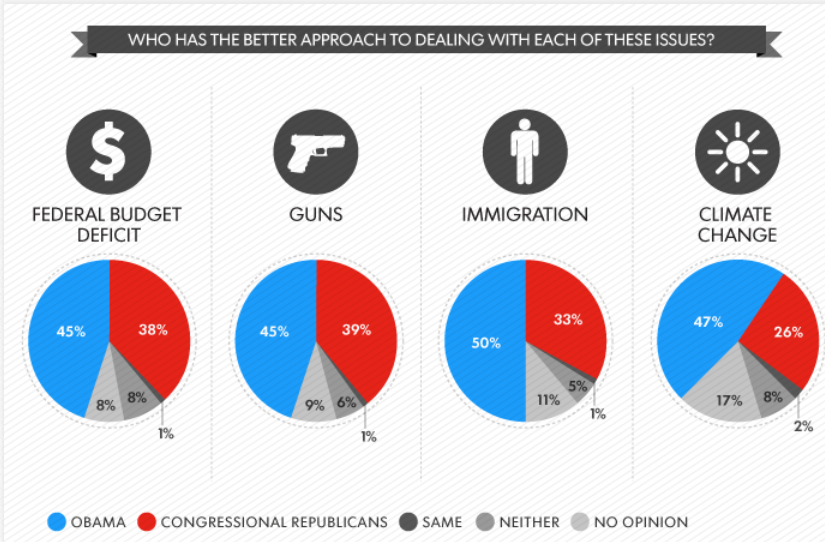
| How Are Your Priorities Aligned? Posted: 24 Feb 2013 04:30 PM PST Via USA Today, we see this interesting assortment of political issue and priority questions:
More charts after the jump
 |
| Gas Tanker Attempts First Winter Arctic Crossing Posted: 24 Feb 2013 01:00 PM PST |
| Pinocchio Investors: How Investors Lie to Themselves Posted: 24 Feb 2013 08:00 AM PST > My Sunday Washington Post Business Section column is out. This morning, we look at the lies we all tell to ourselves as investors. Here’s an excerpt from the column:
How exactly do investors lie to themselves? Here are just 8 ways I discuss in the column:
What are you lying to yourself about?
Source:  |
| More on Markets and Wealth Effects Posted: 24 Feb 2013 05:30 AM PST More on Markets and Wealth Effects
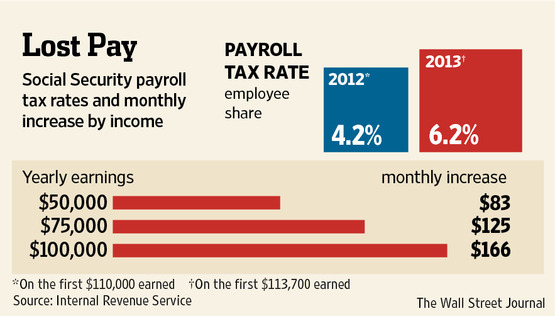
We are scheduled for a half hour with Pimm Fox on Bloomberg TV, Monday, February 25, at 5 PM. We plan to discuss our recent commentary on markets and wealth effects. See www.cumber.com for a copy. We are also scheduled for a half hour on Bloomberg radio on Tuesday morning, February 26, at 8 AM with Tom Keene and Mike McKee. I suspect the subject of wealth effects and markets will be on the agenda. We look forward to these discussions on Monday night and Tuesday morning. Many thanks to readers for the comments on the "wealth effect" piece. Thanks also for the links to other research on this subject. Let's try to hit a few key points raised in emails. Liz Webbink, a skilled economist and long-time friend, noted a technical error. I believe, on rereading my text, that she is correct. She suggested a slight change. Many readers do not know that a reduction in debt is an increase in savings. How that debt is reduced is not part of the calculation. So if you pay down your mortgage, your household savings rate rises. And if you sell with a short sale and the mortgage is reduced because a bank takes a loss, your household savings rate also rises. I wrote, "For the extended, '93-'12 period, including the financial crisis, the elasticity level reached 0.99. That is, under present circumstances nearly 100 percent of income in the US is spent on personal consumption, when it is adjusted into real terms." Liz suggested "For the extended, '93-'12 period, including the financial crisis, the elasticity level reached 0.99. That is, for each dollar of additional income, 99 cents was spent on personal consumption. Consumers were able to save 5 cents per incremental dollar of income because of the reduction in debt through foreclosures." Liz also suggested I give readers a link for those who want to delve into this detail. Thank you, Liz. Readers may find this useful: "A Guide to the National Income and Product Accounts of the United States (NIPA)". See: http://www.bea.gov/national/pdf/nipaguid.pdf . Some readers asked how high the stock market would have to go to offset the payroll tax hike. That is difficult to estimate, but we will try. Think of it like this. The payroll tax hike is about $125 billion in a permanent shift. If the Credit Suisse elasticity estimates are correct, we would need to multiply that number by about 100 in order to derive the wealth effect needed from stock prices that would offset the reduction of income. That means stocks would need to rise about $12.5 trillion in market value, implying a 60% permanent upward market move. Of course, that silly calculation assumes there is no change in the housing wealth effect. But we know there would be one, and we have the Credit Suisse estimates that housing has about 3 times the elasticity of stocks. Let's simplify. A $4 trillion increase in the value of the housing stock would generate about the same consumer spending as a $12 trillion increase in stock prices. Either one would be about enough to offset the $125 billion negative effect of the payroll tax hike. If we think of the housing stock as worth about the same as the stock market in this post-crisis recovery period, we can estimate a combined housing and stock market outcome. Let's assume that housing and stocks each start from a present base of around $18 trillion. A crudely estimated 12-15% increase in the national housing stock value and a crudely estimated 25-30% increase in the stock market price level would combine to give us enough positive wealth effect to offset the 2% payroll tax hike. Now, I hope you can see why the 2% hike delivered to us by President Obama, the Democrats in the Senate and the Republicans in the House was about as dumb a thing as one can conceive. Dear clients, consultants, professional colleagues, and all readers. At our firm we do not manage policy. We manage portfolios. We do not like this policy of taxing working Americans while engaging in class warfare against wealthy Americans. If we were the czar, we would not do it. But our job is to look at markets and what they will do and why. The present tax policy combined with very slow growth and cheap money will widen the divide between the rich and poor. If you work and live in America and earn $113,700 or less, you have been kicked in the gut by your president, your senator and your congressman; it makes no difference which political party she or he belongs to. They have all hurt you. If you have accumulated some wealth, you now face a prolonged period of rising asset prices. Stocks, real estate, precious items, art, collectibles and anything else that benefits from a widening class divide is a target for appreciation. You also face a long period of very low income on your savings. That means you must change the way you invest. In the very long run this is a terrible policy for America. In the next few years it means a very bullish investment climate.
~~~ David R. Kotok, Chairman and Chief Investment Officer
 |
| Posted: 24 Feb 2013 05:00 AM PST Good Sunday morn. Here is your pre-Oscar party reading material:
What are you doing for brunch today?
Payroll Tax, Expensive Gas, Stagnant Wages Bite Consumers  |
| Posted: 24 Feb 2013 04:30 AM PST Federal Reserve Chairman Ben S. Bernanke talks about the Fed’s policy strategies, the U.S. economy and the so-called fiscal cliff and debt ceiling. The University of Michigan’s Susan Collins moderates the discussion in Ann Arbor, Michigan. Source: Bloomberg, Jan. 14 2012  |
| 2014 BMW 3 Series Gran Turismo Posted: 24 Feb 2013 03:30 AM PST The all-new BMW 3 Series Gran Turismo adds an innovative new concept to the successful BMW 3 Series line-up. It combines the Sedan’s dynamic, sporting genes with the practicality and versatility of the Touring, qualities which are backed up by a palpable increase in space and driving comfort. The Gran Turismo exudes aesthetic and emotional appeal, boasts a distinctive presence on the road and offers similarly pronounced driving pleasure. Have a closer look at the design and the product substance.  |






| You are subscribed to email updates from The Big Picture To stop receiving these emails, you may unsubscribe now. | Email delivery powered by Google |
| Google Inc., 20 West Kinzie, Chicago IL USA 60610 | |



0 comments:
Post a Comment