


The Big Picture |

- ALL of Big Banks’ Profits Come from Taxpayer Bailouts & Subsidies
- 10 Monday PM Reads
- Are Boomers Too Cautious About Stocks?
- Italian markets suggest a Bersani win, with Berlusconi to fail: What about Grillo?
- Parody: AG Lanny Breuer on Prosecuting Whistleblowers
- 10 Monday AM Reads
- Film Deaths: Quentin Tarantino
- Bernanke Goes Car Shopping
- Poll: Americans Back Spending-Cut Delay
- Rug to be pulled out from under the short bonds trade ?
| ALL of Big Banks’ Profits Come from Taxpayer Bailouts & Subsidies Posted: 25 Feb 2013 10:30 PM PST  The Big Banks "Would Just About Break Even In the Absence of Corporate Welfare"The government has propped up the big banks for years through massive, never-ending bailouts and subsidies. Bloomberg noted last year that 77% of JP Morgan's net income comes from government subsidies. Bloomberg reported yesterday:
The money hasn't just gone to the banks shareholders … It has also gone to line the pockets of bank management:
We've noted for years that the big banks – including Citi, Wells, Bank of America and the rest – are actually insolvent. Breaking up the big banks would stabilize the economy … and dramatically increase Main Street's access to credit. But the government has chosen the banks over the little guy … dooming both:
Remember, the Federal Reserve has paid banks high interest rates to stash money (their "excess reserves") with the Fed for the express purpose of preventing loans to Main Street. And the Fed plans to throw more money at the banks when the Federal Reserve starts to tighten. As FT reports:
And while this post focuses on bailouts and subsidies to big American banks, a large percentage of the bailouts went to foreign banks (and see this). And so did a huge portion of the money from quantitative easing. More here and here.  |
| Posted: 25 Feb 2013 01:17 PM PST My afternoon train reads:
What are you reading?
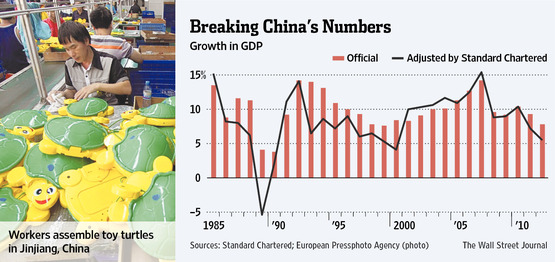
Hidden Risks of a Hard Landing in China  |
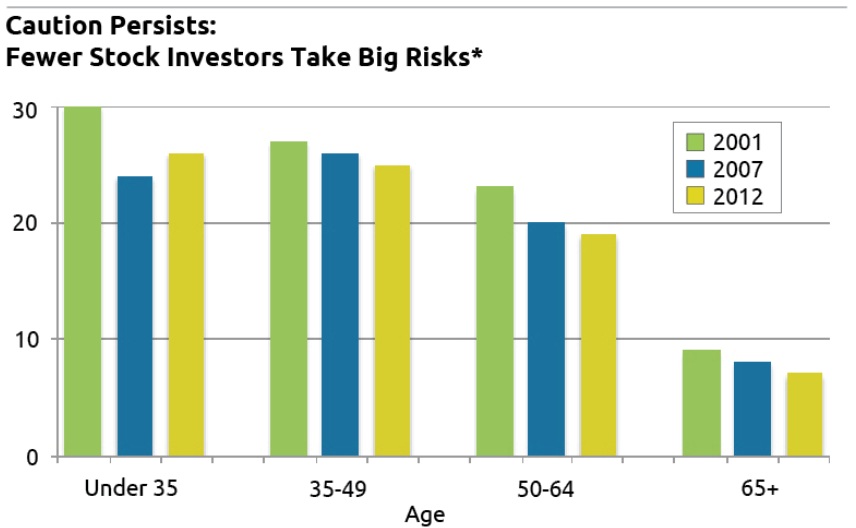
| Are Boomers Too Cautious About Stocks? Posted: 25 Feb 2013 09:00 AM PST Source: Squared Away Blog
The Financial Security Project (of Boston College) references the ongoing risk aversion that many investors still seem to laboring under. They note:
This is something we see in the office all the time, and it is classified as a financial behavioral issue: Boomers have not not gotten back into equities, as they age they continually pare back their risk profiles. I am not sure what the solution to the behavioral issue will be, but I suspect a lot of people who previously thought of themselves as “comfortable” might be in danger of outliving their monies. These are strange days . . .  |
| Italian markets suggest a Bersani win, with Berlusconi to fail: What about Grillo? Posted: 25 Feb 2013 08:09 AM PST Kiron Sarkar’s subscription service for his newsletter commences today Monday 25th February 2013. To subscribe, go to sarkargm.com. This is last free newsletter of his . . .
Japan: "Japan is not, and will never be, a tier-two country" the Japanese PM, Mr Abe, stated during his visit to the US. Whilst true, such a statement is bound to annoy Beijing, who see themselves as the sole regional power. Mr Abe is also proposing to increase defense spending and defend Japanese sovereignty of the Senkaku Islands, which the Chinese call the Diaoyu islands and, indeed, claim as Chinese territory – an ongoing "tricky" situation to say the least. Mr Abe raised the issue with President Obama, who is trying to defuse the situation. The PM also raised the issue of entering talks re the proposed Trans Pacific Partnership, the TPP – though agriculture (politically important Japanese rice farmers) are an issue; Japanese press reported over the weekend that Mr Haruhiko Kuroda, the current president of the Asian Development Bank, will be chosen by PM Mr Abe to be the next head of the BoJ, with the announcement to be made in a few days. He certainly seems to be the best of the 3 contenders allegedly in the running. Mr Abe needs the approval of the Upper House of Parliament, which he does not control. Mr Kuroda has, in the past, recommended that the BoJ target a higher inflation rate (he once suggested 3.0%, but has stuck to the PM's 2.0% target recently) to dig Japan out of its 15+ year deflation problem. There is also speculation that Mr Iwata, the uber dovish candidate, may get one of the 2 deputy governor positions. The markets welcomed the news, with the Nikkei up over 2.4% at the close and the Yen weaker, though off its lows. Traditionally, Japan appoints the head of the Asian Development Bank, though if Mr Kuroda does get the job, there may be a move by some countries in the region to try and change that; China: The HSBC February flash PMI came in at 50.4, lower than the final reading of 52.3 in January and the forecast of 52.2. The reading is just another piece of information which suggests that the Chinese economy has not sprung back as robustly as was thought initially. The Chinese New Year holidays may have impacted, but the new orders component declined to 49.8 in February, as opposed to 53.7 in January. Whilst too early, other anecdotal evidence I have received, suggests some weakness is creeping in. In addition, there are fears over rising inflation and proposals to increase fuel prices, for the 1st time since September, will not help. On another issue – the trial of Mr Bo has not started as yet – Hmmmmmm. It has been a very long time. Some reports suggest that the ousted leader has regained some support – will prove tricky for the new leadership, which takes over in March, if true. Too early to fully analyse the situation though; Cyprus The Centre-right Mr Nicos Anastasiades won the Presidential elections in Cyprus over the weekend, defeating his Communist challenger. The President, who has the backing of Mrs Merkel, has promised to solve the country's sovereign and bank debt issues quickly !!!. Essentially, Cyprus and its banks are bust. Mrs Merkel needs the support of her opposition to approve a bailout and the opposition (the SPD) are deeply concerned about allegations that Cypriot banks were engaged in money laundering and tax evasion on behalf of Russians, in particular. Whilst most expect a speedy resolution, I believe that the more likely outcome is some kind of fudge (yet again) by the EZ, which tides Cyprus over until after Mrs Merkel's September general elections. There is a question of bank bondholders and depositors facing haircuts. These are potentially serious potential contagion effects. However, I believe that bondholders will, indeed, face haircuts, though depositors (just and I repeat just) are unlikely to be hit, based on present circumstances. The Russian authorities will have to contribute. The IMF is pressing for a restructuring of Cypriot sovereign debt as it has to be comfortable with the prospective debt sustainability of the country. The negotiations are likely to be tougher than the market expects and some kind of repayment of bailout loans, linked to prospective natural gas revenues and a significant downsizing of the country's financial sector are likely demands by the Germans, in particular. The other major issue is whether all of this can wait till the German elections are over?; Greece The Bank of Greece forecasts that GDP will decline by -4.5% this year !!!!. They do forecast growth for next year. It's going to be a long hot spring/summer. The threat of civil disorder must be extremely high; France: The French Finance Minister has requested that the EU allow the country an extra year to get their budget deficit down to the 3.0% target – a target which the French were supposed to have been met this year. The EU forecast that the French budget deficit will reach 3.7% this year, rising to 3.9% next, with the EU Commissioner, Mr Olli Rehn, talking semi-tough (for his German audience) last Friday – but in reality, what can he or the EU do. The EU will have to argue that France has embarked on a programme of fiscal and structural reforms – quick go get the microscope !!! and, most likely, they will. The bigger issue, is that relations between Germany and France will become even more strained. The German's are demanding that France, as their key "partner" in the EU (divorce is on the cards), should stick to its commitments. Well they can ask/demand, but………Relations between Mrs Merkel and President Hollande are "strained" and worsening day by day. Seriously, the continuing split between Germany and France will have some pretty profound implications for the EU/EZ in coming years – watch this space; UK: Moody's stripped the UK of its top Aaa rating, downgrading the country by 1 notch to Aa1, through with a stable outlook. The ratings agency cited the country's weak growth outlook, high and rising debt, a reduced capacity to withstand shocks and the challenges it faces in respect of its fiscal consolidation programme. Moody's suggested that UK government debt was unlikely to decline before 2016, The news should not have come as a surprise, though sterling did decline by some 0.9 cents against the US$, to a 2 ½ year low, following the news. However, the downgrade should not really impact the UK (the 10 year gilt yield has risen by just 1 bps). After all the US, Japan and France have all been downgraded, as have other countries, with no discernible negative impact – indeed, quite the opposite. However, politically, the UK Chancellor will be challenged by the opposition party, given his pledge to retain the AAA rating and his party and coalition partners may put pressure on him to limit the austerity measures – unlikely to accede to their requests. The yield curve may steepen, with the short end stable, though the longer end rising, given the inflation outlook – good for UK financials. Latest EU reports suggest that UK debt will rise from 90% of GDP last year, to 95.4% this year and 98% next. In the EZ, Holland is likely to be downgraded as well; Canada: CPI rose by just +0.1% M/M in January, or +1.0% Y/Y, well below the Bank of Canada's 2.0% threshold. It is the slowest rate of inflation since the crisis in 2009. The BoC has been threatening to increase interest rates since the start of 2012. With the extremely poor retail sales numbers announced on Friday, the chances of the BoC increasing rates is zero. However, an interest rate cut by the BoC in due course?. Canadian Q4 GDP will be announced shortly. The C$ declined following the retail sales/CPI data released last Friday and should come under further pressure; US Current information suggests that the sequester will take place. However, there are some who say that there will be a deal sometime after the sequester takes place. A game of chicken/blame game is being played out. The effects of the sequester will take time to impact, which could be a reason for the lack of movement for the present;. Outlook Equities Asian stocks closed higher, with the Nikkei up +2.4%. European markets are much higher as well, ahead of the Italian elections, where polls are to close shortly. The MIB is up strongly (up over +2.3% at present), following up on decent gains on Friday – seems like the market is saying that Bersani will win with Berlusconi failing to make a serious impression. However, what about Mr Grillo?. US markets closed at their highs of the day on Friday, following comments by the St Louis FED governor that the FED"s easy money policy would continue for a "long time". However, US markets (S&P and Nasdaq) broke their 7 week winning streak. US futures suggest that US markets will open higher. Currencies The A$ having weakened on the poor HSBC flash PMI data, is recovering and is currently flat at US$1.0315 – however, the RBA signaled that it was unlikely to cut rates, which should be positive for the A$; The Yen is weaker on the prospective appointment of Kuroda as BoJ governor, though well off its highs – currently Yen 93.98 against the US$ – about Yen 0.70 stronger than its early morning lows; The Euro is up around +0.8% at US$1.3302 – will be impacted by the Italian elections – also suggests a Bersani win; Sterling remains in the doghouse following the Moody's downgrade – currently US$1.5138. Bonds US 2 year Treasury yields are at 0.25%, with the 10 year at 1.97%; German 2 year bunds are yielding just 0.13%, with the 10 year at 1.59%. UK 2 year gilts are yielding 0.26%, with the 10 year yield at 2.12%. The US/German short term yield differential (12 bps) is in favour of US Treasuries and is US$ supportive. Commodities Spot gold is trading at US$1592 at present – the market is not focused on the precious metal at present and, in addition, the US$ is strengthening. In addition, it looks like hedge funds, in particular, are reducing their long positions; April Brent is up strongly, trading at US$115.38 – up 1.1%+, a real concern, given the state of global economies. No major US economic news scheduled for today. Generally, I remain cautious to negative of equity markets and, in terms of currencies, prefer the US$ to other currencies. Finally, welcome to the Sarkar Global Macro newsletter – a mouthful of a name, I know. I trust we all have a long and profitable relationship. Kiron Sarkar 25th February 2013
~~~ Important Notice This newsletter will become a fee based subscription service, starting on Monday 25th February 2013 at www.sarkargm.com To avoid potential subscribers from subscribing too early, while the newsletter remains free of charge, (which will be the case up to and including Friday 22nd February), the subscription process will only be open from 4.00pm GMT (11.00am EST) onwards, on Friday 22nd February, ie after the last free newsletter is sent out.
 |
| Parody: AG Lanny Breuer on Prosecuting Whistleblowers Posted: 25 Feb 2013 08:00 AM PST Assistant Attorney General Lanny Breuer on Whistleblowers and Prosecuting Published on Jan 29, 2013 Lanny Breuer appearing on the PBS production of The Untouchables  |
| Posted: 25 Feb 2013 06:48 AM PST My morning reads to start off of your week:
What are you reading?  |
| Film Deaths: Quentin Tarantino Posted: 25 Feb 2013 05:00 AM PST In honor of the funkiest Oscar speech last night, here are the film deaths of Quentin Tarantino:
 |
| Posted: 25 Feb 2013 04:24 AM PST Have you been shopping for an automobile recently? If you want to understand the impact the Federal Reserve is having on the real economy, I suggest you do a little online homework and then go hit the auto dealers. You will be astonished at what you find. Whether you are buying a car or leasing one, the financing component is a very large part of what is typically the 2nd largest purchase the average American family makes (homes being the largest). Regular readers know I am fan of the automotive arts, from the $15k Fiat 500 to exotics that cost 50X as much. I always have a good sense of what’s available, what’s coming out, and their prices. One of my marketable few skills is the ability to figure out the ideal car for a person within 15 minutes of meeting them (its true). Take this background, and add in my daily awareness of where interest rates are, and one would imagine that I would not be surprised at the cost of buying or leasing a new car today. As it turns out, I was stunned at the bargains available across all price points. We lease our cars through the office. By dumb luck, I have two cars coming up within 30 days of each other. I am the spendthrift, while Mrs. Big Picture is the one who reins in my attempt at single-handedly reviving the American economy. To give you an idea of how things have changed — nearly all due to interest rates — the same monthly payments for leases now buys you about 25%-33% more car for your buck. Financed purchasing power gives you almost as much gains for your buy relative to 3-4 years ago. A car I suggested to the missus as her daily driver in 2009 was dismissed out of hand as “way too expensive.” It was about $18k more (almost $200 more on a monthly lease) than what we ended up with. The same car leased today cost $20 more per month than our current ride. Several cars I didn’t even dare suggest last time (lest I get yelled out) we actually test drove and made offers on. The cost of any given car is a function of its MSRP, programs the dealers are running, what is hot or not, and many other factors. But the key factor today is ZIRP — the near zero percent rates that the Fed is running. If you have half decent credit rating and are even remotely thinking about replacing an automobile, I strongly urge you to go do some shopping. You will be very pleasantly surprised by what you find. This is the entire purpose of QE/ZIRP. To stimulate the economy, move houses and cars and other financed goods. You might pay the cost for it in higher inflation (eventually) and much worse income if you live on a fixed income, but during the mean time, listen to what your Uncle Ben has been suggesting to you — go make some financed purchases. ~~~ I’ll get some details up on the various car prices we have seen and what the negotiations were like later this week.  |
| Poll: Americans Back Spending-Cut Delay Posted: 25 Feb 2013 04:00 AM PST Americans want Congress to delay steep spending cuts to give the economic recovery more time to take hold, according to a Bloomberg News poll. Peter Cook reports on the poll’s results and the effects of sequestration on Bloomberg Television’s “In the Loop.” Cook also previews his interview with Virginia Senator Tim Kaine on this weekend’s “Capitol Gains.”
 |
| Rug to be pulled out from under the short bonds trade ? Posted: 25 Feb 2013 03:00 AM PST In certain aggressive managed accounts, we have been nibbling on some TBT, the inverse 20 year treasury ETF. Data such as the AAII Asset Allocation Survey show investors are very overweight bonds relative to their 27 year mean. Additionally, the multi-decade drop in interest rates suggests we are likely at a secular low, and ready to embark on a long cycle of rising rates. Looking at TBT, we see a technical base building, which looks so inviting. As they say in our industry, it looks so good it makes you "want to back up the truck !" On paper it's a perfect set up: a long death decline, from $ 300 in 2008 to a low of $56.32 on July 25th 2012, exhausts and frustrates even the most ardent TBT holder into capitulation. With most of the owners flushed out of TBT, or at minimum uninterested after being "long and wrong" for so long, shares subsequently have built a beautiful 7 month base. Throw in all the rational and widely assumed fundamental reasons why Treasuries should correct, and instruments like TBT should rock and roll. So after stating all the aforementioned points, you'll be surprised that we are rethinking our small long commitment in TBT. Why ? 1. It's too obvious to everyone: The old saying the "market exists to confound the majority and reward the minority" exists for a reason. Typically, when everyone thinks they have it figured out and it seems so easy and logical – it just doesn't work. Markets don't just shower riches on the masses. It's just never that easy. Markets reward intelligent and diligent thinkers and tacticians. Right now EVERYONE thinks bods will top – so we suggest the maybe the market won't be so accommodating ! 2. Setting up to breakout – and breaking out – are two different things: While that TBT base looks very enticing, we have seen many promising bases fail at the upper end of their range, then slip and fall back into the base again. We all have selective memories of these great breakouts, the kind that bust out and never look back. The reality, however, is those type of breakouts are the minority. The $ 69.25 – $ 70.00 level on TBT has been a sticking point for a while now. We will call it a breakout when those levels are eclipsed. For now, its all potential … and "potential" has gotten many an NFL executive to bite on first round QB's that can't cut it ! 3. Monster spike in Google Trends for TBT: While not scientific, we find the chart below from Google Trends very interesting from a sentiment perspective. As illustrated below, the amount of interest in TBT, as demonstrated by Google searches for TBT, have exploded to an 8 year high as of yesterday. This clearly supports our 1st point: everyone is sniffing around this trade, and we just don't see the market rewarding everyone, as she's just not that kind ! Click chart to see larger image So while the TBT chart below shows a potentially compelling technical bottom, and fundamental evidence to support the trade is plentiful, TBT has been repelled at resistance again, and slipped lower as bond yields moderated. While we believe ultimately this is the correct trade to make, the timing just may be off, however, as too many people are sniffing the trade. Thus, shares may skip or base for several months longer to get investors uninterested again. This trade will remain on our radar as we are setting alerts in our FusionIQ software system to alert us to TBT > $ 70.00, coupled with a new FusionIQ Buy signal. Ultrashort 20 Year Treasury (TBT) – Daily Chart As seen below TBT shares are still below key resistance near $ 70.00 (red line). Only above $ 70.00 will TBT truly have broken out and turned the corner. Until then, the seduction of the breakout will be the lure.
Click Chart To See Larger Image
 |


| You are subscribed to email updates from The Big Picture To stop receiving these emails, you may unsubscribe now. | Email delivery powered by Google |
| Google Inc., 20 West Kinzie, Chicago IL USA 60610 | |



2 comments:
I like the helpful info you provide on your articles. I will bookmark your weblog and
check again right here frequently. I'm fairly certain I will be told plenty of new stuff right here! Best of luck for the next!
My weblog :: i need money now for free
Good way of describing, and good paragraph to obtain facts about my presentation focus, which
i am going to convey in academy.
Also visit my web page: millionaires giving away free money
Post a Comment