


The Big Picture |

- Big Food Is Making Us Sick
- 2013 Audi RS 4 Avant Paintball Duel
- 10 MidWeek PM Reads
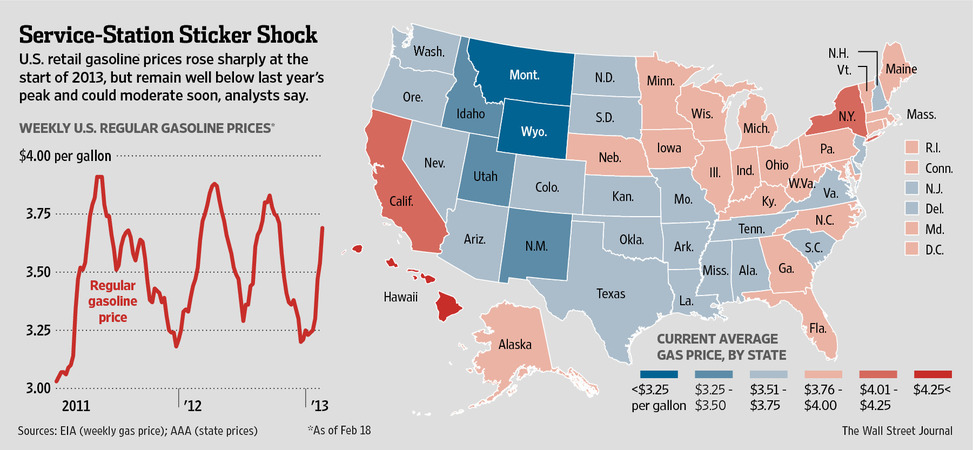
- National Gas Prices
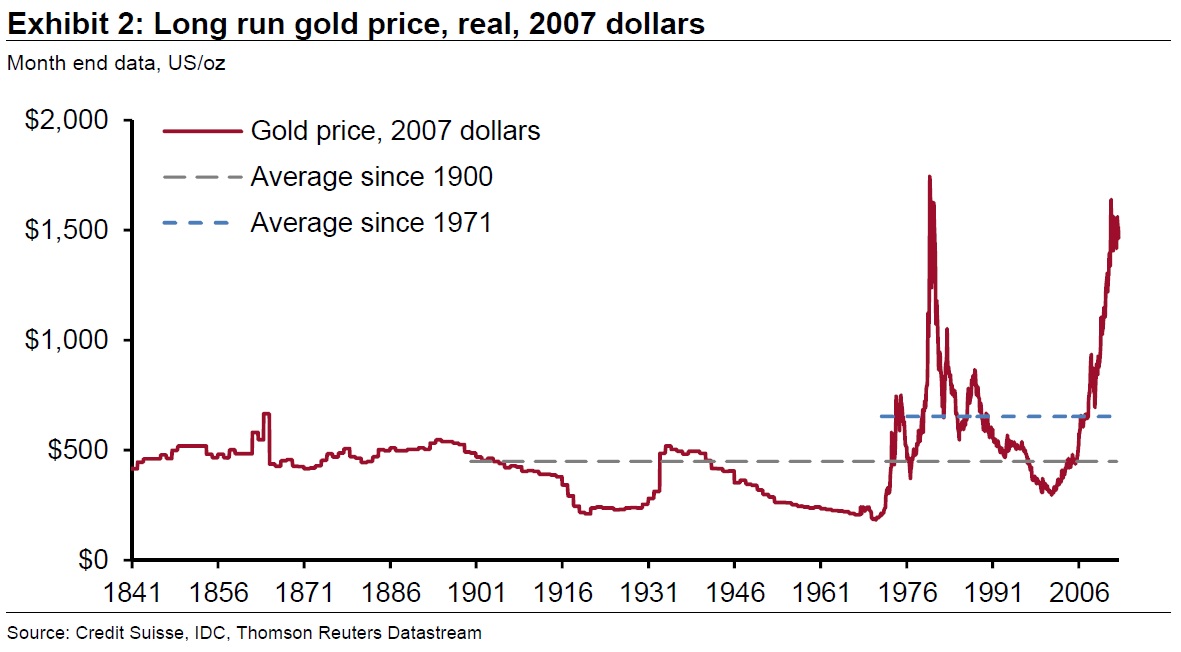
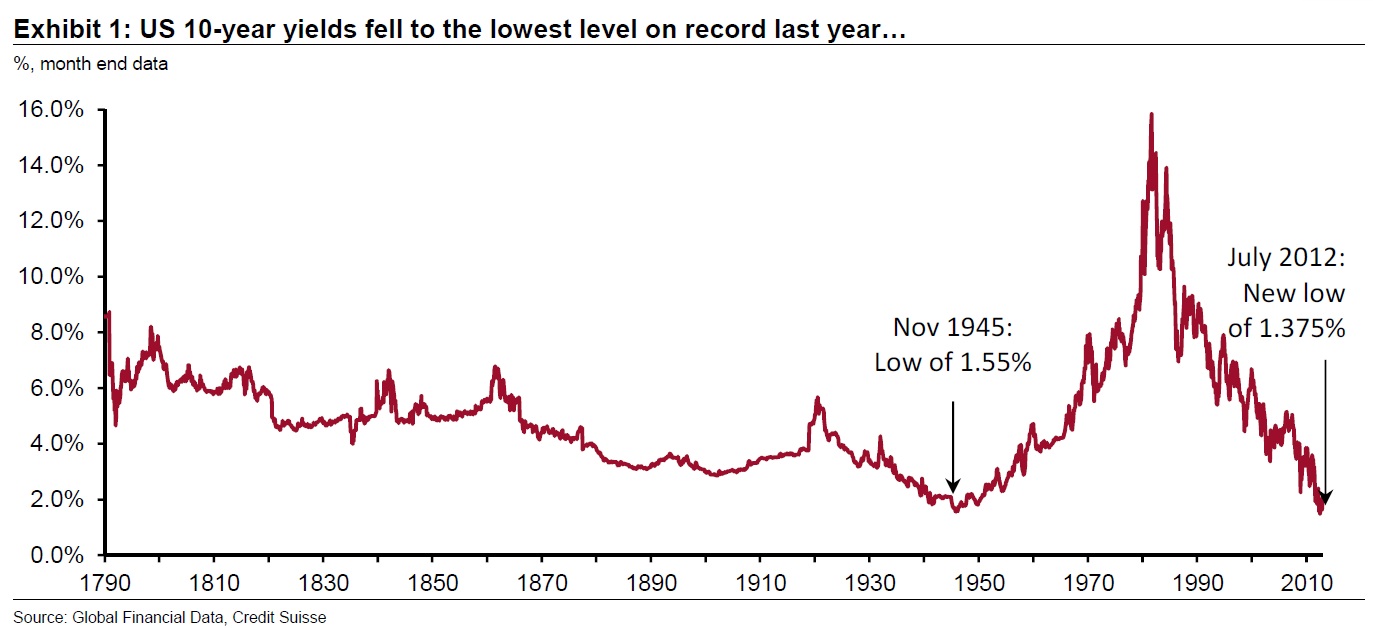
- Gold vs 10-Year Yields
- Markets, Wealth, NY Fed
- 10 MidWeek AM Reads
- Equity Market Review 2.26.13
- Crashing Spiral Galaxies
- QE is Still Here (and what you should do)
- The Big Banks: Too Complex To Manage?
- Jamie Dimon to Mike Mayo: ‘That’s Why I’m Richer Than You’
| Posted: 27 Feb 2013 10:30 PM PST Giant Food Corporations Work Hand-In-Glove With Corrupt Government Agencies To Dish Up Cheap, Unhealthy Food
The Independent reports that small farmers are being challenged by food companies are becoming insanely concentrated:
How is that effecting the safety of our food supply? Reuters notes:
How are giant food manufacturers trying to influence legislation? As Waking Times reports, they're trying to gag all reporting:
So what – exactly – are the giant food corporations trying to hide? They are fraudulently substituting cheaper – less healthy – food for high-quality food. And see this. Indeed, the dairy industry wants to add sweeteners – such as aspartame – to milk without any labeling. Food fraud is rampant .. including huge proportions of fish. The bottom line is that collusion between government and big business is dishing up cheap, unhealthy food … just like collusion between D.C. and giant corporations caused the financial crisis, the Fukushima nuclear meltdown, the Gulf oil spill and other major disasters (and see this; and take a peek at number 9). For example, the FDA:
The Department of Agriculture:
An official U.S. government report finds that Americans 'are sicker and die younger' than people in other wealthy nations. There are a number of factors making us sick … but unhealthy, cheap food is part of it. One solution: buy from local farmers and ranchers … or grow your own as much as possible.  | |||||||||||||||||||||||||||||||||
| 2013 Audi RS 4 Avant Paintball Duel Posted: 27 Feb 2013 04:48 PM PST Two brand new 2013 RS 4 Avants with bonnet mounted paintball guns take over a military aircraft hangar and go head to head in the ultimate paintball duel. Looks like fun:  | |||||||||||||||||||||||||||||||||
| Posted: 27 Feb 2013 02:03 PM PST My afternoon train reads:
What are you reading?
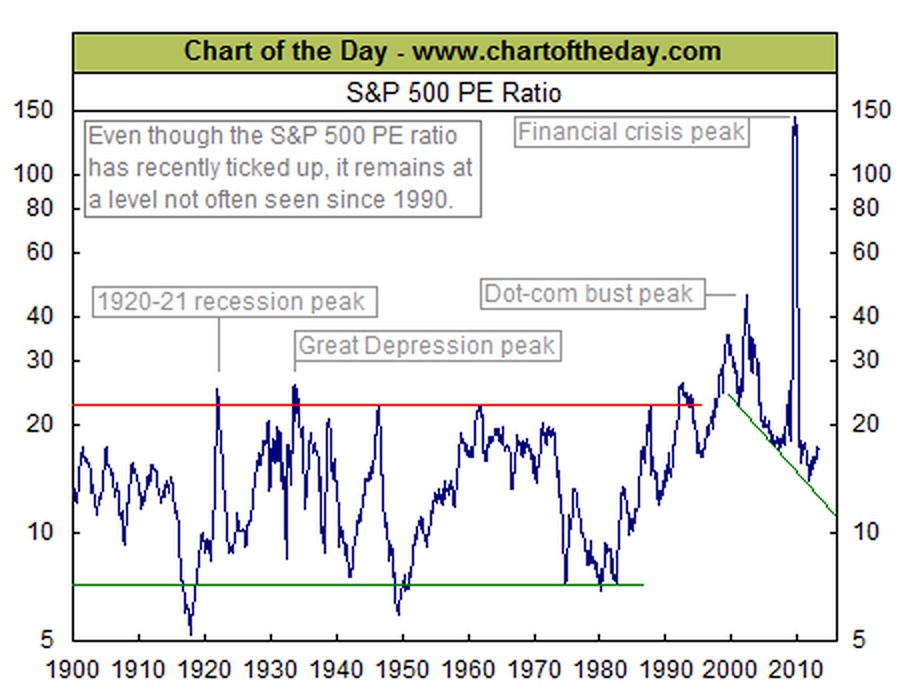
S&P500 PE Ratio  | |||||||||||||||||||||||||||||||||
| Posted: 27 Feb 2013 12:00 PM PST | |||||||||||||||||||||||||||||||||
| Posted: 27 Feb 2013 10:00 AM PST Click to enlarge
With gold back under $1600, and the 10 year at 1.87%, I wanted to show a chart of the two of them. The correlation is not as obvious as most people think: During spikes in Inflation, Gold and Interest Rates tend to run together (see the 1970s or 2001-07). Post crisis, the period of deflation has continued the rally in bonds that has driven rates to record lows over the past few years. But Gold has been unable to get out of its own way the past few years. I’ll have the boys run some analytics to see exactly what this correlation looks like back to 1970s . . .
>  | |||||||||||||||||||||||||||||||||
| Posted: 27 Feb 2013 07:45 AM PST Markets, Wealth, NY Fed
Our written comments on wealth effects were discussed on Bloomberg TV and Bloomberg Radio. For copies see this or Twitter. That discussion and the commentaries about markets and wealth effects triggered a blizzard, which expanded after friends at Big Picture and Business Insider posted them. Thank you to all bloggers, readers, economist writers and others for expressing views on this subject. Below are a few follow-up notes. But first I must add something to the discussion of Gretchen Morgenson's NY Times column and my support of her view. Yesterday, Judge Lewis Kaplan issued an interim order in the litigation. I will quote two sentences. He said "Thus, the FRBNY appears to be engaged in an attempt to circumvent and defeat the forum selection clause to which it is bound by its agreement with AIG. On the face of it, the actions of the FRBNY and its instrumentality, Maiden Lane II, are perhaps unattractive and, indeed, wrongful." I stand with Gretchen and her reporting of the actions of the Federal Reserve Bank of New York. Truth, transparency and US Constitutional protection of the press and of free speech are all that stand between our citizens and the financial tyranny of the last five years. If we lose that Constitutional protection, tyranny will win and we are doomed. Now let's get to wealth effects. Long-time personal friend and TV star economist Bob Brusca weighed in on Liz Webbink's comment. Readers, if you are bored with discussion of wealth and savings and income, stop here. Others who are serious students of economics and/or financial markets may enjoy the next few minutes. Bob Brusca said, "Not true! Not necessarily true – oh those economists!" He explained why we got such disagreement on a simple statement about income and savings and wealth. Bob wrote: There are two calculations of the savings rate. One is from the flow of funds and that is the one for which I believe Liz's statement is correct. The flow of funds report is from the Fed. It builds up its data from stock data stocks ['stocks' as in stockpiles] of assets and of liabilities. The other savings calculation is monthly, from the personal income and spending report (PCE). That is a FLOW calculation. In the PCE framework there is your income (a monthly flow) and your spending (also a monthly flow). The difference between is 'not-spending' or savings. That's all there is to it. If you have a mortgage or pay it off, it does not matter here except to the extent that it you have one, you are making mortgage payments and that will increase spending and reduce savings. Another Bob, my colleague Bob Eisenbeis, suggested we simplify the notion of elasticity. He put it like this: "You may want, for the lay audience, to convert the elasticities; i.e., a dollar increase in stock market wealth leads to 1.5 cents in additional spending." That is what the Credit Suisse calculations showed when they examined the pre-crisis period. The 1.5 cents of spending per dollar increase dropped to 1.1 when the crisis period was included. What about housing? Well, we have some good revised estimates from nationally renowned experts, including a third Bob, as in Bob Shiller. You can find them In "Wealth Effects Revisited: 1975-2012," by Karl E. Case, John M. Quigley, and Robert J. Shiller, NBER Working Paper No. 18667, January 2013. I will paraphrase their summary abstract. The authors re-examine the links between changes in housing wealth, financial wealth, and consumer spending. They extend a panel of US states observed quarterly during the 17-year period 1982 through 1999 to the 37-year period 1975 through 2012Q2. Using techniques reported previously, they impute the aggregate value of owner-occupied housing, the value of financial assets, and measures of aggregate consumption for each of the geographic units over time. They find a rather large and statistically significant effect of housing wealth upon household consumption. This effect is consistently larger than the effect of stock market wealth upon consumption. In their earlier version of this paper they found that households increase their spending when house prices rise, but they found no significant decrease in consumption when house prices fall. The results presented with the extended data now show that declines in house prices stimulate large and significant decreases in household spending. The elasticities implied by this work are large. An increase in real housing wealth comparable to the rise between 2001 and 2005 would, over the four years, push up household spending by a total of about 4.3%. A decrease in real housing wealth comparable to the crash which took place between 2005 and 2009 would lead to a drop of about 3.5%. Let's sum this up. To get rising aggregate demand and translate it into more robust economic growth, the best method is to raise income. Nearly every dollar of additional income is spent. If you want more personal income in the United States, tax work less. If you want to repress income growth, tax work more. Our politicians still do not get this concept, which is why they tax work more and then try to transfer those tax receipts to those who do not work. It is okay to support those who need it, in my view, but doing so in a way that diminishes work exacerbates the negative outcome. It is important to acknowledge that wealth matters. As a nation we want more of it. We want it for our savings, which means investments, and we want it for our housing and our other non-liquid assets. We would prefer that this increased wealth be real, not the product of inflation, where the nominal price is higher but the actual value is not. That is why we fear inflation. The Federal Reserve is trying to engineer the former (rising prices of assets) while controlling the latter (inflation). That is why the interest rates have been and will be so low for so long. The Fed wants to encourage rising asset prices and it wants to encourage us to convert some of that additional wealth into spending. We, meanwhile, are recovering from a major financial shock. We do not trust financial markets, for good reason. And we do not have conviction about national policy, for good reason. So we hold back. And we fret. That makes the Fed's job harder. At the end of this period we will get to some new form of equilibrium. It is likely to include some more inflation and higher asset prices and higher interest rates. How long that takes and what path will lead us there is the major issue facing all investors and all citizens. None of the experts knows the answer. We are all guessing, and we need to be prepared to change our views. The NBER paper cited above is an example of a change in view. It is superb work. What is implied is that we know very little about what our future will bring. More importantly, we have great difficulty forecasting it. At Cumberland, we think there will still be a prolonged period of low interest rates. We think that period and those low rates give assets prices an upward bias. That means those of us who are fortunate enough to have accumulated wealth can benefit from thoughtful allocation of that wealth. We also see our national government applying a rising cost to work. That counters positive wealth effects. There is the basic tension now present in our society. None of us knows how this will be resolved. The economist in me says that taxing work and making earned income more costly to obtain is a bad thing for our country. In the end we all lose when that happens. For now, wealth gets the benefit of the policy, thanks to the Fed. We remain biased toward fully invested positions. ~~~ David R. Kotok, Chairman and Chief Investment Officer  | |||||||||||||||||||||||||||||||||
| Posted: 27 Feb 2013 07:00 AM PST Here are my LIRR weather delayed morning reads:
What are you reading?
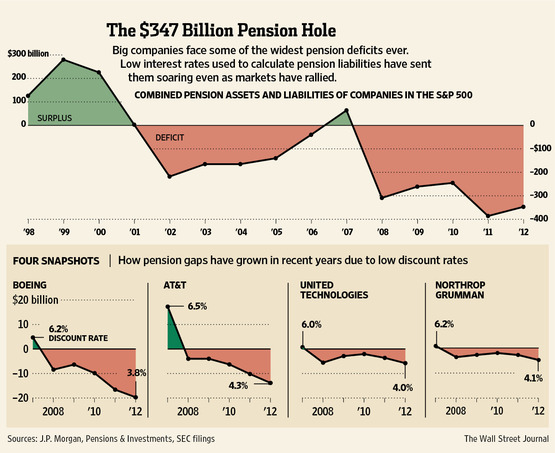
Why the Corporate Pension Gap Is Soaring  | |||||||||||||||||||||||||||||||||
| Posted: 27 Feb 2013 05:30 AM PST  | |||||||||||||||||||||||||||||||||
| Posted: 27 Feb 2013 05:00 AM PST
This galaxy is having a bad millennium. In fact, the past 100 million years haven’t been so good, and probably the next billion or so will be quite tumultuous. The upper left galaxy used to be a normal spiral galaxy, minding its own business, until the one toward its right, crashed into it.  | |||||||||||||||||||||||||||||||||
| QE is Still Here (and what you should do) Posted: 27 Feb 2013 04:36 AM PST Yesterday’s testimony by Fed chair Ben Bernanke makes it clear that QE is here to stay for the foreseeable future. Rather than tilt at windmills, you need to accept this fact, and adjust accordingly. Here are a few of the things that you should be doing in response to zero interest rate policy:
Remember, review the emergency procedures in the card (seat back in front of you) when you are on the ground — not after an engine flames out at 30,000 feet.  | |||||||||||||||||||||||||||||||||
| The Big Banks: Too Complex To Manage? Posted: 27 Feb 2013 03:00 AM PST The Big Banks: Too Complex To Manage?
The phrase "too big to fail" re-entered common use in 2008 after Fannie Mae and Freddie Mac were put into government conservatorship on Sept. 6; the government rescued the large insurance firm AIG starting on Sept. 16; and nine major banks announced on Oct. 14 their intention to subscribe to the Troubled Asset Relief Program (TARP), in which the Treasury would purchase the banks' preferred stock. More unflattering phrases have become associated with megabanks over the past couple of years. "Misbehaviors" connected to the big banks magnified the problems already posed by such large, complex financial organizations, which have concerned legislators and regulators for years. Have they successfully created game plans for "too-big-to-fail" firms? Are big banks needed, or do the misbehaviors indicate that such megabanks should not even exist? These and more questions were explored during the Oct. 1 Dialogue with the Fed, part of the St. Louis Fed's ongoing evening discussion series for the general public. St. Louis Fed economist William Emmons led the Dialogue, titled "Robo-signing, the London Whale and Libor Rate-Rigging: Are the Largest Banks Too Complex for Their Own Good?" Joining Emmons for the Q&A that followed were Mary Karr, senior vice president and general counsel of the St. Louis Fed; Steven Manzari, senior vice president of the New York Fed's Complex Financial Institutions unit; and Julie Stackhouse, senior vice president of Banking Supervision and Regulation at the St. Louis Fed. See the videos and Emmons' presentation slides at www.stlouisfed.org/dialogue. Why Were Big Banks Rescued During the Crisis?The financial crisis reinvigorated the active debate on the "social good" of megabanks—whether they alone can do things smaller financial organizations can't and whether they truly are more effective and efficient. (See “Economies of Scale and Scope” at the bottom for some details.) The primary point of contention, however, is systemic risk. Very large and complex banks are considered to have systemic risk because the failure of a megabank would hurt not just the company itself, its creditors and its employees but potentially the entire financial industry and the economy. In other words, they are "too big to fail" without creating dire consequences for the economy. "Sometimes institutions need to fail. That is essentially what capitalism is about: that when a firm is no longer viable it should be able to leave the market (e.g., fail)," Emmons said. "But we were caught flat-footed in 2008 when the financial system almost collapsed and we had no safe, effective way to wind down failing megabanks." Consequently, the federal government propped up many large and complex financial institutions—including AIG, Fannie Mae and Freddie Mac—to avoid the damage of chaotic collapses. The lack of a structure to deal with a megabank failure has troubled many policymakers and lawmakers who, as discussed later, are attempting to craft such a mechanism. Misbehaviors: A Failure of Discipline?The revelations of recent controversies such as robo-signing, the London Whale and Libor rate-rigging—explored in the "Big Bank Misbehaviors" sidebar at the bottom—as well as other problems not mentioned here indicate that something critical was lacking in the discipline of large, complex banks. "Discipline" is a combination of an institution's internal and external governance. Internal governance includes corporate culture, oversight by the bank's board and managerial self-interest, while external governance comes via supervision and regulation, as well as discipline by product markets, shareholders, depositors, bondholders and counterparties. Was the internal discipline effective? Not really, Emmons explained: "Some of those misbehaviors point in this direction, that the internal corporate cultures at the largest banks are not an effective mechanism for keeping the banks on the straight and narrow." As indicated in Figure 1 below, internal discipline generally appears to work well in the best corporations but not as well among the U.S. megabanks, while external governance generally seems to have worked better for megabanks, Emmons said. "The basic message is that there are some real weaknesses on the internal side, and to the extent that we can be effective as supervisors and regulators, we can probably provide fairly effective external sources of discipline," he said.
Figure 1 Which Forms of Governance Appear To Be Effective for Complex Banks?
"I think it's also true that board oversight is often lacking," Emmons said. It's a perennial issue at small banks and a bigger issue for midsized banks but seems especially challenging for megabanks, as their board members are nonexperts recruited from other economic sectors yet are expected to provide effective oversight of very large and complex organizations. "It's true that the megabanks operate in very competitive product and labor markets, which pushes them to be more efficient. But the other internal governance weaknesses noted above and their overwhelming complexity appear to make them 'too big to manage effectively,'" he said. Both Emmons and Manzari addressed shareholders in response to a question from the Dialogue audience. They noted that small shareholders are exerting some discipline through selling their stock but that there are restrictions on what large shareholders can do and that the type of governing influence that shareholders can have on firms has yet to play out in this changing regulatory environment.
Dealing with Large, Complex BanksBut why didn't federal regulators catch the misbehaviors and other issues before they became major problems? Complexity. For example, Manzari, responding to a Dialogue audience question, said that supervising a handful of megabanks is definitely more complicated than supervising hundreds or thousands of smaller institutions.
Illustrating Emmons' prior exposition on megabank discipline, Manzari added that "The very complexity of megabanks often creates relationships inside the firm that become apparent only after the problem manifests itself." Addressing supervision of smaller banks, Stackhouse noted that while the supervisory process is easier, there is also a very clear resolution mechanism. Since the financial crisis, more than 400 small banking organizations have failed. "A recent failure in St. Louis hit the papers for exactly one day, and I think it's pretty much forgotten about because that's how well (the resolution process) worked," she said. "We're not there yet with large institutions." How To (Maybe) End "Too Big To Fail"So, how will we deal with the megabanks? Emmons outlined two basic approaches: radical and incremental. The radical approach involves structural changes imposed on the banks themselves or the creation of a different legal definition of what a bank is and what it can do. Radical proposals include:
"In fact, we have chosen not to pursue radical approaches to solving the 'too-big-to-fail' problem," he said. "Instead, we're implementing incremental—albeit significant—reforms of the existing legal, regulatory and governance frameworks in which banks operate." Meanwhile, bankers, regulators and legislators won't know whether the regulatory reform efforts will actually work until they are actually used. Those efforts, which have sparked a lot of profound debate throughout the financial industry, include:
Emmons also offered another proposal: Make a strictly enforced "death penalty" regime, a law mandating that any bank requiring government assistance would be nationalized, with a plan to sell it back to new shareholders at some point in the future. "The crux of the matter would be carrying through this pledge to re-privatize the institution," he said. "It should reduce the incentives to take risk because the 'death penalty' is such a severe penalty that it would act as a deterrent." Emmons noted that TARP (the Troubled Asset Relief Program) was a half-step in this direction, in which the federal government took noncontrolling equity positions in megabanks—preferred instead of common equity—and didn't wipe out shareholders or management. "It's not so radical of a proposal because we did impose a 'death penalty' on Fannie Mae and Freddie Mac: Their shareholders and management were wiped out. General Motors and Chrysler were forced into bankruptcy, and AIG was effectively nationalized," he said. "If this were to be the plan, we would need (to continue the metaphor) an undertaker standing by—an institution that would be ready to exact this discipline on the firms," he said, pointing to other nations' permanent "sovereign wealth funds" that can take equity positions in firms. The Jury Is Still OutWhile investigations and lawsuits continue, regulations are written for new laws, and the industry wrestles with proposed capital and other standards, the question remains: Will any of this solve "too big to fail," successfully rein in systemic risk or prevent future "misbehaviors"? Simply put, we don't know yet. "I think it's really important to realize that these are the early days in terms of the reform efforts for the financial system, and many firms still have to navigate a pretty complex set of changes to the regulatory landscape, how the world is unfolding and how they're going to generate profits," Manzari said during the Q&A portion. Stackhouse noted that of the 400 or so regulations and rules required by the Dodd-Frank Act, only about one-third are actually in place. "The financial community, large banks in particular—those with over $50 billion in assets—have a lot ahead of them," she said. "The Dodd-Frank Act right now is the mechanism on the table to deal with these very large firms. The jury is still out on how that particular rule making will take place and how effective it will be."
 | |||||||||||||||||||||||||||||||||
| Jamie Dimon to Mike Mayo: ‘That’s Why I’m Richer Than You’ Posted: 27 Feb 2013 02:43 AM PST Dominic Chu reports on an exchange between Credit Agricole Securities Analyst Mike Mayo and JPMorgan CEO Jamie Dimon over capital ratios. Chu speaks on Bloomberg Television’s “Street Smart.”
Hat tip Manal Mehta  | |||||||||||||||||||||||||||||||||


| You are subscribed to email updates from The Big Picture To stop receiving these emails, you may unsubscribe now. | Email delivery powered by Google |
| Google Inc., 20 West Kinzie, Chicago IL USA 60610 | |



0 comments:
Post a Comment