


The Big Picture |

- JPM: The Washington Mutual Story
- Cool Andromeda
- The Truth About Market Timing
- What’s Driving Medical-Care Spending Growth?
- 2 Year Anniversary of Fukushima
- JPMorgan Chase: Out of Control
- 10 Tuesday PM Reads
- Billy Joel College Q&A Takes A Surprising Turn
- March 2013: Monetary Trends
- Bartels: Breadth & Volume Confirm Rally
- Grantham: Managing Debt Is an Artform
- 10 Tuesday AM Reads
| JPM: The Washington Mutual Story Posted: 13 Mar 2013 05:00 AM PDT Josh Rosner is co-author of the New York Times Bestseller "Reckless Endangerment" and Managing Director at independent research consultancy Graham Fisher & Co. He advises regulators, policy-makers and institutional investors on banking and financial services (a more complete bio appears at the end of this column). This is part 2 of 5; Yesterday evening, we published the Introduction. We will be releasing a different part each evening and morning culminating in the release of Rosner's complete report on Friday morning. On that date, the Senate Permanent Subcommittee on Investigations will release their final report on JPM's CIO Group (aka the London Whale). ~~~ We will address under-appreciated but material fundamental issues in a forthcoming report. Consistent with the purpose of this report we felt it important to consider outstanding internal control, headline and other extraordinary items that could materially impact JPM’s profitability and potentially highlight further breakdowns in controls. Washington Mutual: a Story of Opacity and Impunity Perhaps no other example illustrates JPMorgan's scorched-earth legal approach better than the disputes over the estate of Washington Mutual (WaMu), which the firm acquired from the FDIC in September 2008. JPMorgan portrays its purchase of WaMu during the depths of the financial crisis as a patriotic act performed by a well-run bank. Its public statements and regulatory filings tell a different tale. In August 2009, Deutsche Bank, as trustee for about $92 billion of notional WaMu securitizations, filed suit against the FDIC demanding the repurchase of billions of dollars of mortgages that they argued violated representations and warranties in the pooling agreement. The FDIC moved to dismiss the complaint, arguing that JPMorgan had assumed the liabilities in the WaMu purchase. Consequently, Deutsche Bank amended its complaint to add JPMorgan[i]. JPMorgan is protected by a broad gag order that has sealed away, from public view, any internal communications on Washington Mutual. We have had to rely on public information and information provided as a result of freedom of information requests. After several years of agreeing with the FDIC's position and acknowledging that it acquired the mortgage liabilities of Washington Mutual[ii], JPMorgan appears to have changed its mind when it realized the enormity the industry's mortgage putback risks[iii]. JPMorgan is now boldly demanding indemnification from the FDIC Insurance Fund. JPMorgan, which in the aftermath of the financial crisis, accepted more than $391 billion of government emergency program support[iv], is seeking to shift losses on over $190 billion of Washington Mutual-related mortgage securities onto the FDIC – claiming that for a mere $1.9 billion it bought nearly all of the positive value of WaMu and was able to stick the public with essentially all of the ongoing losses. If the firm fails in these efforts it could be stuck with settlement costs on claims of between $3 and $5 billion. Unfortunately, a continued lack of clarity about the firm's reserves coupled with recent plaintiff-friendly court rulings that may increase putback settlement costs make it difficult to assess whether JPMorgan is adequately reserved. Since it began to deny its obligation, JPMorgan has repeatedly tried getting the FDIC to agree that it has approval to settle and then send the FDIC the bill. The arrogance, impunity and extent to which lengths JPM's lawyers go in attempts to saddle the FDIC with its own losses are amazing. In a strongly worded letter of response to JPM's repeated attempts to fool the FDIC into stating or implying it accepted consent, the FDIC strongly states that it has not consented to any actions or inactions by JPM and that "insomuch as these assertions may have become boilerplate language in correspondence from this firm, please consider this letter to be the FDIC's standing rebuttal" [v]. Still, recent press reports suggest that JPMorgan and Deutsche Bank are engaged in settlement talks and that JPM's strategy may be to settle with the Deutsche Bank (Trustee) investors, indemnify those investors and have them file a claim against the FDIC for indemnification. Even beyond losses on the $92 billion of original principal balance for which Deutsche Bank is trustee, there are losses associated with another $100 billion of WaMu mortgage securities over which either JPMorgan or the FDIC will ultimately be required to settle. The Acquisition In early 2008, JPMorgan began to do due diligence on Washington Mutual with an eye to acquiring the troubled but still solvent firm, but because of the potential for big losses at WaMu, JPMorgan CEO Jamie Dimon chose not to move forward with an acquisition[vi]. Three months later, WaMu was bankrupt. As the FDIC began to plan for the closing and sale of WaMu, it offered bidders five possible transaction structures[vii], each with different levels of acquired liabilities. On September 23 and 24, 2008, the FDIC negotiated over JPMorgan’s bid, which was for the acquisition of all of WaMu’s assets and liabilities except for the preferred stock, subordinated debt and senior debt of the bank[viii]. The deal structure that JPMorgan chose also required that the winning bid come at the least cost to the FDIC.
During the talks, JPMorgan sent an e-mail[ix] to the FDIC expressing concerns and seeking clarity about the "liabilities assumed by the assuming bank"[x] and expressed concern over the broadness of the provision[xi]. In a Q&A document released during the initial invitation to bid process, the FDIC made it clear that the obligations associated with mortgage securitizations would pass to the buyer[xii], their position did not change and JPMorgan did not receive the desired changes to the standard indemnification to protect itself against the liabilities associated with Washington Mutual's mortgage securitizations. It couldn't have been clearer that JPMorgan understood the liabilities it was accepting. The FDIC did make limited changes to the standard bidding form, indemnifying the bank for up to $500 million for damages brought by Washington Mutual or third parties.[xiii] The agency also agreed to provide JPMorgan indemnification against mortgage-borrower (but not investor) claims[xiv], a frequent cause for concern in the fall of 2008. On September 25, 2008, the FDIC announced that JPMorgan acquired the banking operations of Washington Mutual at no cost to the FDIC's insurance fund [xv]. In an SEC filing that evening, JPMorgan said it "acquired all deposits, assets and certain liabilities of Washington Mutual's banking operations from the Federal Deposit Insurance Corporation (FDIC), effective immediately. Excluded from the transaction are the senior unsecured debt, subordinated debt, and preferred stock of Washington Mutual's banks. JPMorgan Chase will not be acquiring any assets or liabilities of the banks' parent holding company (WM) or the holding company's non-bank subsidiaries. As part of this transaction, JPMorgan Chase will make a payment of approximately $1.9 billion to the FDIC"[xvi]. Clearly, the FDIC and JPMorgan both intended and believed that all liabilities not specifically excluded were transferred. Had the FDIC believed otherwise it would have considered its potential exposures to retained liabilities in its announcement and, if there were other bidders, in its decision to award Washington Mutual to JPMorgan. After all, the FDIC has a statutory obligation to approve the least costly resolution. Acknowledgment of WaMu Liabilities When JPMorgan announced its earnings for the fourth quarter of 2008, Dimon proudly claimed that JPMorgan was "doing its part” to help stabilize the financial markets and hasten recovery. We assumed risk and expended resources to assimilate Bear Stearns and Washington Mutual."[xvii] The comments make for a great patriotic sound-bite but deserve further scrutiny in light of the bank’s subsequent claim that it never acquired WaMu's mortgage liabilities. After all, since the bank bought WaMu's assets at book value and wrote the loan book down by $31 billion, it is hard to understand what risk it took if it didn't acquire the liabilities relating to Washington Mutual's securitization activities. In a Jan. 9, 2009, SEC filing, Freddie Mac disclosed that "JPMorgan Chase will assume Washington Mutual's recourse obligations to repurchase any of such mortgages that were sold to Freddie Mac with recourse. With respect to mortgages that Washington Mutual sold to Freddie Mac without recourse, JPMorgan Chase has agreed to make a one-time payment to Freddie Mac with respect to obligations of Washington Mutual to repurchase any of such mortgages that are inconsistent with certain representations and warranties made at the time of sale[xviii]." This filing, like several filings made by JPMorgan, demonstrate that the firm had recognized its obligations to repurchase WaMu-related mortgages sold to the GSEs[xix]. If, as JPMorgan now contends, these repurchase obligations were the rightful liabilities of the FDIC, then one must ask how the firm could legally have settled them on behalf of the FDIC. In fact, section 12.2(f) of the Purchase Agreement specifically protects the FDIC from paying for liabilities it did not assume by requiring that it consent to any settlement that would result in an indemnification obligation. Further supporting the argument that JPMorgan acquired the WaMu liabilities are SEC filings and presentations to shareholders by JPMorgan. In connection with 2010 earnings, the bank warned that "we and certain of our subsidiaries, as well as entities acquired by us as part of the Bear Stearns, Washington Mutual and other transactions, have made such representations and warranties in connection with the sale and securitization of loans (whether with or without recourse… Our obligations with respect to these representations and warranties are generally outstanding for the life of the loan, and relate to, among other things, compliance with laws and regulations; underwriting standards; the accuracy of information in the loan documents and loan file; and the characteristics and enforceability of the loan…. if a loan that does not comply with such representations and warranties is sold, we may be obligated to repurchase the loan and bear any associated loss directly, or we may be obligated to indemnify the purchaser against any such loss. Accordingly, such repurchase and/or indemnity obligations …acquired by us as part of the Bear Stearns, Washington Mutual and other transactions…could materially and adversely impact our results of operations and financial condition." The essence was repeated in other filings as well[xx]. In November 2011, Judge Denise Cote[xxi]of the Southern District of New York found that "JPMorgan does not directly contest the Amended Complaint's detailed allegations that it has assumed WaMu Bank's liabilities with respect to the securitizations at issue here. Indeed, as the plaintiff points out, JPMorgan itself has publicly referenced its liability for ‘repurchase and/or indemnity obligations arising in connection with sale and securitization of loans’ by, among others, WaMu. The FDIC has likewise opined that ‘the liabilities and obligations’ arising from WaMu's sale of mortgage-backed securities ‘were assumed in their entirety by JPMC [(JPMorgan Chase)] under the P&A Agreement, thereby extinguishing any potential liability by FDIC Receiver.’ Thus, for the purposes of this motion, there is no dispute that JPMorgan is a proper defendant with respect to FHFA's WaMu- related claims." Did this finding cause JPMorgan to increase its litigation reserves? We do not know because their disclosures are inadequate. Lack of Clarity on Reserving Policy On the first quarter of 2010 earnings call, JPMorgan’s Michael Cavanagh noted that the bank had put up representation and warranty reserves for WaMu exposures related to both GSEs but acknowledged that the reserves were difficult to decipher, were in several pockets and he then informed investors that JPM would not give any more meaningful guidance or detail[xxii]. In a November 2010 presentation at a Bancanalysts Association of Boston Conference, a JPMorgan senior executive provided details of the Company's "Private Label Repurchase Risk Exposure" broken out by Chase, Bear and WaMu and by product type. Nowhere in this presentation did the firm disavow the liabilities or suggest that they were the liabilities of the FDIC[xxiii]. In January 2010, recognizing that JPMorgan's disclosures were inadequate for investors’ ability to analyze its risks, the SEC sent a letter to Michael Cavanagh directing the bank to provide greater detail[xxiv] of their repurchase obligations. Again, rather than providing investors with the class-leading transparency JPMorgan often claims, the bank responded to the letter, in redacted form[xxv], requesting confidential treatment of certain portions of their response. While, in the past the bank repeatedly acknowledged its acquisition of WaMu repurchase liabilities and initially included those in discussions of repurchase reserves, it appears those policies have not been consistent over time. Where earlier WaMu-related repurchase liabilities appear to have resulted in increased repurchase reserves it seems that once JPMorgan decided to assert that the WaMu repurchase liabilities as the FDIC's obligation, the comparability of their already weak disclosures became even less analyzable. New Mortgage Suits In the past few months, a new round of mortgage-related suits were filed against the firm. investors, regulators, prosecutors, and insurers have filed a new round of claims against the bank related to billions of dollars’ worth of securities backed by residential mortgages. On February 5, 2013, in the matter of Assured Guaranty v. Flagstar[xxvi], U.S. Southern District Court Judge Jed Rakoff appears to have created precedent by handing down a decision to allow staistical analysis provided by Assured's independent auditor, rather than loan-by-loan analysis, to be a basis for findings of breaches to PSAs and Reps and Warranties in pooled mortgage loans. The auditor found that 606 of the sample of 800 loans across the trusts were found to have material breaches. While the ruling will likely be appealed, the reality is that it significantly heightens the risks to JPM and other defendants in putback litigations. It may also lead JPM to determine that they need to increase reserves. In November 2012, CIFG Assurance sued JPM over more than $100 million of losses it sustained in CDOs. U.S. Bank, as Trustee, also filed suit[xxvii], claiming breaches of certain terms and conditions of the Pooling and Servicing Agreements (defining the parties’ obligations to each other) of an RMBS with $698 million of original principal balances suffered losses of $358 million. In a sample of the loans that defaulted, the plaintiffs claim that 74% had one or more breaches. Mortgage insurer Syncora Guarantee also filed suit[xxviii] claiming that, as a result of misrepresentations on almost 85% of the loans involved in the deal, Syncora has had to pay more than $94 million in claims to investors on losses of more than $111 million. The National Credit Union Administration Board filed suit against JPM on WaMu-related losses on almost 50 RMBS deals. In the filing, the NCUA demonstrates the massive difference between the expected losses and the actual losses in these deals[xxix]. This follows an NCUA suit filed against JPM relating to $3.6 billion of "faulty" securities related to JPM's Bear Stearns acquisition. In October 2012, the New York Attorney General, Eric Schneiderman, filed suit against JPM related to alleged misrepresentations in RMBS securities offerings, which are claimed to have resulted in $22.5 billion losses of the $87 billion in original principal value[xxx]. On February 4, 2013, related to a suit filed against JPMorgan by Dexia, Dexia released hundred of e-mails and employee interview transcripts suggesting that JPM received independent underwriter reports showing that between 8% and 20% of the loans sampled for inclusion in pools did not meet underwriting guidelines. Rather than disclose these defects to investors, JPM overrode the independent determinations to create a "final, sanitized version."[xxxi] [i] http://www.gpo.gov/fdsys/pkg/USCOURTS-dcd-1_09-cv-01656/pdf/USCOURTS-dcd-1_09-cv-01656-0.pdf “Memorandum Opinion.” Last modified 2012. Accessed February 26, 2013. http://www.gpo.gov/fdsys/pkg/USCOURTS-dcd-1_09-cv-01656/pdf/USCOURTS-dcd-1_09-cv-01656-0.pdf. [ii] http://files.shareholder.com/downloads/ONE/2289737617x0xS950123-10-102689/19617/filing.pdf J P MORGAN CHASE & CO, “FORM 10-Q (Quarterly Report).” Last modified 2010. http://files.shareholder.com/downloads/ONE/2289737617x0xS950123-10-102689/19617/filing.pdf. "From 2005 to 2008, Washington Mutual sold approximately $150 billion of loans to the GSEs subject to certain representations and warranties. Subsequent to the Firm's acquisition of certain assets and liabilities of Washington Mutual from the FDIC in September 2008, the Firm resolved and/or limited certain current and future repurchase demands for loans sold to the GSEs by Washington Mutual, although it remains the Firm's position that such obligations remain with the FDIC receivership. Nevertheless, certain payments have been made with respect to certain of the then current and future repurchase demands, and the Firm will continue to evaluate and pay certain future repurchase demands related to individual loans. In addition to the payments already made, the Firm has a remaining repurchase liability of approximately $250 million as of September 30, 2010, relating to unresolved and future demands on the Washington Mutual portfolio. After consideration of this repurchase liability, the Firm believes that the remaining GSE repurchase exposure related to the Washington Mutual portfolio presents minimal future risk to the Firm's financial results." [iii] http://www.nakedcapitalism.com/2010/10/josh-rosner-could-violations-of-psa's-dwarf-lehman-weekend.html “Josh Rosner: "Could Violations of PSA's Dwarf Lehman Weekend?".” Naked Capitalism, October 12, 2010. http://www.nakedcapitalism.com/2010/10/josh-rosner-could-violations-of-psa's-dwarf-lehman-weekend.html . [iv] http://www.gao.gov/assets/330/321506.pdf p.131 United States Government Accountability Office, “FEDERAL RESERVE SYSTEM Opportunities Exist to Strengthen Policies and Processes for Managing Emergency Assistance.” Last modified 2011. http://www.gao.gov/assets/330/321506.pdf . p. 131. [v] Federal Deposit Insurance Corporation, “Identification Claims Letter.” Last modified 2012. http://www.scribd.com/doc/127203581/Fdic-Letter-to-Jpm-05-011-2012. [vi]http://wmish.com/joshua_hochbergs_joke/epic_fail/4366/JPM_EX00004075.PDF Morgan Chase and Company, “Letter: (Fw: Meeting with Emilio Botin).” Last modified 2008. http://wmish.com/joshua_hochbergs_joke/epic_fail/4366/JPM_EX00004075.PDF. (See: "Asked why did JP Morgan not buy Wamu and instead TPG injected the capital Jamie replied he thinks the potential losses are higher than TPG estimating plus their losses are limited to their initial equity investment unlike for JPMorgan or any other USA bank which has to mark to market and assign/inject additional capital accordingly") [vii] http://wmish.com/joshua_hochbergs_joke/epic_fail/4405/JPMCD_000001550.00001.pdfWashington Mutual Bank, “Various Documents.” http://wmish.com/joshua_hochbergs_joke/epic_fail/4405/JPMCD_000001550.00001.pdf. All liabilities are assumed except the preferred stock. All liabilities are assumed, except the preferred stock and the subordinated debt. All liabilities are assumed except the preferred stock, the subordinated debt and the senior debt. The acquirer assumes all deposits and secured liabilities. All insured deposits and secured liabilities are assumed.
[viii] Insert link to p. 31 of Deutsche Bank Response to FDIC and JPM Motions (See: "Under this transaction, the Purchase and Assumption (Whole Bank), the Potential Acquirer whose Bid is accepted by the Corporation assumes the Assumed Deposits of the Bank and all other liabilities but specifically excluding the preferred stock, non-asset related defensive litigation, subordinated debt and senior debt, and purchases all of the assets of the Bank, excluding those assets identified as excluded assets in the Legal Documents and subject to the provisions thereof.") [ix] p. 31 of Deutsche Bank Response. [x] http://www.fdic.gov/about/freedom/Washington_Mutual_P_and_A.pdf (See p.8) Whole Bank, “PURCHASE AND ASSUMPTION AGREEMENT.” Last modified 2008. http://www.fdic.gov/about/freedom/Washington_Mutual_P_and_A.pdf . (See: p. 8) [xi] See p. 32 Deutsche Bank Response (See: " Let's say there is a contract between the thrift and the Parent and that is included in the Books and Records (not something like "accrued for on the books of the Failed Bank," which probably would fix the problem) of the thrift at the time of closing. Any liability under that contract is then arguably a liability reflected in the Books and Records. Therefore one would most likely conclude that liabilities under that contract are assumed under 2.1. . . . In a normal P&A between commercial parties this is not something a buyer would ever assume and it really doesn't make sense (nor frankly is it fair) here.") [xii] Deutsche response p. 33 (See: "9. Are the off-balance sheet credit card portfolio and mortgage securitizations included in the transaction? Do you expect the acquirer to assume the servicing obligations? If there are pricing issues associated with the contracts (e.g., the pricing is disadvantageous to the assuming institution), can we take advantage of the FDIC's repudiation powers to effect a repricing? Answer: The bank's interests and obligations associated with the off-balance sheet credit card portfolio and mortgage securitizations pass to the acquirer. Only contracts and obligations remaining in the receivership are subject to repudiation powers.") [xiii] http://www.fdic.gov/about/freedom/Washington_Mutual_P_and_A.pdfWhole Bank, “PURCHASE AND ASSUMPTION AGREEMENT.” Last modified 2008. http://www.fdic.gov/about/freedom/Washington_Mutual_P_and_A.pdf. (See: Section 12.1(a)(9) ) [xiv] Ibid. (See: "any liability associated with borrower claims for payment of or liability to any borrower for monetary relief, or that provide for any other form of relief to any borrower . . . related in any way to any loan or commitment to lend made by the Failed Bank prior to failure, or to any loan made by a third party in connection with a loan which is or was held by the Failed Bank, or otherwise arising in connection with the Failed Bank's lending or loan purchase activities") [xv] http://www.fdic.gov/news/news/press/2008/pr08085.html Gray, Andrew. Federal deposit Insurance Corporation, “JPMorgan Chase Acquires Banking Operations of Washington Mutual.” Last modified 2008. http://www.fdic.gov/news/news/press/2008/pr08085.html . [xvi]http://www.sec.gov/Archives/edgar/data/19617/000119312508201636/dfwp.htm JP Morgan Chase and Company, “Various Documents.” http://www.sec.gov/Archives/edgar/data/19617/000119312508201636/dfwp.htm . [xvii] http://files.shareholder.com/downloads/ONE/2313711404x0x264159/4c69348f-3ee3-4117-bc1b-45a61e2963a4/4Q08-Earnings-Press-Release-Final.pdf JP Morgan Chase and Company, “JPMORGAN CHASE REPORTS FULL-YEAR 2008 NET INCOME OF $5.6 BILLION, OR $1.37 PER SHARE, ON REVENUE OF $67.3 BILLION; FOURTH-QUARTER 2008 NET INCOME OF $702 MILLION, OR $0.07 PER SHARE.” http://files.shareholder.com/downloads/ONE/2313711404x0x264159/4c69348f-3ee3-4117-bc1b-45a61e2963a4/4Q08-Earnings-Press-Release-Final.pdf . [xviii] http://www.sec.gov/Archives/edgar/data/1026214/000102621409000005/f71045e8vk.htm US Securities and Exchange Commission, “FORM 8-K, CURRENT REPORT, Pursuant to Section 13 or 15(d) of the Securities Exchange Act of 1934 .” Last modified 2009. http://www.sec.gov/Archives/edgar/data/1026214/000102621409000005/f71045e8vk.htm . [xix] http://www.sec.gov/Archives/edgar/data/19617/000095012310016029/e82150e10vk.htm (See p5 US Securities and Exchange Commission, “Form 10-K, Annual report pursuant to section 13 or 15(d) ofThe Securities Exchange Act of 1934 (JPMorgan Chase & Co.).” Last modified 2009. http://www.sec.gov/Archives/edgar/data/19617/000095012310016029/e82150e10vk.htm . (See p.5 "If a loan does not comply with such representations or warranties is sold or securitized, we may be obligated to repurchase the loan and bear any associated loss directly, or we may be obligated to indemnify the purchaser against any such losses. In 2009, the costs of repurchasing mortgage loans that had been sold to government agencies such as Freddie Mac and Fannie Mae increased substantially, and could continue to increase substantially further. Accordingly, repurchase and/or indemnity obligations to government-sponsored enterprises or to private third-party purchasers could materially and adversely affect our results of operations and earnings in the future.") and p14 and P18 http://files.shareholder.com/downloads/ONE/0x0x419854/b4dfc42d-8093-4e2e-a3cb-5fb51c17216b/BAC-ML%20Presentation_FINAL_11.17.10.pdf and p.14, p.18 and JP Morgan Chase and Company, “BAC-ML Banking and Financial Services Conference.” Last modified 2010. http://files.shareholder.com/downloads/ONE/0x0x419854/b4dfc42d-8093-4e2e-a3cb-5fb51c17216b/BAC-ML Presentation_FINAL_11.17.10.pdf . (example: "The Firm resolved and/or limited repurchase risks associated with certain WaMu GSE loan sales ― minimal future risk") [xx] http://www.sec.gov/Archives/edgar/data/19617/000119312509249391/d424b7.htm (See:P. JP Morgan Chase and Company, “PRELIMINARY PROSPECTUS SUPPLEMENT (October 16, 2007).” Last modified 2007. http://www.sec.gov/Archives/edgar/data/19617/000119312509249391/d424b7.htm . (See: p. S -7 "We and certain of our subsidiaries, as well as entities acquired by us as part of the Bear Stearns, Washington Mutual and other transactions, have made such representations and warranties in connection with the sale and securitization of loans (whether with or without recourse), and we will continue to do so as part of our normal Consumer Lending business. Our obligations with respect to these representations and warranties are generally outstanding for the life of the loan, and relate to, among other things, compliance with laws and regulations; underwriting standards; the accuracy of information in the loan documents and loan file; and the characteristics and enforceability of the loan. A loan that does not comply with such representations and warranties may take longer to sell, or may be unsaleable or saleable only at a significant discount. More importantly, if a loan that does not comply with such representations and warranties is sold, we may be obligated to repurchase the loan and bear any associated loss directly, or we may be obligated to indemnify the purchaser against any such loss. Accordingly, such repurchase and/or indemnity obligations arising in connection with the sale and securitization of loans (whether with or without recourse) by us and certain of our subsidiaries, as well as entities acquired by us as part of the Bear Stearns, Washington Mutual and other transactions, could materially increase our costs and lower our profitability, and could materially and adversely impact our results of operations and financial condition.") and http://files.shareholder.com/downloads/ONE/847571171x0x415409/c88f9007-6b75-4d7c-abf6-846b90dbc9e3/BAAB_Presentation_Draft_11-03-10_FINAL_PRINT.pdf(JP Morgan Chase and Company, “BANCAN LYSTS ASSOCIATION OF BOSTON CONFERENCE.” Last modified 2010. http://files.shareholder.com/downloads/ONE/847571171x0x415409/c88f9007-6b75-4d7c-abf6-846b90dbc9e3/BAAB_Presentation_Draft_11-03-10_FINAL_PRINT.pdf . (See: P24-26 "Private label Repurchase risk exposure.") [xxi] http://wallstreetonparade.com/wp-content/uploads/2012/11/Judge-Denise-Cote-Decision-Against-Dismissal-of-Federal-Housing-Finance-Agency-v.-JPMorgan-Chase-Co.-et-al-Dated-November-5-2011-11-Civ-6188-in-the-U.S.-District-Court-for-the-Southern-District-of-New-York.pdf UNITED STATES DISTRICT COURT, SOUTHERN DISTRICT OF NEW YORK, “11 Civ. 6188 (DLC), OPINION & ORDER.” http://wallstreetonparade.com/wp-content/uploads/2012/11/Judge-Denise-Cote-Decision-Against-Dismissal-of-Federal-Housing-Finance-Agency-v.-JPMorgan-Chase-Co.-et-al-Dated-November-5-2011-11-Civ-6188-in-the-U.S.-District-Court-for-the-Southern-District-of-New-York.pdf . [xxii] http://seekingalpha.com/article/198755-jp-morgan-chase-amp-co-q1-2010-earnings-call-transcript?part=single Seeking Alpha, “JP Morgan Chase & Co. Q1 2010 Earnings Call Transcript.” Last modified 2010. http://seekingalpha.com/article/198755-jp-morgan-chase-amp-co-q1-2010-earnings-call-transcript?page=1. (See: "Let me make this simple. In the investment bank, retail and corporate we have put up rep and warranty reserves and litigation reserves for GSEs and all other mortgages including private securities. We have tried to do it diligently. Some of those numbers ran through the investment bank this quarter. We have broken out the numbers in retail and we have put the numbers in corporate. A lot of the numbers in corporate relate to WaMu. We are not going to give any other information. We think we properly accrued for reps and warranties whether they come through on the rep and warranty line or the litigation line. There are legitimate claims that some of these mortgages were [properly] done. It is going to be done mortgage by mortgage. Other than that we think we have done a pretty good job recognizing the problem early.") [xxiii] http://files.shareholder.com/downloads/ONE/847571171x0x415409/c88f9007-6b75-4d7c-abf6-846b90dbc9e3/BAAB_Presentation_Draft_11-03-10_FINAL_PRINT.pdf(See: P24-26 "Private label ― Repurchase risk exposure") Scharf, Charlie. JPMorgan Chase & Co, “BANCANALYSTS ASSOCIATION OF BOSTON CONFERENCE.” Last modified 2010. http://files.shareholder.com/downloads/ONE/847571171x0x415409/c88f9007-6b75-4d7c-abf6-846b90dbc9e3/BAAB_Presentation_Draft_11-03-10_FINAL_PRINT.pdf . (See: p.24-26 "Private label ― Repurchase risk exposure.") [xxiv] http://www.scribd.com/doc/33507476/SEC-Letter-to-JPM-Re-More-Disclosure-on-Buybacks-Jun-17-2010 Security and Exchange Commission, “SEC Letter to JPM, Re More Disclosure on Buybacks.” Last modified 2010. http://www.scribd.com/doc/33507476/SEC-Letter-to-JPM-Re-More-Disclosure-on-Buybacks-Jun-17-2010. (See: The specific methodology employed to estimate the allowance related to various representations and warranties, including any differences that may result depending on the type of counterparty to the contract; Discuss the level of allowances established related to these repurchase requests and how and where they are classified in the financial statements; Discuss the level and type of repurchase requests you are receiving, and any trends that have been identified, including your success rates in avoiding settling the claim; Discuss your methods of settling the claims under the agreements. Specifically, tell us whether you repurchase the loans outright from the counterparty or just make a settlement payment to them. If the former, discuss any effects or trends on your nonperforming loan statistics. If the latter, discuss any trends in terms of the average settlement amount by loan type; and Discuss the typical length of time of your repurchase obligation and any trends you are seeing by loan vintage") [xxv] http://www.sec.gov/Archives/edgar/data/19617/000095012310020146/filename1.htm Rauchenberger, Louis. JPMorgan Chase & Co., “Mr. Amit Pande, Accounting Branch Chief Division of Corporation Finance United States Securities and Exchange Commission Letter.” Last modified 2010. http://www.sec.gov/Archives/edgar/data/19617/000095012310020146/filename1.htm. The Firm informed the SEC that: Their potential rep and warranties violations generally surface and are resolved within approximately 24 – 36 months of the loan's origination date. After the Firm's acquisition of certain residential loan assets and liabilities of Washington Mutual Bank from the FDIC in September 2008, the Firm reached agreements with the Agencies to limit the Agencies' repurchase demands with respect to certain Washington Mutual Bank loan repurchase liabilities. As of December 31, 2009, the Firm's allowance related to breaches of reps and warranties (the "Allowance") was $1.7 billion. [Redacted] [xxvi] http://www.scribd.com/doc/124118554/Assured-Guaranty-v-Flagstar-Bank-2-5-13-Ruling Assured Guaranty v. Flagstar Bank, http://www.scribd.com/doc/124118554/Assured-Guaranty-v-Flagstar-Bank-2-5-13-Ruling. [xxvii] http://www.structuredfinancelitigation.com/files/2012/11/US-Bank-Summons.pdf “SACO I Trust 2006-3, issuer of the SACO I TRUST 2006-3 MORTGAGE-BACKED CERTIFICATES, SERIES 2006-3, v. EMC Mortgages.” Last modified 11/8/12. http://www.structuredfinancelitigation.com/files/2012/11/US-Bank-Summons.pdf. [xxviii] http://www.structuredfinancelitigation.com/files/2012/10/Syncora.pdf “Syncora v. EMC Mortgage.” Last modified 2012. http://www.structuredfinancelitigation.com/files/2012/10/Syncora.pdf. [xxix] http://www.ncua.gov/News/Press/NW20130104MorganComplaint.pdf p.36-50 NATIONAL CREDIT UNION ADMINISTRATION BOARD v. J.P. Morgan Chase. Last modified 2013. http://www.ncua.gov/News/Press/NW20130104MorganComplaint.pdf. p. 36-50 [xxx] McLaughlin, David, and Chris Dolmetsch . Bloomberg BusinessWeek, “NY Attorney General Says More Suits Will Follow JPMorgan.” Last modified 2012. http://www.businessweek.com/news/2012-10-01/jpmorgan-sued-by-n-dot-y-dot-for-fraud-over-mortgage-securities. [xxxi] http://www.bloomberg.com/news/2013-02-07/jpmorgan-hid-reports-of-defective-loans-before-sales.html Schneider, Joe. Bloomberg, “JPMorgan Hid Reports of Defective Loans Before Sales.” Last modified 2013. http://www.bloomberg.com/news/2013-02-07/jpmorgan-hid-reports-of-defective-loans-before-sales.html.  |
| Posted: 13 Mar 2013 05:00 AM PDT Click to enlarge  |
| Posted: 13 Mar 2013 04:20 AM PDT In Barron’s yesterday, Mark Hulbert asks: “So, How Did the Market Timers Do?“:
With all do respect to Mark, he’s doing it wrong. The data overwhelmingly shows that no one is ever going to make a risk assessment that allows them to top tick on the way out going to 100% cash at the highs and bottom tick at the bottom, going all in. Forget the proverbial typing monkeys writing Hamlet; even a million fund managers over a million cycles might not generate one outcome of top and bottom ticking. And if it did, we know it would be purely random. (A fairer test would be getting out within 10-25% of a peak and getting back in within the same parameters at the bottom). Regardless, that one in a million-million trades misses the point. Individual investors should not market time, but they should be aware of other factors when they make capital commitments. I prefer to Risk Analysis rather than engage in pure Market Timing. Rather than making the low probability attempt to market time, here are a few things investors should at least be aware of instead of attempting to jump in and out,
Most people are much better off if they simply do two things: Rebalancing their holdings on a regular basis and changing the tilt of their allocations on rare occasions (i.e., 70/30 to 60/40). Focus on maintaining an intelligent balance of assets, and leave the martket timing to the newsletter writers. When they get it wrong, they lose subscribers. When you get it wrong, it crushes your retirement plans . . .
Source:  |
| What’s Driving Medical-Care Spending Growth? Posted: 13 Mar 2013 03:00 AM PDT What's Driving Medical-Care Spending Growth?
Medical-care expenditures have been rising rapidly and now represent almost one-fifth of all U.S. economic activity. An analysis of the privately insured health-care market from 2003 to 2007 indicates that higher prices for medical services contributed largely to nominal spending growth, but did not greatly exceed general overall inflation. In addition, the quantity of services consumed per episode of treatment did not grow during this period. Instead, most of the rise in inflation-adjusted medical-care spending reflected a higher percentage of insurance enrollees receiving treatment. The United States spends more per capita on health care than any other developed country. In 2010, health care accounted for more than 17% of gross domestic product (GDP), more than double the average of other developed countries. In addition, the pace of health-care spending growth has been rapid, outpacing overall GDP growth. The Centers for Medicare and Medicaid Services (CMS) projects that, by 2020, health-care spending will total $4.64 trillion, representing approximately 20% of GDP (Keehan et al. 2011). Understanding the source of this growth is essential to control costs, or "bend the cost curve," without sacrificing access to care or quality. This Economic Letter summarizes recent research (Dunn, Liebman, and Shapiro 2012a, b, c) that pinpoints the distinct sources of medical-care spending growth in the employer-sponsored and private health insurance market. The privately insured health-care market is economically important. Total spending for employer-sponsored private health insurance was $709 billion in 2011 (Gaynor and Newman 2012), which was approximately 30% more than Medicare outlays that year. Unlike the Medicare market in which CMS fixes payments to providers, private-sector prices are set through negotiations between insurers and providers. As a result, those prices are sensitive to competitive factors. Thus, spending growth in the privately insured market can stem from a multitude of sources, including growth in negotiated services prices. Identifying the components of medical spending growth From 2003 to 2007, medical-care expenditures per enrollee grew 28%, an average of 6.3% annually, faster than the 20% growth in nominal per capita GDP. Spending may have grown so rapidly relative to GDP for a few reasons. The growth-accounting framework of Dunn, Liebman, and Shapiro (2012a, b, c) tracks four potential sources of this growth: One, the prices of procedures may be outpacing general price inflation. Two, patients may be receiving a higher quantity of services for treatment. Three, a higher percentage of enrollees may be seeking medical care. Four, the population of insured individuals may be aging. Dunn, Liebman, and Shapiro (2012a, b, c) assess these components by analyzing retrospective claims data contained in the Thomson Reuters MarketScan research database for a sample of employer-sponsored and privately insured patients. These data provide payment information from employer and health-plan sources, and contain medical and drug data for several million commercially insured individuals, including employees, spouses, and dependents. The data were then processed using the Ingenix Symmetry program, which assigns each claim to a particular condition category and episode of care. Specifically, illnesses, injuries, and other conditions requiring medical care are classified by condition groupings and severity. The episode of care for a particular patient with a specific condition begins at the time of initial treatment and ends at final treatment. Figure 1 Figure 1 displays a breakdown of medical-care expenditures. Spending is initially assessed on a per capita basis and adjusted using demographic population weights that control for changes in age and gender distribution. Spending after applying the weights is labeled demographically adjusted spending per enrollee. Because demographically adjusted spending does not equal actual spending, a difference exists. This remaining portion is labeled the demographic residual. Demographically adjusted spending per enrollee can be divided between expenditure per episode of treatment and episodes per enrollee. The latter is a measure of the prevalence of treatment for a condition. For example, in the case of hypertension, we track the number of episodes of treatment for hypertension per enrollee as well as the expenditure per episode of treatment for this condition. Finally, expenditure per episode of treatment is split into service price and service utilization, which is the quantity of services per episode. Service price represents the payment for a specific service, for example, a 15-minute office visit. Service utilization represents the quantity of services performed during an episode of treatment, taking into account the relative intensity of the service. For example, in our methodology, a 30-minute doctor office visit is considered a higher quantity of services than a 15-minute office visit. Figure 2
Figure 2 shows growth in these individual components of medical-care spending. The index representing spending per enrollee increased 28% between 2003 and 2007, meaning that overall medical-care spending grew approximately 6.3% annually. Episodes per enrollee increased 10.3% over the four-year period, while medical-care prices grew 15.9%, or 3.8% annually. Notably, price growth for medical-care services was not much higher than inflation in the overall economy. The personal consumption expenditure price index, a widely followed inflation measure, rose 11.5% over our sample time frame. Adjusting for inflation, real medical service prices rose only 4% over the period. Figure 1 also shows that the quantity of services consumed per episode did not change over the sample period. This suggests that substituting more expensive procedures, lengthening office visits or hospital stays, or adding more procedures are not contributing to spending growth. Rather, an increase in the proportion of enrollees receiving treatment is driving most real spending growth. It should be noted that this accounting methodology is not able to determine whether more enrollees are getting treatment because a larger percentage of them are getting ill, more of them are realizing they are sick, or more treatment options are available. Growth patterns of selected condition categories To get a better sense of which types of diseases are contributing to growth, Dunn, Liebman, and Shapiro (2012b) report growth patterns for specific condition categories. Each category is calculated as a weighted average of the many underlying condition indexes in that category. Condition indexes track growth in prices, utilization, and prevalence at the condition level. Figure 3 breaks down growth between 2003 and 2007 for the four largest condition categories: orthopedics, cardiology, gastroenterology, and gynecology. It also analyzes conditions grouped into the preventive-care category, which includes routine checkups. These five categories represented approximately half of all spending in 2003. Figure 3
Note: Numbers in parentheses show disease category shares of the overall spending level. Figure 3 shows two interesting results. First, the quantity of services per cardiology episode fell 7% between 2003 and 2007, a sizeable decrease. Second, spending for preventive care grew tremendously. The decline in the quantity of cardiology services held down spending growth for cardiology-related treatments. Per capita spending for cardiology conditions grew only 18% over the sample period. A shift in treatment from inpatient to outpatient care largely explains the decline in the quantity of cardiology services performed. Thus, service substitution seems to account for much of the slow growth in spending in this area. Spending for preventive treatment increased at an extremely rapid rate over the four-year sample period. Growth in the percentage of enrollees getting preventive treatment, that is, episodes per enrollee, drove half this increase. That indicates people are seeking preventive care at an increasing rate. At the same time, medical care generally shifted away from treating late-stage illnesses. For instance, the prevalence of treatment for late-stage ischemic heart disease, late-stage colon cancer, and late-stage breast cancer all decreased. Thus, treatment has shifted towards preventive care and away from care for late-stage illnesses. Conclusion An analysis of the components of medical-care expenditures indicates that spending growth in the privately insured market is being driven by the number of treated enrollees as opposed to the cost of treatment. In fact, patterns of utilization of medical services held spending growth in check. This is most evident for cardiology conditions, in which the quantity of services per episode of care declined sizably over the sample period. Thus, "bending the cost curve" does not necessarily imply reducing growth in the cost of treatment. Rather, it may also imply slowing the growth in the number of enrollees receiving medical treatment. Treatment growth is most pronounced for preventive care. But we are skeptical that holding down growth in this area would be beneficial. In fact, a higher percentage of enrollees receiving preventive treatment may lead to lower expenditures in the future, better health outcomes, or both. Ultimately, more research is needed to determine which forms of spending growth are wasteful and which are productive in terms of health outcomes. A shift from inpatient to outpatient services has caused utilization of services for certain conditions to decline. At the same time though, some areas, such as cancer treatment, have seen growth in both service utilization and prices. In the case of cancer, we hypothesize that cost growth reflects extensive innovation in treating malignancies. A more comprehensive study of cancer treatment would lead to a better understanding of the rising costs in this area. Adam Shapiro is an economist in the Economic Research Department of the Federal Reserve Bank of San Francisco. References Dunn, Abe, Eli Liebman, and Adam Shapiro. 2012a. "Implications of Utilization Shifts on Medical-Care Measurement." Bureau of Economic Analysis Working Paper. Dunn, Abe, Eli Liebman, and Adam Shapiro. 2012b. "Decomposing Medical-Care Expenditure Growth." Federal Reserve Bank of San Francisco Working Paper 2012-26. Dunn, Abe, Eli Liebman, and Adam Shapiro. 2012c. "Developing a Framework for Decomposing Medical-Care Expenditure Growth: Exploring Issues of Representativeness." Forthcoming in Measuring Economic Sustainability and Progress, NBER Book Series Studies in Income and Wealth, eds. Dale Jorgenson, Steven Landefeld, and Paul Schreyer. Gaynor, Martin, and David Newman. 2010. Health Care Cost and Utilization Report: 2010. Washington, DC: The Health Care Cost Institute. Keehan Sean P., Andrea M. Sisko, Christopher J. Truffer, John A. Poisal, Gigi A. Cuckler, Andrew J. Madison, Joseph M. Lizonitz, and Sheila D. Smith. 2011. "National Health Spending Projections through 2020: Economic Recovery and Reform Drive Faster Spending Growth." Health Affairs 30(8), pp. 1,594–1,605.
More Economic Letters »  |
| 2 Year Anniversary of Fukushima Posted: 12 Mar 2013 10:30 PM PDT The Accident Is NOT Contained: Worse Than Ever?Nuclear expert Arnie Gundersen said today that the containment vessel at Fukushima reactor 2 has a large crack in it. Reactors 1, 2 and 3 all exploded. BBC reports today:
Indeed, there is no containment at Fukushima. Large quantities of radiation are still leaking into the Pacific Ocean. And see this. The operator of the Fukushima plants says it's "impossible" to keep storing radioactive water in tanks, and Tepco will need to intentionally dump it into the ocean. The area around Fukushima has become so contaminated that even the trees are radioactive. And Tokyo is almost as irradiated as Fukushima. Agence France-Presse notes:
American sailors were exposed to massive doses of radiation. Conditions were so bad that they considered suicide. Many of these good men and women are now really sick. More here, here and here. (But both the Japanese and American governments have abandoned them.) Tepco might not even meaningfully start working to decommission the plants until the radiation level drops … decades from now (Or until the technology exists to clean it up.) It has now been officially admitted that the accident was caused by collusion between the government and nuclear industry. A worker at the Fukushima nuclear plan succinctly notes:
We don't mean to pick on Japan. After all, the American government is dictating nuclear policy in Japan. American reactors are even more dangerous than Fukushima. And a secret report confirms that Southern California Edison knew of major problems at the San Onofre nuclear plant … but let the slipshod expansion and remodeling project continue anyway.  |
| JPMorgan Chase: Out of Control Posted: 12 Mar 2013 05:30 PM PDT Josh Rosner is co-author of the New York Times Bestseller “Reckless Endangerment” and Managing Director at independent research consultancy Graham Fisher & Co. He advises regulators, policy-makers and institutional investors on banking and financial services (a more complete bio appears at the end of this column). This is part Intro, the first part of 5; We will be releasing a different part each evening and morning culminating in the release of Rosner’s complete report on Friday morning. On that date, the Senate Permanent Subcommittee on Investigations will release their final report on JPM’s CIO Group (aka the London Whale). Enjoy. ~~~ INTRO: On Friday, the Senate Permanent Subcommittee on Investigations will release the final report on the losses associated with failures of internal controls in JPM’s CIO group. We expect that the findings will demonstrate significant failures of senior management and conclude that the Company’s own investigation was incomplete. It is important to remember that those losses, while the largest and most notable, are only one example of many such failures in recent years. In this report we will focus on the risk management and internal control environment at JPMorgan Chase, a bank whose balance sheet is almost one-ninth the size of the United States economy. JPMorgan’s financial filings, its “Task Force” investigation of losses in the CIO’s office and its recent history of significant regulatory failures demonstrate that shareholders of are continuing to be called upon to pay for the firm’s inability to ensure an acceptable control environment. We have intentionally chosen not to detail all of the many private or public actions settled or outstanding (which have driven almost $16 billion in litigation expenses since 2009) or, other than the multistate settlement and foreclosure review settlement, the agreed to or unresolved costs of actions related to mortgage putback demands, including those of institutional investors, insurers, the GSEs, FHA, or the costs of foreclosure-related actions. Moreover, the impunity with which the firm is seeking to transfer billions of dollars of Washington Mutual (WaMu) related losses to the FDIC demonstrates their unwillingness to accept the responsibilities for their own management failures. Even without the inclusion of these items, since 2009, the Company has paid more than $8.5 billion in settlements for the various regulatory and legal problems discussed in this report. These settlement costs, which include a small number of recent settlements of older issues, represent almost 12% of the net income generated between 2009-2012. Banking regulations and laws are intended to protect stakeholders and the public but some portion of these costs may be tax deductible to the company allowing management to transfer to the public the costs of and future risks of these violations. In addition, JPM's ability to retain its reputation, its political power and support of investors in the face of financials that lack the details necessary for a proper analysis are reminiscent of another too-big-to-fail institution: Fannie Mae. We are not suggesting that JPM will meet the fate that Fannie did. But there are notable similarities in the actions taken by these institutions. JPM appears to have taken a page out of the Fannie Mae playbook in which the company perfected the art of cozying up to elected officials, dominating trade associations, employing political heavyweights and their former staffers and creating the image of American Flag-waving, apple-pie-eating, good corporate-citizen, all of which supported an "implied government guarantee" and seemingly lowered their cost of funding. Additionally, rather than being driven by the strength of its operations and management, many of the JPM's returns appear to be supported by an implied guarantee it receives as a too-big-to-fail institution. JPM has a reputation of being the best managed of the biggest banks. In our reviews we could not find another "systemically important" domestic bank that has recently been subject to as many public, non-mortgage related, regulatory actions or consent orders. The firm's pride in a disputable "fortress balance sheet" – which underestimates their off-balance sheet risks appears to have given investors false comfort, after all poor risk management and control failures are almost always the major drivers of capital destruction.
REPORT: In this report we will focus on the risk management and internal control environment at JPMorgan Chase, a bank whose balance sheet is almost one-ninth the size of the United States economy. JPMorgan’s financial filings, its “Task Force” investigation of losses in the CIO’s office and its recent history of significant regulatory failures demonstrate that shareholders are continuing to be called upon to pay for the firm’s inability to ensure an acceptable control environment. There are real risks of further regulatory or legislative changes to required leverage and capital ratios, and that the FDIC's "single point of entry" approach to the orderly liquidation authority may result in new long-term debt issuance requirements at the holding company. Furthermore, other business risks appear under-appreciated, such as those associated with interest-rate risk management and also the collateral management of derivatives. While these fundamental issues deserve attention, they are not areas of focus in this report but will be addressed in a forthcoming report that considers the fundamental financial realities of "fortress JPM". The failures we highlight are not exhaustive but should nonetheless serve to demonstrate the ongoing strains in managing a firm the size of JPMorgan and the benefits that would accrue to shareholders from better oversight and a business plan more focused on core operations. We have intentionally chosen not to detail all of the many private or public actions settled or outstanding (which have driven almost $16 billion in litigation expenses since 2009) or, other than the multistate settlement and foreclosure review settlement, the agreed to or unresolved costs of actions related to mortgage putback demands, including those of institutional investors, insurers, the GSEs, FHA, or the costs of foreclosure-related actions. Moreover, the firms attempts to transfer billions of dollars of Washington Mutual (WaMu) related losses to the FDIC demonstrates their unwillingness to accept the responsibilities for their own management failures. Even without the inclusion of these items, since 2009, the Company has paid more than $8.5 billion in settlements for the various regulatory and legal problems discussed in this report. These settlement costs, which include a small number of recent settlements of older issues, represent almost 12% of the net income generated between 2009-2012. Banking regulations and laws are intended to protect stakeholders and the public but some portion of these costs may be tax deductible to the company[i] allowing management to transfer to the public the costs of and future risks of these violations. In addition, JPM's ability to maintain its reputation, its political power and support of investors in the face of financials that lack the details necessary for a proper analysis are reminiscent of another too-big-to-fail institution: Fannie Mae. We are not suggesting that JPM will meet the fate that Fannie did, nor that its actions will result in accounting problems. But there are notable similarities in the actions taken by these institutions. JPM appears to have taken a page out of the Fannie Mae playbook in which the company perfected the art of cozying up to elected officials, dominating trade associations, employing political heavyweights and their former staffers and creating the image of American Flag-waving, apple-pie-eating, good corporate-citizen, all of which supported an "implied government guarantee" and seemingly lowered their cost of funding. Additionally, rather than being driven by the strength of its operations and management, many of the JPM's returns appear to be supported by an implied guarantee[ii] it receives as a too-big-to-fail institution. JPM has a reputation of being the best managed of the biggest banks. This has enabled the Company to employ its muscle with elected officials and thwart regulatory efforts. Oft-cited arguments that strong regulatory actions in the midst of a recovery could destabilize the biggest banks appear to have helped minimize penalties for the many internal weaknesses that might otherwise have impacted market perception of the firm's management relative to its peers. In our reviews we could not find another "systemically important" domestic bank that has recently been subject to as many public, non-mortgage related, regulatory actions or consent orders. The firm's pride in a disputable[iii] "fortress balance sheet" – which underestimates their off-balance sheet risks – appears to have given investors false comfort.[iv] Poor risk management and control failures are almost always the major drivers of capital destruction. Today, even the primary regulator to the largest banks recognizes that operational, compliance, strategic and reputation risks are more critical and a greater reason for concern than credit, liquidity, interest rate and price risk[v]. Unfortunately, not a single one of the 19 largest banks met the OCC’s requirements for internal auditing, risk management or succession planning.
~~~ Disclosures: Neither Rosner nor Ritholtz have any position, long nor short, in JPM stock. _____________ [i] Should Companies’ Settlements with Uncle Sam be Tax-deductible? (Some of these fines may be tax deductible) [ii] Quantifying Structural Subsidy Values for Systemically Important Financial Institutions, p.12 p.4 (See. "Using this and the overall rating bonuses described in the previous paragraph, we can evaluate the overall funding cost advantage of SIFIs as around 60bp in 2007 and 80bp in 2009.", See also Remember That $83 Billion Bank Subsidy? We Weren’t Kidding [iii] CAPITALIZATION RATIOS FOR GLOBAL SYSTEMICALLY IMPORTANT BANKS ( FDIC CAPITALIZATION RATIOS FOR GLOBAL SYSTEMICALLY IMPORTANT BANKS (G-SIBs) Financial data as of second quarter 2012 (See: "Adjusted Tangible Equity to Adjusted Tangible Assets Ratio – IFRS estimate (3.12 Percent)") [iv] The Bankers’ New Clothes: What’s Wrong with Banking and What to Do about It, Anat Admati and Martin Hellwig, Princeton University Press (February 2013), P. 83-87 [v] Big Banks Flunk OCC Risk Tests American Banker, "Big Banks Flunk OCC Risk Tests", by Barbara A. Rehm DEC 13, 2012 ~~~ Josh Rosner is co-author of the New York Times Bestseller “Reckless Endangerment “How Outsized Ambition, Greed, and Corruption Led to Economic Armageddon”, and Managing Director at independent research consultancy Graham Fisher & Co. He advises regulators, policy-makers and institutional investors on banking and financial services. Previously he was the Managing Director of financial services research for Medley Global Advisors, Executive Vice President at CIBC World Markets and a Managing Director at Oppenheimer & Co. In 2001 Mr. Rosner authored “Housing in the New Millennium: a Home without Equity is Just a Rental with Debt” warning of the risks resulting from structural changes in the mortgage finance system. In 2003 Mr. Rosner was among the first analysts to identify operational and accounting problems at the Government Sponsored Enterprises. In 2005 he was among the first analysts to identify the peak in the housing market. In February 2007, warning of the likelihood of contagion in credit markets Rosner co-authored the Hudson Institute paper “How Resilient Are Mortgage Backed Securities to Collateralized Debt Obligation Market Disruptions?”. In the co-authored May 2007 paper “Where Did the Risk Go? How Misapplied Bond Ratings Cause MBS and CDO Market Disruptions” Rosner identified the problems in structured finance. His “Toward an Understanding: NRSRO Failings in Structured Ratings and Discreet Recommendations to Address Agency Conflicts” was presented in the Winter 2009 Journal of Structured Finance.  |
| Posted: 12 Mar 2013 01:30 PM PDT My afternoon train reading:
What are you reading?
The rich pay majority of U.S. income taxes  |
| Billy Joel College Q&A Takes A Surprising Turn Posted: 12 Mar 2013 01:00 PM PDT “Okay.” You’re supposed to say no. But the problem with excluding all comers is you forgo serendipity, you eliminate magic. Yes is risky, but it can blow your mind. Like it does in this clip of Billy Joel at Vanderbilt. First you should watch the clip of Billy playing “Miami 2017″ at the MSG Sandy show. Kinda reminds me of that old John Lennon comment, that the rich should just rattle their jewelry. Billy’s got an entire band, he’s firing on all cylinders…and the audience just doesn’t care. They’re self-satisfied, smiling because they’re there. He’s changing the lyrics, making them apropos, but you get no hoot of recognition, no excitement, but Billy soldiers on. He’s playing to millions, but you believe he’d rather be home on the North Shore, watching TV, riding his motorcycle. But at Vanderbilt… Billy does these college shows. Where he tells his story. Can’t make as much money as he does in an arena, but it’s much more fulfilling, it’s different. And at this small show, he knocks it so far out of the park you become a fan, even if you weren’t one before. Billy Joel… Wasn’t he supposed to be a joke? Don’t pay attention to the press. Hang around long enough and you outlive the critics. Don’t forget Led Zeppelin was panned by “Rolling Stone.” And we can’t even remember who wrote the review. College kids are not supposed to care, they’re not supposed to know. But listen to them ooh and ahh in this clip. That’s what’s great about being young, the moment is the most important. It’s all about the now. Which is why we revere the youth, they’re untainted by experience, they don’t know what they don’t know, and they can let go. Like this Michael Pollack. Who has the chutzpah to ask if he can accompany Billy, play with him. Why not, you’re never gonna get the chance again. And this is not like those YouTube videos where someone gets up on stage and the moment is merely a brush with fame. Pollack can really play. As well as Billy. He didn’t write it, which is the key, but boy can he play it. But the true magic moment comes when Billy puts on his sunglasses. He’s up to the challenge. He’s gonna perform. He’s gonna blow everybody AWAY! That’s what performers do. They grab the audience and lift them higher. That’s why you go to the show. To hear songs you know by heart in a slightly different iteration and have the night of your life. Listen to the roar when Billy dons his shades. This is not Madison Square Garden. The audience is not separated from each other by their income, they’re all in it together.
Billy Joel College Appearance Takes A Pretty Amazing Turn Subscribe to the LefsetzLetter – Visit the archive – –  |
| Posted: 12 Mar 2013 10:30 AM PDT  |
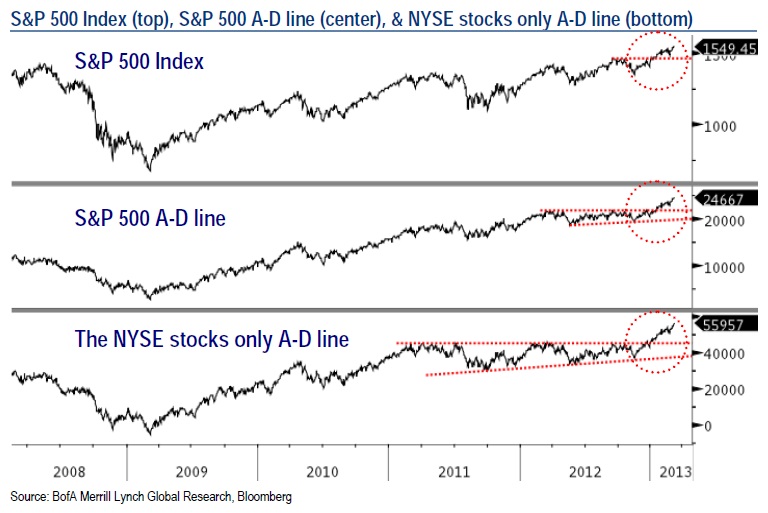
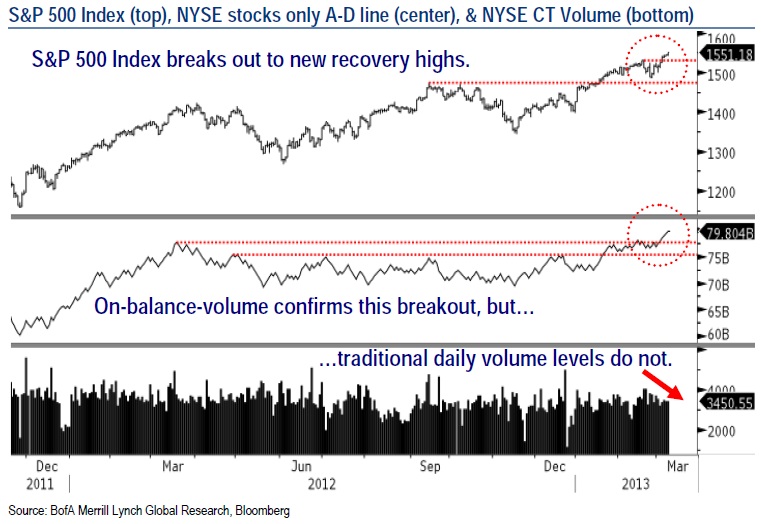
| Bartels: Breadth & Volume Confirm Rally Posted: 12 Mar 2013 08:30 AM PDT Advance Decline Line On Balance Volume
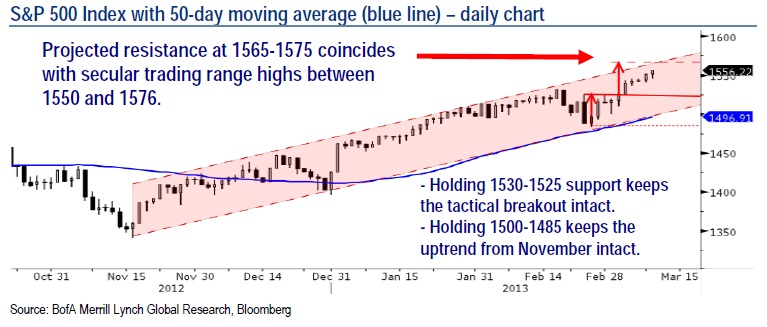
Merrill Lynch’s Mary Anne Bartels observes that market Breadth and Volume are confirming new S&P 500 recovery highs. In a research note last night, Merrill’s Technical Research Analyst noted that:
She also observes that sentiment has gotten somewhat frothy as markets have become short term over-bought. These reflect possible pullbacks, but not the end of the cyclical rally.
Source:
 |
| Grantham: Managing Debt Is an Artform Posted: 12 Mar 2013 08:15 AM PDT Jeremy Grantham, co-founder and Chief Investment Strategist of Grantham Mayo Van Otterloo (GMO), discusses investing in a low-growth world and the outlook for the US economy. TONIGHT on Charlie Rose @ 8p & 10p ET.
Complete video here Hat tip: Fusion Marketsite  |
| Posted: 12 Mar 2013 06:50 AM PDT My morning reads:
What are you reading?
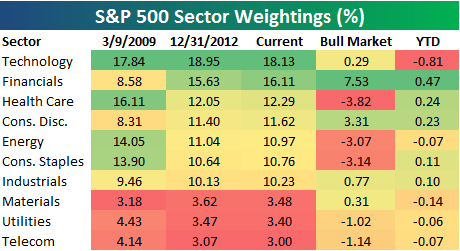
Historical S&P 500 Sector Weightings  |


 Source: MarketScan Research Database.
 Source: MarketScan Research Database.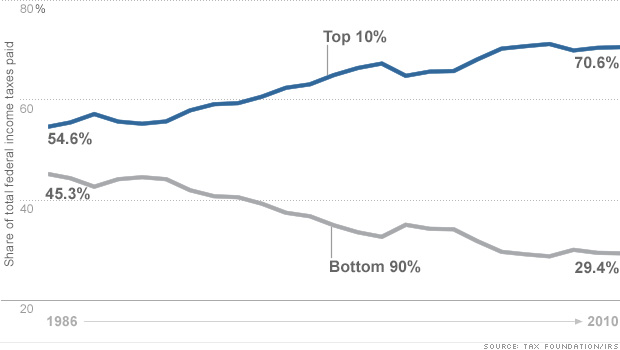
| You are subscribed to email updates from The Big Picture To stop receiving these emails, you may unsubscribe now. | Email delivery powered by Google |
| Google Inc., 20 West Kinzie, Chicago IL USA 60610 | |



3 comments:
I am not sure where you're getting your information, but great topic. I needs to spend some time learning much more or understanding more. Thanks for magnificent information I was looking for this information for my mission.
Also visit my blog - best ways to make money Online
My site :: easy ways to make money online
What's Taking place i'm new to this, I stumbled upon this I've discovered It absolutely useful and it has helped me out loads. I'm hoping
to give a contribution & aid different customers like its
aided me. Great job.
Also visit my website: Investing in penny stocks
Have you ever considered about including a little bit more than just your
articles? I mean, what you say is important and all. But think about if you added some great visuals
or video clips to give your posts more, "pop"! Your content
is excellent but with images and video clips, this website could undeniably be one of the greatest in its niche.
Great blog!
Also visit my blog post; legitimate online jobs
Post a Comment