.

{2} GoogleTranslate (H)

English French German Spanish Italian Dutch Russian Portuguese Japanese Korean Arabic Chinese Simplified

Our New Stuff

{3} up AdBrite + eToro

Your Ad Here

Thursday, March 14, 2013

The Big Picture

The Big Picture


Argentina on Sale

Posted: 14 Mar 2013 03:00 AM PDT

Argentina on Sale
By John Mauldin
March 13, 2013


Argentina: A Lesson in Chaos
Argentina on Sale
Why Don't You Just Stop?
Can the US Experience Argentinean Inflation?
Webinar
The Andes, Sonoma, Manila, and Singapore


When I was younger, so much younger than today,
I never needed anybody’s help in any way.
But now these days are gone, I’m not so self assured,
Now I find I’ve changed my mind and opened up the doors.

– John Lennon, the Beatles


(From Cafayate, Argentina) There are some who worry whether the path that Argentina has taken to monetary ruin on multiple occasions (and that it seems intent on taking again) is one that the US may also find itself on. That worry has crossed my mind a few times, I must confess. Today we will look at Argentina more in depth. From a monetary perspective, it deserves attention. And once again there will be opportunity.

Let me jump right to the conclusion: Just as Spain is not Greece, because each chose a unique route to economic malaise, the US is not Argentina. We are perfectly capable of avoiding Argentina's problems while cooking up ones that are all our own. But there are some worrisome and potentially instructive issues in Argentina.Argentina: A Lesson in Chaos

At the turn of the 20th century Argentina was one of the richest countries in the world, due primarily to its vast and fertile farmlands. In 1913, GDP per capita was about equal to those of France and Germany and close to that of the US. By 1950, though, Argentina’s GDP per capita wasn't even half that of the United States. (You can read a short, graphic history of the economic chaos that has been Argentina from the 1930s on at http://en.wikipedia.org/wiki/Economic_history_of_Argentina.)

Currency values plummeted. Inflation reached 5,000% at one point in the 1970s. Prices increased by a factor of 20 billion from 1975-1991 – over 300% per year. In 1983, at the urging of the IMF, a new peso was introduced at a value of 10,000 to one of the old pesos. Ouch. And that was just the beginning!

The Peronist government of Menem, elected in 1989, made a deal with the IMF, which promptly collapsed, leading to a rapid 12,000% inflation. On January 1, 1992, a new monetary reform replaced the austral (the name of the currency at that time) with the new peso at a rate of 10,000 australs for one peso. Another 10,000-fold devaluation – twice within ten years! The peso was now fixed to the dollar.

The following chart shows the value of the peso in dollar terms since 1936. The numbers are in German, which makes the chart just too ironic not to use. Note that each one of the horizontal bars represents a devaluation of 90%! (The vertical axis is a log-10 scale.)

I first came to Argentina in 1993. The country had just emerged from economic chaos. Real per capita income had dropped by 20% in the previous 20 years. But even with the chaos, the restaurants were busy at 10 PM, when Argentines like to eat!

Over the succeeding years, with a fixed dollar exchange rate, some industries could not compete and trade deficits grew. As in Greece today, the only way to create a fiscal balance was labor-price devaluation, which was decidedly unpopular. So Argentina went off the dollar standard, and the value of the peso dropped by 50%.

In December 1999 Fernando de la Rúa was inaugurated President, seeking assistance from the IMF shortly thereafter. In March 2000, the IMF agreed to a three-year $7.2 billion stand-by arrangement with Argentina, conditioned on a strict fiscal adjustment and the assumption of 3.5% GDP growth in 2000 (actual growth was 0.5%). In late 2000, Argentina began to experience severely diminished access to capital markets, as reflected in a sharp and sustained rise in spreads on Argentine bonds over U.S. Treasuries. In December, the de la Rua government announced a $40 billion multilateral assistance package organized by IMF. The uneven implementation of fiscal adjustments and reforms, a worsening global macroeconomic environment, and political instability led to the complete loss of market access and intensified capital flight by the second quarter of 2001. Argentine debt, held mostly in bonds, was massively sold short and the government found itself unable to borrow or meet debt payments. [Shades of later Greece!]

In December 2001, a series of deposit runs began to have a severe impact on the health of the banking system, leading the Argentine authorities to impose a partial deposit freeze. With Argentina no longer in compliance with the conditions of the expanded IMF-supported program, the IMF decided to suspend disbursements. At the end of December, in a climate of severe political and social unrest, the country partially defaulted on its international obligations; in January 2002, it formally abandoned the convertibility regime. (Wikipedia)

The economic and political crisis that followed was arguably the worst since the country gained its independence from Spain in 1816. By the end of 2002, the economy had contracted 20% since 1998.Over the course of two years, output fell by more than 15%, the Argentine peso lost three-quarters of its value, and registered unemployment grew to 25%. Income poverty in Argentina grew from an already high 35.4% in October 2001 to a peak of 54.3% in October 2002.

My friend and Uruguayan business partner Enrique Fynn tells stories of coming to Buenos Aires and hearing new prices being announced hour by hour over a public address system in a grocery store. He had dollars, which bought him lots of goods to take back on the ferry.. People who were prescient and had money were able to buy apartments in BA and land in Argentina at what can only be called fire-sale prices.

Argentina on Sale

I remember coming to Argentina about three years ago. I thought prices in Buenos Aires were high – the peso was about 3.50 to the dollar. When I visited again last November, prices were "reasonable" by my travel standards, and here in Cafayate I found good value. I have friends who are building homes here much more cheaply than they could in the US. And the quality is high; there are some real craftsmen here. Their stonework is exquisite.

I was in Buenos Aires last Friday. The official exchange rate is now 5.50 pesos to the dollar. The street price is 7.75, on its way to 8. But the largest bill is a 100-peso note, which is now worth less than $13. Using a credit card costs at least an extra 10%, if not 20%; but the prices you are quoted for using a credit card instead of cash are higher to start with, before the surcharge, so using a card ends up costing you about an extra 40%. But you need to carry a lot of cash if you want to buy anything expensive. (Be very careful if you do not know your way around. I am told there are lots of counterfeit bills passed off on tourists. Not that I exchanged anything, of course this is all theoretical, for illustration purposes.)

I was staying in the Recoleta area, which is one of the most expensive areas of the city and a wonderful place to while away a day or two.

But things were cheap. A simple lunch for two on a fashionable street was around $15. We had a fabulous meal at a restaurant we stumbled on, called Sirop Folie. (I will go again!) It would have been $150 at a comparable place in Dallas or NYC (or Europe), but it cost us just $50, including tip. I left my computer mouse in Dallas but was able to pick one up for $6. Vegetables and cheeses were around half what I am used to paying in Dallas. I began to "shop" in order to look at prices. By US standards, Argentina is on sale. And this was in the high-rent district.

On the way to Cafayate, there were signs on the road for chicken dinners for the local trade priced at $2 equivalent. Our dinner last night for two was less than $40 (all in) at what is considered one of the better local restaurants, Vinas de Cafayate (fabulous menu!). The place was packed by 10 pm, as I was leaving. So Argentina seems inexpensive today. Not a definitive study, admittedly, but the trend is clear.

President Kirchner is again experimenting with price controls. (Peron infamously tried to control even restaurant menu prices in the late 1940s – you'd think he would have known better). The last time price controls failed was in 2005. Now, Argentina has limited beef exports in the futile hope that doing so will drive down beef costs. All that has happened is that cattle herds have been reduced and exports are down. Similar export controls to try to keep bread prices down have seen wheat production fall.

Brazil has seen its cattle exports explode in 20 years, while Argentina's have not grown at all as the government tries to control production and export prices. Argentina used to be the world's largest beef exporter, but Brazil now has a herd almost four times the size of Argentina's. How many jobs have been lost to Brazil? One long-time exporter says, "There are developed countries, emerging countries, and then there’s Argentina.

Want to see something sad? An illustration of what governments can do to an industry by trying to control it? Look at this chart. Argentina is now down at #11. Tiny neighbor Uruguay exports twice the beef and veal.

The government is committed to a path of monetization. Inflation is denied by government statisticians, but it is at about 30% and rising. While the government is putting pressure on grocers to maintain prices, which always leads to shortages, as of this morning you can still find anything you want at the local equivalent of a well-stocked Hypermart.

Why Don't You Just Stop?

I sat down for what became a lengthy conversation with Juan Carlos Romero, the current senator from Salta Province. Juan Carlos is my age (which is to say a young 60ish) and is the very image of as an old-style patron, straight from central casting. He was governor of the province from 1995 to 2007 (it's the family business – his father was governor, too) and has been vice-president of the senate and on a national presidential ticket. He is a very successful businessman. We met last time I was here, and I hit it off with both him and his son, Juan Sebastian.

I related to him my surprise at prices and inflation. The last time I was in the Recoleta, in November, there was a protest march (quite peaceful and civilized, if enthusiastic and noisy) of some 700,000 people in the center of town, along 9 de Julio Avenue, which is the widest avenue in the world. It is impressive to walk down.

But things have only gotten worse since then. "Haven't you seen this movie before?" I asked. "Don't you know how this ends? What part of seeming insanity do you keep wanting to repeat? Why can't you stop it?" I will summarize Juan Carlos's answers from the notes I took.

Argentines don't want to hear bad news (does anyone?). Monti gave the Italians bad news, and he only got 9% of the vote. The bureaucracy is out of control in Argentina, and it just keeps growing and creating costs. There are too many subsidies to certain businesses. And, as a result of votes during the last crisis, power is now concentrated in the presidency and a few key positions. There are not the checks and balances we are used to between branches of government in the States. Both major parties voted to nationalize pensions. Government benefits and subsidies are given to a large number of people, who then vote for more government benefits.

"In Argentina, we have the ability to make the same mistake many times, and nothing happens to change things. Why? Because there is a pervasive belief that the state can provide all that people need: jobs, welfare, everything." Perhaps, he mused quietly, that attitude is a heritage from colonial days, when the King of Spain controlled the country and power and privilege and benefits came from the King.

Aerolineas loses $2 million a day, but people believe it is better than a private company. The government is not seen as something owned by the people but as something that exists to solve problems and take care of the people. Both parties and a majority of voters seem to agree that government is better than the private sector. Some sectors have few controls, and others are tightly controlled.

"Even so," I asked, "can't those in control see that inflation is bad?" The problem, he explained, is that those who have the ear of the president see inflation as a way to growth and thus a good thing. Those in power deny there is inflation and think it is caused by "commercial" interests that selfishly raise prices. Kirchner and those around her actually believe that their current policies will work. Meanwhile, 42% of GDP is government expenditures.

In a country of vast lands and unsurpassed beauty, more than half the people live in one city, Buenos Aires. (I think they all try and get out on the roads when I am going to or from the airport.) And that urban power base is central to Kirchner's control – she won the last election handily.

As I walked through the Recoleta, I thought I saw stress on the faces of the people I encountered. You can talk to businesspeople and sense the stress.

How do you cope with such repeated episodes of chaos? Argentines who have money keep it outside the country. As one person told me, "In America, you buy gold to protect yourselves. We buy dollars." The national sport – second only to fútbol – is tax evasion. (They come by both naturally, as about 60% of the population has Italian ancestors.)

And yet there is a thriving business community. The skyline is much more impressive in BA than it was 20 years ago. Argentines are an educated people. And things can and do get done.

Jon Malinski is a Minnesota businessman. He invested in a vineyard in Mendoza and recently bought a vineyard here in Cafayate, in one of the better growing regions. Two years ago, he broke ground on a massive, sophisticated, modern winery here. It is now open for business. He hosted a dinner on my first night here (accompanied by a huge lightning display back up in the mountains).

I have been to a few wineries in my time. This one was rivaled in elegance by only a few in the Napa Valley or France and the Ferragamo estate in Italy. Note: He bought the land and decided to build, and the winery was completed in two years. In the US, for an undertaking this large, you can't even get the approval process underway in two years. One of Jon's competitors told me he probably spent $20 million. For all the Argentinean government controls, in certain sectors you are free to do what you want.

This region is booming. Building is going on everywhere. People smile on the streets and are patient with your mangled attempts at Spanish.

There is a rather amazing contrast between the macroeconomic situation of the country and life on the street. Soon, the peso will once again come to be seen as a medium that will only be usable in immediate exchanges. Unless something is done, Argentina is going to repeat its past. Unlike Germany, which still remembers the Weimar hyperinflation, Argentina just seems to shrug off its past. The economy has recently survived on a boom in soybeans, but there is not much else to rely upon.

Argentina is on sale. I think prices relative to the dollar will rise. This is one sale where the last day is not yet known. Think about coming down here next fall and enjoying the time with me.

Can the US Experience Argentinean Inflation?

I know some readers think the worst of the Fed, and I am not a fan in general (and am opposed to the current QE policy), but I simply can't conceive of the FOMC voting to monetize if inflation tops 10% again. I think there would be serious efforts to curb QE (monetization) at 5-6% inflation, although until we reach that level I think it will be tolerated. With higher inflation than that, voters would simply rebel. Think the '70s: both Ford and Carter lost in part because of the economy and inflation.

In theory, any country can experience Argentinean-style inflation. It just takes a printing press (which today simply involves pushing some electrons around), a willing central bank, and a complicit citizenry. US citizens have an inherent distrust of government, although I admit that is slowly changing. Two factoids:

  • Nearly a quarter of the voters in the last presidential election were single women, and they voted 2:1 for Obama and thus a larger role for government. (Guardian) Romney won married women voters by a significant amount, but the singles went to Obama, and they are the fastest-growing voter group. Government is increasingly being seen in certain circles as a provider of benefits and support, both for healthcare and as a general safety net. Growing economic malaise and rising healthcare costs only fuel this trend.
  • And government is expanding the list of people who get direct benefits. Food stamps now go to almost 49 million people. Eleven states have welfare benefits that are higher than the minimum wage. And look at this chart on the growth of disability payments. Over half the recent rise above trend in disability benefits is for the treatment of mental disability and stress.

"How," I had asked Juan Carlos, "can you let it happen?" But how, indeed, can we?

Webinar

If you are a qualified purchaser or a FINRA licensed advisor, please join me and my partners at Altegris for an exclusive Mauldin Circle webinar on Tuesday, March 26 at 12:00 pm EDT/9:00 am PDT. Listen in as I interview Jacob Gottlieb, CIO of Visium Asset Management, a premiere long/short multi-strategy fund manager. We will learn more about Visiums' unique investment approach and how they're finding alpha opportunities in the current environment – both on the long and short side. Visium Asset Management is a firm that I follow closely, and I know you will find our discussion timely.

If you are a Mauldin Circle member and a qualified purchaser or an investment advisor, a webinar invitation will be sent directly to you by email. A replay will also be available to qualified registrants. If you are unable to listen in to the live discussion, be sure to register so that you can receive the replay information.  If you are not a member of the Mauldin Circle and are a qualified purchaser, please join today. Upon qualification by my partners at Altegris, you will receive an email invitation . I apologize for limiting this discussion to qualified purchasers and investment advisors, but we must follow the rules and regulations.  I look forward to having you at this exclusive Mauldin Circle event. (In this regard, I am president and a registered representative of Millenium Wave Securities, LLC, member FINRA.)

The Andes, Sonoma, Manila, and Singapore

Tomorrow I venture off with Doug Casey, David Galland, and Olivier Garret to Bill Bonner's hacienda at Guafin, a few hours from here. A few years back, Bill bought this enormous (200,000-acre) ranch of mostly worthless land some 8,000 feet above sea level, but with magnificent views of the Andes, and he sneaks off there every now and then. I have been to his place in Ouzilly, France (a little easier to get to!) on several occasions, but this one sounds like a real fixer upper. Buying places that need lots of work seems to be his personal addiction (otherwise known as an expensive hobby), but it is a socially acceptable one and fun for his friends who drop in on him. I have known Bill for 30 years, since we were both young and starting out in the writing and publishing business. He has been a huge success, while I am hoping to be a late bloomer. But I have never had a moment with him that was not enjoyable, and most were thought-provoking. He does make me think.

He is one of my favorite writers in the business. I have often said that I feel like a house painter in front of a Rembrandt when I read Bill's musings. Actually, he is more than just a writer; he is a consummate storyteller, a raconteur worthy of the name. I am looking forward to magnificent vistas and a new adventure but also to great conversations with old friends – war horses who have seen lots of battles but are not yet ready to be put out to pasture.

I will be speaking at a special one-day event in Sonoma, California, on April 5. My friend Mike Shedlock is holding a charity fundraiser to support research into ALS (Lou Gehrig's disease. You can find out more at Mish’s Conference.

My own conference (co-sponsored with Altegris Investments) is May 1-3. It is filling up rapidly. The line-up of speakers is the best I have seen anywhere this year. We offer an early-bird registration, which is about to run out. Because of security regulations, we do have to limit attendance to accredited investors and those in the securities/investment business. You can start the process by going to the Strategic Investment Conference page. I hope to see you there.

I will be in Singapore for a speech April 18-19. I was going to go to Cambodia and Angkor Wat, but it is their New Year, so I will postpone that trip till the next Asia speaking trip and see Manila instead, where I have some old friends and have never been. I then hop back to San Francisco for a speech for the National Association of Surety Bond Producers (NASBP) on April 22.

Some final thoughts on Cafayate. This is just a hopping little town with a magnificent vista. Perfect climate in the tropics but at 5,000 feet. The mountains change color throughout the day. My friends have built a first-class resort. The spa is truly world-class, there is a great gym, and a massage will run you about $40. The golf course is the longest one in South America, which means there is more room for me to lose balls. There are very good to great places to eat. I am not one for road trips, but the drive through the canyon to get here is stunning, well worth a few hours' diversion.

The people who seem to collect here are about as eclectic as you can get. Nearly everyone has great stories to regale you with. And they are just generally nice people. This is going to be quite the community. I will plan to be here more, but when I am, let's see how much writing I actually get done.

Somehow, the memo that sequestration was supposed to be about austerity has gotten lost. There have been 2,600 new federal jobs posted since the introduction of the bill, 600 at Homeland Security, which was going cut workers, making lines longer at airports. I guess I am new to this off brand of austerity. But what do I know?

I know it is late, and I need a few hours' sleep. Have a great week.

Your living for places and times like this analyst,John Mauldin

subscribers@mauldineconomics.com

Want to Cut the Debt? Try Cutting Off the Corporate Welfare Queens

Posted: 13 Mar 2013 10:30 PM PDT

Cutting Corporate Welfare Queens Off from the Dole Would be the Best Way to Cut the Debt

TOO BIG TO JAIL DOUCHE BAGImage by William Banzai

In previous installments, we've noted that we could more than offset the need for the "sequestration" budget cuts by doing any one or combination of the following:

Here's another way to offset the need for budget cuts: cut off the welfare queens. (Jamie Dimon – shown above- and the other Wall Street queens are the largest recipients of welfare.)

Liberals and conservatives agree that we should stop subsidizing the fatcats. For example, the conservative Cato Institute points out that corporate welfare amounts to almost $100 billion per year. Cato notes:

Corporate welfare often subsidizes failing and mismanaged businesses and induces firms to spend more time on lobbying rather than on making better products. Instead of correcting market failures, federal subsidies misallocate resources and introduce government failures into the marketplace.

While corporate welfare may be popular with policymakers who want to aid home-state businesses, it undermines the broader economy and transfers wealth from average taxpaying households to favored firms.  Corporate welfare also creates strong ties between politicians and business leaders, and these ties are often the source of corruption scandals in Washington. Americans are sick and tired of "crony capitalism," and the way to solve the problem is to eliminate business subsidy programs.

Cato also notes:

The federal government continues to subsidize some of the biggest companies in America. Boeing, Xerox, IBM, Motorola, Dow Chemical, General Electric, and others have received millions in taxpayer-funded benefits …. In addition, the federal crop subsidy programs continue to fund the wealthiest farmers.

(Indeed, the Federal Reserve threw money at hedge funds, McDonald's, Harley-Davidson, "several billionaires and tens of multi-millionaires", including  Christy Mack, the wife of Morgan Stanley's John Mack, billionaire businessman H. Wayne Huizenga, and Michael Dell, co-founder of Dell Computer, hedge fund manager John Paulson and private equity honcho J. Christopher Flowers.)

The liberal Huffington Post reports that corporate welfare dwarfs individual welfare:

Welfare Spending Nearly Half What U.S. Forked Out In Corporate Subsidies In 2006: Study

Welfare queens may actually look more like giant corporations.

***

Charles Koch, the CEO of Koch Industries, argued in a Wall Street Journal op-ed earlier this month that crony capitalism is a "destructive force" for business and government. [Both conservatives and liberals hate crony capitalism.]

Conservative Senator Tom Coburn has documented that many wealthy and famous people receive huge tax and other subsidies.

The liberal New Yorker magazine notes:

In recent decades, what you could call the corporate welfare state has become bigger. Energy companies lease almost forty million acres of onshore land in the U.S. and more than forty million offshore, and keep the lion's share of the profits from the oil and natural gas that they pump out.

***

In 1996, for instance, the government temporarily lowered royalties on oil pumped in the Gulf of Mexico as a way of encouraging more drilling at a time of low oil prices. But this royalty relief wasn't rescinded when oil prices started to rise, which gave the oil companies a windfall of billions of dollars. Something similar happened in the telecom industry in the late nineties, when the government, in order to encourage the transition to high-def TV, simply gave local broadcasters swathes of the digital spectrum worth tens of billions of dollars. In the mining industry, meanwhile, thanks to a law that was passed in 1872 and never rewritten, companies can lease federal land for a mere five dollars an acre, and then keep all the gold, silver, or uranium they find; we, the people, get no royalty payments at all. Metal prices have soared in the last decade, but the only beneficiaries have been the mine owners.

***

U.S. sugar companies benefit from the sweetest boondoggle in business: an import quota keeps American sugar prices roughly twice as high as they otherwise would be, handing the industry guaranteed profits.

The tax code, too, is a useful tool for helping businesses. Domestic manufacturers collectively get a tax break of around twenty billion dollars a year. State and local governments give away seventy billion dollars annually in tax breaks and subsidies in order to lure (or keep) companies. The strategies make sense for local communities keen to generate new jobs, but, from a national perspective, since they usually just reward companies moving from one state to another, they're simply giveaways.

A New York Times investigation found that the number is even larger:

A Times investigation has examined and tallied thousands of local incentives granted nationwide and has found that states, counties and cities are giving up more than $80 billion each year to companies. The beneficiaries come from virtually every corner of the corporate world, encompassing oil and coal conglomerates, technology and entertainment companies, banks and big-box retail chains.

The cost of the awards is certainly far higher. A full accounting, The Times discovered, is not possible because the incentives are granted by thousands of government agencies and officials, and many do not know the value of all their awards.

***

A portrait arises of mayors and governors who are desperate to create jobs, outmatched by multinational corporations and short on tools to fact-check what companies tell them. Many of the officials said they feared that companies would move jobs overseas if they did not get subsidies in the United States.

***

For many communities, the payouts add up to a substantial chunk of their overall spending, the analysis found. Oklahoma and West Virginia give up amounts equal to about one-third of their budgets, and Maine allocates nearly a fifth.

***

Nationwide, billions of dollars in incentives are being awarded as state governments face steep deficits. Last year alone, states cut public services and raised taxes by a collective $156 billion ….

But this isn't just a state issue. As the Times notes, "20 percent of state and local budgets come from federal spending."

The New Yorker continues:

More subtly, government boosts business profits via regulation. The most obvious example, perhaps, is the banking industry. The F.D.I.C. encourages people to deposit money in banks, and the biggest banks also benefit from the perception that the government will not allow them to fail, which enables them to borrow money at a low cost. Another leading beneficiary of regulation is the ethanol industry, a sacred cow of American politics. The government requires refiners to blend billions of gallons of ethanol into gasoline annually, and hands out an ethanol tax credit. As a result, forty per cent of corn acreage in the U.S. now goes to make ethanol. This jacks up food prices, since less corn is grown for feed and table, and the environmental benefit is dubious. But farmers and refiners benefit enormously, so the mandate stays in place.  [Treehugger notes that - as of 2007 - 76% of all federal renewable energy support went to ethanol.] Vested interests of this kind also explain why so many states have onerous licensing regulations; Florida says that you need six years of training and apprenticeship to become an interior designer. Such regulations, which have grown precipitously in recent decades, are catnip to incumbent businesses worried about competition.

Perhaps the biggest boon that the government offers business is the benefit of copyright and patent protection. As the [liberal] economist Dean Baker shows in his book "The End of Loser Liberalism," patent protection is worth hundreds of billions of dollars a year to the drug industry alone. And while most of us would find it hard to imagine doing without copyrights and patents, that doesn't justify the huge expansion of intellectual-property rights we've seen of late: the length of copyright has been expanded eleven times since 1962, and the range of things that can be patented has increased hugely, even in areas where, as [conservative, free market advocate] Judge Richard Posner recently argued, there's little or no economic benefit to society.

Forbes' Doug Bandow – a conservative from the Cato institute – notes:

Most politicians want to cut the federal budget in theory. Few want to cut it in practice. So it is with corporate welfare, which is enthusiastically supported by Democrats and Republicans alike.

***

Among the most outrageous expenditures is corporate welfare. Desperate businesses now overrun Washington, begging for alms. Believing that profits should be theirs while losses should be everyone else's, corporations have convinced policymakers to underwrite virtually every industry: agriculture, education, energy, housing, manufacturing, medicine, transportation, and much more.

***

Cutting business subsidies would be a good start to balancing the budget. Moreover, going after corporate welfare is essential to create a budget package that the public will see as fair. Corporate welfare reflects politics at its worst.

For example:

The largest single source of business subsidies is the Department of Agriculture, with $25.1 billion. For the most part crop payments go to large farmers, who are big businessmen.

Bondow notes that – notwithstanding mainstream Republican party rhetoric – narrowly-drafted tax loopholes are a form of subsidy:

Spending is the most obvious but not only form of corporate welfare. Tax preferences, often called "tax expenditures," are the functional equivalent of direct outlays. Failing to tax is not the same as spending, since all income does not belong to the government. However, when the government provides a narrow exemption from general tax obligations it essentially is writing a check. While appropriations have some level of transparency, tax preferences often are obscurely drafted and dropped into larger bills, hidden from public view. Taxpayers then are unaware that they are being looted.

He also notes the hypocrisy of Republican politicians who talk about the free market, but enthusiastically dole out corporate pork:

The greater outrage is support for corporate welfare from the Right. Political conservatives wax poetic about the virtues of the free market, but conservative office-holders often are pro-business rather than pro-market.

Liberal writer Matt Stoller notes:

Here are eight corporate subsidies in the fiscal cliff bill that you haven't heard of.

1) Help out NASCAR - Sec 312 extends the "seven year recovery period for motorsports entertainment complex property", which is to say it allows anyone who builds a racetrack and associated facilities to get tax breaks on it. This one was projected to cost $43 million over two years.

2) A hundred million or so for Railroads - Sec. 306 provides tax credits to certain railroads for maintaining their tracks. It's unclear why private businesses should be compensated for their costs of doing business. This is worth roughly $165 million a year.

3) Disney's Gotta Eat - Sec. 317 is "Extension of special expensing rules for certain film and television productions". It's a relatively straightforward subsidy to Hollywood studios, and according to the Joint Tax Committee, was projected to cost $150m for 2010 and 2011.

4) Help a brother mining company out – Sec. 307 and Sec. 316 offer tax incentives for miners to buy safety equipment and train their employees on mine safety. Taxpayers shouldn't have to bribe mining companies to not kill their workers.

5) Subsidies for Goldman Sachs Headquarters – Sec. 328 extends "tax exempt financing for  York Liberty Zone," which was a program to provide post-9/11 recovery funds. Rather than going to small businesses affected, however, this was, according to Bloomberg, "little more than a subsidy for fancy Manhattan apartments and office towers for Goldman Sachs and Bank of America Corp." Michael Bloomberg himself actually thought the program was excessive, so that's saying something. According to David Cay Johnston's The Fine Print, Goldman got $1.6 billion in tax free financing for its new massive headquarters through Liberty Bonds.

6) $9B Off-shore financing loophole for banks – Sec. 322 is an "Extension of the Active Financing Exception to Subpart F." Very few tax loopholes have a trade association, but this one does. This strangely worded provision basically allows American corporations such as banks and manufactures to engage in certain lending practices and not pay taxes on income earned from it. According to this Washington Post piece, supporters of the bill include GE, Caterpillar, and JP Morgan. Steve Elmendorf, super-lobbyist, has been paid $80,000 in 2012 alone to lobby on the "Active Financing Working Group." 

7) Tax credits for foreign subsidiaries –  Sec. 323 is an extension of the "Look-through treatment of payments between related CFCs under foreign personal holding company income rules." This gibberish sounding provision cost $1.5 billion from 2010 and 2011, and the US Chamber loves it. It's a provision that allows US multinationals to not pay taxes on income earned by companies they own abroad.

8 ) Bonus Depreciation, R&D Tax Credit – These are well-known corporate boondoggles. The research tax credit was projected to cost $8B for 2010 and 2011, and the depreciation provisions were projected to cost about $110B for those two years, with some of that made up in later years.

And as conservative Congressman Chuck Grassley (R-IA) said of defense contractors in 1986:

They are the new welfare queens, isolated from competition and the consequences of their mistakes and with the government always ready to bail them out….

Here are some specific examples of welfare handouts to defense contractors, which total many hundreds of billions  per year.

And see this and this.

JPMorgan’s Internal Control Problems, or HSBC’s Got Nothing On Us!

Posted: 13 Mar 2013 04:30 PM PDT

Josh Rosner (@JoshRosner) is co-author of the New York Times Bestseller "Reckless Endangerment" and Managing Director at independent research consultancy Graham Fisher & Co. He advises regulators, policy-makers and institutional investors on banking and financial services (a more complete bio appears at the end of this column).

This is part 3 of 5; Yesterday evening, we published the Introduction. We will be releasing a different part each evening and morning culminating in the release of Rosner's complete report on Friday morning. On that date, the Senate Permanent Subcommittee on Investigations will release their final report on JPM's CIO Group (aka the London Whale).

Prior installments are here: Intro, and part 2

~~~

INTERNAL CONTROL PROBLEMS APPEAR TO BE PERVASIVE

We have chosen not to detail every violation and will only highlight the operational failures that we believe demonstrate management’s inability to effectively manage this "Too Big to Fail" firm.

The repeated violations and the longstanding failures of the Board to remedy many of these problems raising serious questions about the veracity of the CAMELS supervisory examination process[i] and the willingness of regulators to demand corrective actions of our largest firms. Moreover, with apparent justification for the OCC to issue a "Safety and Soundness Order"[ii], one has to wonder whether the Federal Reserve's "stress test" has placed constraints on the firm.

JPMorgan's list of regulatory violations over the past five years is long, diverse and crosses legal and regulatory jurisdictions. Many of these infractions are for repeated violations of specific control failures, which the Company had previously agreed to remedy. This calls into question Jamie Dimon's remarks before the Miami Chamber of Commerce on February 4th 2013, during which he stated that when JPMorgan makes mistakes “we try and fix those mistakes".

OCC and Federal Reserve Board

Anti-Money Laundering and Bank Secrecy Act issues

On  January 14, 2013, the Federal Reserve and the OCC issued a Consent Order to JPM designed to remedy deficiencies, which the bank neither admitted nor denied.  The OCC identified deficiencies indicating that JPMC's firm-wide Bank Secrecy Act (BSA) and Anti-Money Laundering (AML) compliance program failed to ensure the  bank’s compliance with certain requirements.

While the Order does not detail the specific violations or deficiencies that were found, other regulatory actions suggest that either these were tied to new violations or that the OCC and Federal Reserve were, a year and a half later, acting in response to an August 2011 civil settlement[iii]  by the U.S. Treasury's Office of Foreign Asset Control (OFAC) that found JPM had egregiously violated:

-  Cuban Assets Control Regulations (“CACR”);

-  Weapons of Mass Destruction Proliferators Sanctions Regulations (“WMDPSR”);

-  Executive Order 13382, “Blocking Property of Weapons of Mass Destruction Proliferators and Their Supporters”;

-  the Global Terrorism Sanctions Regulations (“GTSR”);

-  the Iranian Transactions Regulations (“ITR”);

-  the Sudanese Sanctions Regulations (“SSR”);

-  the Former Liberian Regime of Charles Taylor Sanctions Regulations (“FLRCTSR”); and

- the Reporting, Procedures, and Penalties Regulations (“RPPR”)

Beyond these violations, which were determined to be "egregious because of reckless acts or omissions,” the bank was found to have violated several other AML/BSA regulations in non-egregious ways including by an undisclosed transfer of 32,000 ounces of gold bullion for the benefit of a bank in Iran.

If, on the other hand, the recent Consent Orders relate to violations  other than those identified in the OFAC settlement it seems plausible that JPMorgan could have been found to have violated AML/BSA regulations related to its role in the recent Vatican Bank scandal[iv], a drug cartel money-laundering scheme[v] or even tied to the Madoff bankruptcy[vi].

The government's treatment of foreign banks relative to the seeming deference given JPM raises questions about the infractions relative to the penalties. After all, HSBC recently settled a money-laundering probe for $1.92 billion and Standard Chartered paid $327 million to settle charges relating to Iranian transactions while JPMorgan paid $88.3 million for a civil settlement of these violations.

If one contrasts JPM's treatment with the FDIC’s recent action against a state bank with two branches[vii], in which the bank's charter was revoked for violations related to money laundering and the bank was fined $15 million, one must wonder if state-chartered banks are held more accountable than our nation’s largest firms.


Commodity Futures Trading Commission (CFTC)

Segregation of Client Funds

JPMorgan's handling of customer monies should be another cause for concern.  The Company's executives and its Board have repeatedly failed to address ongoing problems and have exposed shareholders to the costs associated with repeated fines. The problems appear only to come to light only after being discovered as a result of customer problems but, once discovered the Firm is routinely permitted, without admitting wrongdoing, to make an offer for civil settlement. These offers are accepted on the expectation that internal control violations will be remedied and, as a result, matters that might otherwise have potentially led to criminal charges are settled for fines.

On September 9, 2009, the CFTC sanctioned JPMorgan for failing to properly segregate customer funds and for failing to report these "under-segregations" on a timely basis[viii]. The CFTC accepted JPMorgan's offer of settlement without requiring the Company to either admit or deny wrongdoing, as a result the firm was able to avoid an administrative proceeding that could have uncovered more regulatory and legal violations. This matter relates to activities that occurred between May and June 2007 but it is unknown if this was the entirety of the period of violations or if it was only the period the regulator chose to identify. According to the CFTC, JPM failed to segregate $725 million of its own money from a $9.6 billion account. The CFTC cited numerous violations resulting from "under segregation", "untimely computation of segregation", "untimely notification of under segregation" and "failures to supervise". The Company was allowed to settle for $300,000.

In June 2010, in demonstration that the failures to segregated funds that the CFTC had settled were not isolated occurrences, the British Financial Services Authority fined JPMorgan a record 33.32 million British pounds for failing to "adequately protect between $1.9 billion and $23 billion of client money between November 2002 and July 2009."[ix] In this instance, the FSA determined that the error remained undetected for nearly seven years".

On April 4, 2012, JPM was again found, by the CFTC, to be in violation of segregation rules. Once again, to avoid administrative proceedings in the face of findings of violations of law, the Company made an offer of settlement that the CFTC accepted without requiring the Company to admit or deny wrongdoing. The Company was fined $20 million in civil money penalties and, once again, directed to remedy control problems[x]. As in prior instances the firm’s internal controls were inadequate and failed to discover these violations before a problem arose.

The CFTC found that from at least November 2006 though September 2008, JPM accepted deposits of customer funds from Lehman Brothers, Inc. In violation of law JPMorgan extended credit to Lehman Brothers for 22 months based on these customer funds because JPM determined, wrongfully, those funds were to be included in Lehman Brothers net free equity. After the bankruptcy of Lehman Brothers, again in violation of law, JPMorgan refused repeated requests by the Trustee and the Commission to release those Lehman customer funds to the Trustee of Lehman's estate.

While there have been no findings against JPMorgan, ongoing legal wrangling by the Company seems to offer some basis to believe that similar problems in the segregation of funds may have also occurred related to the failure of Peregrine Financial[xi] and MF Global[xii].

Commodities Violations

On September 27, 2012, the CFTC issued an Order[xiii] claiming that JPMorgan violated Section 4a(b)(2) of the Commodity Exchange Act and, for $600,000, allowed the bank to again settle a matter without admitting or denying the violations. The summary of facts suggest, had the CFTC instituted an administrative proceeding and full inquiry, the alleged violations may well have been far more pervasive; encompassing a larger number of commodity assets and a greater occurrence of violations than merely those settled. After all, according to the CFTC, these systems were not relied on only for the trading of cotton, they were "used by commodity traders to track their current positions in partcular futures contracts" [xiv].

Moreover, the underlying actions of JPMorgan that led to the CFTC actions appear to demonstrate either a willful attempt to circumvent the regulations or the  bank’s complete incompetence in the management of its controls.

According to the CFTC, a "deficiency in its newly created automated position limit monitoring system for the commodity business" caused JPM to violate position limits in cotton futures. Since, according to the CFTC's own statement, the systems appear to have been used for commodities beyond just cotton, it would seem reasonable for the CFTC to have engaged in a deeper inquiry in an effort to ascertain whether the violations had occurred in the trading of other commodities.

More troubling than the breakdown of internal controls that lead to reliance on an obviously failed system is that "after learning of this deficiency, JPMCB utilized a manual position limit monitoring procedure pending correction of the automated monitoring system. Despite adoption of this manual position limit monitoring procedure, JPMCB violated its short-side speculative position limit on several occasions." So, the breakdown in controls was not limited to the automated system but also occurred during the application of the remedial manual procedures.

These issues lead to obvious questions for which we will likely never have answers:

  • Do the violations that occurred when JPMorgan instituted the manual procedures result from negligence or something more?
  • Did the OCC review the implementation of these "newly created" automated systems?
  • Are there mechanisms in place for regulators to inform each other of violations and control weaknesses in instances where a settlement occurs without an admission or denial of wrongdoing?
    • Is there a formal mechanism within the Financial Stability Oversight Committee?
    • Is there an inter-agency system to record all settled matters with a regulated entity?
  • If there are no such effective inter-regulator procedures, then the notion of the "enhanced supervision" of Systemically Important Financial Institutions created by Dodd-Frank has offered the American public false security.

JPMorgan's violations in commodity markets do seem to extend beyond the cotton market findings by the CFTC. In December 2012, JPM was fined $65,000 by the NYMEX Business Conduct Committee for "inadvertently" overstating open interest in a crude futures contract by 46.9%, and offsetting concurrent long and short positions it held for a customer resulting in an overstatement of open interest of 5.2% for that trade date[xv].

Fictitious Trade/Wash Sale

On March 8, 2012, the CFTC simultaneously alleged and settled with JPMorgan over its belief that the company violated Section 4c(a)(I) of the Commodity Exchange Act [xvi] by, on May 25, 2010, knowingly executing a fictitious trade to sell and buy 11,642 ten-year spreads on behalf of a client. The customer was on both sides of the transaction and JPM was aware of that. In  its filing, the Commission stated its recognition of Congress’s intent in creating the relevant law[xvii] but again, allowed a civil settlement, for $140,000, without a deeper investigation. As a result, it is unclear if this instance represented a one-time failure or if shareholders are at ongoing legal or regulatory risk from future exposures to a more pervasive breakdown of controls.

There is some evidence that, if the regulators engaged in a full and broad investigation, shareholders would likely be exposed to further destruction of shareholder equity resulting from failures of management. In June 2012 the NYMEX found that on 10 separate occasions between January and June 2011 JPM executed wash trades in WTI or gasoline between entities with the same beneficial ownership. In each instance the company's trader was the sole decision maker for both the buy and sell side of the trade. While the firm was fined only $30,000 to settle these violations (neither admitting nor denying wrongdoing) it is unclear if they have yet addressed the control problems.[xviii].


[i] http://www.occ.gov/publications/publications-by-type/other-publications-reports/prbbnkgd.pdf p.1 ("One of the most challenging and important aspects of a bank examiner's job is knowing how to read and react, in a balanced and effective way, to symptoms of problems that may not yet be obvious to bank management and directors …Examiners will recognize and sometimes refer to such banks as "borderline" or "dirty 2's," referring to the imminence of a CAMELS downgrade to a "3" if conditions worsen. It is not unusual for officers and directors of banks such as these to overlook or deny the potential seriousness of problem symptoms at this stage. Indeed, it sometimes boils down to who is more confident in their assessment of the fundamental issues – the banker or the examiner, and whether the examiner has prioritized his/her findings by order of significance". See also p.30 "Under the existing Corrective Action PPM and going forward, formal action or PCA should be considered for 3-rated banks with weak management or when conditions are deteriorating rapidly. The corrective measures should be appropriately severe and explicit as to implementation…Such actions are also used when corrective action by the board is not forthcoming, or when informal actions are insufficient. In some circumstances, there is a presumption for formal action, regardless of the bank's capital level and composite CAMELS rating. That presumption in favor of formal action exists when one or more of the following conditions exist:

  • Significant problems in the bank's systems, controls, policies, internal audit programs, or MIS.
  • Significant insider abuse or compliance problems.
  • Failure to respond to prior supervisory efforts.
  • Substantial noncompliance or lack of full compliance over an extended period of time". )

[ii] IBID p. 31 (See: "Safety and Soundness Standards: The OCC also has the authority under 12 USC 1831p-1 and 12 CFR 30 to issue a safety and soundness order against a bank that fails to meet established safety and soundness standards. Operational and managerial standards have been established under Part 30 in the following areas: Internal controls and information systems; Internal audit system; Loan documentation; Credit underwriting; Interest rate exposure; Asset growth; Asset quality; Earnings; Compensation fees and benefits.This tool was designed to address unsafe and unsound conduct that is not reflected in bank capital levels".)

[iii] http://www.treasury.gov/resource-center/sanctions/OFAC-Enforcement/Pages/20110825.aspx  US department of treasury, “Release of Civil Penalties Information – JPMorgan Chase Bank, N.A. Settlement.” Last modified 2011. http://www.treasury.gov/resource-center/sanctions/OFAC-Enforcement/Pages/20110825.aspx .

[iv] http://www.spiegel.de/international/europe/a-growing-vatican-bank-scandal-threatens-catholic-church-image-a-842140-2.html Wassermann, Andreas, and Peter Wensierski . Spiegel Online, “Transparency vs. Money Laundering: Catholic Church Fears Growing Vatican Bank Scandal.” Last modified 2012. Accessed February 25, 2013. http://www.spiegel.de/international/europe/a-growing-vatican-bank-scandal-threatens-catholic-church-image-a-842140-2.html . (See: "Officials from the Council of Europe committee responsible for combating money-laundering were supposed to assist these efforts and, to do so, even be allowed into the inner sanctum of the Vatican bank. Yet veteran Church bankers and members of the Curia apparently had no intention of abstaining from lucrative dealings with problematic funds. The plan, Italian financial investigators believe, was from then on to discretely eliminate all traces of clandestine business dealings. A role in the effort was played by a bank in Benedict’s home country: Germany. In 2009, the same year that Gotti Tedeschi took over as president of the IOR, the bank set up an account with the Milan-based branch of the American bank JPMorgan Chase. From that point on, millions started flowing on an almost daily basis from JPMorgan’s Milan office to the one in Frankfurt, where the IOR also had a JPMorgan account. Vatican officials opted for a special account in Milan with the number 1365, a so-called “sweep facility account,” which was automatically zeroed out at the end of each day. The Vatican bank confirmed the existence of this account late last week, though it said it was primarily used for handling securities transactions. Through last year, this financial set-up was allegedly used to process more than a billion euros for the Vatican bank. Italian investigators suspect that it was also used to launder funds from dubious sources. The transfers via JP Morgan would likely have remained unnoticed if the IOR hadn’t involved another Italian bank two years earlier in two cases. The attention of Italian financial regulators had been attracted by curious transactions the Vatican bank had made via Credito Artigiano. In 2010, a total of €23 million had been transferred from several accounts at that bank, but without listing the account holders or purposes of the transfers. Of that, €20 million was reportedly supposed to make its way to the Vatican’s JPMorgan account in Frankfurt, while the remaining €3 million was destined for an account at another bank in Rome.")

[v] http://www.amlcftblog.com/2008/01/cocaine-trade-fuels-euro-laundering.html  AKGUN ALP, INONU. AML-CFT, “Cocaine trade fuels Euro laundering.” Last modified 2008. http://www.amlcftblog.com/2008/01/cocaine-trade-fuels-euro-laundering.html.

[vii] http://blogs.wsj.com/corruption-currents/2012/11/19/first-bank-of-delaware-loses-charter-over-aml-problems/  Rubenfeld, Samuel. “First Bank of Delaware Loses Charter Over AML Problems..” The Wall Street Journal, November 19, 2012. http://blogs.wsj.com/corruption-currents/2012/11/19/first-bank-of-delaware-loses-charter-over-aml-problems/  (accessed February 25, 2013).

[viii]http://www.cftc.gov/ucm/groups/public/@lrenforcementactions/documents/legalpleading/enfjpmorganorder09092009.pdf  Instituting Proceedings Pursuant to 6(c) and 6(d) of the Commodity Exchange Actand Making Findings and Impossing Remidial Sanctions.” Last modified 2009. http://www.cftc.gov/ucm/groups/public/@lrenforcementactions/documents/legalpleading/enfjpmorganorder09092009.pdf .

[x]http://www.cftc.gov/ucm/groups/public/@lrenforcementactions/documents/legalpleading/enfjpmorganorder040412.pdf  Commodities Future Trading Commission. “Instituting Proceedings Pursuant to 6(c) and 6(d) of the Commodity Exchange Actand Making Findings and Impossing Remidial Sanctions.” Last modified 2012.

[xi] http://observer.com/2012/08/jpmorgan-would-prefer-peregrine-financial-group-trustee-not-subpoena-jamie-dimon/ and http://www.huffingtonpost.com/2012/07/12/pfg-customer-account-jpmorgan-chase_n_1668386.html  Clark, Patrick. “JPMorgan Would Prefer Peregrine Financial Group Trustee Not Subpoena Jamie Dimon.” New York Observer, August 6, 2012. http://observer.com/2012/08/jpmorgan-would-prefer-peregrine-financial-group-trustee-not-subpoena-jamie-dimon/.

Gongloff, Mark. “In PFG Scandal, JPMorgan Chase Had Surprising Role: It Held Customer Accounts.” Huffington Post, July 12, 2012. http://www.huffingtonpost.com/2012/07/12/pfg-customer-account-jpmorgan-chase_n_1668386.html .

[xiv] IBID (See: "The automated monitoring system generated a report that is used by commodity traders to track their current positions in pmiicular futures contracts relative to the applicable speculative position limits.")

[xv] http://www.nfa.futures.org/BasicNet/Case.aspx?entityid=0000815&case=12-08778-BC+-+J.P.+MORGAN+SECURITIES&contrib=NYME  National Futures Association, “Case Summary.” http://www.nfa.futures.org/BasicNet/Case.aspx?entityid=0000815&case=12-08778-BC – J.P. MORGAN SECURITIES&contrib=NYME.

[xvii]http://www.cftc.gov/ucm/groups/public/@lrenforcementactions/documents/legalpleading/enfjpmorganorder030812.pdf COMMODITY FUTURES TRADING COMMISSION, “ORDER INSTITUTING PROCEEDINGS PURSUANT TO.” Last modified 2012. http://www.cftc.gov/ucm/groups/public/@lrenforcementactions/documents/legalpleading/enfjpmorganorder030812.pdf .  (See: "Congress’ intent in enacting Section 4c(a) was to “‘ensure that all trades are focused in the centralized marketplace to participate in the competitive determination o f the price o f the futures contracts.’” In re Collins, [1996-1998 Transfer Binder] Comm. Fut. L. Rep. (CCH) ~ 27,194 at 45,742 (CFTC Dec. 10, 1997) (quoting S. Rep. No. 93-1131, at 16-17 (1974». In other words, Section 4c(a) was meant “to prevent collusive trades conducted away from the trading pits,” Merrill Lynch Futures. Inc. v. Kelly, 585 F. Supp. 1245, 1251 n.3 (S.D.N.Y. 1984), and “to outlaw insofar as possible all schemes of trading that are artificial and not the result of arms-length trading on the basis of supply and demand factors,” In re Goldwurm, 7 Agric. Dec. 265,276 (1948)."

10 MidWeek PM Reads

Posted: 13 Mar 2013 01:30 PM PDT

My afternoon train reading:

• Transports: On the Road Again (Dr. Ed’s Blog)
• Dow Theorist (and Uber Bear) Richard Russell Flips Bullish (MarketBeat) see also The Most Inevitable Market Headline of All Time (The Motley Fool)
• Five reasons the payroll tax hike won't kill US consumers (Quartz)
• Banks' Debt Addiction Said to Face Scrutiny at Basel Group (Bloomberg)
• Big Sugar Is Set for a Sweet Bailout (WSJ)
• Nothing’s Stopping America’s Enemies from Smashing Our Power Grid (Business Insider) • Is Paul Ryan an Inflation Nutter? (Bloomberg)
• Apple's plan for its cash: stock buyback or more dividends likely coming this spring (Quartz) see also How Google Grabbed Apple's Groove (The Fiscal Times)
• Android Owners Aren’t Real Smartphone Owners (Business Insider)
• Richard Feynman on the Universal Responsibility of Scientists (brain pickings)

What are you reading?


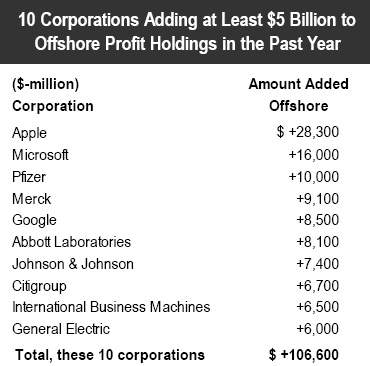
10 Corps Increased Offshore Holdings by $5 Billion or More in 2012

Source: CTJ

Media Appearance: Bloomberg TV 3:00-4:30

Posted: 13 Mar 2013 11:45 AM PDT

Street Smart


I will be guest hosting with the lovely Trish Regan at Bloomberg TV from 3:00 pm to 4:30 pm on Street Smart.

We will talk Chinese Cyber Espionage, Retail, Global Recession (in Advanced but not emerging Nations), Why politics does not matter to stocks, and your favortie the Fed.

Should be lots of fun — Check it out at their live streamer on TV.


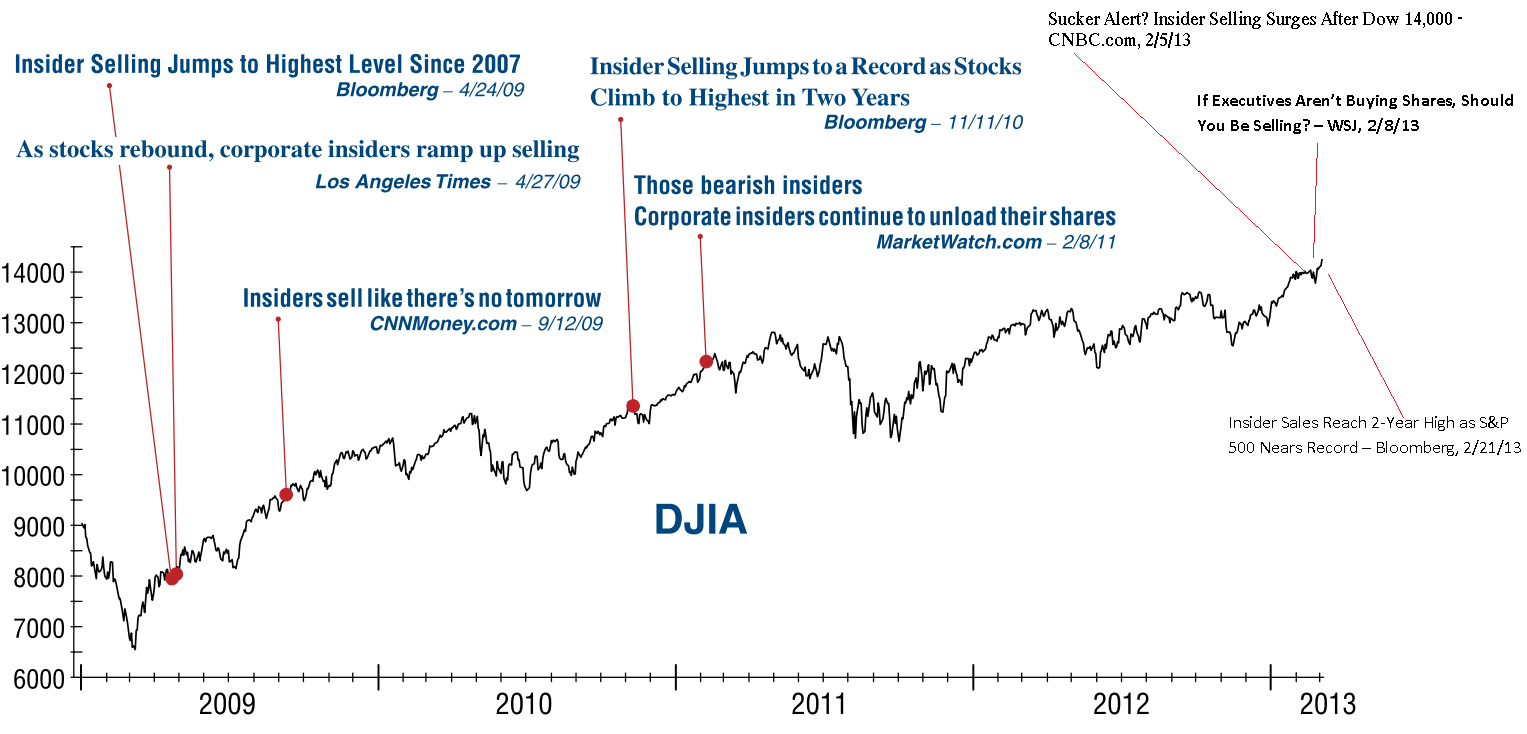
Is Insider Selling A Concern? (No)

Posted: 13 Mar 2013 09:00 AM PDT


Source: Investech Research


The chart above comes from my favorite market historian, Jim Stack of Investech. Jim notes that Insider Sells have never been a reliable signal — it typically means the market has just rallied a bit and the insiders are looking to lock in some free money (also known as stock option cash outs).

Here is some more history of Insider Buys & Sells from Stack:

• In late 1982, as the DJIA approached 1050 –a level that had proven a barrier for 17 years– Insider Selling reached its highest (supposedly most bearish) extreme in almost a decade.

• Ironically, by the summer of 1987 corporate insiders had turned into aggressive buyers of their own stock. In fact, Insider Buying reached a record (supposedly
most bullish) level in October 1987… just one week before the 1987 Crash.

• In 1991 Insider Selling spiked as the stock market roared out of the 1990 recession and corporate earnings languished. Everyone was convinced that stocks had disconnected from reality and the insiders were right. Wrong again!That was only the first year
of a 9-year bull market run that would produce the longest period without a 10% correction.

• By May 1999 Insider Buying hit an 8-year high as corporate insiders had again become avid fans of their own stock – at the worst possible time… right before the peak of the dot-com bubble.

In other words, corporate insiders are just as dumb as the rest of you Humans!

(I mean other than that whole transferring wealth from corporate owners to themselves and convincing the eejit shareholder owners its actually good for them! Hahaha that’s hilarious!)

10 MidWeek AM Reads

Posted: 13 Mar 2013 07:00 AM PDT

Some reads to start your day:

• Gold is the worst investment of 2013 (Quartz)
• Our 5 Favorite ETFs Launched in the Past 6 Months (MorningStar)
• Preparing for Day When Rates Rise (WSJ) see also Bernanke Provokes Mystery Over Fed Stimulus Exit (Bloomberg)
• Blessings of Low Taxes Remain Unproved (NYT)
• How Apple Gets All the Good Apps (WSJ) but see Samsung Targets Galaxy 4 at Apple's Core iPhone Market (Bloomberg)
Who could have foreseen that? Financial irregularities killed Intrade  (New Yorker)
• Don't fall for Pentagon spin (Salon) see also Pentagon needs $12.6 billion per year through 2037 for F-35 (Yahoo Finance)
• Your adviser could be a psychopath (msn money)
WTF? US teenager crafts early detection tool for cancer (global post) see also How "Breakthrough Medical Findings" Disappear (Same Facts)
• Ferrari 458 Lets CEO Hit Le Mans Like Steve McQueen (Bloomberg)

What are you reading?


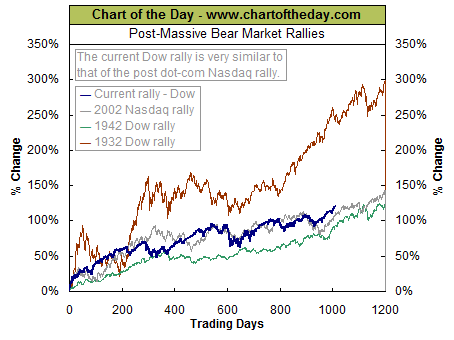
Massive bear markets (50%+ declines) since 1896

Source: Chart of the Day

.

0 comments:

Post a Comment

previous home Next

{8} chatroll


{9} AdBrite FOOTER

{8} Nice Blogs (Adgetize)