


The Big Picture |

- Drones: A Booming Business?
- WTF Were They Thinking?
- Look Out Below, Cyprus Edition
- The “Fix” Is In for Gold and Silver Prices?
- How I Was Hacked
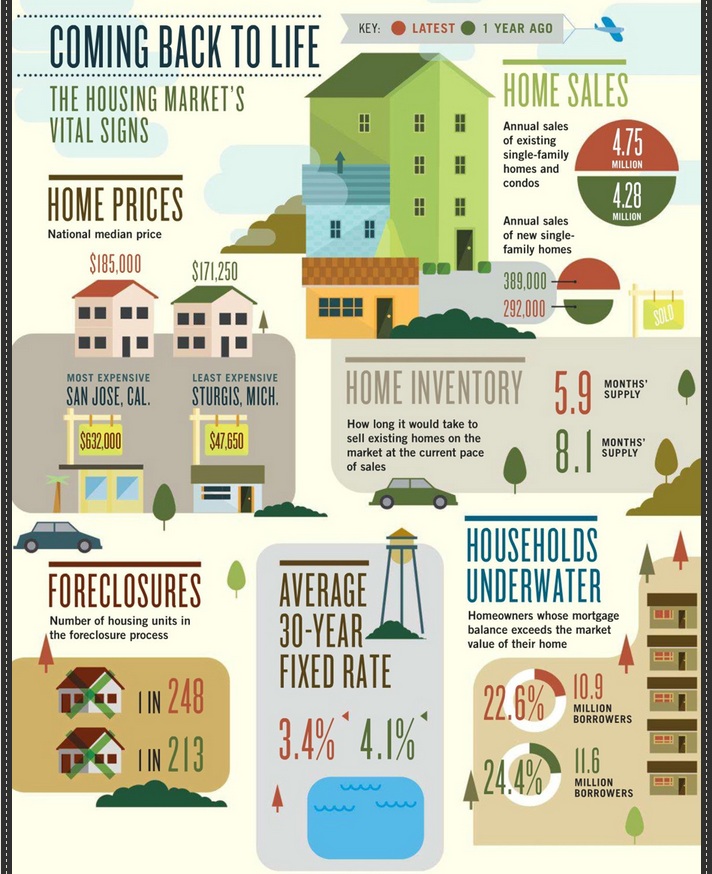
- Coming Back to Life: The Housing Market’s Vital Signs
- 12 Cognitive Biases That Endanger Investors
- 10 Sunday Reads
- The Right Skill Set
| Posted: 18 Mar 2013 03:30 AM PDT Unmanned aerial vehicles, also known as drones, may soon become commercialized. In Grand Forks, N.D., people are preparing for a coming boom in drones-related business.
 |
| Posted: 18 Mar 2013 03:00 AM PDT That's our System 1 (fast) thinking kicking in after hearing the news of the Cyprus bail-in of depositors. Our fast thinking really fears contagion and makes us want to vendere la casa! We often get into trouble trading with System 1 thinking. Our System 2 (slow) thinking is more analytical and raises the following questions before we jump on the bandwagon with those who think the Cyprus bail-in is tantamount to financial thermonuclear war. 1) Can a country with a GDP ($23 billion) only 1/10th the size of Detroit, Michigan or one half of Tulsa, Oklahoma be a systemic risk to the global economy and clip, say, $300 billion in value, off the U.S. stock market? Seriously doubt it. Detroit, for example, is on its way to bankruptcy and you hardly hear a peep from the Euro Bears or their American comrades. 2) Will depositors in Italy, Spain, and Greece view their banking systems similar to Cypress and move their money? That's the biggest risk, but no doubt the ECB will be there to provide the liquidity if they do. Furthermore, it is doubtful the OMT mechanism will include a depositor bail-in. If I were an Italian, Greek, or Spanish depositor, however, and saw a bunch of Russians lining up at my bank, then I'd be a little more scared. No doubt some bank depositors will withdraw and ask questions later. Will it be enough to overwhelm the ECB? Nope. 3) Would Cypriot depositors have lost more money by leaving the eurozone and suffering a currency devaluation? We think so, Ask the Venezuelan depositors who had their currency devalued more than 40 percent a couple weeks ago. Then compare to the 6-10 percent deposit tax. Seriously, folks, do you think Germans bailing out Russian depositors was really an option? 4) Is it unprecedented? No. Here's a headline from a few years back:
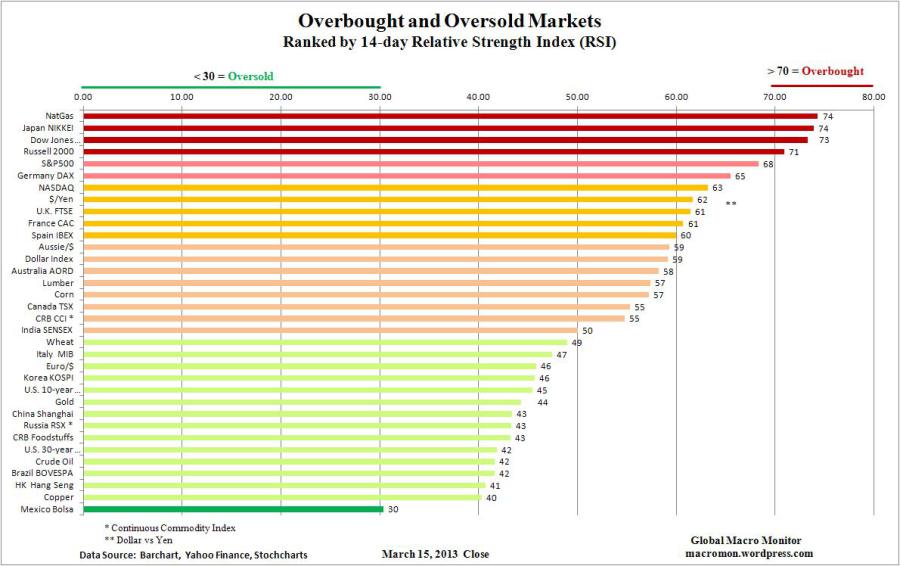
5) Could the deal have been structured better? Absolutely. Remember, the EU went through several painful iterations before completing the Greece PSI deal. The first Greek haircut was not really a haircut and actually increased the country's interest costs and it was clear those who financial engineered the deal had absolutely no idea what they were doing. See here. Cyprus should be no different. We doubt what we have seen is the final deal. Don't expect the Eurocrats to deliver a clean first deal. 6) Were markets overbought going into the weekend? Very overbought. The Nikkei, Dow, and Russell 2000 had RSIs over 70. The Cyprus news gave markets an excuse to sell. 7) Is it now risk off and a new bear market? First, risk on/risk off is so 2012. Take a look of the returns this year. Money is flowing into U.S. equities and some select countries with weak currencies, mainly Japan and the United Kingdom. The emerging markets are performing poorly, the BRICs are dogs, and commodities are doing nothing. Risk on is now about as vogue as snail mail and for non-Twits. In fact, the Cyprus deal only reinforces the 2013 trade. The U.S. and its large cap stocks will be now viewed even more as a safe haven, in our open. Second, we seriously doubt Cyprus' $20 billion economy is going to derail the fundamentals that have been driving the U.S. stock market. Will it end fracking and cheap energy? Derail the housing market? Cause the Fed to remove quantitative easing prematurely and raise interest rates? Get frickin' real, comrades. Finally, could it dislodge some stock and cause some real selling? Of course, and probably some at the U.S. open by traders who were too long or leveraged. Will the buyers disappear? We doubt it but they may pull their bid to buy lower. The S&P futures are down over 20 points as we write. We're not buying French dips but will buying this sell-off when it turns. Could be wrong and always with a stop.  |
| Look Out Below, Cyprus Edition Posted: 18 Mar 2013 02:40 AM PDT click for updated futures
Cyprus, according to the CIA factbook, is a former British colony with a population of 1,138,071 people, 77% of whom are Greek. The tiny island nation rarely moves markets, but is at the center of today’s weakness, as fears that Cyprus could kick off of the next European crisis. The Euro fell 1.1%, as the dollar rallied as monies poured into US Treasuries as a safe haven. European stocks slid on contagion fears. In Asia, markets were significant pressure. MSCI Asia Pacific Index (MXAP) sank 2%; Japan's Nikkei 225 dropped 2.7% (biggest decline in 10 months). Even Australia's S&P/ASX 200 Index got hit for 2.1%. Gold advanced past $1600 for the first time in 2 weeks. How significant is the Cyprus story to markets? Over the long haul, probably not much, but as of 5am this morning, the first 6 most popular stories on Bloomberg.com are all Cyprus related.
Most Popular Stories
 |
| The “Fix” Is In for Gold and Silver Prices? Posted: 17 Mar 2013 10:30 PM PDT Gold and Silver Prices Are Set In Libor-Like Daily Conference Calls Between a Handful of Big Banks
There is increasing evidence that the gold market is manipulated. The amount of physical bullion may be greatly over-stated, and gold may be manipulated in the same way that Libor rates are:
Yesterday, the Guardian reported on the stunning similarities between the daily "fixing" of the gold price and of the Libor rate:
 |
| Posted: 17 Mar 2013 03:30 PM PDT |
| Coming Back to Life: The Housing Market’s Vital Signs Posted: 17 Mar 2013 12:00 PM PDT |
| 12 Cognitive Biases That Endanger Investors Posted: 17 Mar 2013 09:00 AM PDT Before Todd Harrison created Minyanville, he was an options trader at Morgan Stanley, eventually becoming President of Cramer Berkowitz, where he toiled as head trader at Jim Cramer’s hedge fund. Todd has an excellent analysis of the various biases that endanger investors. Here is the full list:
Check out his explanation and descriptions here.
Source:  |
| Posted: 17 Mar 2013 05:15 AM PDT Some Sunday morning reading to stimulate your brain pans:
What’s for brunch ?
Overbought and Oversold Markets  |
| Posted: 17 Mar 2013 05:00 AM PDT What sort of skills do you need to work on our team of researchers, asset managers and financial planners? We look for people who are not only smart and talented, but also have diverse abilities and interests. With so many large firms laying off so many talented people, there is a huge talent pool out there. You need to be able to stand out from the crowd. Our entire staff all have something a little special (read “odd”) about them — something different that allows them to think outside the box. They all have various interests, backgrounds, abilities that give them a better worldview. There are disadvantages to becoming too specialized. For example, this is what Caitlyn, my administrative assistant, does on the weekends:
 |





| You are subscribed to email updates from The Big Picture To stop receiving these emails, you may unsubscribe now. | Email delivery powered by Google |
| Google Inc., 20 West Kinzie, Chicago IL USA 60610 | |



0 comments:
Post a Comment