


The Big Picture |

- Top Economists and Financial Experts Say We Must Break Up the Giant Banks
- Baby Elephant Plays in the Ocean
- Colbert Nation: Budget Sequestration
- Population Distribution of USA
- More Information
- What Do Investors Lie To Themselves About?
- Louis C.K.’s Annotated Wisdom
- Charlie Munger: The Psychology of Human Misjudgement
- Fifty Trades of Grey
- State Unemployment and the Allocation of Federal Stimulus Spending
- 10 Weekend Reads
| Top Economists and Financial Experts Say We Must Break Up the Giant Banks Posted: 02 Mar 2013 10:30 PM PST Stunning List of Economists, Financial Experts and Bankers Say We Need to Break Up the Big Banks
The following top economists and financial experts believe that the economy cannot recover unless the big, insolvent banks are broken up in an orderly fashion:
Even current Fed chairman Ben Bernanke says that the big banks should be downsized: And the head of the New York Federal Reserve Bank – and former Goldman Sachs chief economist – William Dudley – says that we should not tolerate a financial system in which certain financial institutions are deemed to be too big to fail. Federal Reserve Board governor Daniel Tarullo also backs a cap on the size of banks, and Former Treasury secretary under Reagan and George H.W. Bush, Nicolas Brady, says that we need to put a cap on leverage. Top Bankers Call for Big Banks to Be Broken UpWhile you might assume that bankers themselves don't want the giant banks to be broken up, many are in fact calling for a break up, including:
Indeed, a bipartisan consensus is forming regarding the need to break up the big banks. Click here for background on why so many top bankers, economists, financial experts and politicians say that the big banks should be broken up.  |
| Baby Elephant Plays in the Ocean Posted: 02 Mar 2013 04:00 PM PST
 |
| Colbert Nation: Budget Sequestration Posted: 02 Mar 2013 01:00 PM PST Because Democrats and Republicans failed to reach an agreement over the debt ceiling, Obama’s sequester will cripple programs that both sides love The Colbert Report Thursday February 28, 2013  |
| Population Distribution of USA Posted: 02 Mar 2013 12:00 PM PST Fascinating graphic showing the distribution of population in the US:
Click to enlarge  |
| Posted: 02 Mar 2013 09:00 AM PST I’m a researcher. Let me give you the latest example… My headphones broke. You know, the connection, by the plug, so that one ear goes in and out. In the seventies, you’d get this fixed. Today, it costs more to repair than to rebuy, and the art of repair seems to have gone by the wayside, craftsmanship is neither taught nor expected. Come on, aren’t you stunned when your auto mechanic actually fixes the problem? If he does, you tell everybody you know about him, you’re loath to switch brands for fear of losing him. Bottom line, I need a new pair of Sennheisers. Don’t get the wrong idea. These are my out and about headphones, they cost thirty-odd dollars. But they no longer sell the same model. There’s one that looks the same, and costs the same, but if you go on Amazon you’d be stunned at the complaints. You see they’re just not LOUD enough! Other sounds creep in. And that’s a no-go. But you won’t learn this on the Sennheiser site. And the vaunted headphone.com doesn’t sell this model. What do I do know? We’re all looking for more information. But we live in a withholding, gotcha culture. None could be worse than the record business. Wherein we let you hear one song on the radio, and if you like that you can buy ten more, unheard, for fifteen bucks. That was the CD paradigm. Sound outdated? You bet. Today no one other than a diehard fan is going to purchase an album without hearing most of it first. They’ll just buy the single, and move on. We want more information. That we can trust. But no one is providing this. Because they believe that sales is more important than marketing. Because they oftentimes don’t believe in the product itself. And that’s key. Especially in music. Great sales and marketing will never help a lame song. To break through the clutter your material almost has to sell itself. But you can’t get anybody to admit this. Which is one of the reasons music is such a turnoff. Everybody’s beholden to something other than the truth. Labels are beholden to the corporate board. Radio is beholden to advertisers. And acts are delusional. Which is why we depend upon our friends. Because we can trust no one else. But what if there was a trustworthy source… Long after midnight I found this article in the “New York Times” about marketing and selling pools: “A Revolutionary Marketing Strategy: Answer Customers’ Questions”: http://nyti.ms/YdH7rX This guy Marcus Sheridan’s fiberglass pool company hit the skids in the recession. It went from selling six pools a month to barely two. He cut his $250k a year marketing budget by ninety percent and started to blog. And sales shot back up. Did Marcus Sheridan stand on a rooftop and say his was the best pool company out there? OF COURSE NOT! He ranked his competitors. Gave them kudos. Didn’t even mention his own company. But Marcus smiled on the inside. Because he knew he owned the customer, because the customer was surfing on his site. I’ll buy from Amazon even if it’s not the lowest price. I trust them. I know third parties using the site will always come through, they’re afraid of getting blasted in the ratings. Amazon owns me. Marcus Sheridan owns the pool business. Yup, Google anything about pools, and his site comes up. Through a sheer plethora of information. As for social networks? HE DOESN’T BELIEVE IN THEM! Just because it’s the latest and the greatest, that doesn’t mean it works. “Q. Once you wrote a blog post, how much time did you spend promoting it on Twitter and Facebook? A. I didn’t. Dude, that one article on price has never been tweeted. It’s never been Facebooked. I’m not saying social media doesn’t help, but it’s nowhere near what people think. The only metric that really matters is total pages viewed. Here’s a statistic for you: If somebody reads 30 pages of my River Pools Web site, and we go on a sales appointment, they buy 80 percent of the time. The industry average for sales appointments is 10 percent. So, our whole marketing campaign revolves around getting people to stick around and read our stuff, because the longer they stay on our site, the greater the chance they’re going to fall in love with our company.” I love anybody who is willing to question the conventional wisdom. That’s what endeared me to Marcus Sheridan. Most people follow the herd, they do dumb marketing. Marcus is all about being smart. And now he’s become a consultant. Hell, I’m savvy enough to know that this article didn’t appear on the “Times” by itself, via luck. Marcus is working it. And that makes me question the veracity of his vision. Still, what he says rings true, because I WANT INFORMATION! Trusted information. Truthful information. If you hype your own band, I don’t care. But if someone unconnected to you does, I’m interested. And if that someone keeps telling me about good stuff, I trust them. But almost no one adheres to the above rules. Self-promoters are rampant. Recommenders don’t ask themselves if I’D like it. I get that THEY like it, but they read me, they know my taste…how come they think I’D like this? So I went to Marcus’s website, http://www.riverpoolsandspas.com I was stunned at the amount of information provided. You could fall down the rabbit hole and have no time to swim. And then I clicked through to http://www.thesaleslion.com, Marcus’s consultancy site. And was confronted with this: “10 Reasons Why Employees SHOULD be Required to Participate in Blogging and Content Marketing” Read it. And you’ll change your corporate philosophy. Imagine if everybody at Universal Music blogged. That would do more to sell recordings than just about anything else, especially if the writers talked about music they liked on other labels, to build their credibility. But the vaunted Lucian Grainge is not net-savvy. As for Doug Morris…he believes in radio. Something I never ever listen to, I’m done with terrestrial, I just can’t handle the formatted playlists and the commercials. In other words, Doug is preaching to a dwindling audience. As for the outliers, soon to be the mainstream…IGNORE THEM! Huh? I don’t know a single person who doesn’t use Google. It’s the Go-To of life. Whether you’re researching old girlfriends, movie times or wanna buy something. As for music… If you don’t want to know more about it and the people who made it, you’re not a fan. Today you have to know how to write. How to communicate. You must establish trust as opposed to banging people on the head to buy. It’s the opposite of everything we’ve been taught in the music business. But it’s a brand new day. P.S. The Sennheiser headphones I own, that broke, are the PMX 60. The replacement model, that they’re complaining about on Amazon, is the PMX 90. Research tells me I can switch to Polk or Grado. But they look bulkier. I’m honestly thinking of overpaying a scalper for the old model. I know what it is, that it works. I want to waste neither time nor money. I’m staying with the trusted source. Everybody’s reluctant to switch. But getting them into your corner to begin with? That takes more than yelling, more than convincing, it takes honesty and openness. P.P.S. Read the negative reviews of the PMX 90 here: http://amzn.to/14bdmsD
– Subscribe to the LefsetzLetter – Visit the archive – –  |
| What Do Investors Lie To Themselves About? Posted: 02 Mar 2013 07:00 AM PST Pinocchio traders with fantastic returns are lying to themselves
In my last column, we discussed my annual rite of Mea Culpa. That's where I look back at the prior year to evaluate what I got wrong and why. It is a humbling experience designed to make me a better investor, and I have been doing it — in public — for several years. Numerous readers have told me that this is a rarity in the world of finance. But every year, I hear from a small segment of active traders who misread what the discussion is about, seeing it as an invitation to brag about their best trades. Astonishingly, these e-mailers have all significantly outperformed the markets over the years, putting up fantastic return numbers. They never seem to have a losing trade. They sold Apple at exactly $705 and bought gold precisely at the bottom. Even more amazingly, they got out at the market top in October 2007 and bought in at the exact lows in March 2009. The polite term for these people is "fibbers." Personally, I say it's lying. Mathematical probabilities make these claims of uniformly spectacular track records extremely unlikely. And what I find most intriguing is that these Pinocchio traders (as I call them) are not really lying to you or me, but, rather, to themselves. Little white lies are told by humans all the time. Indeed, lying is often how we get through each day in a happy little bubble. We spend time and energy rationalizing our own behaviors, beliefs and decision-making processes. As investors, we want to believe we are smart, insightful and uniquely talented — even though we often fail to do the heavy lifting, put in the long hours, and make the uncomfortable but necessary decisions to achieve success. But self-deception is especially costly when it comes to investing. So let's consider some of the lies that a lot of you may be telling yourselves and the impact they may have on your portfolios. • You know what your investment returns are. You would be surprised at how few people actually know what their returns are. Even fewer understand their performance relative to a benchmark. According to a study of online investors by Markus Glaser and Martin Weber, "The correlation coefficient between return estimates and realized returns is not distinguishable from zero." In other words, what we think our investment returns are and what they actually are have literally nothing to do with each other. It is not that complicated to correct this. Set up a simple spreadsheet using Microsoft Excel or Google Drive or one of the available online tools. Keep careful records of your portfolios, cumulative and YTD returns, and you will avoid the "performance delusion." • You can predict the future. You may not say you believe you can forecast what will happen next year, but you certainly behave that way. Whenever you try to pick market tops and bottoms, you are making a prediction. Guessing what stock is going to outperform the market is forecasting, as is selling a stock for no apparent reason. Indeed, nearly all capital decisions made by most people are unconscious predictions. We've discussed this many times, but it bears repeating: No one can consistently predict the future with any degree of accuracy. If your investing approach requires that you become Nostradamus to succeed, then you are destined to fail. • You know how costs, fees and taxes impact your returns. Not too long ago, an acquaintance was bragging about what a great year he was having. And truth be told, his gross returns were impressive. Then I had him calculate his net returns. Once he figured in his turnover, commissions and especially taxes, he realized he had an enormous cost structure that ate into his P&L. After all costs, his great gross returns turned into below-market returns. I informed him, "My retired 75-year-old mom bought an S&P 500 index last January, paid an $8 commission and forgot about it for the year. She kicked your professional butt." He was not happy about that. Perhaps we need a corollary rule about active trading: Gross returns don't count, net returns do. • You can pick fund managers. Yes, we all know who the great fund managers of the past 20 years were, but that's after the fact. What makes you think you have the skill set to evaluate the best ones of the next 10 to 20 years — their investing approach, discipline, character and ability to express their investing thesis? Only 1 percent of fund managers actually earn their fees: Why do you believe that you can pick them out? • You understand mean reversion. Every year, it seems, some fund manager gets the hot hand and becomes a media darling. He attracts lots of assets as investors chase past performance. The size of his fund balloons. Then the disappointments come. Here's why. Outperformance is often random among the 20 percent who manage to do better than their benchmark each year. But it's always a different 20 percent. Following that run of good fortune, they typically follow with a subpar year, as their chosen style or sector cools off — it reverts to the mean, or average. (Math is a cruel mistress.) • You have a plan. I am constantly astonished at how few people actually have any sort of long-term plan other than throwing some money into a 401(k) or IRA and hoping for the best. • You can pick stocks. Let's be brutally honest about this: Discussing specific stocks during a bull market is loads of fun. Chatting about new products, management and exciting new technologies makes for great cocktail party chatter. The problem is that most of you lack the specific skill set to do this well. This includes understanding valuations, recognizing problems early and, perhaps most of all, following your discipline to limit losses when things don't work out. Most investors are better off owning a set of broad indexes for their main retirement accounts. • You are saving enough for retirement. I'll spare you the lecture, but for most of you this is not true. The average retirement account held by 60 percent of Americans is less than $25,000 (according to the Employee Benefit Research Institute). The average 401(k) is $77,300 (Fidelity). According to EBRI, only 14 percent of American workers are very confident they will have enough money to live comfortably in retirement. This has been a short list. As Mark Twain wrote: "Everybody lies — every day; every hour; awake; asleep; in his dreams; in his joy; in his mourning." What are you lying to yourself about?  |
| Posted: 02 Mar 2013 05:00 AM PST There is a brilliant set of Louis C. K. excerpts at Splitsider. Here is a small tasting:
Go read the entire piece and watch the accompanying videos.
Source:  |
| Charlie Munger: The Psychology of Human Misjudgement Posted: 02 Mar 2013 04:00 AM PST Related to Poor Charlie’s Almanack: Audio of the often referred to speech by Charlie Munger on the psychology of human misjudgement given to an audience at Harvard University circa Jun 1995. Mr. Munger speaks about the framework for decision making and the factors contributing to misjudgements. c. Jun 1, 1995 The Psychology of Human Misjudgement – Charlie Munger Full Speech See also Influence: The Psychology of Persuasion by Rober Cialdini  |
| Posted: 02 Mar 2013 03:45 AM PST Fifty Trades of Grey
I get so much broker research that I must admit I don't usually read it or do so really fast. But the headline above caught my eye, and the piece turned out to be such a fun read, as well as truly thought-provoking and insightful, that I've made it today's Outside the Box. The personalization of a "relationship" with the Fed gives us a decidedly delicious way to think about QE! Michael Cembalest walks us through the changes in his attitude toward the Fed, from the heady days of early 2009, when The Fed Chairman's picture in the paper reminded me of a cross between Sean Connery and King Hussein of Jordan. His message was clear: he was going to shroud the markets in a warm embrace of unbounded, limitless liquidity. It was slow at first, but then appeared everywhere I looked, like an endless, pounding summer rain. By late summer, though, his impressions shifted: … as the leaves turned, these opportunities began to fade as capital came back to credit markets. I held on tight, pulled in a convulsion of rising optimism and the search for yield. But that's ancient history now, he says: For the last fifty months, the Fed has been buying Treasuries and Agencies, $2.5 trillion in all … My relationship with the Fed started to change: with its relentless debt purchases and 0% policy rates, the Fed apparently sees me as a rentier capitalist whose savings should be expropriated by keeping short term interest rates below inflation. What's a rentier capitalist? According to Lenin, someone who 'clips coupons, who takes no part in any enterprise whatever, whose profession is idleness'. I began to question my feelings about Quantitative Easing, even though it led to a very powerful rally in the credit markets… He goes on to take a thoughtful look at the pros and cons of QE, with some of the best analysis I've seen, concluding with these deathless lines: A period of diminishing credit returns is upon us, and it's probably time for those with more than a normal credit allocation to begin saying goodbye. It will not be easy; love knows not its own depth until the hour of separation. Once credit markets began to tighten, he notes, "investors rushed headstrong into an intense love affair with dividend-paying stocks." That has certainly been a strong theme here at Mauldin Economics, in both our Yield Shark and Bull's Eye Investor letters. I'll just tease you with the opening lines of his final sections: What of equity market valuations overall? Has a dreaded Fed-driven overvaluation cycle already begun?… Reasonable valuations and a modest recovery in the US, China and parts of the developing world should keep the party going…. Nevertheless, the end of the affair will come one day, and probably when I am not expecting it…. I remember the last time I was in this kind of tangled, complicated relationship…. Good stuff and well-written! I will pay more attention to Michael Cembalest in the future, to see if he can keep this up. This has been a whirlwind week. I finished up in Palm Springs, flew back on Monday, and wrote this week's TFTF that night. The next day saw multiple afternoon meetings and dinner with Dick Pfister, one of my long-term partners from Altegris. The next morning Jon Sundt, president and founder of Altegris, joined us and we drove out to spend the day with Kyle Bass at his Barefoot Ranch in Athens, Texas, where between meetings and calls we did take a little time for some fun. My son seems to have a knack for skeet shooting, while keeping myself seated on a very gentle horse was more my speed. I needed to see if I could still ride without getting back issues, because I'm supposed to do some trail riding in the Argentinean Andes in a few weeks. I think I am good to go. And we did finalize some plans for helping you navigate the current rather uncertain market landscape. I will let you know as they develop. Back at home, we are busy making plans to move and put everything into storage while we wait for the new condos to close. I leave for Cafayate, Argentina, next Thursday and will move into a hotel when I return in two weeks, until the new place is finalized. I'll move in and then move right back out again when construction starts. So, homeless off and on for the next few months, but the end result will be something of a dream come true for me. The haunting sounds of Ladysmith Black Mombazo's poignant song "Homeless" keep running through my mind. If you are not familiar with their work, you should be. Your moonlight sleeping on a midnight lake analyst, John Mauldin, Editor subscribers@mauldineconomics.com Fifty Trades of GreyAn illustrated story of investment, temptation, addiction, and the cost of money By Michael Cembalest, J.P. Morgan Asset Management Q1 US retail sales were better than expected in January, despite higher tax rates, as the US consumer is still more active than European counterparts (1st chart). It's too soon to see the full impact of higher US income and payroll tax rates, but a Q4 jump in real wages, improved household balance sheets and a turnaround in housing may offset part of the headwind. We'll see in a couple of quarters. Meanwhile, in the SOTU address, the President talked about raising revenues. It will be interesting to see where they come from: after the recent tax act, top quintile tax rates are now 5 times higher than the second quintile, up from 2x in 1979 as progressivity increases further (2nd chart). Everywhere I go, however, there's a different topic on everyone's minds: what will happen when the Federal Reserve stops purchasing tens of billions in Treasury and Agency debt every month? It's possible that with a sufficiently dovish Chairperson replacing Bernanke in 2014 that they will never end, and that the US will end up like Ireland, with its Treasury perpetually beholden to its Central Bank; but I don't think so. The autobiographical story below is my view on Fed purchases and their impact on the world of investing. Fifty Trades of Grey I was always the cautious type. I would wait until other people jumped into a lake to make sure it was deep enough. I have never been on a motorcycle, and have never held or fired a weapon. I once rented a Maserati for a day to see what it was like, and drove under the speed limit the entire time. So, it's not surprising that by the fall of 2007, with mounting problems in housing, over-crowding in hedge fund strategies like statistical arbitrage and very low credit spreads, I got nervous and reduced portfolio risk heading into 2008. The following fall, after the collapse, I imagined a slow and steady approach to reinvesting. It would take time to rebuild confidence after the second 40% equity market decline in a single decade, right? After recessions in 1989 and 1999, you could take your time reinvesting in credit: high yield spreads remained elevated for 3 to 4 years, allowing for a long, relaxed period of risk-taking by investors with the wherewithal to have avoided some of it in the first place.
Then one day in early 2009, everything changed. The Fed Chairman's picture in the paper reminded me of a cross between Sean Connery and King Hussein of Jordan. His message was clear: he was going to shroud the markets in a warm embrace of unbounded, limitless liquidity. It was slow at first, but then appeared everywhere I looked, like an endless, pounding summer rain. The convertible bonds we bought in November 2008, and the commercial real estate-backed securities and leveraged loans we bought the following spring, rose in a passionate revival of credit markets. During the first few months of 2009, you could earn 10% or more on debtor-in-possession financing, and purchase private equity interests from overextended college endowments at steep discounts. But by the late summer, as the leaves turned, these opportunities began to fade as capital came back to credit markets. I held on tight, pulled in a convulsion of rising optimism and the search for yield. That's ancient history now. For the last fifty months, the Fed has been buying Treasuries and Agencies, $2.5 trillion in all (measured in 10-year equivalents). As the Fed ravishes the riskless debt markets, its demand now accounts for ~55% of the entire net supply issued by the Treasury, Ginnie Mae, Fannie Mae and Freddie Mac. My relationship with the Fed started to change: with its relentless debt purchases and 0% policy rates, the Fed apparently sees me as a rentier capitalist whose savings should be expropriated by keeping short term interest rates below inflation. What's a rentier capitalist? According to Lenin, someone who 'clips coupons, who takes no part in any enterprise whatever, whose profession is idleness'. I began to question my feelings about Quantitative Easing, even though it led to a very powerful rally in the credit markets… On the plus side for credit, companies have a lot of cash and cash flow and I do not see a recession brewing, so a messy break- up between investors and credit markets seems unlikely this year based on fundamentals. Net of Fed purchases, there will be almost no net debt new issuance in 2013, a very bullish supply picture. (Debt universe: high yield and high grade bonds, EM sovereign and corporate debt, municipals, Agencies, Treasuries and structured credit.) Furthermore, high yield companies have termed out their debt substantially relative to where they stood in 2008, and there has been a revival in CLO and CMBS issuance as structured credit markets improve. Remember as well that the Fed may not raise rates above 1% until 2015 (extrapolated based on the pace of employment gains, labor force participation and the Fed's reported 6.5% unemployment threshold). For some investors, every bit of coupon income counts: they will be loath to sell, and feel bound to hold their credit positions forever. However, I'm also watching underwriting standards as investors weaken their emotional resolve. HY issues rated B- or below are rising as a % of issuance. So are debt-to-cash flow multiples on leveraged buyouts, and in Q4 2012, payment-in-kind and covenant-lite issuance hit 2007 levels. This month, Federal Reserve Governor Jeremy Stein voiced concerns about over-heating credit markets, noting 'reach for yield' behavior and deterioration in terms and conditions. While high yield spreads don't look tight in an historical context, yields tell a different story. Given manipulation of riskless rates, I am inclined towards caution. (If you research estimates of the Fed's impact on long-term interest rates, you might be surprised at how low they are. The latest paper on the subject puts the impact at 35-45 basis points, and other studies show even lower estimates. See "The Federal Reserve’s Large-Scale Asset Purchase Programs: Rationale and Effects", D'Amico, Nelson, Lopez-Salido and English, December 2012.) 'Long credit' is a crowded position, and dealer inventory/liquidity has declined given industry rule-changes (according to Citi, high grade and high yield dealer inventories are 20% of 2007 levels). A period of diminishing credit returns is upon us, and it's probably time for those with more than a normal credit allocation to begin saying goodbye. (The same view does not hold for credit hedge funds with minimal directional exposure to spreads or rates, and who seek to take advantage of the decline in dealer inventory/market-making and resulting arbitrage opportunities that arise between bonds and credit default swaps.) It will not be easy; love knows not its own depth until the hour of separation. Once credit markets began to tighten, investors rushed headstrong into an intense love affair with dividend-paying stocks. The S&P Dividend Aristocrats Index has outperformed the market by a huge margin starting in 2009, so much so that a few months ago, cyclical stocks were trading at the largest discount on record relative to defensive ones, and still appear to be doing so. What of equity market valuations overall? Has a dreaded Fed-driven overvaluation cycle already begun? It depends on the lens you apply to remembrance of things past. Using 3 years of trailing earnings, the S&P 500 P/E multiple is around median compared to the last hundred years, and reasonable at a time of low inflation. Using 5 years of earnings makes today's multiple seem more expensive, since it inherently assumes that the earnings collapse in 2008 will occur every decade (I don't think this is a good assumption). Some positives: market expectations of future long-term earnings growth are low, and there's a lot of corporate and household cash lying around, the most in many decades on a combined basis. What about the equity market-to- replacement cost ratio? It can be a useful buy/sell signal when it's at extremes, but that's not the case now. As for other equity valuation methods, such as those which flatter stocks by looking at the fact that I am forced to earn zero percent on my cash, I am trying to cast them aside: the deceptions we tell others are nothing compared to those we tell ourselves. Reasonable valuations and a modest recovery in the US, China and parts of the developing world should keep the party going. When inflation comes back and the Fed tightens, the party will likely end for a while, but at least right now the output gap (a measure of spare US capacity) still looks large. I have even seen remarks by Bernanke's courtiers, Evans and Yellen, indicating that the Fed will allow inflation to drift above its long term target for a while to ensure a recovery. In other words, they will postpone the inevitable for as long as they can. Nevertheless, the end of the affair will come one day, and probably when I am not expecting it. Since the Greenspan- Bernanke era of ultra-low policy rates began, the volatility of equities is even higher than before the creation of the Fed in 1913, when the US was beset by frequent recessions and depressions. So here I remain, trapped in a cycle of market passions that careen from sadness to ecstasy, and then back again. The ecstasy phase has more room to run for now, and we are seeing signs that M&A activity (Berkshire Hathaway and 3G purchase of Heinz, Comcast purchase of GE assets, Liberty Media purchase of Virgin Global) and share repurchases are picking up, which is generally good for stocks. The Fed is looking for 'substantial' labor market improvement, which means there will probably be another 12 trades of grey before its purchases end. What kind of imbalances will grow during this time? When the Fed stops buying riskless securities, we will find out how ready risky securities are to stand on their own, and how addicted investors are to Fed support. I remember the last time I was in this kind of tangled, complicated relationship. It was in 2003: the Fed set policy rates at 1%, below the rate of inflation, and set in motion another cycle in which the value of cash was destroyed. (Inflation was at the same level in 2003 as it was in 1997, yet policy rates were 4.5% higher in 1997. This is a point that Stanford's John Taylor, a critic of current Fed policy, made last November at the Centennial Celebration of Milton Friedman at the University of Chicago.) Incredibly, investors in US T-bills earned returns below the rate of inflation until September 2005, which was well into the recovery and around the time the housing collapse began. Fed sponsorship of (another) housing boom and the credit markets was great while it lasted, and I thought the affair would never end. But it did end, with sadness and with betrayal: when it came time for the Federal Reserve to warn me about possible consequences of surging home ownership costs, I didn't even get an email, or a salacious text. Instead, I read one day in the newspaper that the subprime issue was 'contained'. Love means never having to say you're sorry.  |
| State Unemployment and the Allocation of Federal Stimulus Spending Posted: 02 Mar 2013 03:00 AM PST State Unemployment and the Allocation of Federal Stimulus Spending
Fiscal stimulus, in the form of large discretionary increases in federal spending and tax reductions, is often triggered by a strong and persistent rise in the national unemployment rate. The most recent example was the $860 billion (6 percent of GDP) stimulus contained in the 2009 American Recovery and Reinvestment Act (ARRA), adopted in the context of rising unemployment rates. The spending components of the program were varied, including federal transfers to state governments to support education and social services, assistance to unemployed and disadvantaged individuals, and funds for capital construction projects. The majority of the stimulus funds were allocated to state governments and, since the program was motivated by high and rising aggregate unemployment, a reasonable expectation would have been that states with high unemployment rates would receive large allocations. Our analysisof the distribution of ARRA funds across states shows that the expanded assistance to unemployed workers was indeed highly correlated with state unemployment rates. It turned out, however, that most other state allocations had little association—positive or negative—with state unemployment rates. The ultimate distribution instead seemed to reflect a number of practical considerations involved in implementing such a vast spending program. In this post, we outline what in our view were the key considerations that governed the distribution of the stimulus spending across states, and we use the example of one component of that spending—highway infrastructure investment—to illustrate how the stimulus funds got to the states. Using per capita stimulus dollars in a state as the spending metric, the scatter plot below shows the lack of correlation between stimulus spending and state unemployment rates at the time the program was introduced. The lack of correlation is also evident in a comparison of spending with the cyclical change in state unemployment rates at the time. Major federal spending programs challenge policymakers to appropriate large amounts of money efficiently and expeditiously. We believe five practical considerations drove the ultimate allocation of funds, and that each potentially weakened the link between spending and unemployment. The first was competing program goals. The program was designed to create or save jobs, so the distribution of spending reflected, in part, how and where these effects would be most likely to occur. The program also had the stated goal of stabilizing state and local government budgets. In fact, it has been argued in at least two articles that this may have been a more important goal of the program. (See FRBSF Economic Letter and an NBER working paper.)
Second was timing, particularly the need to get the spending up and running as quickly as possible. While the ARRA did create one new program, the State Fiscal Stabilization Fund, the majority of the spending relied on temporarily augmenting the size of existing federal-aid programs to states while using the existing formulas governing the distribution of that aid. Third was the jobs per dollar of spending. Jobs per dollar of spending differs across programs, so that metric, rather than spending per capita, might be expected to be positively correlated with unemployment rates. Fourth, there was a sense that this stimulus program offered an opportunity for expanded federal funding of infrastructure and education projects that could lead to longer-term economic benefits for states. Finally, equity considerations, both within and across programs, implied that each state should receive some funds and that no state should have an average level of spending that was too far from the mean. The distribution of the $27.5 billion of aid to states through the Federal Highway Administration of the Transportation Department illustrates the allocation process. The spending was specifically allocated for projects that restore, repair, and construct federal highways. The funds had to be spent within three years and, for large metro areas, had to be consistent with the relevant metropolitan area transportation plan. Similar aid had been provided by the federal government to states for a number of years. The aid constituted 5 percent of total ARRA spending, and the projects were 100 percent federally funded. The allocation of ARRA aid was determined as follows: The program set aside $1 billion for aid to Native American reservations and federal lands, on-the-job-training programs, Puerto Rico and other U.S. territories, and administrative expenses. Of the remaining funds, roughly 50 percent was distributed to states based on the formula used to distribute highway aid in 2008, and 50 percent was distributed based on each state's share of total lane miles (25 percent), total vehicles miles traveled (40 percent) on federal-aid highways, and each state's share of the taxes paid by highway users (35 percent). There were also some funds set aside for sub-state areas with a population of less than 200,000. The graph below shows that this allocation formula led to highway spending across states that did not have a positive relationship with unemployment rates. The increase in spending on federal-aid highways, nevertheless, could be viewed favorably from several standpoints. There was an effort to make the spending equitable in that there were initial set-asides for segments of the population, and then all states with federal-aid highways received funding. The spending was timely, aided by the use of existing highway funding allocating formulas and existing project eligibility guidelines. Also, there are potentially positive long-term economic impacts of the funding from an improvement in state transportation infrastructure. In sum, practical considerations in targeting new federal spending under a vast program like the ARRA led to spending that was less linked to state unemployment rates than might be expected. Estimates vary as to the effects of the ARRA, but larger questions remain. Did the particular way that the funds were targeted affect the ultimate impact of the program? Would a given amount of funding distributed in another way have been more effective? Would future anti-recessionary spending programs benefit from pre-planned allocation formulas? Answering those questions would take more than a blog post. Disclaimer
 |
| Posted: 02 Mar 2013 03:00 AM PST My longer form reading to start off your weekend:
Whats up this weekend?
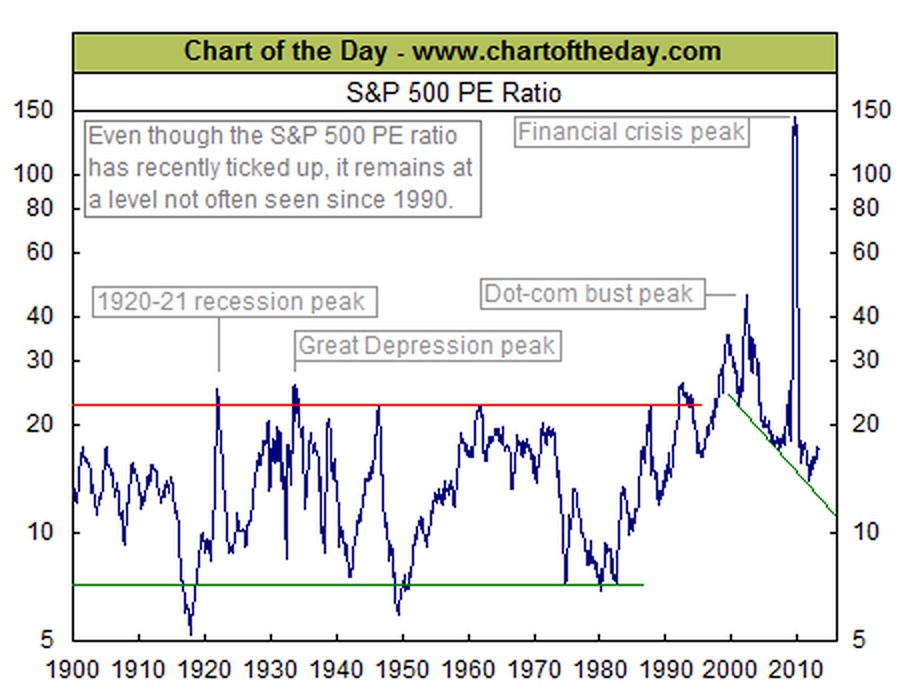
S&P500 P/E Ratio  |



| You are subscribed to email updates from The Big Picture To stop receiving these emails, you may unsubscribe now. | Email delivery powered by Google |
| Google Inc., 20 West Kinzie, Chicago IL USA 60610 | |



2 comments:
This is very interesting, You're a very skilled blogger. I've
joined your feed and look forward to seeking more of your wonderful post.
Also, I have shared your website in my social networks!
my page :: How to make counterfeit money
I like the helpful info you provide in your articles.
I'll bookmark your weblog and check again here regularly. I am quite certain I will learn many new stuff right here! Good luck for the next!
Feel free to surf to my homepage :: online earn moneyways to get money fast
Post a Comment