.

{2} GoogleTranslate (H)

English French German Spanish Italian Dutch Russian Portuguese Japanese Korean Arabic Chinese Simplified

Our New Stuff

{3} up AdBrite + eToro

Your Ad Here

Monday, March 4, 2013

The Big Picture

The Big Picture


American Banks ARE NOT Smaller than their Foreign Rivals

Posted: 03 Mar 2013 10:30 PM PST

US Banks Are World's Largest (according to Internationally-Accepted Accounting Methods)

We have extensively documented that failing to break up the big banks is destroying America because:

In the face of such overwhelming criticism, apologists for America's largest banks say that they are smaller than their European and Asian competitors … and that they have to be big to compete.

Current Vice Chair and director of the Federal Deposit Insurance Corporation – and former 20-year President of the Federal Reserve Bank of Kansas City – Thomas Hoenig destroyed that argument earlier this month.

Specifically, Bloomberg reports:

Warning: Banks in the U.S. are bigger than they appear.

That label, like a similar one on automobile side-view mirrors, might be required of the four largest U.S. lenders if Thomas Hoenig, vice chairman of the Federal Deposit Insurance Corp., has his way. Applying stricter accounting standards for derivatives and off-balance-sheet assets would make the banks twice as big as they say they are — or about the size of the U.S. economy — according to data compiled by Bloomberg.

"Derivatives, like loans, carry risk," Hoenig said in an interview. "To recognize those bets on the balance sheet would give a better picture of the risk exposures that are there."

U.S. accounting rules allow banks to record a smaller portion of their derivatives than European peers and keep most mortgage-linked bonds off their books.

***

Using international standards for derivatives and consolidating mortgage securitizations, JPMorgan Chase & Co. (JPM), Bank of America Corp. and Wells Fargo & Co. would double in assets, while Citigroup Inc. (C) would jump 60 percent, third- quarter data show. JPMorgan would swell to $4.5 trillion from $2.3 trillion, leapfrogging London-based HSBC Holdings Plc and Deutsche Bank AG, each with about $2.7 trillion.

World's Largest

JPMorgan, Bank of America and Citigroup would become the world's three largest banks and Wells Fargo the sixth-biggest. Their combined assets of $14.7 trillion would equal 93 percent of U.S. gross domestic product last year, the data show.

***

U.S. accounting rules for netting derivatives allow banks to erase about $4 trillion in assets, the data show. The lenders also can remove from their books most mortgages they package into securities, trimming an additional $3 trillion.

Off-balance-sheet assets and derivatives were at the root of the 2008 financial crisis. Mortgage securitizations kept off the books came back to haunt banks forced to repurchase home loans sold to special investment vehicles.

***

The U.S. Financial Accounting Standards Board and the International Accounting Standards Board pledged a decade ago to converge the two bookkeeping systems. After six years of meetings, they remain divided. Proposed rules for how much money banks need to set aside for loan losses may make European and U.S. lenders even less comparable.

***

"Having no uniform standard is challenging for issuers and users," said John Hitchins, head of U.K. banking and capital markets at PricewaterhouseCoopers in London. "Analysts and investors can't compare companies' financials across borders. Banks have to prepare multiple versions of their financial statements in different countries where they have units."

***

If the banks used international standards for derivatives and consolidated mortgage securitizations, the ratio for JPMorgan and Bank of America, the two largest U.S. lenders, would fall below 4 percent. It would be just above 4 percent for Citigroup and Wells Fargo.

That would make the biggest U.S. banks look no better capitalized, or worse, than European peers such as HSBC at 5.6 percent or France's BNP Paribas SA at 3.9 percent at the end of last year. It also could require them to raise more capital. Spokesmen for all four banks declined to comment.

***

"The U.S. leverage ratio doesn't capture off-balance-sheet risks," said [former FDIC boss] Bair, now chairman of the Systemic Risk Council, a private regulatory watchdog. "Once U.S. banks start publishing the new Basel-mandated ratios, more off-balance-sheet assets will become obvious."

***

Bair said she favors raising the simple capital ratio as high as 8 percent. Hoenig, the FDIC vice chairman, has called for 10 percent. U.S. regulators are still debating how to implement the rules. Because Basel isn't an international treaty, each country needs to adopt its own version.

***

Progress on common standards slowed after Mary Schapiro became SEC chairman in 2009 and faced lobbying by companies opposed to what they said would be costly accounting changes, according to four people with knowledge of the discussions who asked not to be identified because the talks were private.

***

After failing to agree on common standards for derivatives netting and consolidation of securitizations, rule-setters are now heading in different directions as they debate how to account for loan-loss reserves.

Week in Review (ending March 1 2013)

Posted: 03 Mar 2013 05:45 PM PST


WIR_Key Levels
~~~
WIR_Equity_Week
~~~
WIR_Bond_Week
~~~
WIR_Equity_YTD


~~~

WIR_Bond_YTD

(click here if charts are not observable)

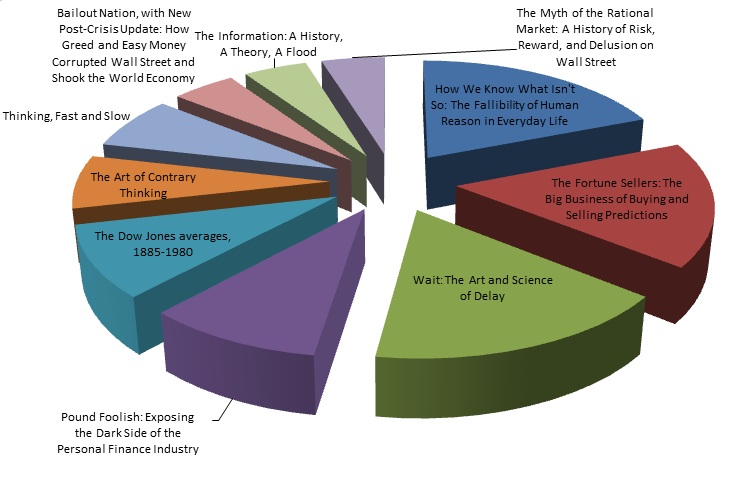
Books Bought By Big Picture Readers (February 2013)

Posted: 03 Mar 2013 03:00 PM PST

Click to enlarge

Once again, its time to peruse the data to see which books TBP readers bought last month. Amazon's embed code lets me track every click from these links — how many people look at the page, how many books get seen, and/or collectively purchased.

Its anonymous — I don't know who bought what — but there's lots of data on the various books generated.

These were the most popular TBP books for February:

How We Know What Isn’t So: The Fallibility of Human Reason in Everyday Life (Thomas Gilovich)

The Fortune Sellers: The Big Business of Buying and Selling Predictions (The Fortune Sellers: The Big Business of Buying and Selling Predictions)

Wait: The Art and Science of Delay (Humphrey B. Neill)

Pound Foolish: Exposing the Dark Side of the Personal Finance Industry (Helaine Olen)

The Dow Jones averages, 1885-1980 (Phyllis S. Pierce)

The Art of Contrary Thinking (Humphrey B. Neill)

Thinking, Fast and Slow (Daniel Kahneman)

Bailout Nation (Barry Ritholtz)

The Information: A History, A Theory, A Flood (James Gleick)

The Myth of the Rational Market: A History of Risk, Reward, and Delusion on Wall Street (Justin Fox)

Spending Cuts Are Nothing New for U.S. Economy

Posted: 03 Mar 2013 09:00 AM PST


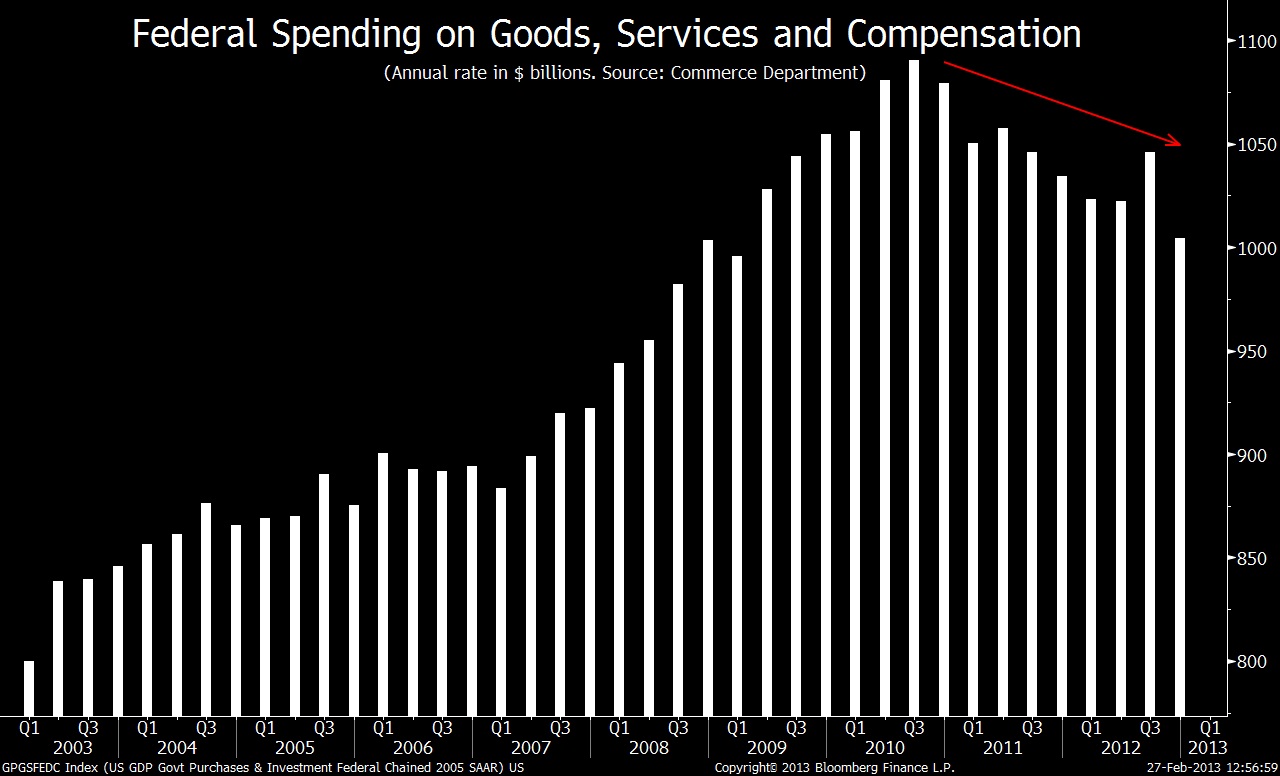
Source: Bloomberg


As the chart above shows, federal outlays for goods, services and employee compensation have fallen in seven of the past nine quarters, according to data compiled by the Commerce Department. The inflation-adjusted annual rate fell 7.9 percent from a peak reached in the third quarter of 2010. Spending by state and local governments has also dropped.

The automatic spending cuts that the  $85 billion of reductions sequester has imposed is "the same old drag" that the economy has been suffering through for most of the past few years. That is according to a report from Milton Ezrati, of Lord Abbett & Co.

Q4 saw outlays fall 7.2% below Q3 2009.

The possible offset: Spending by state and local governments. After falling during and after the financial crisis, tax revenue is now rising. In 2012, outlays for goods, services and salaries slid 0.9% after dropping a big 2.7% in 2011 and a bigger 3.6% in 2010.


Source:
Spending Cuts Are Nothing New for U.S. Economy
David Wilson
Bloomberg Chart of the Day, February 27, 2013

Carrozzeria Touring Disco Volante

Posted: 03 Mar 2013 05:00 AM PST

Updated version of the surprisingly aerodynamics 1952 Touring designed by Alfa Romeo.

The base car is the Alfa Romeo 8C Competizione — it supplies the rolling chassis and drivetrain, along with the electronics systems.  A 4.7 litre, 450 PS V8 engine is coupled to a sequential paddle-shift transaxle gearbox.


Click to enlarge


Source: Classic Driver


Related Links

The website of Carrozzeria Touring Superleggera touringsuperleggera.eu

Building the New Carrozzeria Touring Disco Volante: Part 1  Classic Driver Magazine

Building the New Carrozzeria Touring Disco Volante: Part 2  Classic Driver Magazine

Building the New Carrozzeria Touring Disco Volante: Part 3 Classic Driver

Five questions to Louis de Fabribeckers, Head of Design Carrozzeria Touring Superleggera in the Classic Driver Magazine

Geneva 2012: Disco Volante 2012 by Touring Superleggera Classic Driver Magazine

10 Sunday Reads

Posted: 03 Mar 2013 04:45 AM PST

Good Sunday morning to ya! Here are some worthwhile reads to start your day:

• More Stocks, Fewer Bonds (Barron’s)
• Retirement Investing vs. ‘Performance Delusion’ (Forbes) see also Fund Fees: Slash Them Early (Market Riders)
• If Not For That Pesky Sequester (Economist’s View)
• Wall Street’s Brightest Minds Reveal The Charts That Worry Them Most (Business Insider) see also It's Frankfurt that should be your worry – not Rome (The Market Monetarist)
• Have Investors Finally Cracked the Stock-Picking Code? (WSJ)
• A Conversation with Emmanuel Saez: Taxing Away Inequality (Boston Review)
• Shocked, Shocked, Over Hospital Bills (Economix)
• Strategies for the Spring Housing Scrum (Bloomberg)• TED on the Run: How a Conference Copes With Success — and Brickbats (Wired)
• Break up the too-big, too-dangerous banks (MarketWatch)
• Girlfriend Leads Photographer Around the World (Twisted Sifter) see also Murad Osmann (Instagram)

Whats for brunch?


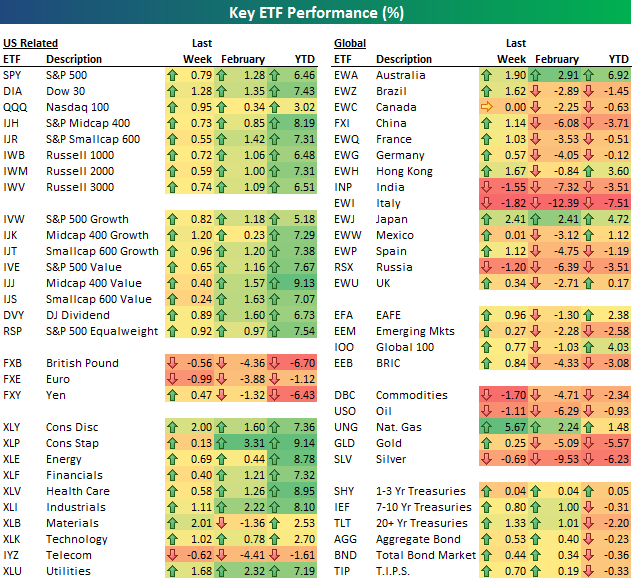
Key Asset Class Performance in February and YTD  

Source: Bespoke


Rethinking Potential Output: Embedding Information About the Financial Cycle

Posted: 03 Mar 2013 03:00 AM PST

.

0 comments:

Post a Comment

previous home Next

{8} chatroll


{9} AdBrite FOOTER

{8} Nice Blogs (Adgetize)