


The Big Picture |

- Painless and Easy Ways to Cut $83 Billion
- Blog Comments & the Nasty Effect
- 10 Monday PM Reads
- Taleb on Markets, Banking Industry, Fiscal Policy
- Apple, Amazon, Google, Microsoft Market Caps (2006- )
- 10 Monday Reads
- “Pervasive” Fraud by our “Most Reputable” Banks
- The Out-of-Office Reply
- Scott Adams Discovers Market Manipulation
- Global Trend Indicators, Overbought/Oversold Markets
| Painless and Easy Ways to Cut $83 Billion Posted: 04 Mar 2013 10:30 PM PST Stopping the Failed War on Drugs Would More than Pay for the Sequester CutsEric Zuesse notes that this year's subsidy to Wall Street – $83 billion - exactly equals the amount of the this year's sequester cuts. Spiegel reports that ending the failed "war on drugs" would pay for the sequester cuts by itself:
(Of course, stopping government support for drug dealers might be one place to start.) And there are many other painless and easy ways to cut $83 billion per year.  |
| Blog Comments & the Nasty Effect Posted: 04 Mar 2013 05:32 PM PST In this morning’s reads, I linked to this article in the NYT: This Story Stinks. I bring this up, because I had previously mentioned I was considering getting rid of comments altogether. This latest article confirmed my suspicions that trolls and other rude commenters work to undermine the intentions of of the author. In a study of over 1000 participants who were given a fictitious blog post to read on a new (mnade up) technology called “nanosilver.” After reading the post, one half were exposed to civil intelligent comments, while the half were exposed to rude ones. The researchers described the results as “both surprising and disturbing:”
The authors noted that “60 percent of the Americans seeking information about specific scientific matters say the Internet is their primary source of information — ranking it higher than any other news source.” Thus, Trolls and other jackholes operate to undermine basic knowledge in society about important principles. The researchers findings confirms my instincts expressed in my prior post. Rude, dumb, and rhetorically misleading comments get deleted, their authors banned. I am no longer willing to give these cretins a platform. So while I am going to keep some form of comments, I have instructed my crack team of editors to delete junk comments with extreme prejudice. GYOFB. I would love to find a more effective technological solution to this. Feel free to make any suggestions you like in the (heh heh) comments. You know what to do if you want them not to be unpublished.
GYOFB (May 15th, 2011) Source:  |
| Posted: 04 Mar 2013 02:00 PM PST My afternoon train reads:
What are you reading?
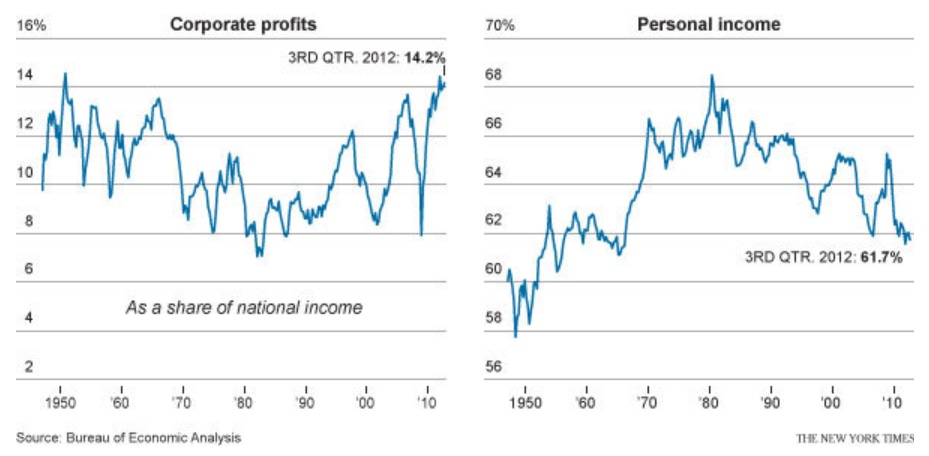
Income Shifting to Businesses  |
| Taleb on Markets, Banking Industry, Fiscal Policy Posted: 04 Mar 2013 01:00 PM PST Nassim Nicholas Taleb, a New York University professor and author of “The Black Swan” and “Antifragile: Things That Gain From Disorder,” talks about financial markets, the banking industry and fiscal policy. He speaks with Erik Schatzker and Sara Eisen on Bloomberg Television’s “Market Makers.”
 |
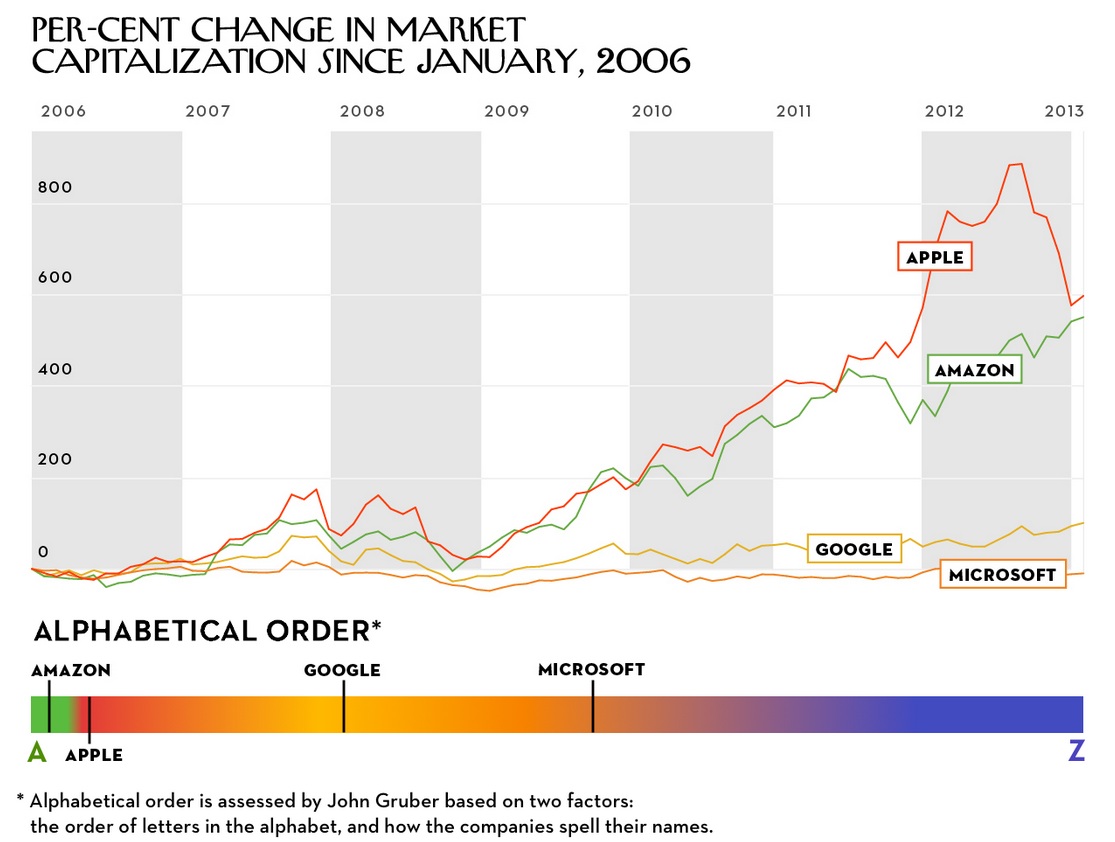
| Apple, Amazon, Google, Microsoft Market Caps (2006- ) Posted: 04 Mar 2013 08:30 AM PST Click to enlarge
Fascinating chart via John Gruber looking at the relative change in market capitalizations of four of the largest publicly trading tech companies. The ongoing strength of Amazon is nearly amazing as the continued weakness in Microsoft. All the while, Google keeps chugging along . . .  |
| Posted: 04 Mar 2013 07:00 AM PST My morning reads to start your week:
What are you reading?
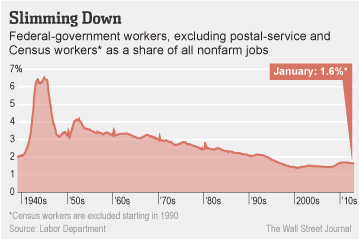
Government Payrolls Shrinking Even Before the Sequester  |
| “Pervasive” Fraud by our “Most Reputable” Banks Posted: 04 Mar 2013 05:30 AM PST "Pervasive" Fraud by our "Most Reputable" Banks
A recent study confirmed that control fraud was endemic among our most elite financial institutions. Asset Quality Misrepresentation by Financial Intermediaries: Evidence from RMBS Market. Tomasz Piskorski, Amit Seru & James Witkin (February 2013) ("PSW 2013"). The key conclusion of the study is that control fraud was "pervasive" (PSW 2013: 31).
Finance scholars are not known for their sense of humor, but the irony of calling the world's largest and most harmful financial control frauds our "most reputable" banks is quite wondrous. The point the financial scholars make is one Edwin Sutherland emphasized from the beginning when he announced the concept of "white-collar" crime. It is the officers who control seemingly legitimate, elite business organizations that pose unique fraud risks because we are so loath to see them as frauds. The PSW 2013 study confirmed one form of control fraud and provided suggestive evidence of two other forms that I will discuss in a future column. The definitive evidence of control fraud that PSW2013 identifies is by mortgage lenders who made, or purchased, mortgages and then resold them to "private label" (non-Fannie and Freddie) financial firms who were creating mortgage backed securities (MBS). The deceit they documented by the firms selling the mortgage loans consisted of claiming that the loans did not have second liens. The lenders knowingly sold mortgages they knew had second liens under the false representations (reps) and warranties that they did not have second liens. (The authors confirm the point many of us have been making for years – the banks that fraudulently sold fraudulent mortgages did have "skin in the game" because of their reps and warranties. The key is that the officers who control the banks do not have skin in the game – they can loot the banks they can control and walk away wealthy.) The PSW 2013 study documents that the officers controlling the home lenders knew the representations they made to the purchasers as to the lack of a second lien were often false (pp. 2, 5 n. 6), that such deceit was common (p. 3), that the deceit harmed the purchasers by causing them to suffer much higher default rates on loans with undisclosed second liens (pp. 20-21), and that each of the financial institutions they studied – the Nation's "most reputable" – committed substantial amounts of this form of fraud (Figure 4, p. 59). The most interesting reaction to the PSW 2013 study is that of a fraud denier, The Economist's "M.C.K." In his January 25, 2013 column, ("Just who should we be blaming anyway?") M.C.K. argued that we should blame the victims of the fraud ("the real wrongdoers were not those who sold risky products at inflated prices but the dupes who bought them…."). Only three weeks later, in his February 19, 2013 column discussing the PSW 2013 study, M.C.K. admitted that fraud by banks had played a prominent role in the crisis.
I will explain in a later column why I believe this passage is badly flawed, but my point here is that the fraud denier and "blame the victim" columnist has recanted.
These two paragraphs are worth savoring in some detail. The central point we have been arguing for years is now admitted – and treated as a universally known fact: "mortgage originators were told to do whatever it took to get loans approved, even if that meant deliberately altering data about borrower income and net worth." The crisis was driven by liar's loans. By 2006, half of all the loans called "subprime" were also liar's loans – the categories are not mutually exclusive (Credit Suisse 2007). As I have explained on many occasions, we know that it was overwhelmingly lenders and their agents (the loan brokers) who put the lies in liar's loans. The incidence of fraud in liar's loans was 90% (MARI 2006). Liar's loans are a superb "natural experiment" because no entity (and that includes Fannie and Freddie) was ever required to make or purchase liar's loans. Indeed, the government discouraged liar's loans (MARI 2006). By 2006, roughly 40% of all U.S. mortgages originated that year were liar's loans (45% in the U.K.). Liar's loans produce extreme "adverse selection" in home lending, which produces a "negative expected value" (in plain English – making liar's home loans will produce severe losses). Only a firm engaged in control fraud would make liar's loans. The officers who control such a firm will walk away wealthy even as the lender fails. This dynamic was what led George Akerlof and Paul Romer to entitle their famous 1993 article – "Looting: the Economic Underworld of Bankruptcy for Profit." Akerlof and Romer emphasized that accounting control fraud is a "sure thing" guaranteed to transfer wealth from the firm to the controlling officers. M.C.K. now admits that liar's loans were endemically fraudulent and that it was lenders and their agents who "deliberately" put the lies in liar's loans. Given the massive number of liar's loans and the extraordinary growth of liar's loans (roughly 500% from 200-2006) it is clear that that they were the "marginal loans" that caused the housing markets to hyper-inflate and created the catastrophic losses (in the form of loans, MBS, and CDOs) that drove the financial crisis. The key fact that must be kept in mind is that once a fraudulent liar's loan begins with the loan officer or broker inflating the borrower's income and suborning the appraiser into inflating the home appraisal the subsequent sales of that mortgage (or derivatives "backed" by the mortgage) by private parties will be fraudulent. The authors of the PSW 2013 study expressly cautioned that their data allowed them to examine only two of the varieties of fraud. Lenders' frauds in originating and selling liar's loans were far more common, and far more harmful, than the two forms of fraud the PSW study was able to study. The many forms of mortgage frauds by lenders and their agents, of course, were cumulative and the frauds interact to produce greatly increased defaults. The greatest importance of the PSW 2013 study is that even the fraud deniers have to admit that our most prestigious banks were the world's largest and most destructive financial control frauds. Given this confirmation that the banks engaged in one form of control fraud in the sale of fraudulent mortgages (false representations about second liens), there is no reason to believe that their senior officers had moral qualms that prevented them from becoming even wealthier through the endemic frauds of liar's loans and inflated appraisals. Appraisal fraud is almost invariably induced by lenders and their agents. Given the "pervasive" willingness of the officers controlling our most prestigious banks to enrich themselves personally by lying about the presence of second liens, they certainly cannot have any moral restraints that would have prevented them from creating the perverse incentives that caused loan officers and brokers to put the lies in liar's loans and to induce appraisers to inflate appraisals – two other control fraud schemes that were far more "pervasive" (and even likelier to produce severe losses) than the two forms of fraud studied by the PSW 2013 authors. Once the fraud deniers have to admit that one form of control fraud involving mortgages was "pervasive" among our most prestigious banks, it becomes untenable to ignore the already compelling evidence that other forms of control fraud involved in the fraudulent origination and sale of mortgages and mortgage derivatives were even more pervasive at hundreds of financial institutions. The PSW 2013 study destroyed the myth of the Virgin Crisis. It also exposes the falsity of the ridiculous "definition" of mortgage fraud that the Mortgage Bankers Association (MBA) foisted on the FBI and the Department of Justice that implicitly defines control fraud out of existence for mortgage lenders. Attorney General Holder and President Obama have no excuse for their faith in the Virgin Crisis, conceived without fraud and should repudiate the MBA definition immediately and train the regulators and agents to spot and prosecute the epidemic of control frauds that drove this crisis (and the S&L debacle and Enron-era frauds).  |
| Posted: 04 Mar 2013 05:00 AM PST |
| Scott Adams Discovers Market Manipulation Posted: 04 Mar 2013 04:20 AM PST Regular readers know I am a fan of Scott Adams, creator of the comic Dilbert and occasional commentator on a variety of matters. He has a somewhat odd blog post up, titled, Here Come the Market Manipulators. In it, he makes two interesting suggestions: The first is to decry “market manipulators,” who do what they do for fun and profit to the detriment of the rest of us. The second is to say that these manipulators are likely to cause “a 20% correction in 2013.” Let’s quickly address both of these issues: First off, have a look at the frequency of 20% corrections in markets. According to Fidelity (citing research from Capital Research and Management Company), over the period encompassing 1900-2010, has seen the following corrections occur:
Note that Fido does not specify which market, but given the dates we can assume it is the Dow Industrials. (I’ll check on that later). Note that US market’s have not had a 20% correction since the lows in March 2009. I’ll pull up the relevant data in the office, but a prior corrective action of 19% is the closest we’ve come, followed by a ~16% and ~11%. As to the manipulators of the market, I can only say: Dude, where have you been the past 100 years or so? Yes, the market gets manipulated. Whether its tax cuts or interest rate cuts or federal spending or wars or QE or legislative rule changes to FASB or even the creation of IRAs and 401ks, manipulation abounds. In terms of the larger investors who attract followers — I do not see the same evidence that Adams sees. Sure, the market is often driven by large investors. Yes, many of these people have others who follow them. We need only look at what Buffet, Soros, Dalio, Icahn, Ackman, Einhorn and others have done to see widely imitated stock trades. But that has shown itself to be a bad idea, and I doubt anyone is making much money attempting to do so. And, it hardly leads to the conclusion that any more than the usual manipulation is going on. Will be have a 20% correction? I guarantee that eventually, we will. Indeed, we are even overdue for it, postponed as it is by the Fed’s manipulation. But I have strong doubts it is going to be caused by a cabal manipulating markets for fun & profit. It will occur because that’s what markets do . . .
Previously: 7 Suggestions for Scott Adams (November 27th, 2007) Don't Follow Wealthy Investors, Part 14 (February 17th, 2008)
 |
| Global Trend Indicators, Overbought/Oversold Markets Posted: 04 Mar 2013 03:00 AM PST
~~~ (click here if tables are not observable)
~~~ The Relative Strength Index (RSI) is a momentum oscillator that measures the speed and change of price moves. The RSI moves between zero and 100 and is considered overbought with a reading above 70 and oversold when below 30. Note the RSI can sustain an overbought (oversold) reading in a strong up (down) trend. Click chart to enlarge.
(click here if chart is not observable)  |


| You are subscribed to email updates from The Big Picture To stop receiving these emails, you may unsubscribe now. | Email delivery powered by Google |
| Google Inc., 20 West Kinzie, Chicago IL USA 60610 | |



1 comments:
Hi there, I wish for to subscribe for this blog to obtain
latest updates, so where can i do it please help.
Have a look at my website: i need money free
Post a Comment