


The Big Picture |

- Red Light Green Light: Equity Sector ETF Daily Performance
- Big Banks Worth More to Investors Broken Up
- Jim Rogers & Me at 4th Alternative Investment Strategies
- 10 Wednesday PM Reads
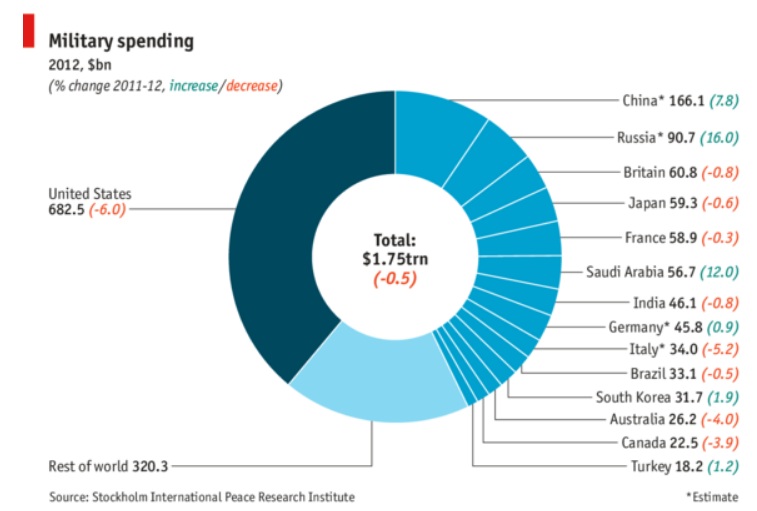
- US Military Spending vs World
- Gold, Silver vs DJIA, S&P 1885-2013
- Equity Market Review: S&P 500
- 10 Wednesday AM Reads
- Monetary Policy: Many Targets, Many Instruments. Where Do We Stand?
- Update: Rotation, Gold and Markets
- Synchronized Dancing Robots
- 2013 Tax Changes
| Red Light Green Light: Equity Sector ETF Daily Performance Posted: 18 Apr 2013 02:00 AM PDT Binary market action as in a daily game of red light green light. Take a look at this week's daily action in the sectors. What will tomorrow bring? (click here if charts are not observable)  |
| Big Banks Worth More to Investors Broken Up Posted: 17 Apr 2013 10:30 PM PDT Shareholders Join Bankers, Economists, Financial Experts, Regulators and the American People In Calling for a Break Up of the Giant BanksThe president of the Federal Reserve Bank of Dallas, Richard Fisher, has long said that the component parts of the biggest banks would be "worth more broken up than as a whole." Last year, Crain's New York estimated that Citi's component parts are worth 40% more than Citigroup's current market price. Forbes' Robert Lezner argues:
Now, analysts at even the giant banks themselves are starting to agree. Bloomberg reported yesterday:
In a separate story yesterday, Bloomberg noted:
Who Wants to Break Up the Big Banks … And Who Wants to Maintain the Status Quo?Financial experts, economists and bankers say we need to break up the big banks. The overwhelming majority of Americans want to break up the giant banks as well. Given that shareholders are now starting to understand that breaking up the giants would be better for their own portfolios, the power of the markets may finally weigh in to split up the too big to fail banks. So who is is against breaking up the giant banks? Apparently, the only people opposing a break up are the handful of welfare queens – er, I mean current top corporate brass – who mooch off the public to reap insane windfalls, and the bought and paid for D.C. politicians who make money hand over fist by literally pimping out the American people to their buddies. And see this.  |
| Jim Rogers & Me at 4th Alternative Investment Strategies Posted: 17 Apr 2013 05:00 PM PDT |
| Posted: 17 Apr 2013 01:30 PM PDT My afternoon train reads:
What are you reading?
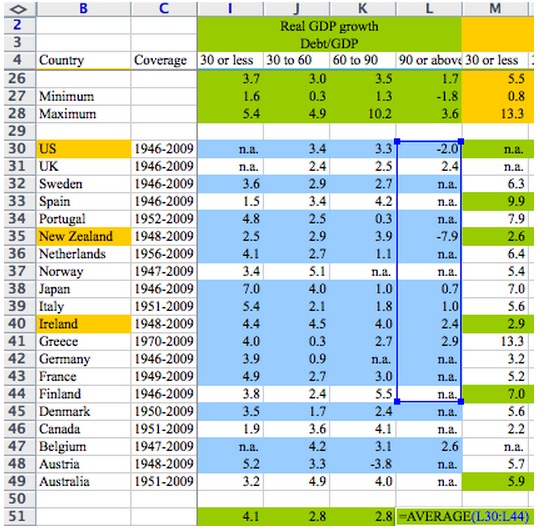
Microsoft Excel: Despoiler of global economies!  |
| Posted: 17 Apr 2013 11:30 AM PDT |
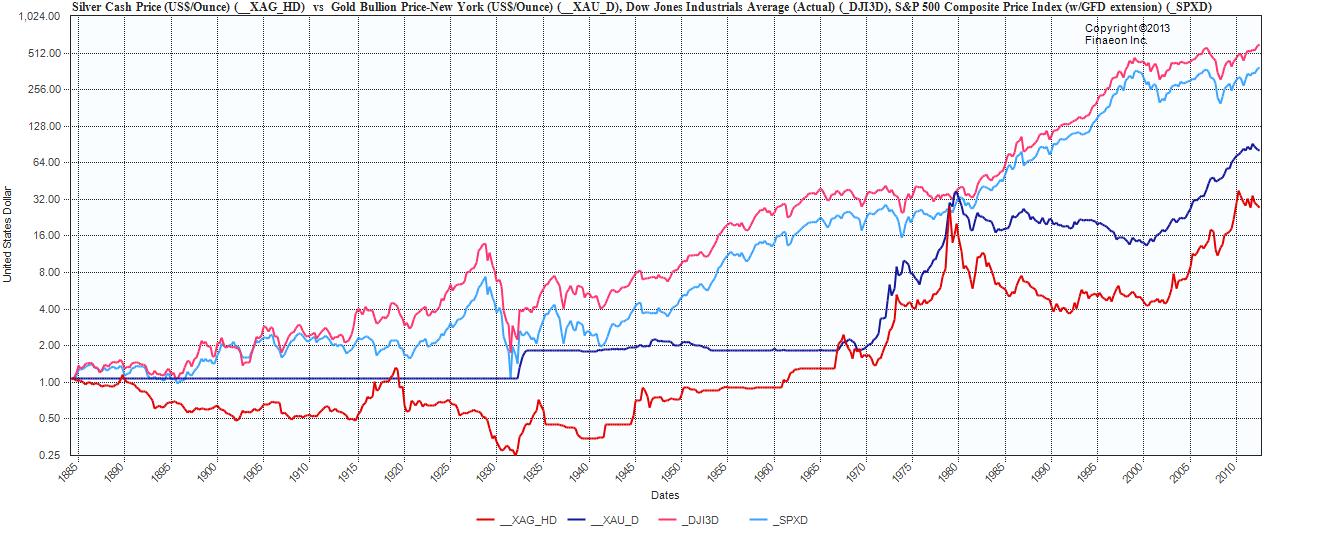
| Gold, Silver vs DJIA, S&P 1885-2013 Posted: 17 Apr 2013 10:00 AM PDT Click to enlarge
Fascinating look at the very long term via Global Financial Data, starting from the same point. The best performers are the Dow, SPX Gold and then Silver. I have no idea what this means, but its interesting and pretty and hopefully thought provoking.
Source:  |
| Posted: 17 Apr 2013 08:30 AM PDT Summary: The depth of the recent sell-off, coupled with the horrific and cowardly Boston Marathon bombing, seems to have shaken the confidence of the bulls a bit. The next few days will be important in regards to near term direction. We do not want to see yesterday's lows violated as it will suggest, at least temporarily, buying power is exhausted. In our opinion, especially with the historically weaker month of May rapidly approaching, the market needs to rebound and recapture lost ground very soon otherwise, the long awaited correction may be at hand. Anecdotal sentiment, which had the pendulum stuck on skeptical for most of this rally, seems to have taken a bit of a swing back to the complacency of late. We even note the title of our last market note, "Teflon Market" as first hand evidence on the subtle comfort the upward market action has given us all. Market breadth, which has improved, has started to deteriorate again, and now looks more like a bump form short covering than a continuation of the durable and strong breadth seen earlier in the advance. Please see attached pdf for more details and charts.  |
| Posted: 17 Apr 2013 07:00 AM PDT My morning reads:
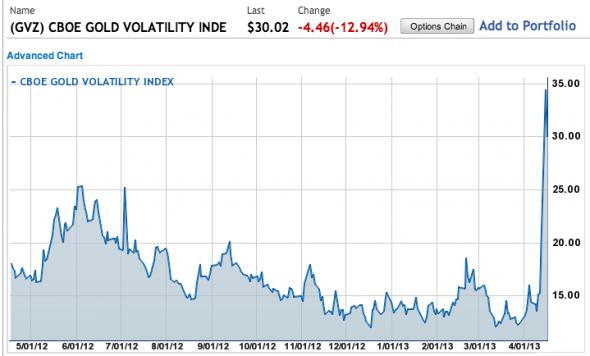
What are you reading? Gold VIX Spike  |
| Monetary Policy: Many Targets, Many Instruments. Where Do We Stand? Posted: 17 Apr 2013 06:30 AM PDT Panel Discussion on “Monetary Policy: Many Targets, Many Instruments. Where Do We Stand?”
Thank you to the International Monetary Fund for allowing me to take part in what I expect will be a very lively discussion.1 Only five or six years ago, there wouldn’t have been a panel on the “many instruments” and “many targets” of monetary policy. Before the financial crisis, the focus was on one policy instrument: the short-term policy interest rate. While central banks did not uniformly rely on a single policy target, many had adopted an “inflation targeting” framework that, as the name implies, gives a certain preeminence to that one objective. Of course, the Federal Reserve has long been a bit of an outlier in this regard, with its explicit dual mandate of price stability and maximum employment. Still, the discussion might not have gone much beyond “one instrument and two targets” if not for the financial crisis and its aftermath, which have presented central banks with great challenges and transformed how we look at this topic. Let me start with a few general observations to get the ball rolling. In terms of the targets, or, more generally, the objectives of policy, I see continuity in the abiding importance of a framework of flexible inflation targeting. By one authoritative account, about 27 countries now operate full-fledged inflation-targeting regimes.2 The United States is not on this list, but the Federal Reserve has embraced most of the key features of flexible inflation targeting: a commitment to promote low and stable inflation over a longer-term horizon, a predictable monetary policy, and clear and transparent communication. The Federal Open Market Committee (FOMC) struggled for years to formulate an inflation goal that would not seem to give preference to price stability over maximum employment. In January 2012, the Committee adopted a “Statement on Longer-Run Goals and Monetary Policy Strategy,” which includes a 2 percent longer-run inflation goal along with numerical estimates of what the Committee views as the longer-run normal rate of unemployment. The statement also makes clear that the FOMC will take a “balanced approach” in seeking to mitigate deviations of inflation from 2 percent and employment from estimates of its maximum sustainable level. I see this language as entirely consistent with modern descriptions of flexible inflation targeting. For the past four years, a major challenge for the Federal Reserve and many other central banks has been how to address persistently high unemployment when the policy rate is at or near the effective lower bound. This troubling situation has naturally and appropriately given rise to extensive discussion about alternative policy frameworks. I have been very keen, however, to retain what I see as the key ingredient of a flexible inflation-targeting framework: clear communication about goals and how central banks intend to achieve them. With respect to the Federal Reserve’s goals, price stability and maximum employment are not only mandated by the Congress, but also easily understandable and widely embraced. Well-anchored inflation expectations have proven to be an immense asset in conducting monetary policy. They’ve helped keep inflation low and stable while monetary policy has been used to help promote a healthy economy. After the onset of the financial crisis, these stable expectations also helped the United States avoid excessive disinflation or even deflation. Of course, many central banks have, in the wake of the crisis, found it challenging to provide appropriate monetary stimulus after their policy interest rate hit the effective lower bound. This is the point where “many instruments” enters the discussion. The main tools for the FOMC have been forward guidance on the future path of the federal funds rate and large-scale asset purchases. The objective of forward guidance is to affect expectations about how long the highly accommodative stance of the policy interest rate will be maintained as conditions improve. By lowering private-sector expectations of the future path of short-term rates, this guidance can reduce longer-term interest rates and also raise asset prices, in turn, stimulating aggregate demand. Absent such forward guidance, the public might expect the federal funds rate to follow a path suggested by past FOMC behavior in “normal times”–for example, the behavior captured by John Taylor’s famous Taylor rule. I am persuaded, however, by the arguments laid out by our panelist Michael Woodford and others suggesting that the policy rate should, under present conditions, be held “lower for longer” than conventional policy rules imply. I see these ideas reflected in the FOMC’s recent policy. Since September 2012, the FOMC has stated that a highly accommodative stance of monetary policy will remain appropriate for a considerable time after the economic recovery strengthens. Since December 2012, the Committee has said it intends to hold the federal funds rate near zero at least until unemployment has declined below 6-1/2 percent, provided that inflation between one and two years ahead is projected to be no more than 1/2 percentage point above the Committee’s 2 percent longer-run goal, and longer-term inflation expectations continue to be well anchored. I believe that the clarity of this commitment to accommodation will itself support spending and employment and help to strengthen the recovery. Asset purchases have complemented our forward guidance, and the many dimensions of different purchase programs arguably constitute “many instruments.” In designing a purchase program, one must consider which assets to buy: Just Treasury securities or agency mortgage-backed securities as well? Which maturities? The Federal Reserve, the Bank of England, and, more recently, the Bank of Japan have emphasized longer-duration securities. At what pace should the securities be purchased? And how long should they be held once purchases cease? Each of these factors may affect the degree of accommodation delivered. Two innovations in the FOMC’s current asset purchase program, for example, are that it is open-ended rather than fixed in size like past programs, and that the overall size of the program is explicitly linked to seeing a substantial improvement in the outlook for the labor market. In these brief remarks, I won’t thoroughly review the benefits or costs of our highly accommodative policies, emphasizing only that I believe they have, on net, provided meaningful support to the recovery. But I do want to spend a moment on one potential cost–financial stability–because this topic returns us to the theme of “many targets” for central banks. As Chairman Bernanke has observed, in the years before the crisis, financial stability became a “junior partner” in the monetary policy process, in contrast with its traditionally larger role. The greater focus on financial stability is probably the largest shift in central bank objectives wrought by the crisis. Some have asked whether the extraordinary accommodation being provided in response to the financial crisis may itself tend to generate new financial stability risks. This is a very important question. To put it in context, let’s remember that the Federal Reserve’s policies are intended to promote a return to prudent risk-taking, reflecting a normalization of credit markets that is essential to a healthy economy. Obviously, risk-taking can go too far. Low interest rates may induce investors to take on too much leverage and reach too aggressively for yield. I don’t see pervasive evidence of rapid credit growth, a marked buildup in leverage, or significant asset bubbles that would threaten financial stability. But there are signs that some parties are reaching for yield, and the Federal Reserve continues to carefully monitor this situation. However, I think most central bankers view monetary policy as a blunt tool for addressing financial stability concerns and many probably share my own strong preference to rely on micro- and macroprudential supervision and regulation as the main line of defense. The Federal Reserve has been working with a number of federal agencies and international bodies since the crisis to implement a broad range of reforms to enhance our monitoring, mitigate systemic risk, and generally improve the resilience of the financial system. Significant work will be needed to implement these reforms, and vulnerabilities still remain. Thus, we are prepared to use any of our many instruments as appropriate to address any stability concerns. Let me conclude by noting that I have touched on only some of the important dimensions of monetary policy targets and instruments that have arisen in recent years. I look forward to a discussion that I expect will explore these issues and perhaps raise others.
1. The views I express here are my own and not necessarily those of my colleagues in the Federal Reserve System. Return to text 2. See Gill Hammond (2012), State of the Art of Inflation Targeting (PDF),  |
| Update: Rotation, Gold and Markets Posted: 17 Apr 2013 04:30 AM PDT A quick note on some of our commentary in April — it has been an interesting month for TBP. On April 9th, I mentioned that the Great Rotation theme was incorrect: It was not stocks into bonds, as is so commonly claimed. Rather, it was a New Great Rotation: Commodities into Bonds. Since then, Bond yields have plummeted and gold has collapsed. Had I followed my own insights and put on a Gold short/Bond Long trade, it would have made some money. Alas, we are investors not traders. This led to a comment asking the question: What Are Gold's Fundamentals ? Most of the Gold investors I see have a flawed understanding of what drives gold prices. That was followed with World's Biggest ETF/Contrarian Indicator: GLD > SPY. As far as contrary indicators go, this was similar to Pimco Total Return Bond Fund surpasses Vanguard S&P500 fund to become the largest mutual fund back in October 2002. We did a few interviews as to why Gold was collapsing, including this one on BNN (Gold country). It is nuanced, and apparently not what people were expecting. This all culminated in yesterday’s 12 Rules of Goldbuggery — which went totally viral.
Back shortly . . .
 |
| Posted: 17 Apr 2013 03:00 AM PDT Click to enlarge
Why do I find this print so amusing? Does it reflect our society’s move towards automation and robotics? The new manufacturing base? HFT? Regardless, my nephew Brad and his partner Erin Schoop have these and others posted at Reddit. In addition to being a software engineer, Brad runs the geek website TechKeys.
 |
| Posted: 17 Apr 2013 02:00 AM PDT With tax day now behind us, its time to start looking forward towards next year filing. Here are the changes going for your taxes:  |



 Centre for Central Banking Studies, CCBS Handbook No. 29 (London: Bank of England).
| You are subscribed to email updates from The Big Picture To stop receiving these emails, you may unsubscribe now. | Email delivery powered by Google |
| Google Inc., 20 West Kinzie, Chicago IL USA 60610 | |



0 comments:
Post a Comment