


The Big Picture |

- All About Infographics
- Bipartisan Report: US Practiced Widespread Torture, Has “No Justification” Doesn’t Yield Significant Information, Nation’s Highest Officials Bear Responsibility
- Friday Night Jazz R&B: Miguel Adorn
- Succinct Summations of Week’s Events (April 19, 2013)
- Home Improvement: How Americans Modernize Their Homes
- Economy: Top 500 Influencers
- 10 Friday AM Reads
- Kotok on Gold
- Ritholtz: Market Bull Run is Not Over (Yet)
- Don’t Bother Reading This Blog Post
- Are Earnings Expectations Realistic?
| Posted: 20 Apr 2013 02:00 AM PDT
by Aditya Dhotre on Apr 13, 2013 What is Infographics? We’re talking about any graphic that displays and explains information, whether that be data or words. When we use the term “data visualization,” we’re using it as a general term used to describe data presented in a visual way. Why Infographics?  |
| Posted: 19 Apr 2013 10:30 PM PDT We Can't Just Look Forward … We Have to Admit What Went WrongYesterday, a bi-partisan panel – co-chaired by the former undersecretary of homeland security under President George W. Bush, former Republican congressman from Arkansas and NRA consultant (Asa Hutchinson) and former Democratic congressman and U.S. ambassador to Mexico (James Jones) – released a 577-page report on torture after 2 years of study. Other luminaries on the panel include:
The panel concluded:
The panel also found:
At a press conference at the National Press Club in Washington, co-chair Hutchinson said:
Retired Brigadier General David Irvine, a former strategic intelligence officer and Army instructor in prisoner interrogation said:
Indeed, top American military and intelligence interrogation experts from both sides of the aisle have conclusively proven the following 10 facts about torture: 1. Torture is not a partisan issue 2. Waterboarding is torture 3. Torture decreases our national security 4. Torture can not break hardened terrorists 5. Torture is not necessary even in a "ticking time bomb" situation 6. The specific type of torture used by the U.S. was never aimed at producing actionable intelligence … but was instead aimed at producing false confessions 7. Torture did not help to get Bin Laden 8. Torture did not provide valuable details regarding 9/11 9. Many innocent people were tortured 10. America still allows torture  |
| Friday Night Jazz R&B: Miguel Adorn Posted: 19 Apr 2013 03:15 PM PDT
He may be that rare young artist who comes along once a decade with the chops, vision, and creative conviction to give you a glimpse of his entire career over 40 years as soon as you hear him sing. For me, that moment was his live version of Adorn on SNL last week. Miguel crushed it the way very few artists ever do. His “raw honey falsetto” is a thing of beauty, painting aural portraits of his loves, heartbreaks and fantasies. I have yet to hear all of Kaleidoscope Dream, but on the strength of this song, plus Sure Thing and Do You, it looks to be worth a throw. (I am unfamiliar with All I Want Is You, and I am curious if any readers know it). ~~~ I don ‘t know what it is with this song, but the whole thing just comes together so well: Adorn: Live on SNL, April 13, 2013  |
| Succinct Summations of Week’s Events (April 19, 2013) Posted: 19 Apr 2013 12:55 PM PDT Succinct Summations week ending April 19, 2013. Positives:
Negatives:
Our Weekly Succinct Summations would not be possible without the help of our caped crusader, the Batman  |
| Home Improvement: How Americans Modernize Their Homes Posted: 19 Apr 2013 11:00 AM PDT click for larger graphic  |
| Posted: 19 Apr 2013 09:00 AM PDT Nifty interactive tool showing the relationships to some of the more popular economics writers, bloggers and Tweeters. There are some notable omissions and dubious rankings — in the real world, I doubt Zero Hedge is more influential than Paul Krugman, nor do I have more sway than Nouriel Roubini — but overall, its an interesting way to depict a structure of how ideas move through social networks.
click for interactive site  |
| Posted: 19 Apr 2013 07:23 AM PDT My morning reads:
What are you reading?
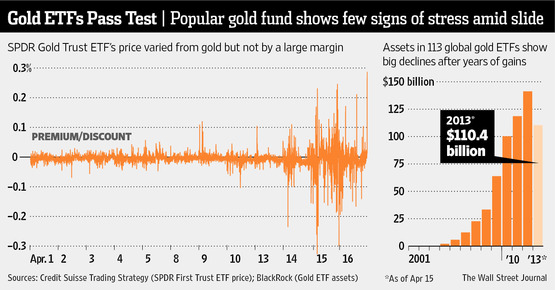
Gold ETFs Shine in Midst of Tumult  |
| Posted: 19 Apr 2013 07:00 AM PDT Gold
G Central bankers prefer to have the public, the investor class, and the holders of institutional wealth believe in the credibility of their central banking skills and their ability to manage their respective currencies. But central bankers miss a critical point. When it comes to gold, the gold bugs argue that gold is money. Simply put, that is not exactly correct. Gold was money 150-200 years, and even centuries, ago. In the US, if you wanted to buy something, you could pay for it with a gold coin. Those days are long gone. I repeat, those days are long gone. But gold still maintains one important characteristic out of the three that we attribute to a functional currency. So let us get to this question of whether or not gold is money. To be money, you have to have the ability to exchange easily in transactions. When you go to the store and pay for something in dollars, those dollars function as money. You can pay in paper currency, write a check, transfer it electronically, or pre-purchase the electronic entry on a piece of plastic that is carried and use it for payment. Money is a way in which payments are conducted. You cannot easily buy something with a bag or bar of gold, not even with a gold coin. There are not many people in the world who will take gold for payment. The payment mechanism of money is conducted in the currencies managed by the central banks, regardless of whether the currency is the dollar, pound, yen, euro, franc, krona, dinar, yuan, peso, or something else. The second characteristic of money is to act as a unit of account, a method of measurement. Open up the income statement of your favorite company. It shows how much revenue, expenses, profits, assets, and liabilities they have in dollars as a unit of account or way of measurement. The same is true all over the world. We use these measurement tools constantly, so money has to provide easy, secure ways of measurement. The problem with money substitutes that fail these two initial tests is that they become subject to volatilities that disrupt their use. Gold is such an item. Bitcoin is another one. Pay for something with bitcoin and how do you know how much you are paying in comparison to the rest of your daily transactions? The third characteristic of money is that it is a "store of value." It supplies an answer to the question, "Where can I safely place my accumulation of wealth, the result of my work effort, the gathering of my savings, –and have it hold its value?" Store of value is very important to gold. Historically, gold, as well as silver and other precious items like diamonds to a lesser extent, has been seen as a place to store value. Gold worked in this regard: it was fungible, it was measurable by weight, and it was the same worldwide; and so it remained for many centuries the traditional place to store value. In the beginning, central banks traded gold and used it as a reserve because it was such a successful store of value. The central banks still retain their attachment to gold, even when they do not want to admit it. Now let us get to the wild volatilities of the gold market in the last few days and weeks. In Europe we have a crisis. The crisis involves Cyprus and its ability to pay. Cyprus is broke. It owes more than it has and more than it can earn. And it is beset by a banking collapse in the midst of all this. Cyprus uses the euro for money like the all other Eurozone members. With the euro, the monetary characteristics needed for transactions and pricing still apply, and so Cyprus now has to lock up part of its money because capital controls have been imposed. Furthermore, Cypriots have been restricted in their ability to take their euros and convert them to another currency such as dollars, yen, or pounds. Lastly, Cyprus has some gold, as do most other countries around the world. The Eurozone colleagues of Cyprus are proposing that Cyprus sell some of its gold. They are very public about it. And the government of Cyprus may have to engage in some negotiation over that gold due to the pressure from its European colleagues. If it does not continue to receive Eurozone assistance, it will not be able to obtain money and make the payments it owes. The Central Bank of Cyprus does not want to sell the gold. It knows it will not get it back. It also knows that if it holds the gold, it will maintain this mystical store of value that is associated with gold. But if it sells the gold, it will not have that store of value. The central bank resists the sale of gold for two reasons: (1) It has a historical basis on which to maintain the reserve of gold, and (2) It knows that it cannot replace its position if it sells. In pressing Cyprus to sell, Europeans have announced to the world that there may be a large seller of gold. World traders in gold and other commodities will quickly jump on that trade. They know that if Cyprus breaks loose with the sale of its gold, countries like Greece, Portugal, and Slovenia may be next. They cannot see buying gold, thereby raising gold's US-dollar-denominated price, in such a circumstance; but they can see selling it short, or otherwise trading it to the downside. Result: gold plummets and there is massive selling. That terrifies the ETF holders and the retail buyers of gold. They pile on the trade, and gold gaps down to an unexpectedly low price. What happens next? First, the European drama around gold has to run its course. That is going to take a while. Second, the terrified retail investors who panicked and sold have to become exhausted sellers. That is happening very quickly, though it is not over. The notion that gold can no longer be trusted as a store of value was clubbed into investors without any preparation. They saw the consistently upward movement of gold prices as confirmation that gold would continue to increase in value. They failed to see that volatilities could be very high in a market that is relatively thin worldwide. Now, disillusioned, they are reacting out of panic. What happens after the retail investors are exhausted and the curtain is drawn on the European gold drama? We believe there will emerge a new set of buyers of gold. They will be emerging-market institutions including central banks whose gold holdings are much lower as a proportion of total reserves than the Europeans have maintained. There will also be some larger purchasers of gold. Here we are going to propose that the Japanese view gold as a new addition to their reserves. Japan has already said it is going to up its reserves. It has already said that it's going to implement highly stimulative monetary policies. It has already launched that program in a very substantial way. Japan is printing yen and buying assets. Simply put, that raises the price of all assets. Now Japan has a problem. It has to negotiate its policy change in a world in which colleagues in other major countries do not like this rapid weakening of the yen against their own currencies. And they do not want the Japanese to directly buy sovereign debt in other countries by converting newly printed yen into another currency and using that currency to buy the government debt of the country in which they have made the conversion. But there is another option for Japan. Japan can print yen and buy gold. If it buys metal instead of a bond issued by a sovereign country, it will raise the price of the metal. It will exchange yen for currencies and diversify its exposure among all of the currencies. It will not be able to be accused of direct interference with the bond markets of other sovereign countries. Nor will Japan be able to be accused of interfering with the Federal Reserve's present policy of buying US dollar-denominated, government-backed debt, or with the policies of the Eurozone's central banks or those of the Bank of England. Furthermore, with central banks and other institutions in Germany, France, the US, India, Russia, and elsewhere continuing to buy gold, Japan is in a position to ask, "Why can't we buy gold, too?" Other emerging-market countries also have gold-buying programs. In our view, we are now likely to see more of them. Our conclusion about gold is this. It is not money in the traditional sense of a currency in which transactions can be made. It does not facilitate payments. It is not a unit of account. We do not print financial statements in terms of ounces or tons of gold. Instead, we use currencies to measure our financial status. Gold does have a historical store of value characteristic. It is held by central banks and institutions as a reserve. They do not want to sell it. On the contrary, many of them want to buy and accumulate it. Therefore, gold's characteristic role with regard to sovereign reserves is still intact, even amid the fascinating evolution of central banking and institutional finance we witness today. Our view about gold as an investment is slightly different from that of a trader. Gold is a long-term investment. We think it should constitute a small portion of a portfolio and be maintained on a continuing basis. It should be a relatively passive investment. Think of it as a type of insurance policy. So we would recommend gold acquisition, for those who are inclined to pursue it, on a very modest level, utilizing a dollar-cost averaging method. Buy a little gold and put it away. Forget the price. Come back again, buy a little more, add to your hoard, and forget the price. Look at gold as an insurance policy that you hope you never need to use. We do believe that abandoning gold completely and disparaging it as a barbarous relic is too extreme. David R. Kotok, Chairman and Chief Investment Officer, Cumberland  |
| Ritholtz: Market Bull Run is Not Over (Yet) Posted: 19 Apr 2013 05:15 AM PDT click for video
More here . . .  |
| Don’t Bother Reading This Blog Post Posted: 19 Apr 2013 04:30 AM PDT
There is nothing to say while we are all transfixed by the live real time manhunt playing out before our eyes.
Back soon . . .  |
| Are Earnings Expectations Realistic? Posted: 19 Apr 2013 02:00 AM PDT Are Earnings Expectations Realistic?
In today's Outside the Box, Sheraz Mian, Director of Research for Zacks Investment Research, gives us a thorough overview of corporate earnings trends for the past several quarters, along with consensus expectations for this year and next. Then he asks, "How realistic are these expectations?" Not very, he says, and proceeds to tell us why. If we accept his analysis – and he admits right up front that it runs counter to the consensus – then we should be asking ourselves, how does a potential falloff in earnings vs. expectations matter, and why is it important at this particular juncture? I'll let Sheraz answer those questions, too – he does so convincingly – but I'll just add that his analysis is a significant piece in the puzzle we're all putting together here in this tipping-point year of 2013. Depending on what the politicians and bureaucrats do, or fail to do, in the US, Europe, and China (not to mention Japan), we could turn one of two corners this year: The left-hand turn – toward ever more QE, ballooning fiscal deficits, and an accelerating global currency war – would take us further up Inflation Hill, whose back side is a sheer cliff. The right-hand turn – toward deepening austerity and unemployment – spirals us down into the Morass of Negative Growth. It is only by forging straight ahead along the Main Street of innovative business and technological development, supported by balanced fiscal and financial policies and realistic market expectations (based on valid data and assumptions – something I have been driving at in my last couple Thoughts from the Frontline letters), that we will get through this challenging decade intact. But that is a difficult path to find between the siren calls of austerity and more printing. Zacks Investment Research was founded in 1978 by Len Zacks, PhD. Many innovations have come from this firm over the years, including the creation of the Earnings Consensus that many investors now use to compare earnings estimates with actual earnings reports. Most notably, Len discovered the predictive power of earnings estimate revisions. He harnessed these benefits into the proprietary Zacks Rank stock rating system that has allowed Zacks Rank to compile an outstanding track record. Zacks is offering OTB readers, at a very low rate, a one-month trial of all their products. You can learn more here. As I write this, I find myself in Singapore, where it is early Wednesday morning, so I have lost a day – but I'll get it back next Friday. I will meet Grant Williams in a few hours, and we will take a train to Malaysia for lunch and discuss the markets and business. Then it's back to Singapore for a little work before enjoying the evening, when Simon Hunt and Steve Diggle will join us for dinner. The next day is meetings with event sponsors Saxo Bank and The Business Times, and then it is Writing Night – a day too early, but deadlines are deadlines, no matter which side of the international date line you are on. Saturday night was rather amazing. I am used to more subdued fundraising events, but Dr. Mike Roizen is one of the senior guys in the Cleveland Clinic, and the Lou Ruvo Center for Brain Health in Vegas is part of the Cleveland Clinic system and is setting all sorts of records. If I or someone I knew had Alzheimer's, I would check it out. I guess if you are Michael Caine and Quincy Jones you can gather a lot of stars (it was their 80th birthday). I was told they raised the second most ever for an event like this. The proceeds go toward research into Alzheimer's and brain injuries/trauma. OK, so Bono walks out on stage unannounced and nails Frank Sinatra. Who knew Bono could do Sinatra? (The hook was, Q produced Sinatra). We were treated to Steve Wonder, Patti Austin, and Shaka Kahn – all of whom still have their chops and look great – Carlos Santana, and on and on. It was good to see people my age (ahem) still going strong on stage. You can watch the whole thing on various cable channels and donate a few dimes with your cell. It really is time to hit the send button. Have a great week. And yes, I know gold went down. That just means I get more coins when I buy at the end of the month – if it will stay down. Your needing to find a gym analyst, John Mauldin, Editor subscribers@mauldineconomics.com Are Earnings Expectations Realistic?By Sheraz Mian, Director of Research, Zacks Investment ResearchWe all know that markets don't always reflect the health of the economy. It is not unusual to experience stellar market returns in an otherwise mediocre economic backdrop – something that investors are currently experiencing. But future success in this investing climate is a greater challenge and requires a good hard look at how realistic earnings expectations are. On March 28, the S&P 500 hit a new all-time closing high and is now on the cusp of surpassing the intraday high set in March 2000. The Dow Jones Industrial Average and a number of market indices comprising small- and mid-cap stocks are already at record levels – all in the midst of a struggling economy. The first-quarter 2013 reporting season about to get into high gear will be the second earnings cycle of the current market rally. The rally got underway last November, but the first two months this year overlapped with the fourth-quarter 2012 earnings season. With corporate earnings generally considered to be the mother's milk of stock prices, the market's positive year-to-date momentum could be safely interpreted as investor satisfaction, if not happiness, with the earnings picture. Past performance matters to the market, but it is far more concerned with what will happen in the future. After all, stock prices reflect expectations about the future. You can think of these future expectations built into the current stock prices as the collective wisdom of all investors. "Consensus" estimates of all the key variables that investors care about – like earnings, revenues, the economy, the Fed, etc. – reflect this "collective wisdom." So, where do current market expectations stand? Earnings growth has been essentially flat over the last three quarters, a trend that current consensus expectations project into the first half of 2013. But the market's "collective wisdom," as reflected by consensus estimates, expects growth to come roaring back in the second half of the year and continue into 2014. My experience leads me to disagree with the consensus. I don't see a return to booming growth panning out this way, and would like to share the basis of my skepticism with you. I am by no means suggesting that an earnings train wreck is on the horizon. Nor am I making a call to exit the market altogether. What I am suggesting instead is that current earnings expectations are vulnerable to significant downward revisions. An acceleration in that negative revisions process will most likely result in the market giving back some, if not all, of its recent gains. You don't have to agree with my conclusions, wholly or partly. In fact, many of my colleagues and I don't see eye to eye on this issue. But nevertheless, it would pay to be a little skeptical of current earnings expectations being touted in the media, and maybe take another look at your portfolio to perhaps reposition it for a period of potential market weakness. The discussion is particularly timely with the 2013 Q1 earnings season about to get underway. Expectations remain low, as they were ahead of the 2012 Q4 earnings season. The Q4 earnings season turned out to be better relative to preseason expectations, and we will likely see a repeat performance in the Q1 earnings season. But that shouldn't lead to overly optimistic expectations for the coming quarters. My goal in this write-up is to give you an update on how the Q4 earnings season turned out, and what recent estimate revisions trends tell us about the future of earnings growth. Evaluating the Q4 Earnings Season By most conventional measures, the Q4 earnings season turned out to be average. Not particularly good, but not bad either. Total earnings for companies in the S&P 500 were up +2% year over, and 65.6% of companies beat earnings expectations with a median surprise of +3%. Total revenues were up +2.6%, with 62% of companies beating top-line expectations and median revenue surprising by +0.6%. Excluding the Finance sector, earnings were barely in the positive category. The table below provides a summary picture of the actual results for 2012 Q4 and consensus expectations for 2013 Q1. Please be mindful of two factors as you read the table below and other earnings data here. First, we have divided the S&P 500 into 16 sectors, compared to the Standard & Poor's official 10 sectors. This gives us a more granular view of sectors like retail, construction, autos, transportation, aerospace, and business services. Second, the earnings data here accounts for employee stock options as a legitimate expense, rather than excluding them, as is the practice on Wall Street. As a result, the earnings numbers and growth rates are relatively lower. Source: Zacks Data. Finance-sector revenue in the fourth quarter got a one-off boost from gains at Prudential Financial (Ticker: PRU). Excluding the Prudential revenue, total Finance-sector and S&P 500 revenue growth would be +11.9% and +2.6%, respectively. The margins column represents the net margins (total net income/total sales). Despite Q4′s average results, the stock market's strong year-to-date performance shows that investors are overall quite happy with them. But why would this be? Simply, the reason is the extremely low levels to which expectations had fallen as the reporting season was getting underway in early January. As you can see in the chart above, consensus expectations in early January were significantly below where they stood in early October. This tells us that the market's favorable response to the Q4 earnings performance was largely a function of how low expectations had fallen between October and January. But how does the Q4 earnings performance compare to other quarters?
Note: The average is of the four quarters preceding 2012 Q4.
Evaluating Expectations for the Coming Quarters Earnings estimates from analysts are heavily influenced by guidance from management teams, particularly on the earnings calls. And while the tone of guidance in Q4 was somewhat less negative relative to what we heard from management teams in Q3, it was nevertheless predominantly weak and tentative. This prompted analysts to cut their estimates for the coming quarters, and particularly Q1. The first table below provides the expected earnings growth rates for the coming quarters, while the second table looks at this year and next. Note: The growth rates are year over year To provide a context for the consensus growth expectations for the coming quarters, the next two tables show the absolute dollar levels of total quarterly and annual earnings (as against the YoY growth rates shown above). Note: The quarterly data is for actual total earnings in the last four quarters and the consensus earnings expectations for the coming four quarters. The annual data shows the actual earnings for the five years through 2012 and the next two years. For example, companies in the S&P 500 earned $238.2 billion in the last quarter of 2012 and $965 billion for the full year 2012. Consensus expectations are for total earnings to come in at $242.3 billion in 2013 Q1 and $1.03 trillion in full-year 2013. What we see from looking at the last few quarters is that total quarterly earnings have yet to get back to the 2012 Q1 peak of $248 billion. Total earnings have basically been trending down over the last three quarters, but consensus expectations are looking for earnings to start trending back up from 2013 Q1 onwards, with the growth pace materially picking up from Q2 onwards. Another way to look at this data is by comparing the consensus expectations for the first half of 2013 with the actual results for the same period in 2012. Expectations are for flat earnings growth in the first half of the year, but a ramp-up in the back half of the year to a growth pace of +9.5%. This growth momentum is expected to carry into 2014, giving us earnings growth of +11.7% that year, after the +6.8% gain in 2013 and the +3.8% growth in 2012. In absolute dollar terms, consensus expectations are for companies in the S&P 500 to earn $1.03 trillion (yes that is a trillion) in 2013 and $1.15 trillion in 2014. In terms of earnings per share, this approximates to $109.88 per "share" of the S&P 500 index in 2013 and $122.72 in 2014. How Realistic Are These Expectations? In my professional opinion, they are not realistic. I don't think these expectations will pan out, and here is why. Earnings increase through two ways: revenue growth and/or margin expansion (margins are basically earnings as a percentage of sales). The outlook on both fronts is problematic. Margins have peaked already and at best can be expected to stabilize around current levels. And you can't have significant revenue growth in the current growth-constrained environment. Another avenue for growth, particularly at the individual company level, is through mergers and acquisitions. While many M&A deals don't end up creating value for the acquiring company's shareholders and don't generate growth at the aggregate level, they do produce growth at the company level. The historical track record of corporate deal making, in terms of aggregate growth and returns, is spotty at best. But management teams are ever ready for a deal, particularly when elevated equity markets provide them with an easy-to-use currency and the credit markets are willing to fund anything, as is the case at present. The expected strong earnings growth in the second half of 2013 and next year reflect a combination of revenue growth and margin gains. Revenue growth has a very strong correlation with (nominal or non-inflation-adjusted) global GDP growth. But economic growth has been very anemic lately, with the rich world's slow-motion deleveraging process casting a dark shadow over the faster-growing emerging world. The US economy is actually in better shape relative to the recession in Europe and Japan's nascent efforts to inflate away its problems. But that's only in relative terms – the reality is that the US economy is at best on a sub-2% growth trajectory. Even that growth pace may be at risk from unfolding fiscal austerity efforts such as the budget sequester and Fiscal Cliff-related tax hikes. But consensus expectations are looking for a second-half 2013 GDP growth ramp-up that pushes the growth pace close to +3%, and even higher next year. With the US economy barely producing any growth in 2012 Q4, it is hard to envision the growth outlook improving to that extent. But current revenue-growth expectations reflect these optimistic assumptions. As the chart below shows, margin gains play a big part in projected earnings growth in the coming quarters. © Note: These are net income margins, meaning total net income for the S&P 500 as a percentage of total sales. The data for the last four quarters and last seven years represents what companies actually reported. Net margins for the next four quarters and two years represent current consensus expectations. Margins have already travelled quite some distance from the 2009 bottom and are essentially in line with the prior cyclical peak. One could argue that margins should move past the prior peak like the stock market; but before we buy into that argument, let's not forget what gave us the 2006/2007 peak in the first place. Without even getting into the details of how the housing bubble back then pumped up everything, one could say with a lot of confidence that those were unusual times and cannot be expected to repeat. Total earnings, on the other hand, are already above the 2007 peak. Margins follow a cyclical pattern. They expand as the economy comes out of a recession and companies use existing resources in labor and capital to drive business. But eventually capacity constraints kick in, forcing companies to spend more for incremental business. At that stage, margins start to contract again. Given the extent of unemployment and under-employment in the US economy, one could reasonably say that we haven't reached those levels. That said, it is hard to envisage companies doing more with less forever. So What Gives? Not only are margins already at record levels, but corporate earnings as a share of GDP are also at multi-decade highs. Just as trees don't grow to the skies, margins and the ratio of earnings to GDP don't expand forever, either. What all of this boils down to is that current earnings estimates are too high and they need to come down – and come down quite a bit. One could reasonably draw a scenario where earnings growth turns negative this year. But the most likely path appears to be for earnings growth to flatten out – with the absolute level earnings this year and next not much different from what we got in 2012. Granted, negative earnings revisions would not be a new phenomenon, as estimates have been coming down for more than a year now. But the market has essentially shrugged off this weakening picture in the hope of an improving earnings outlook for the coming quarters. Importantly, investors have been heartened by the improving outlook for China, a less worrisome European picture, and resolution of some of the domestic macro issues. But the level of calm in the market is bordering on complacence. After all, Europe remains in a recession; and recent Chinese data about PMI, industrial production, retail sales, and inflation show that we can't take a rebound in that country for granted. Importantly, recent talk of changes to the Fed's QE program from within the FOMC are offsetting its effectiveness, Bernanke's assurances notwithstanding. With global tailwinds dissipating, the earnings outlook question becomes far more significant for the market. Unless the domestic and international growth backdrop materially improves from current levels, it is hard to imagine current earnings growth expectations holding up. And as investors wake up to the significantly weaker corporate earnings backdrop over the coming months, it will become harder to justify the market's recent gains, potentially leading to a broad-based pullback. Investing in a Low Earnings Growth Environment The bottom line is that actual earnings growth will be substantially lower than what is currently built into stock prices. This view is contrary to current consensus expectations and could potentially serve as a major headwind for the market once investors begin to share it in coming months. The way to invest in such an environment is to look for stocks that don't reflect aggressive growth expectations and that enjoy company-specific growth drivers not tied to broader macro trends. Companies that generate plenty of cash flows beyond their immediate capital needs and have track records of sharing excess cash with shareholders through dividends and buybacks are particularly well suited for a period of sub-par earnings growth.  |






| You are subscribed to email updates from The Big Picture To stop receiving these emails, you may unsubscribe now. | Email delivery powered by Google |
| Google Inc., 20 West Kinzie, Chicago IL USA 60610 | |



0 comments:
Post a Comment