


The Big Picture |

- Rocky debt-mountain
- Doubling Down On What Caused the Financial Crisis
- Difference Between Bankers & Pirates
- California Housing Still Bouncing Along the Bottom
- On the Move
- Duality: Domestic Jungle Cat
- 10 Weekend Reads
- Ritholtz: Sentiment, Housing, Stock Market Rally
- Fusion Research – Equity Market Review for April 5th 2013
- Someone Reached Way Down Into The Archives To Retrieve These Pictures
| Posted: 07 Apr 2013 01:00 AM PDT Americans and Britons have pared back their levels of debt, but in Canada it has grown
Source: Economist  |
| Doubling Down On What Caused the Financial Crisis Posted: 06 Apr 2013 10:30 PM PDT Big Banks and D.C. Politicians Doing the EXACT SAME THINGS Which Caused the Financial Crisis In the First Place — Instead of Changing their Behavior to Prevent Another Crisis, the Powers-That-Be Double Down On the Strategies that Caused the Financial Crisis In the First Place
Liberals blame deregulation and reckless Wall Street greed for the economic crisis. Conservatives blame bad government policy. Now, the D.C. politicians are doing the exact same things which got us into the crisis in the first place. For example, they are:
And the big banks and financial institutions are engaging in the same risky behavior which got us into the crisis in the first place. For example, they are:
What could possibly go wrong?  |
| Difference Between Bankers & Pirates Posted: 06 Apr 2013 04:00 PM PDT  |
| California Housing Still Bouncing Along the Bottom Posted: 06 Apr 2013 01:00 PM PDT CA Housing…"Bouncing Along the Bottom" for FIVE YEARS
Major housing market headwinds create flat to negative 2013 rates of change. Market forecasts and sector stock multiples are forecasting sales, price and home improvement gains similar to what we saw in 2012 YoY. This will not occur. Summary: Following nearly 20 years of an unprecedented housing sector and mortgage credit expansion/bubble that resulted in the greatest housing and mortgage credit collapse in history one must be particularly optimistic or ignorant — or both — to think that 2012 was "the" durable bottom. Especially when: 1) the Homebuyer tax credit of 2009/10 also created a "short squeeze" in the housing sector that everybody thought was a "durable bottom"; 2) at least 50% of all mortgage'd homeowners coast to coast are Zombies…dead to the housing market equation — unable to freely sell and rebuy – due to negative equity; "effective" negative equity (not enough equity to pay a Realtor 5% and put 10% to 20% down on a new house); or insufficient income or credit needed for a mortgage; 3) banks and the gov't have turned up to 8 million legacy distressed borrowers into underwater renters of their own houses by the use of new-vintage, higher-leverage, worse-than-Subprime loans (aka Mortgage Mods) that redefault at about the same clip as legacy Subprime loans defaulted from in the first place; 4) thin and more transitory demand cohorts — the first-timer and institutional/private 'buy and rent' speculator "investor" – make up half housing demand; 5) and repeat buyers — historically housings' primary demand AND supply cohort — remain structurally unable to carry the sector until significant legacy first and second lien de-leveraging occurs. As such, the CA housing data for February presented as follows highlight why calling "the bottom" is a risky (and early) proposition. I will agree the 2012 "bottom" (and 2010 "bottom") are all part of a "bottoming process". But so was the Homebuyer Tax Credit stimulus "hangover" of 2011 and the much larger Twist hangover that will grip housing in 2013/14.
CA Feb Home Sales…FLAT for 5-straight years. YoY rate of change now flat to negative. The first negative MoM and YoY print since 2008. Bottom line: Beginning in Q3 2011 and continuing through late 2012 housing & finance enjoyed YoY comparables against very weak housing market activity — the severe hangover created by the perma- Homebuyer Tax Credit stimulus that sunsetted in mid-2010 – while at the exact same time being injected with the greatest rates jet fuel stimulus in the history of the known universe a la Twist. On the supply side, bank portfolio mortgage modifications — ultimate in legacy loan high-risk can-kicking that leaves homeowners as over-levered, underwater renters of their own house – surged to several million units.
Post-Crash Stimulus and Hangover Cycle Backgrounder The 2012 Spring/Summer peak-season YoY "hangover to jet fuel" stimulus imbalance created the 'appearance' of much stronger market activity than was really occurring. But most importantly, it made for a sharply positive rate-of-change in the deeply cyclical housing market that analysts' could extrapolate forward at the same pace every year for a decade into the future making for a situation in which fundamental analysis and PE ratios are thrown out the window. But if all of a sudden data begin to show that the house sales volume and pricing rate of change has flattened, or worse turned negative (happening now in key leading indicator markets around the nation), then the high-flyer names in this sector will have a bad year one month. Remember back a few years…this exact same happened. A YoY massive stimulus imbalance occurred beginning mid-2009 through mid-2010 on the Homebuyer Tax Credit. There were "lines down the street making multiple offers", the Case-Shiller went positive YoY for several months in a row, and consensus shifted to a "full-blown housing market recovery with escape velocity". Nobody even wanted to hear when 'some' cited major pulled-forward demand occurring especially in the first-time buyer cohort. Bulls called the tax credit "de minimis"; we called it "the first, best, and last chance millions of homebuyers will have to buy a house" with nothing down on an FHA loan when monetizing the credit, which was allowed in 38 states for FHA lending purposes. In short, the month after the tax-credit sunsetted in mid-2010 house sales volume fell 30% MoM and the first major "stimulus hangover" was born. This hangover lasted until rates fell the most in history over the shortest time period ever — rates down 30% in Q3 2011 — in anticipation of Twist. Yes, the Twist-induced 30% drop in mortgage rates and historic low UST yields have been a much more powerful and long lasting stimulus than the Homebuyer Tax Credits. And this is being reflected in the numbers. But at the end of the day, "the greater the stimulus the greater the hangover that follows" and the Tax Credit gave us a great look at that. And now — after a year and a half of the "Twist effect in full force – rates are up, investor and first timer demand cohorts are burning out, and repeat buyers are only slightly less structurally imprisoned. But obviously, sentiment is much better. It certainly will be interesting to see how many houses Mr Sentiment can buy at 10% over ask/appraised value — at 1% to 3% rental cap rates — vs last year.
The CA Feb Housing Data…What "Durable Recovery with Escape Velocity"? I see a market bouncing along the bottom, muddling through. The data in this report fly in the face of loudest drumbeat of one-way consensus opinion and hyperbole since David Lereah was pounding the table on CNBC several times a month from 2006 to 2007 telling everybody there was "nothing to see here" and inciting short squeezes in doomed stocks that would blow your account apart. Highlights… - First double drop…lower MoM and YoY — sales volume since 2008 - First Feb MoM CA sales volume drop since 2008 - First Feb YoY drop in 2 years - Only the 2nd YoY drop (of any month) since July 2011 - Largest YoY drop (-3.1%) since 2010 - Mix-Shift no longer a tailwind - "Median" house prices back to Sept levels — down 4% – after peaking for this cycle in Dec (odd month to peak but housing went straight until Dec on the "mix-shift effect")
1) Feb CA House Sales – FLAT for 5-years. Still "bouncing along the bottom". If one were to look at the chart below knowing nothing about the US housing condition they would definitely say "the market crashed, bounced, and has been bouncing along the bottom for 5 years". But that's not what consensus believes or what is priced into sector stocks…far from it.
2) Feb Total House Sales (blue) vs. Distressed (red) vs. Organic (green) Total house sales bouncing along the bottom (blue), distressed is plunging (red) artificially, and organic (green) is increasing; the latter a certain positive on a relative basis. Then again, organic sales down 57% from 2005 is a testament to just how structurally damaged this housing market really is and how the only cure for it is lots and lots of years of de-leveraging. On a YoY basis organic sales look great…but on an absolute basis the number is horrifying. Bottom line: After almost 6-years of ZIRP, 4-years of QE, and 3 years of blowing a mortgage mod bubble larger in size than the entire pool of Subprime loans in existence in 2007 organic sales remain down 57% from 2005. This highlights – in Zombie color – the structural chaos from 60%+ mortgage'd homeowners in the state of CA either underwater, "effectively" underwater, or lacking the credit or income needed to get a mortgage loan…and how much de-leveraging still needs to occur. The menacing problem here is that organics lack the firepower to really ratchet up demand. Thus, when investors and first-timers go away — the hangover begins — support for this housing market will be far thinner than it ever has before. another look at CA Feb organic sales by itself. On a YoY basis this chart is great. But on an absolute basis it is horrifying. When looking at this chart on an absolute basis the structural damage is obvious. I see a CA housing market in which 450k houses transact per year up only 8k house sales per month from the worst February on record. This is still down 57% from 2005. Or viewed another way, a Feb organic sales number only 1,100 sales greater than the past 5 year average of organic sales.
3) House Prices…Mix-Shift is no longer a tailwind; in 2013 mix-shift turns into "mix-shaft". Median house prices are highly influenced by the "mix-shift" as shown in the chart below. The correlation is perfection. But now with foreclosures at an (artificial) pre-crisis low due to the mortgage mod bubble and foreclosure outlawing the "mix-shift" is no longer a tailwind. In fact, due to "investor" burning out — on the verge of becoming a headline story on rental price cutting wars and far lower cap rates than any had modeled — the days of bidding 10% to 20% over appraised value looking solely at the yield are ending quickly. This headwind will have significant consequences for house prices.
4) A look at CA Feb house prices back to 2005. Yes, the 2013 YoY jump in median prices is impressive but the absolute level not so much. It always very important to keep housing analysis in the context of "post-crash" in order to seek out trends. The price increase shown below is almost exclusively due to three "transitory" factors… 1) a 15% increase in purchasing power by individuals using a mortgage due to Twist. 2) New-era Wall Street landlord investors deploying other people's money without any regard for "list price" or "appraised value". 3) Banks and the gov't originating 8 million new-vintage, higher-leverage, worse-than-Subprime loans in the past 3 years in order to abate foreclosures. Bottom line: Unless rates drop below the level of last year, households get a huge tailwind of income or lower taxes/expenses, new-era investors get comfortable with sub 3% rental cap rates, or we get a swift wave of immigration from those will pockets full of cash then the next step for CA median house prices is retracement.
Work ups of other "recovery" regions such as Arizona and Nevada look eerily similar.  |
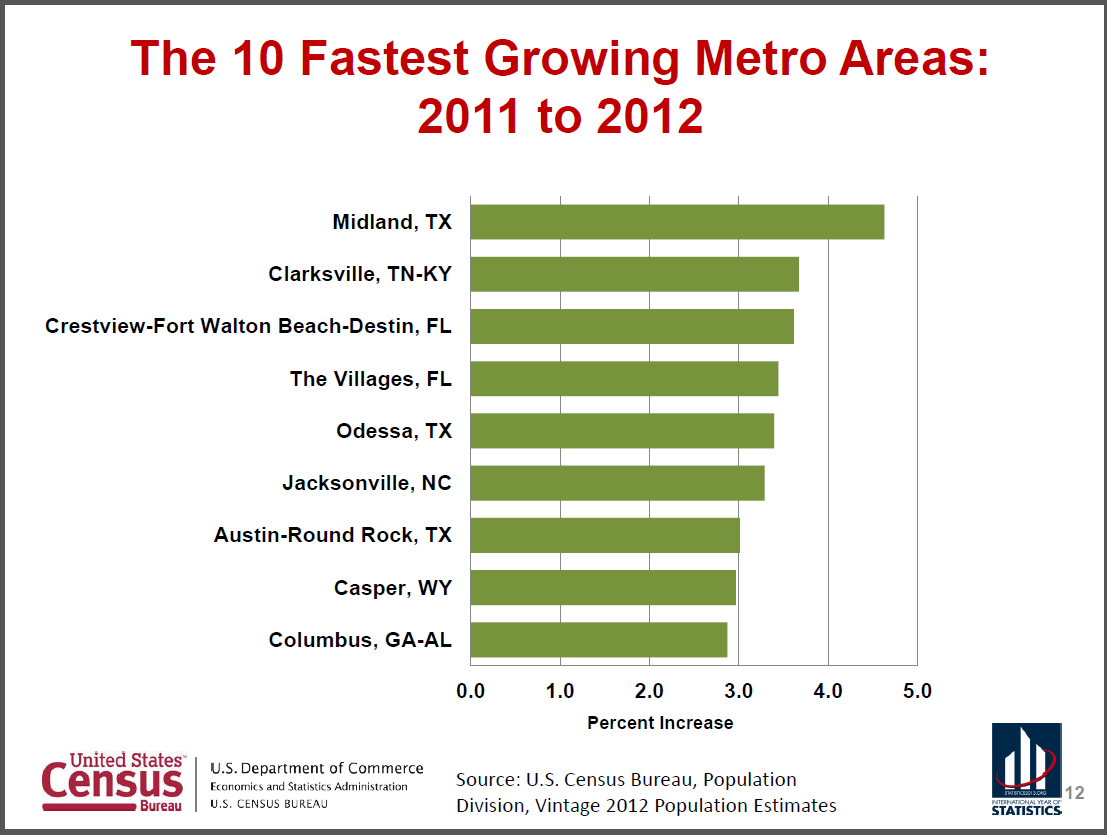
| Posted: 06 Apr 2013 09:00 AM PDT @ Following up on my recent post on Correlation & Causation 101, I delved into various migratory and population estimate datasets at Census.gov. Fascinating stuff. [Note to self: Get a life.] As promised, I also called and corresponded with a contact at Census to be 100 percent certain my criticism of Mr. Moore and Mr. Laffer was well-founded. It was. That said, I also came upon some neat infographics from Atlas Van Lines - a company that probably moves as many Americans (and Canadians, apparently) as any other. Here’s their infographic on 2012 Household Moving Migration Patterns. Also, here’s an older link to the reasons we move (based on the exact Census data I wound up digging into that I’m sure Moore and Laffer ignored).
Back for a moment to Mssrs. Laffer and Moore, who cited Census as their source for this claim: “Among the 10 fastest-growing metro areas last year were Raleigh, Austin, Las Vegas, Orlando, Charlotte, Phoenix, Houston, San Antonio and Dallas.”
Census says otherwise. Moore and Laffer got one right; even the folks I contacted at Census had no idea WTF they were talking about. Draw your own conclusions.  |
| Posted: 06 Apr 2013 08:30 AM PDT |
| Posted: 06 Apr 2013 04:30 AM PDT My long form weekend reading — pour a cup of coffee, and enjoy:
Whats for brunch?
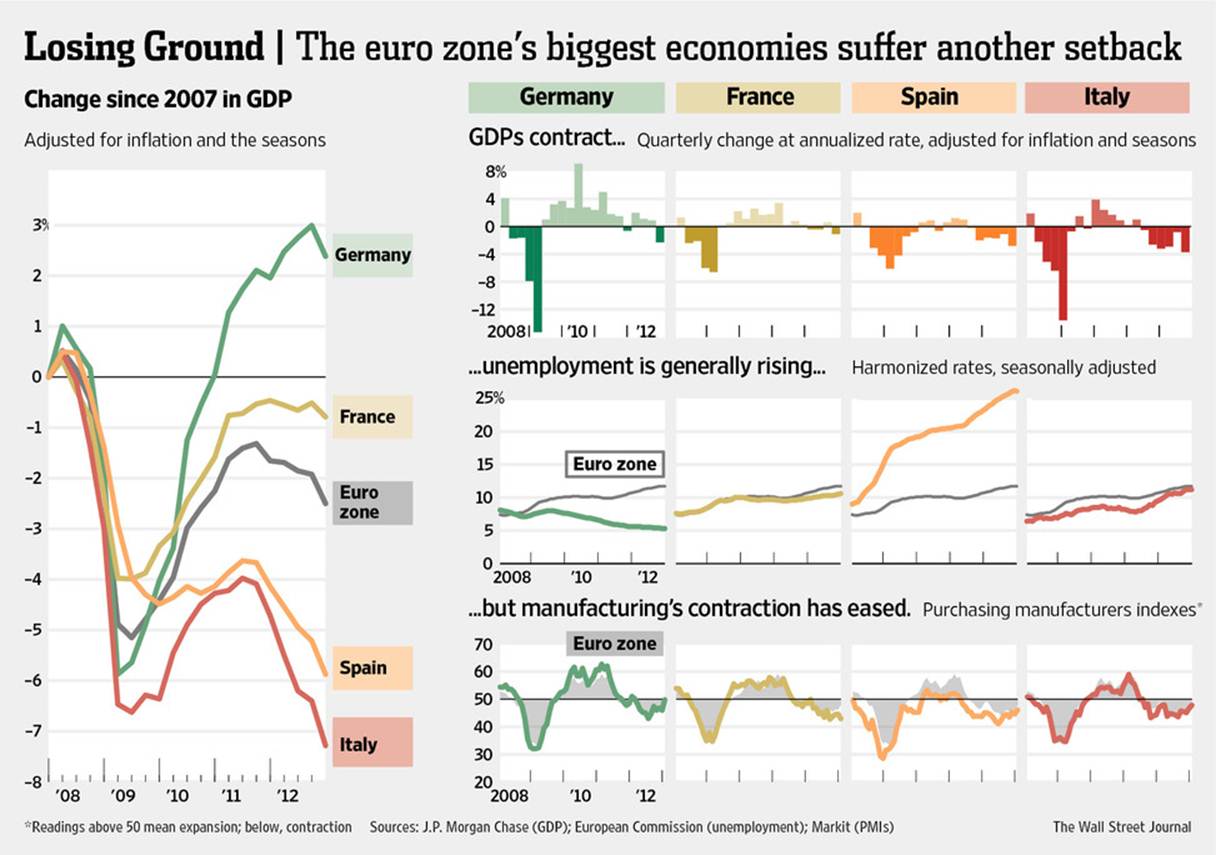
Europe Woes Deepen as Economies Contract  |
| Ritholtz: Sentiment, Housing, Stock Market Rally Posted: 06 Apr 2013 03:00 AM PDT Barry Ritholtz, chief executive officer of FusionIQ, talks about the performance of the U.S. stock market. Ritholtz, Ed Pinto, a resident fellow at the American Enterprise Institute, and Tim Rood, managing director at Collingwood Group LLC, also discuss Fannie Mae’s 2012 profit. They speak with Trish Regan and Adam Johnson on Bloomberg Television’s “Street Smart.” Ritholtz, Pinto, Rood on Stocks, Fannie Mae Profit if video does not load, click here ~~~ Fusion IQ’s Barry Ritholtz, AEI Resident Fellow Edward Pinto, The Collingwood Group’s Tim Rood and Bloomberg’s Peter Cook discuss the problem with Fannnie Mae’s large profit. They speak on Bloomberg Television’s “Street Smart.” Fannie Mae’s Big Comeback Story if video does not load, click here ~~~ On today’s “Chart Attack,” Fusion IQ’s Barry Ritholtz and Bloomberg’s Adam Johnson look at bearishness in the stock markets. They speak on Bloomberg Television’s “Street Smart.” How Bullish and Bearish Are Market Strategists? if video does not load, click here ~~~ Wells Fargo’s Ron Florance, Fusion IQ’s Barry Ritholtz and United Futures Trading’s Gary Kozlowski discuss the outlook for U.S. stocks on Bloomberg Television’s “Street Smart.” Is the Stock Market Unstoppable at This Point? if video does not load, click here  |
| Fusion Research – Equity Market Review for April 5th 2013 Posted: 06 Apr 2013 02:00 AM PDT Summary: Subtly market internals continue to slip underneath the surface. Additionally, high beta and other "risk on" barometers continue to underperform "risk off" benchmarks such as, utilities, consumer staples and healthcare. Typically, when these two events occur it is a precursor to a corrective wave. Add in seasonal trends, which tend to turn negative as we approach May, and clearly the odds favor a correction as opposed to a continued rally. Please open attached pdf for more comments and charts. Best.  |
| Someone Reached Way Down Into The Archives To Retrieve These Pictures Posted: 06 Apr 2013 01:00 AM PDT Click to enlarge
 |






| You are subscribed to email updates from The Big Picture To stop receiving these emails, you may unsubscribe now. | Email delivery powered by Google |
| Google Inc., 20 West Kinzie, Chicago IL USA 60610 | |



0 comments:
Post a Comment