


The Big Picture |
- Rockonomics
- Succinct Summation of Week’s Events (June 14, 2013)
- Fun Finance Trivia
- Dormant Inflation Seen Giving Fed Time to Wait
- 10 Friday AM Reads
- Possible versus Probable
- QOTD: The Market Giveth . . .
- The Age of Fraud
- Equity Market Review for June 13 2013
| Posted: 15 Jun 2013 02:00 AM PDT Rock and Roll, Economics, and Rebuilding the Middle Class
Today, at 7:00 pm EST, Chairman of the Council of Economic Advisers Alan Krueger will deliver remarks on income inequality and rebuilding the middle class at the Rock and Roll Hall of Fame. As he’ll discuss this evening, using rock and roll industry as a example is one of the best ways to explain economics — many of the forces that are buffeting the U.S. economy can be understood in the context of the music industry. Tune in right here at 7:00 pm EST to watch a livestream of the speech, titled “Land of Hope and Dreams: Rock and Roll, Economics, and Rebuilding the Middle Class.” (You can also watch here.)
Read the remarks as prepared for delivery below.
Land of Hope and Dreams: Rock and Roll, Economics, and Rebuilding the Middle ClassAlan B. Krueger, Chairman, Council of Economic Advisers Thank you very much for your kind introduction. I have always felt that this is a magnificent museum, one of the few in the world that brings people of all backgrounds together, young and old, rich and poor – there is something here for everyone to marvel at. Particularly at a time when economic forces have been chipping away at the middle class for decades, I think it is essential to have institutions like the Rock and Roll Hall of Fame that can bring people together, and remind us that we are one nation, united by our hopes and dreams. I gave this talk the title, "Land of Hope and Dreams: Rock and Roll, Economics and Rebuilding the Middle Class" because many of the forces that are buffeting the U.S. economy can be understood in the context of the music industry. I have also learned from 25 years of teaching that the best way to explain economics is through the example of the rock 'n roll industry. The music industry is a microcosm of what is happening in the U.S. economy at large. We are increasingly becoming a "winner-take-all economy," a phenomenon that the music industry has long experienced. Over recent decades, technological change, globalization and an erosion of the institutions and practices that support shared prosperity in the U.S. have put the middle class under increasing stress. The lucky and the talented – and it is often hard to tell the difference – have been doing better and better, while the vast majority has struggled to keep up. These same forces are affecting the music industry. Indeed, the music industry is an extreme example of a "super star economy," in which a small number of artists take home the lion's share of income. The music industry has undergone a profound shift over the last 30 years. The price of the average concert ticket increased by nearly 400% from 1981 to 2012, much faster than the 150% rise in overall consumer price inflation. And prices for the best seats for the best performers have increased even faster. At the same time, the share of concert revenue taken home by the top 1% of performers has more than doubled, rising from 26 percent in 1982 to 56 percent in 2003. The top 5 percent take home almost 90 percent of all concert revenues. This is an extreme version of what has happened to the U.S. income distribution as a whole. The top 1% of families doubled their share of income from 1979 to 2011. In 1979, the top 1% took home 10 percent of national income, and in 2011 they took home 20%. By this measure, incomes in the entire U.S. economy today are almost as skewed as they were in the rock 'n roll industry when Bruce Springsteen cut "Born in the U.S.A." In my talk, I will focus on why these dramatic changes are taking place and explore their consequences. I will also describe President Obama's vision for providing more opportunities for middle class families and those struggling to get into the middle class. I should be clear about my overall theme: while the U.S. economy is recovering from the worst financial and economic crisis since the Great Depression, we must also take steps to strengthen the middle class and provide more opportunities for those born to less fortunate circumstances. If we don't, we will fail to live up to our promise as a Nation and be susceptible to the kinds of forces that created economic instability in the past. To rebuild the economy from the middle out, the private sector will have to step up and reinvigorate the norms and institutions that have supported inclusive growth in the past. The government has an important role to play as well, but with severe budget constraints and limited political will, the government can only set the conditions for the private sector to grow, and provide more jobs and opportunities for middle class families. It is, to a considerable extent, up to private sector businesses, organizations and communities to ensure that economic growth leads to widely shared prosperity and a decent living for the vast majority of our people. Let me start with the economics of the music industry, and then turn to the economy at large. Rockonomics I want to highlight four factors that are important in generating a superstar economy. These are technology, scale, luck and an erosion of social norms that compress prices and incomes. All of these factors are affecting the music industry. The idea of a "super star economy" is very old. It goes back to Alfred Marshall, the father of modern microeconomics. In the late 1800s, Marshall was trying to explain why some exceptional businessmen amassed great fortunes while the incomes of ordinary artisans and others fell. He concluded that changes in communications technology allowed "a man exceptionally favored by genius and good luck" to command "undertakings vaster, and extending over a wider area, than ever before." Ironically, his example of a profession where the best performers were unable to achieve such super star status was music. Marshall wrote, "so long as the number of persons who can be reached by a human voice is strictly limited, it is not very likely that any singer will make an advance on the £10,000 said to have been earned in a season by Mrs. Billington at the beginning of the last century, nearly as great [an increase] as that which the business leaders of the present generation have made on those of the last." Elizabeth Billington reputedly was a great soprano with a strong voice, but she did not have access to a microphone or amplifier in 1798, let alone to MTV, CDs, iTunes, and Pandora. She could only reach a small audience. This limited her ability to dominate the market. Modern economists have elaborated on Alfred Marshall's insights. The economist Sherwin Rosen developed a theoretical model in which super star effects are driven by "imperfect substitution" and "scale" in production. Simply put, imperfect substitution means that you would rather listen to one song by your favorite singer than a song and a half by someone else. Or, in another context, it means that if you need to have heart surgery, you would rather have the best surgeon in Cleveland perform it rather than the second and third best together. Scale means that one performer can reach a large audience. Technological changes through the centuries have long made the music industry a super star industry. Advances over time including amplification, radio, records, 8-tracks, music videos, CDs, iPods, etc., have made it possible for the best performers to reach an ever wider audiencewith high fidelity. And the increasing globalization of the world economy has vastly increased the reach and notoriety of the most popular performers. They literally can be heard on a worldwide stage. But advances in technology have also had an unexpected effect. Recorded music has become cheap to replicate and distribute, and it is difficult to police unauthorized reproductions. This has cut into the revenue stream of the best performers, and caused them to raise their prices for live performances. My research suggests that this is the primary reason why concert prices have risen so much since the late 1990s. In this spirit, David Bowie once predicted that "music itself is going to become like running water or electricity," and, that as a result, artists should "be prepared for doing a lot of touring because that's really the only unique situation that's going to be left." While concerts used to be a loss leader to sell albums, today concerts are a profit center. But there are limits to how much artists can charge their fans for concert tickets because of social pressures. Most people do not want to think of their favorite singer as greedy. There are a lot of great singers to choose from. Would you rather listen to a singer who is committed to social causes you identify with, or one who is only in it for the money? Part of what you are buying when you buy a recording or concert ticket is the image of the performers. The image and the music are intrinsically linked. Some of our greatest artists have also been great champions of important social and economic causes, including George Harrison, Joan Baez and Bono. If artists charge too much for their tickets, they risk losing their appeal. In this sense, the market for rock 'n roll music is different from the market for commodities, or stocks and bonds. Considerations of fair treatment exert pressure on how much musicians can charge, even superstars. Along these lines, one of my favorite performers, Tom Petty, once said, "I don't see how carving out the best seats and charging a lot more for them has anything to do with rock & roll." And artists like Garth Brooks and, more recently, Kid Rock have made a point of charging a low price for all of the seats in the house when they perform. In fact, the best seats for the hottest concerts have historically been underpriced. This is a major reason why there is a market for scalped tickets. But many artists have been reluctant to raise prices to what the market will bear for fear of garnering a reputation of gouging their fans. They also protest when tickets sell for a higher price on the secondary market, and often try to prevent the secondary market entirely. And it is considered scandalous when performers sell tickets on the secondary market themselves. This behavior can only be explained in light of fairness considerations. Singers want to be viewed as treating their fans fairly, rather than charging them what supply and demand dictate. Indeed, you can think of market demand as depending on the perception of fairness. In many respects, concerts could be thought of as a giant block party instead of a traditional market. While it is socially appropriate to charge neighbors some fee for coming to a block party to pay for the provisions, it is inappropriate to charge them enough to make a hefty profit. There is a compact that fans come and bring their enthusiasm and support for the band, and the band charges a reasonable price and puts on a good show. Now, as inequality has increased in society in general, norms of fairness have been under pressure and have evolved. Prices have risen for the best seats at the hottest shows – and made it possible for the best artists to make over $100 million for one tour – but this has come with a backlash from many fans who feel that rock 'n roll is straying from its roots. And this is a risk to the entire industry. Let me next turn to the role of luck. I said "best artists," but I also could have added luckiest artists. Luck plays a major role in the rock 'n roll industry. Success is hard to judge ahead of time, and definitely not guaranteed, even for the best performers. Tastes are fickle, and herd behavior often takes over. Even the experts, with much at stake, have difficulty picking winners. Columbia Records turned down Elvis Presley in 1955 and the Beatles in 1963. They turned down Bob Dylan in 1963, and almost rejected "Like a Rolling Stone" in 1965, which was later named the greatest rock 'n roll song ever by Rolling Stone magazine. Or consider Sixto Rodriguez, the subject of the documentary movie Searching for Sugar Man. Rodriguez recorded two-and-a-half albums from 1970 to 1975, which were commercial flops. But he was a huge success in South Africa, and his music became the battle hymn of the anti-Apartheid movement. And – amazingly – he was unaware of his fame and influence. Both good and bad luck play a huge role in the rock 'n roll industry. And the impact of luck is amplified in a superstar economy. This was clearly demonstrated in a fascinating experiment conducted by the sociologists Matt Salganik and Duncan Watts. With the musicians' permission, the researchers posted 48 songs in an online music library. Subjects were invited to log on to the library and sample the songs, with the opportunity to download the songs for free. Participants could see the list of songs, ranked by the number of times each one had been downloaded up to that point. They could also see the exact download counts, so they were aware of the popularity of each song based on the collective opinions of other participants. From there, the subjects could click on a song to play it, and then were given the option to download the song for free. For the first 750 participants, the researchers faithfully tallied and displayed the number of downloads. However, the subsequent 6,000 participants were randomly – and unknowingly – assigned to one of two alternative universes. In one universe, they continued to see the true download counts. For the other participants, the researchers deviously created an alternative universe where the download counts had been flipped, so that the 48th song was listed as the most popular song, the 47th song was listed as the number two song, and so on. After this one-time inversion in the ranking, the researchers let the download tallies grow on their own. They wanted to see if the cream would rise to the top, or if the boost in ranking that the worst song received would lead it to become popular. Here's what happened in the world where the download counts were presented accurately. By the end of the experiment, the top song ("She Said" by Parker Theory) had been downloaded over 500 times, while the least popular song ("Florence" by Post Break Tragedy) had been downloaded just 29 times – so the natural outcome of the experiment was that the most popular song was nearly 20 times more popular than the least popular song. Now let's see what happened when the download counts were flipped, so that the new participants thought the least popular song was actually the most popular. As you can see, the download count for the least popular song grew much more quickly when it was artificially placed at the top of the list. And the download count for the most popular song grew much more slowly when it was artificially placed at the bottom of the list. In the alternative world that began with the true rankings reversed, the least popular song did surprisingly well, and, in fact, held onto its artificially bestowed top ranking. The most popular song rose in the rankings, so fundamental quality did have some effect. But, overall – across all 48 songs – the final ranking from the experiment that began with the reversed popularity ordering bore absolutely no relationship to the final ranking from the experiment that began with the true ordering. This demonstrates that the belief that a song is popular has a profound effect on its popularity, even if it wasn't truly popular to start with. A more general lesson is that, in addition to talent, arbitrary factors can lead to success or failure, like whether another band happens to release a more popular song than your band at the same time. The difference between a Sugar Man, a Dylan and a Post Break Tragedy depends a lot more on luck than is commonly acknowledged. Decent Wages Let me next turn to the economy more generally. The same forces of technology, scale, luck and the erosion of social pressures for fairness that are making rock 'n roll more of a superstar industry also are causing the U.S. economy to become more of a winner-take-all affair. The effects of technological change and globalization on inequality have been well documented in the past. It is abundantly clear that computer and information technology has revolutionized the way work is done in the U.S. In 1984, less than a quarter of workers directly used a computer on their job. Today, nearly two thirds of workers directly touch a keyboard at work, and millions of others have had their jobs altered by embedded computers and information technology. Computer and information technology has reduced the demand for jobs that can be routinized, and increased the demand for highly educated workers who can use the technology to increase their productivity The U.S. economy has also become much more integrated with the world economy in recent decades. While exports and imports made up only 11 percent of GDP in 1970, they made up 31 percent last year. You see signs of globalization everywhere: for example, American bands tour much more internationally today than they used to. A more globally connected economy increases the reach of successful entrepreneurs and artists, but also brings many more low-wage workers into competition with our workforce. These developments have contributed to some of the momentous changes we have seen in the U.S. economy. This chart shows the share of total income going to the top 1% of families starting in 1920. During the Roaring '20s inequality was very high, with the top 1% taking in nearly 20% of total income. This remained the case until World War II. Price and wage controls and the patriotic spirit that "we're all in it together" during World War II caused inequality to fall. Interestingly, the compression in income gaps brought about by World War II persisted through the 1950s, 1960s and 1970s. Beginning in the 1980s, however, inequality rose significantly in the U.S., with the share of income accruing to the top 1% rising to heights last seen in the Roaring '20s. After World War II, a social compact ensured that workers received a fair share of the gains of economic growth. This was enforced by labor unions, progressive taxation, a minimum wage that increased in value, anti-discrimination legislation and expanding educational opportunities. This social compact was good for business and good for the economy. But the social compact began to fray in the 1980s. You can see from the following chart that wages of production and nonsupervisory workers moved pretty much in lockstep with productivity until the late 1970s. Since the 1980s, however, labor compensation has failed to keep pace with productivity growth, and this has put stress on middle class workers. The next two charts show what has happened to income growth in other parts of the distribution.The charts show average annual income growth for families broken down to whether they are in the poorest fifth, second poorest fifth, and so on. First look at the post-war period through 1979. All segments grew together. But since 1979, the top has done better than the middle – which has barely grown over three decades – and those in the bottom have done even worse, with real income declining. An astonishing 84 percent of total income growth from 1979 to 2011 went to the top 1 percent of families, and more than 100 percent of it from 2000 to 2007 went to the top 1 percent. These trends are driven by a pulling apart of wages, with much faster wage growth for the highest income earners over the last three decades, and wages barely keeping pace with inflation or falling behind for everyone else. Now the forces that brought about these changes were not unique to the U.S., but they have had a more dramatic effect in the U.S. Consider the following chart again with other countries added. Inequality has followed a broadly similar trend in the U.K., France and Sweden, for example. But notice that the level of inequality varies considerably across these countries, and the rise in the share going to the top 1% varies considerably as well. In Sweden, for example, the share of income brought home by the top 1% rose just 3 percentage points, from 4% in 1980 to 7% in 2011, while in the U.S. it doubled from 10% to 20%. The widely differing responses to globalization and technological change suggest that other factors mediate these forces. This brings me to discuss the role of luck, education and institutions that ensure that prosperity is broadly shared. Globalization and technological change have increased the payoff to completing more education. Countries that have expanded access to education have weathered the polarizing effects of technological change and globalization to a better extent. To demonstrate the economic benefit of education, I'll describe a study that a colleague and I conducted not very far from here, in Twinsburg, OH. For four summers in a row in the 1990s, we went to the Twins Days Festival in Twinsburg. We interviewed identical twins about their education and their incomes. We were particularly interested in knowing whether a twin who had more education than his sibling also had higher income. The following graph shows the difference in wage rates and years of education between pairs of twins. You can see that, on average, twins with higher education tend to earn more than their other half with less education. On average, we find that completing four more years of education is associated with 60 percent higher wages. This and other studies demonstrate that education has a high payoff, on average. But, as we saw in the rock 'n roll industry, luck also matters. Consider identical twins with the same level of education. They were raised by the same family, under the same roof, and typically were dressed alike and went to the same school. They are as alike as two peas in a pod. Yet in most cases they have very different economic outcomes as adults. Earnings differed by 25% or more for pairs of identical twins in half of our sample. And earnings differed by more than 50% in a quarter of identical twins with identical school levels. These discrepancies for such similar workers suggest that luck is an important factor in the labor market, as well as in the music industry. As in the music industry, the effect of luck is amplified in a winner-take-all economy. Consider the pay of CEO's. The pay of top executives relative to their workers has soared since the 1980s. In 1965 the average CEO earned about 18 times as much as the average worker; now the average CEO earns over 200 times as much. As in Alfred Marshall's time, successful executives can now command undertakings on a much vaster scale. This undoubtedly has played a role. But luck and an erosion of norms of fairness have also boosted CEO pay in many cases. For example, Marianne Bertrand and Sendhil Mullainathan show that the compensation paid to CEO's of oil companies jumps when the price of oil rises. Since the price of oil is set on a world market, with gyrations caused by geopolitical forces well beyond the control of CEO's, movements in the price of oil have nothing to do with their job performance. Yet they benefit when the price of oil rises. Next, let me consider the role that fairness plays in the economy. We already saw that social pressures for fairness affect the concert industry. Workers, like music fans, expect to be treated fairly, and if they perceive they are paid unfairly their morale and productivity suffer. To examine the role of fairness at the workplace, in a recent experiment Ernst Fehr and coauthors randomly varied the pay of members of pairs of workers who were hired to sell membership cards to discotheques in Germany. Obviously, it is not fair if, by luck of the draw, your pay is lower than that of your co-worker who was hired to do the exact same job. They found that increasing the disparity in pay between pairs of workers decreased the productivity of the two workers combined. Their findings suggest that a more equal distribution of wages would be good for business because it would raise morale and productivity. This conclusion is reinforced by fascinating new research by Alex Edmans of Wharton. Edmans finds that when a company makes the list of the "100 Best Companies to Work for in America" its stock market value subsequently rises by 2 to 4 percent per year. Because employee morale suggests that treating workers fairly is in shareholders' interests. Unfortunately, too many executives have strayed from this ethic, to the detriment of their shareholders and the economy. The notion that profitable companies should share some of their success with their workforce used to be ingrained in U.S. companies. Earlier studies have found that companies and industries that are profitable tend to pay all of their workers relatively well, the managers as well as the janitors. In economics we call this "rent sharing". While this is still the case, the practice has been eroded. The following chart shows the relationship between the average pay of managers and janitors across industries in the 2000s. The correlation is 0.7, indicating that pay is higher for janitors in industries where managers are relatively well paid. If the same analysis is done using data for 1980s, however, the correlation is higher (0.8), indicating that there used to be a stronger tendency for janitors' pay to move together with that of managers in their industry. This suggests that companies are less likely to share their profits with all workers. It is not hard to find reasons why the institutions and practices that long enforced norms of fairness in the labor market have been eroded. At a time when market forces were pushing an increasing share of before-tax income toward the wealthiest Americans, the previous administration cut taxes disproportionately for the well off. Even earlier, in the 1980s when inequality was starting to take off, the nominal value of the minimum wage was left unchanged from 1981 to 1989, causing it to decline in the value by 27 percent after accounting for inflation. The minimum wage serves as an important anchor for other wages, and the whole wage scale was brought down by the decline in the minimum wage. A lower minimum wage and regressive tax changes sent a clear signal that maintaining fairness was not a priority. And policies and tactics that undermined the ability of workers' to join unions and exercise their right to collectively bargain weakened a critical institution that has long fought for fairness in the labor market, and served to strengthen the middle class, both for union members and nonmembers. Consequences While we rightly celebrate the achievements of those who have been able to scale new heights of success in our economy, the shift toward becoming more of a winner-take-all economy has also had a number of adverse consequences for the U.S. economy that merit great concern. I'll highlight three. First, the three-decades' long stagnation in real income for the bottom half of families threatens our long cherished goal of equality of opportunity. In a winner-take-all society, children born to disadvantaged circumstances have much longer odds of climbing the economic ladder of success. Indeed, research has found that countries that have a high degree of inequality also tend to have less economic mobility across generations. This is shown in the next chart, which displays a plot of the degree of income mobility across generations in a country on the Y-axis (the intergenerational income elasticity) against a measure of the extent of inequality in that country in the mid-1980s (the Gini coefficient for after-tax income) on the X-axis. A little over a year ago, I called this relationship "the Great Gatsby curve," because F. Scott Fitzgerald's novel highlighted the inequality of the Roaring '20s and class distinctions – I had no idea they would remake the movie as a result! Each point in the graph represents a country. Higher values along the X-axis reflect greater inequality in family resources roughly around the time that the children were growing up. Higher values on the Y-axis indicate a lower degree of economic mobility across generations. The points cluster around an upward sloping line, indicating that countries that had more inequality across households also had more persistence in income from one generation to the next. Note that the U.S. is on the upper right of the line, indicating that we have both high inequality and low mobility. The rise in inequality since the 1980s is likely to move us further out on the Great Gatsby Curve. Quantitatively, the persistence in the advantages and disadvantages of income passed from parents to children is predicted to rise by about one quarter for the next generation as a result of the rise in inequality that the U.S. has experienced over the last 25 years. We are already seeing a growing gap in the enrichment activities provided to children born to higher and lower income families. This next chart shows that since the 1970s expenditures on educated-related activities – including music and art lessons, books and tutoring – have been growing for children in families in the top 20 percent of income earners, but stagnant for children in the bottom 20 percent. And the following chart shows that there is a growing gap between the top and bottom in participation in extracurricular activities at school. And there is also a widening gap in participation in music, dance and art outside of school. Children of wealthy parents already have much more access to opportunities to succeed than do children of poor parents, and this is likely to be increasingly the case in the future unless we ensure that all children have access to quality education, health care, a safe environment and other opportunities that are necessary to have a fair shot at economic success. There is a significant cost to the economy and society if children from low-income families do not have anything close to the opportunities to develop and apply their talents as their more fortunate counterparts from better-off families, who can attend better schools, receive college prep tutoring, and draw on a network of family connections in the job market. Diverse observers from Raghuram Rajan of the University of Chicago to Robert Reich of Berkeley have suggested a second way in which rising inequality and slow income growth for the vast middle class have harmed the U.S. economy – namely, by encouraging families to borrow to try to maintain consumption, a practice which cannot go on forever, and by reducing aggregate consumption. As a result of the rise in inequality, the amount of income going to the top 1 percent of American families has increased by about $1 trillion on an annual basis. Because the middle class has a higher propensity to spend their income than the top 1 percent, this curbs consumption. An increasingly top-heavy distribution of income is a drag on aggregate demand and economic growth, and a contributing factor to credit bubbles. President Obama made this point very clearly in a speech in Osawatomie, Kansas: "When middle class families can no longer afford to buy the goods and services that businesses are selling, it drags down the entire economy, from top to bottom." Third, an active line of research examines the connection between inequality and longer term economic growth. In a seminal study, Torsten Persson and Guido Tabellini found that in a society where income inequality is greater, political decisions are likely to result in policies that lead to less growth. A recent IMF paper also finds that more equality in the income distribution is associated with more stable economic growth. Historically, a growing middle class has led to new markets, supported economic growth and built stronger communities. Growing the Economy from the Middle Out In this year's State of the Union Address, President Obama said, "We can either settle for a country where a shrinking number of people do really well, while a growing number of Americans barely get by, or we can restore an economy where everyone gets a fair shot, and everyone does their fair share, and everyone plays by the same set of rules." He went on to outline a robust set of proposals to grow the economy from the middle out, by creating more middle class jobs and opportunities for those who are struggling to make it to the middle class. I'll conclude by explaining why the President's agenda makes so much sense for our economy. This slide summarizes key elements of the President's proposals to rebuild the middle class. First, we need to provide ladders of opportunity so we can fully utilize and develop the talents of everyone in our country. One example of such a policy is pre-school education. Much research has found that high quality pre-school pays for itself many times over down the road. All children should have access to a safe learning environment. Second, the only force stronger than globalization is the strength of community. There are synergies within local areas. There is the reason why tech companies agglomerate in Silicon Valley or movie producers in Hollywood. And it is why Motown produced so much great music. There can be positive spillovers within communities. Research by the economist Enrico Moretti, for example, shows that high school graduates benefit when the number of college graduates rise in an area. The Obama Administration is committed to revitalizing distressed communities. The President's Budget proposed to designate 20 of the communities hardest hit by the recession as "Promise Zones". These "Promise Zones" will benefit from coordinated federal support to reduce crime, build more affordable housing, revamp schools, and attract private investment. Third, the landmark Affordable Care Act expands access to health insurance coverage by providing subsidies for low- and moderate-income families, creates more competition and transparency in the insurance market, and gives providers and insurers new incentives to keep costs down. Fourth, to restore fairness to our economy, President Obama has proposed raising the minimum wage to $9 an hour and indexing it so it rises with inflation. This would bring the real value of the minimum wage back to where it was in 1981. Government actions and the use of the bully pulpit can also strengthen norms of fairness when it comes to private sector pay. As part of the Wall Street Reform Act, for example, the President signed legislation that requires a nonbinding shareholder vote on the pay of top executives at public companies, called "Say-on-Pay". About 3 percent of companies had shareholders vote against executive pay packages in Say-on-Pay votes in 2012. Although this may seem small, there were some very consequential and newsworthy negative votes, including at Citigroup and Hewlett-Packard. About one in four of the companies that lost Say-on-Pay votes in 2011 subsequently replaced their CEO. Moreover, the fact that pay packages must now be aired in front of shareholders should cause at least some compensation committees to moderate their proposals. President Obama has also proposed limiting the pay of federal contractors to the same salary received by the President himself, which was $400,000 this year (before he voluntarily returned 5% of his salary to the Treasury out of sympathy for federal workers who were forced to take pay cuts due to furloughs under the budget sequester). The current rules governing pay for federal contractors permits top managers at these firms to be reimbursed in line with the pay of top private sector CEOs. The contractor reimbursement level has skyrocketed by more than 300 percent since the mid-1990s, and the top rate is slated to rise from $763,000 to $950,000 this year if action is not taken. This proposal not only reduces waste and inefficiency in government, but also represents another step towards strengthening norms of fairness in pay setting. In addition, the American Taxpayer Relief Act, which passed at the beginning of this year and allows tax rates on the top 2% of income earners to return to where they were in the Clinton years, restores more fairness to our tax code, while maintaining tax breaks for middle class families. The manufacturing and construction industries were hit particularly hard by the Great Recession, and manufacturing languished before the recession. These industries provide relatively many middle class jobs, especially for workers with less than a college degree. To revitalize manufacturing, the President has proposed to create Institutes of Manufacturing Innovation, and one has already been launched in Youngstown, Ohio. He has also proposed investing more in our infrastructure. It makes tremendous economic sense to repair and rebuild our roads and highways, ports and airports, when unemployment is high in the construction sector and interest rates are low. This would put more people back to work today and improve our competitiveness tomorrow. Finally, all of these President's proposals were made in the context of a sustainable federal budget. The budget is a means to an end, not an end in itself. President Obama has insisted on a balanced approach to deficit reduction that closes loopholes for the well-off and well-connected and addresses our long-run entitlement problems, while protecting the middle class and making key investments in infrastructure and research and development, which will raise our living standards in the future. We should not expect problems that have built up over decades to be solved overnight, but the President's proposal would put us on a path to rebuild the middle class. Conclusion One of my predecessors as Chairman of the Council of Economic Advisers, Arthur Okun, wrote an influential book called, Equality and Efficiency: The Big Tradeoff. Okun argued that policies that increase equality often reduce efficiency. But given the dramatic rise in inequality in the U.S. over the past three decades, we have reached the point where inequality is hurting the economy. Today, a reduction in inequality would be good for efficiency, economic growth and stability. Growing the economy from the middle out is not only an economic necessity; it is also a national imperative. Our system of government as well as our economy work better when we have a rising, thriving middle class, with broad common interests. The expanding middle class in the post-war period was a defining experience for our country. Just like music, this shared growth and prosperity helped bring the nation together. President Obama captured the changes sweeping our economy well when he said, "The world is faster and the playing field is larger and the challenges are more complex. But what hasn't changed – what can never change – are the values that got us this far. We still have a stake in each other's success. We still believe that this should be a place where you can make it if you try. And we still believe, in the words of … [Theodore Roosevelt that] 'The fundamental rule of our national life, the rule which underlies all others – is that, on the whole, and in the long run, we shall go up or down together.'" And I agree with the President that America is still on the way up.  |
| Succinct Summation of Week’s Events (June 14, 2013) Posted: 14 Jun 2013 12:54 PM PDT Succinct Summations week ending June 14, 2013. Positives:
Negatives:
 |
| Posted: 14 Jun 2013 11:00 AM PDT |
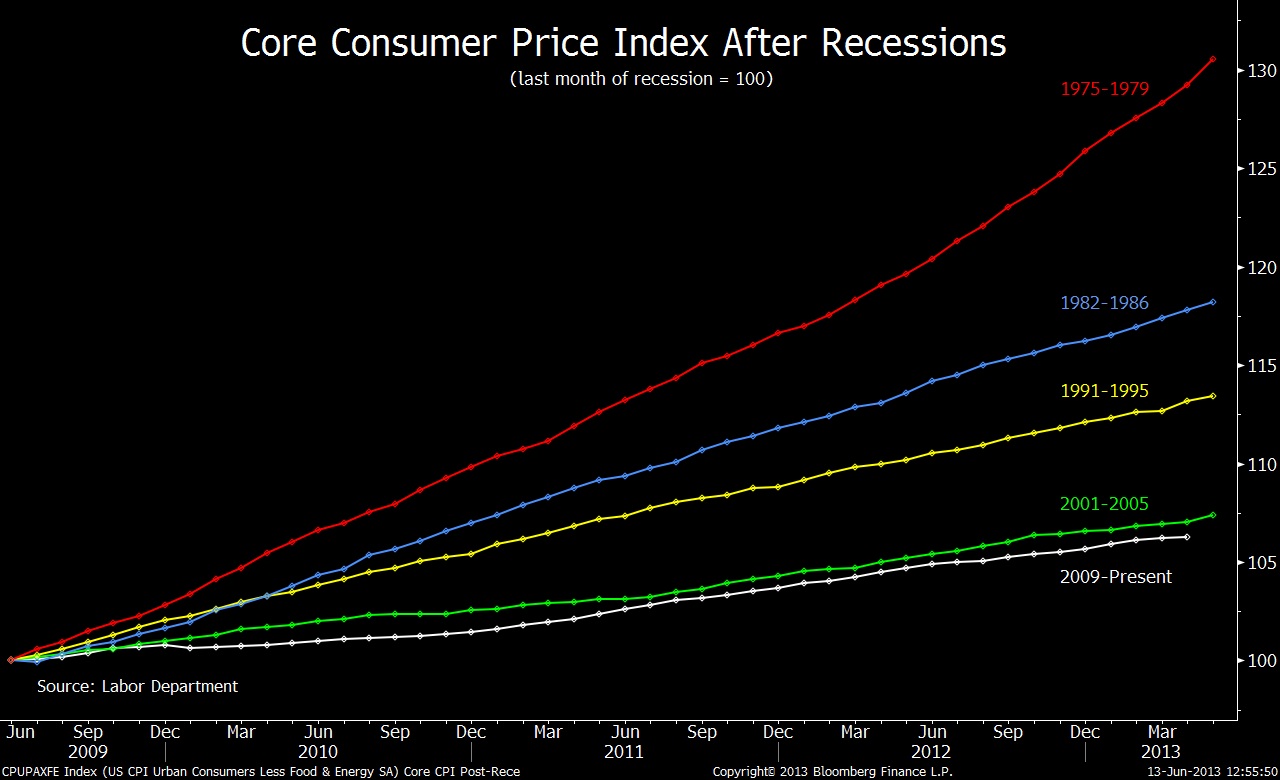
| Dormant Inflation Seen Giving Fed Time to Wait Posted: 14 Jun 2013 08:45 AM PDT U.S. core consumer price index's increase since the latest recession ended in June 2009 Click to enlarge The amount of inflation since the end of the recession in June 2009 is the smallest for any multiyear recovery since the 1970s. The gauge of prices excluding food and energy rose 6.3% through April. Core consumer prices were 7% higher at the same point in the previous recovery, which started in December 2001, as the chart shows. The biggest increase in the inflation gauge was 29%, posted in a recovery that began in April 1975. The Federal Reserve may be able to take its time in adopting a more restrictive monetary policy because inflation is relatively tame.
Source:  |
| Posted: 14 Jun 2013 07:00 AM PDT My morning reads:
What are you reading?
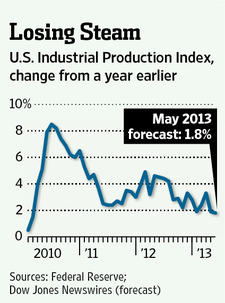
America Is Feeling a Bit Less Industrious  |
| Posted: 14 Jun 2013 04:15 AM PDT Its Friday, and has become my wont, this is the day of the week I like to kick back, wax philosophical about various thoughts kicking about me noggin. One of the things that I have been noticing of late is the way so many people seem to confuse facts with forecasts. Twitter is rife with this issue, as 140 characters plus a dearth of actual thinking turns out to be a bad combination. Where I see this more than anywhere else in the investing world is the significant confusion between Possibility and Probability. Stated differently, more than a few investors are lumping all of the non-zero probabilities together as one similar trade. They are not, for reasons I shall soon make clear, the same thing. This has been true with many people, from Pension fund managers down to mom & pop investors. Let’s define the terms Possible and Probable so that we all begin with the same basic understanding of these words. Something that is Possible may — or may not — come to be. There is no statistical insight provided, it is merely an outcome that may or may not come to pass. It is possible that you could get hit by lightning, or win the lottery, or marry a supermodel. When we describe something as possible, we mean there is a non-zero likelihood of that outcome — it could happen; we just don’t know if it will or will not, but it might. What seems to confuse investors about possible is the statistical likelihood of occurrence. Can a company on the verge of bankruptcy go on to become the biggest company in the world? It is possible — and Apple (AAPL) did just that over the course of a 15 year from 1998-2012. But think about all of the many tens of thousands of companies that have been on the verge of going belly up. Is it possible that they could do the same? Well, the answer is Yes, it is theoretically possible — but not very probable. And indeed, experience teaches us that most insolvent and near insolvent firms actually do go bankrupt eventually. Probability is a the term for the branch of statistics dealing with chance and outcome. Possibility is binary — can this happen or not? Probable is more nuanced mathematics — there is a n% chance of a given outcome, where n = a number between 0-100. Anything that is Probable must by definition be Possible; However, not everything that is Possible is going to be Probable. And therein lay the rub. Lately, I have seen this error come up in two areas — long term Pension Funds, and Venture Capital. The most common mistake is to conflate the two — mistake what is possible for something that is probable. With Pension Funds, we have an issue of national import in that many of these defined benefit plans are significantly underfunded. To catch up, some of these have been directed to add more Hedge Fund exposure. There is an accounting reason — but not a good investing reason — for this based on idea of expected returns. While the tiny minority of funds that create Alpha means that there exists a theoretical possibility for Hedgies to help pension funds make up their shortfalls, the high fees and under-performance makes it rather improbable that this will occur. This is to say nothing of the long odds that Pension funds will pick the next Ray Dalio or Jim Simons. Hence, the possibility of better performance perversely leads to the probability of worse performance. In Venture Investing, the dream of 100X returns is the tantalizing possibility that keeps investors coming back to the VCs — despite the very long odds that your fund will find the next Instagram. The poor track record of the past decade, the limited ability to select VCs that will outperform, means that the dream is a possibility, but the odds are improbable. Whenever asked about Angel or Venture investing, I say the same thing: Assume it goes to zero. That is the highest probability, most likely outcome. Invest no more money than what you are comfortable lighting up in flames (i.e., going to nothing). Who should focus on the Possible? Writers, dreamers, artists, futurists, designers, technologists — the people who imagine the future. Nothing I wrote here should discourage any of these sorts of folks from pushing for the possible, (however improbable). It is how nearly all of human progress has been made, pursuing the improbable. For investors, however, you are best served by sticking with the Probable. Understanding the difference will save you a lot of capital over the long run.  |
| Posted: 14 Jun 2013 03:30 AM PDT Here is my market quote for today, from MacroMan:
That’s a bit more severe than “and the market taketh away,” but certainly makes a noteworthy point . . .
 |
| Posted: 14 Jun 2013 03:00 AM PDT How Elite Economic Hucksters Drive America's Biggest Fraud Epidemics
Editor’s note: This article is part of an ongoing series, “The Age of Fraud.”
What do you get when you throw together economic fraudsters, plutocrats and opportunistic criminals? A financial crisis, that's what. If you look back over the massive frauds that have swept the country in recent decades, from the savings and loan crisis of the 1980s to the 2007-’08 financial crash, this deadly combination always appears. A dangerous cycle begins when prominent economists pander to plutocrats and bought politicians, who reward them with top posts, where they promote the perverse economic policies that cause fraud epidemics. Crises develop, and millions of people are ripped off. Those who fight for truth are ignored or ruined. The criminals get wealthier, bolder and more politically powerful, and go on to hatch even more devastating cons. The three most recent financial crises in U.S. history were driven by a special type of fraud called "control fraud" — cases where the officers who control what look like legitimate entities use them as "weapons" to commit crimes. Each time, Alan Greenspan, former chairman of the Federal Reserve, played a catastrophic role. First, his policies created the fraud-friendly (criminogenic) environment that produces epidemics of control fraud, then he failed to identify those epidemics and incipient crises, and finally, he failed to counter them. At the heart of Greenspan's failure lies an ethical void in the brand of economics that has dominated American universities and policy circles for the last several decades, a brand known as "free market fundamentalism" or the "neoclassical school." (I call it "theoclassical economics" for its quasi-religious belief system.) Mainstream economists who follow this school assert a deeply flawed and controversial concept known as the "efficient market hypothesis," which holds that financial markets magically regulate themselves (they automatically "self-correct") and are thus immune to fraud. When an economist starts believing in that kind of fallacy, he is bound to become blind to reality. Let's take a look at what blinded Greenspan:
As delusional and immoral as this "logic" chain is, many elite economists believe it. This warped perspective has spawned policies so perverse that they turn the world of finance into the optimal environment for criminals. The upshot is that most of our elite financial leaders and professionals have thrown integrity out the window, and we end up with recurrent, intensifying financial crises, de factoimmunity for our most elite criminals, and the rise of crony capitalism. Let's do a little time travel to see exactly how this plays out. How to stoke a savings and loan fiasco The Lincoln Savings and Loan Association of Irvine, California was at the center of the famous crisis that rocked the financial world in the 1980s. A once prudently run company morphed into a casino when S&L associations became deregulated and started doing risky business with depositors' money. Businessman, GOP darling, and anti-pornography crusader Charles Keating, ironically nicknamed "Mr. Clean," took over Lincoln in 1984 and got the casino rolling. (It was a special kind of casino where the games were rigged – and not in favor of newlywed brides who were the subject of sexual extortion in Casablanca.) In a classic case of control fraud, Keating devoted himself to turning the company into a weapon of mass financial destruction and a source of wealth for his family. Keating's "weapon of choice" for his frauds was accounting. Keating went on a spree buying land, taking equity positions in real estate projects, and purchasing junk bonds. In 1985, the Federal Home Loan Bank Board (FHLBB), where I was the staffer leading the regulation efforts, grew alarmed at the new activities of savings associations like Lincoln. So we made a rule: S&Ls could not put more than 10 percent of company assets in “direct investments" – an activity that led to very large losses. Alan Greenspan, chairman of an economic consulting firm at the time, urged us to permit Lincoln Savings to go full steam ahead. His memo supporting Lincoln's application to make hundreds of millions of dollars in direct investments praised the company's management (Keating) and claimed that Lincoln Savings "posed no foreseeable risk of loss." The FHLBB rejected Lincoln's request to exceed the rule's threshold because direct investments were a superb vehicle for accounting fraud – they made it easy to hide losses and to create fictional income. Nevertheless, Lincoln continued to violate the rule and created fictional (backdated) board consents with hundreds of forged signatures to make it appear that the investments were "grandfathered" under the rule. The hundreds of millions of dollars in unlawful direct investments were used for fraudulent purposes by Lincoln Savings' controlling officers and caused enormous losses – many of them to elderly citizens who were conned into buying the junk bonds of Lincoln Savings' holding company. The massive losses on Lincoln's illegal direct investments were a major reason those bonds were worthless. Hoping to use his political clout to continue the fraud, Keating hired Greenspan to lobby the senators who eventually became the known as the "Keating Five." I remember well when these senators intervened at Keating's request to try to prevent me and my colleagues from taking an enforcement action (or conservatorship) that would have saved over a billion dollars. (I took the notes of that meeting, which led to the Senate ethics investigation of the Keating Five.) The cronyism was so thick in Washington that William Weld, then a top Department of Justice official and later the Republican governor of Massachusetts, actually tried to gin up a criminal investigation of the regulators rather than Keating at the request of Lincoln's lawyers who had just left the DOJ! Eventually, Keating and many of the senior managers of Lincoln Savings were convicted of felonies and Lincoln Savings became the most expensive failure of the S&L debacle. When you look back on this expensive fiasco, you see that the work of respected professional economists was frequently called upon to support the fraudulent activities. One of the ways Greenspan tried to advance Keating's effort to have the courts strike down the direct investment rule was to use a study conducted by a less famous economist, George Benston, who showed that S&Ls that violated the direct investment rule earned higher profits than those who didn't. So he recommended the rule be dropped. Small problem: In less than two years all 33 of the companies Benston studied had failed. Most were accounting control frauds in which executives cooked the books to show fictional profits. Keating had a talent for obtaining endorsements from prominent economists. He got Daniel Fischel to conduct a study that purported to show that Lincoln Savings was the best S&L in America. Fischel invoked the efficient market hypothesis to opine that our examiners provided no useful information because the markets had already perfectly taken into account any information to which we had access. In reality, of course, this was nonsense, and Lincoln Savings was the worst S&L in the country. Economists who pander to plutocrats have a great advantage over scholars in other fields: There is no reputational penalty among your peers for being dead wrong. Benston got an endowed chair at Emory, Fischel was made dean of the Univerisity of Chicago's Law School, and Greenspan was made Chairman of the Fed. Those who got control fraud right and fought the elite scams and their powerful political patrons – people like Edwin Gray, head of the FHLBB, and Joe Selby, head of supervision in Texas – saw their careers ended. Consider what that perverse pattern indicates about how badly ethics have fallen in the both economics and government. How to create a regulatory black hole Alan Greenspan was Ayn Rand's protégé, but he moved radically to the wacky side of Rand on the issue of financial fraud. And that, friends, is pretty wacky. Greenspan pushed the idea that preventing fraud was not a legitimate basis for regulation, and said so in a famous encounter [3] with Commodities Futures Trading Commission (CFTC) Chair Brooksley Born. "I don't think there is any need for a law against fraud," Born recalls Greenspan telling her. Greenspan actually believed the market would sort itself out if any fraud occurred. Born knew she had a powerful foe on any regulation. She was right. Greenspan, with the rabid support of the Rubin wing of the Clinton administration, along with Republican Chairman of the Senate Banking Committee Phil Gramm, crushed Born's effort to regulate credit default swaps (CDS). The plutocrats and their political allies deliberately created what's known as a regulatory black hole – a place where elite criminals could commit their crimes under the cover of perpetual night. Greenspan chose another Fed economist, Patrick Parkinson, to testify on behalf of the bill to create the regulatory black hole for these dangerous financial instruments. Parkinson offered the old line that efficient markets easily excluded fraud — otherwise, they wouldn't be efficient markets! (Parkinson would later tell the Financial Crisis Inquiry Commission in 2011 that the "whole concept" of a related financial instrument known as an "ABS CDO" had been an "abomination"). Greenspan's successor richly rewarded Parkinson for being stunningly wrong in his belief: Ben Bernanke appointed Parkinson — who had no experience as a supervisor or examiner — as the Fed's head of supervision. Lynn Turner, former chief accountant of the SEC, told me of Greenspan's infamous question to his group of senior officials who met at the Fed in late 1998 or early 1999 (roughly the same time as Greenspan's conversation with Born): “Why does it matter if the banks are allowed to fudge their numbers a little bit?” What's wrong with a "little bit" of fraud? Conservatives often support the "broken windows" theory of criminal activity, which asserts that you stop serious blue-collar crime by cracking down on minor offenses. Yet mysteriously, they never apply the concept to white-collar financial crimes by elites. The little-bit-of fraud-is-ok concept got made into law in the Commodities Futures Modernization Act of 2000, which created the regulatory black hole for credit default swaps. That black hole was compounded by the Commodity Futures Trading Commission under the leadership of Wendy Gramm, spouse of Senator Phil Gramm. Enron's fraudulent leaders were delighted to exploit that black hole, because they were engaged in a massive control fraud. They appointed Wendy Gramm to their board of directors and proceeded to use derivatives to manipulate prices and aid their cartel in driving electricity prices far higher on the Pacific Coast. In a bizarre irony, the massive increase in prices led to the defeat of California Governor Gray Davis (the leading opponent of the cartel) and his replacement by Governor Schwarzenegger – a man who was part of the group that met secretly with Enron's leadership to try to defeat Davis's efforts to get the federal regulators to kill the cartel. How damaging was Greenspan's dogmatic and delusional defense of elite financial frauds in the case of Enron? If you look closely, you can see that Enron brought together all the critical elements of a financial crisis: big-time accounting control fraud, derivatives, cartels, and the use of off-balance sheet scams to inflate income and hide real losses and leverage. On top of all that, many of the world's largest banks aided Enron and its extremely creative CFO Andrew Fastow to create frauds. The Fed could have responded by adopting and enforcing mandates to end the criminal practices that were driving the epidemic, but it didn't. Instead, Greenspan and other Fed economists championed Enron's leadership and cited the company as proof that regulation was unnecessary to prevent control fraud. They were so extreme that they attacked their own senior supervisors for daring to criticize the banks' role in aiding and abetting Enron's activities. Later, when risky derivatives activities and control frauds at large financial institutions were pushing us toward the catastrophic crash of 2007-2008, the Fed took no meaningful action based on the lessons learned from Enron. Greenspan and the senior leadership of the Fed had learned absolutely nothing, which shows how disabling economic dogma is to regulators – making them worse than simply useless. They become harmful, again attacking their supervisors for criticizing the banks' fraudulent "liar's" loans. When Bernanke placed Patrick Parkinson (an economist blind to fraud by elite banksters) in a supervisory role at the Fed, he sealed the fate of millions of Americans whose financial well-being would be sucked right into that regulatory black hole – and removed the ability of the accursed supervisors to criticize the largest banks. How to protect predatory lenders Finally, we come to the mortgage meltdown of 2008, when the entire housing industry went into freefall. Central to this crisis is the story of the liar’s loan — mortgage-industry slang for a mortgage that a lender gives without checking tax returns, employment history, or anything else that might reliably indicate that the borrower can make the payments. The Fed, and only the Fed, had authority under the Home Ownership and Equity Protection Act (HOEPA) to ban liar's loans by all lenders. At a series of hearings mandated by Congress, dozens of witnesses representing home mortgage borrowers and state and local criminal investigators urged the Fed to do this. The testimony included a study that found a 90 percent incidence of fraud in liar's loans. What did Greenspan and Bernanke do? Exactly nothing. They consistently refused to act. Greenspan went so far as to refuse pleas to send Fed examiners into bank holding company affiliates to find the facts and collect data on liar's loans. Simultaneously, the Fed's economists dismissed the warnings from progressives about fraudulent liar's loans as "merely anecdotal." In 2005, the desperate Fed regulators, blocked by Greenspan from sending in the examiners to get data from the banks, resorted to simply sending a letter to the largest banks requesting information. The Fed supervisor who received the banks' response to that letter termed the data "very alarming." If you suspect that the banks would typically respond to such requests by understating their problem assets significantly, then you have the right instincts to be a financial regulator. By 2003, loan quality was so bad that it could only be explained as the inevitable product of endemic accounting control fraud and it continued to collapse through 2007 until the bubble burst. By 2006, over two million fraudulent liar's loans were originated annually. We know that it was overwhelmingly lenders and their agents who put the lies in liar's loans. Liar's loans make the perfect "natural experiment" because no governmental entity ever required a lender or a purchaser (and that includes Fannie and Freddie) to make or purchase a liar's loan. Banks made, and purchased, trillions of dollars in liar's loans because doing so lined the pockets of their controlling officers. The Fed's leadership, dominated by economists devoted to false theory, was enraged when the Fed's supervisors presented evidence of endemic control fraud by the most elite lenders, particularly in the making of fraudulent liar's loans. How dare the supervisors criticize our most reputable bank CEOs by showing that they were making hundreds of thousands through scams? Bernanke finally acted under Congressional pressure on July 14, 2008 to ban liar's loans. He cited evidence of endemic fraud available since early 2006 – evidence which would have been available way back in 2001 had Greenspan moved to require examiners to study liar's loans. Even in the face of overwhelming evidence, Bernanke delayed the ban for 18 months — one would not wish to inconvenience a fraudulent lender, after all. We did not have to suffer this crisis. Economists who were not blinded by neoclassical theory, like George Akerlof (who won the Nobel Prize in 2001) and Christina Romer (adviser to President Obama from 2008-2010), had warned their colleagues about accounting control fraud and liar's loans, as did criminologists and regulators like me. But Greenspan (and Timothy Geithner) refused to see the obvious truth. Alan Greenspan had no excuse for assuming fraud out of existence, and his exceptionally immoral position on fraud and regulation proved catastrophic to America and much of the world. We cannot afford the price, measured in many trillions of dollars, over 10 million jobs, and endless suffering, of unethical economists. See more stories tagged with: alan greenspan [4], america [5], Andrew Fastow [6], ayn rand [7], ben bernanke [8], born [9], business [10], businessman [11], california [12], Casablanca [13], chair [14], charles keating [15], chicago [16], christina romer [17], clean [18], clinton administration [19], congress [22], corporate crime [23], Daniel Fischel [24], department of justice [25], Economic history [26], economics [27], Editor [28], Edwin Gray [29], Emilio Barzini [30], Employment Change [31], Employment Relation [32], enron [33], fannie [34], Federal Home Loan Bank [35], financial institutions [37], freddie [38], George Akerlof [39], George Benston [40], governor [41], Joe Selby [42], keating five [43], law school [45], Lincoln Savings [46], Lynn Turner [48], massachusetts [49], Objectivists [50], Pacific Coast [51], Patrick Parkinson [52], Person Career [53], Person Communication [54], Person Location [55], Phil Gramm.Enron [56], Product Issues [57], Product Recall [58], Quotation [59], Republican Chairman [60], republican party [61], Republican governor [62], Savings and loan crisis [63], schwarzenegger [64], Source URL: http://www.alternet.org/economy/how-elite-economic-hucksters-drive-americas-biggest-fraud-epidemics Links:  |
| Equity Market Review for June 13 2013 Posted: 14 Jun 2013 02:00 AM PDT  |


| You are subscribed to email updates from The Big Picture To stop receiving these emails, you may unsubscribe now. | Email delivery powered by Google |
| Google Inc., 20 West Kinzie, Chicago IL USA 60610 | |



0 comments:
Post a Comment