


The Big Picture |
- What is Behind the Infation Numbers?
- Do You Have ANY IDEA How Widespread Government Spying Really Is?
- Taper Tantrum Reaction
- 10 Thursday PM Reads
- Can You Hear Me Now?
- Gold vs S&P500
- 10 Thursday AM Reads
- Really!?! With Ben & Janet
- Lanny Breuer at DOJ Was a “Disaster”
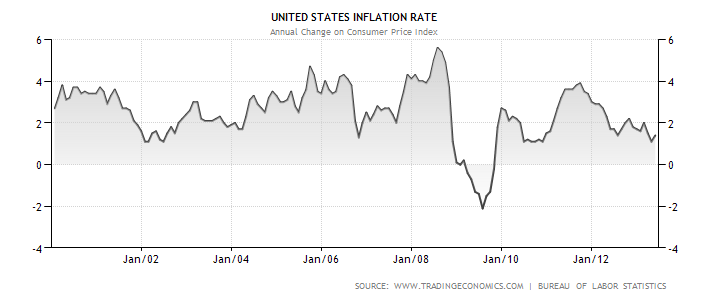
| What is Behind the Infation Numbers? Posted: 21 Jun 2013 02:00 AM PDT  |
| Do You Have ANY IDEA How Widespread Government Spying Really Is? Posted: 20 Jun 2013 11:30 PM PDT You've Heard that the Government and Big Corporations Are Spying. But Do You Have ANY IDEA How Widespread the Spying Really Is?Preface: Americans now know that the government is spying. But they still have no idea how many of their communications and activities are being surveilled … or what might be done with that information. Yes, the Government Is Spying On YouYou know that the government has been caught spying on the Verizon phone calls of tens of millions of Americans. The spying effort specifically targeted Americans living on U.S. soil. And as NBC News reports:
This includes metadata … which can tell the government a lot about you. And it also includes content. In addition, a government expert told the Washington Post that the government "quite can literally watch your ideas form as you type." A top NSA executives have confirmed to Washington's Blog that the NSA is intercepting and storing virtually all digital communications on the Internet. Private contractors can also view all of your data … and the government isn't keeping track of which contractors see your data and which don't. And top NSA and FBI experts say that the government can retroactively search all of the collected information on someone since 9/11 if they suspect someone of wrongdoing … or want to frame him. The American government is in fact collecting and storing virtually every phone call, purchases, email, text message, internet searches, social media communications, health information, employment history, travel and student records, and virtually all other information of every American. The Wall Street Journal reported that the NSA spies on Americans' credit card transactions as well. In fact, all U.S. intelligence agencies – including the CIA and NSA – are going to spy on Americans' finances. The IRS will be spying on Americans' shopping records, travel, social interactions, health records and files from other government investigators. The government is flying drones over the American homeland to spy on us. Indeed, the head of the FBI told Congress today that drones are used for domestic surveillance … and that there are no rules in place governing spying on Americans with drones. Senator Rand Paul correctly notes:
Emptywheel notes in a post entitled "The OTHER Assault on the Fourth Amendment in the NDAA? Drones at Your Airport?":
Many police departments are also using drones to spy on us. As the Hill reported:
Moreover, Wired reports:
RT notes:
Cell towers track where your phone is at any moment, and the major cell carriers, including Verizon and AT&T, responded to at least 1.3 million law enforcement requests for cell phone locations and other data in 2011. (And – given that your smartphone routinely sends your location information back to Apple or Google – it would be child's play for the government to track your location that way.) Your iPhone, or other brand of smartphone is spying on virtually everything you do (ProPublica notes: "That's No Phone. That's My Tracker"). Fox news notes that the government is insisting that "black boxes" be installed in cars to track your location. The TSA has moved way past airports, trains and sports stadiums, and is deploying mobile scanners to spy on people all over the place. This means that traveling within the United States is no longer a private affair. You might also have seen the news this week that the Department of Homeland Security is going to continue to allow searches of laptops and phones based upon "hunches". What's that about? The ACLU published a map in 2006 showing that nearly two-thirds of the American public – 197.4 million people – live within a "constitution-free zone" within 100 miles of land and coastal borders: The ACLU explained:
Computer World reports:
Wired pointed out in 2008 that the courts have routinely upheld such constitution-free zones:
Going further down the high tech Big Brother rabbit hole, the FBI wants a backdoor to all software. (Leading European computer publication Heise said in 1999 that the NSA had already built a backdoor into all Windows software.) The CIA wants to spy on you through your dishwasher and other appliances. And they're probably bluffing and exaggerating, but the Department of Homeland Security claims they will soon be able to know your adrenaline level, what you ate for breakfast and what you're thinking … from 164 feet away. It has gotten so bad that even the mainstream media is sounding the alarm. Big Corporations Are Spying On Us As WellBig companies have been selling our data for years. Bloomberg noted recently that big companies are giving data to the NSA and other government agencies … in return for favored treatment (and see this). But spying by private companies is getting more and more intrusive. For example, companies have developed billboards that can watch you. And see this. Verizon has applied for a patent that would allow your television to track what you are doing, who you are with, what objects you're holding, and what type of mood you're in. The Washington Times reports:
(And some folks could conceivably be spying on you through your tv using existing technology.) And the new Xbox can spy on you as well. Postscript: This is not some "post-9/11 reality". Spying on Americans started before 9/11. And the national security boys can choose to share U.S. civilian information with federal, state, local, or foreign entities for analysis of possible criminal behavior, even if there is no reason to suspect them. And many say that the spying isn't being done to keep us safe … but to crush dissent and to smear people who uncover unflattering this about the government … and to help the too big to fail businesses compete against smaller businesses (and here). And for other reasons. For example, the Atlantic notes:
Note: Here's a full report card on how well the government has been balancing civil liberties with other concerns.  |
| Posted: 20 Jun 2013 06:00 PM PDT |
| Posted: 20 Jun 2013 01:30 PM PDT My afternoon train reading:
What are you reading
Banks Blundered on Mortgage Pact  |
| Posted: 20 Jun 2013 12:56 PM PDT Can You Hear Me Now?
The Fed has decided to keep its asset purchase program in place and also its accommodative low target for the Federal Funds rate. The statement issued after yesterday’s meeting was accompanied by the FOMC's revised economic projections. For those of us who have been engaged in the economic forecasting business for a while, the projections are filled with contradictions that make one wonder about the underlying structure of the individual forecasts that are being masked by their aggregation. Here are some basic observations that suggest that at least on the surface there are logical inconsistencies that could possibly be easily removed if the forecast procedure and release of those forecasts were revised. First let’s look at the GDP forecasts. The Committee lowered the central tendency for growth from March from 2.3-2.8% to 2.3-2.6%. The central tendency is derived by dropping the three highest and the three lowest forecasts. From March to June the full range of forecasts, including those dropped from the central tendency data, went from 2.0-3.0% to 2.0-2.6%. In other words, the Committee marked down its growth forecasts, and all of those markdowns reflected changes in the views of the most optimistic FOMC participants. This is at best tepid growth, and it is puzzling why some in the press would view this as a more optimistic outlook. We estimate that, if the economy grew new the upper end of the Committee's forecast range of 2.5%, somewhere between 113K and 158K jobs would be created per month. Based upon the historical average rate of job creation, it would normally take our economy until well into the second quarter of 2015 for the unemployment rate to fall to 6.5%, the so-called trigger to initiate discussion of a possible movement away from the Fed’s accommodative strategy. So what do the FOMC's unemployment forecasts look like? The central tendency for the unemployment rate is 7.2-7.3%, a remarkably tight consensus as to where unemployment will be at the end of 2013. The forecast range is only slightly wider at 6.9-7.5%. This is an improvement from the Committee's March forecast, and it comes with a somewhat less optimistic central tendency for growth than the Committee had in March. How can one explain this better job outlook, given slower expected growth, especially with the emphasis on fiscal drag from sequestration that Chairman Bernanke gave in his press conference? The forecasts for 2014 are equally interesting. The central tendency for GDP in 2014 was revised up significantly from that in March, and with it the central tendency for the unemployment rate was also lowered to 6.5-6.8%. What is there in the data that suggests such a dramatic improvement? The question is whether by the end of 2013 the improvement in the forecast growth rate would be sufficient to generate enough jobs to justify that kind of improvement in the unemployment rate. Here more detail on the expected trajectory for growth in the latter half of 2013 going into 2014 might help explain the optimistic 2014 employment picture. Our estimates suggest that if the economy were to grow at 3% from this point forward, and if it consequently created on average the number of jobs that growth rate has historically generated, it would still take until somewhere between the third quarter of 2014 and the middle of 2015 before the unemployment rate hit 6.5%. Again, this evidence-based analysis seems inconsistent with the Committee's forecasts and calls for more explanation for the forecasts' deviation from historical performance. In short, given the modest growth forecasts, it appears that the FOMC's projected improvement in the employment situation is very optimistic. All this makes the message delivered by Chairman Bernanke yesterday understandably confusing, since he talked about tapering off the asset purchase program in 2013. What did the Chairman do and not do? The Chairman was brutally honest and forthcoming with a message that markets didn't want to hear, as demonstrated by the subsequent market reactions. He spooked markets by suggesting that the tapering off of the Fed's asset purchase program could begin as early as this fall and might even be triggered by an unemployment rate that reached 7%. Notice that he didn't tie this trigger to the FOMC's forecasts, though perhaps he should have. Note too that the 7% number was outside the bounds of the Committee's 7.3-7.4% central tendency for 2013 and will thus require robust growth in the second half of the year, which is inconsistent with the Committee's own assessment, or at least the evidence it provided in its forecasts. Understandably then, markets are confused. What about the Chairman's other messages? They were clear, both with regard to the fact that the decision to begin tapering off the asset purchase program will depend upon incoming data, and also with respect to the Committee's assessment of conditions in labor markets and the inflation situation. While Bernanke’s remarks were perhaps an accurate description of the Committee's views, these weren’t the specifics that markets wanted to hear. Huge positions rest on getting the expected policy situation right, and the markets' initial reactions suggest that policy moves are expected sooner rather than later. This is not the message that the Chairman likely intended to communicate, but that's what happened. Additionally, the Chairman was clear that the Committee viewed its chief policy instrument to be the size of the Fed's portfolio rather than its incremental asset purchases. Bernanke stated that, by taking assets off the market, prices were bid up and rates were lowered. There was no similar reference to the effects that the incremental purchases might or might not have. Indeed, he seemed to be puzzled as to why markets would place so much emphasis on a slight decrease in asset purchases and why that would prove to be such a negative event. Finally, the chairman was clear that not only was the Committee focused on unemployment, but also that conditions in labor markets more generally, along with inflation (and inflation expectations), would be important conditioning factors affecting any policy decisions. Yet again, all this apparently generally fell upon deaf ears as the market responded negatively. When questioned about the recent rise in longer-term bond rates and how that squared with his statement that inflation expectations were well-anchored, he replied that it could reflect a more optimistic view for growth. Clearly, this is not the typical interpretation of market participants who emphasize uncertainty and policy risks, rather than growth prospects or increased inflation risks, as the reasons that rates have moved up. So what are the lessons from the day's events? Clearly, while the Fed may view communication as an important policy tool, its use is not yet refined; nor does the Committee appear to recognize that there are multiple constituents for information who may require different messages. Yesterday's events and the problems that the press had in interpreting the Fed-speak bring to mind the now familiar refrain, “Can you hear me now?” The answer seems to be "No." Investors and market participants have a short time horizon and need a degree of specificity that the general public doesn't require. There is a need to better link the Fed’s communications to its forecasts, which were absent to a surprising extent. The Committee should give careful consideration to revising its forecast process. In particular, markets are interested in the near-term path of policy and are less interested in Committee's views about the economy's progress over a series of yearly horizons. Quarterly as opposed to yearly forecasts would be especially helpful, especially when the Chairman is trying to explain why the Committee believes that it could begin tapering off its asset purchase program in 2013. Finally, the Committee's next meeting will be even more closely watched than yesterday's announcement. But there will not be a press conference. Nor will revised forecasts be available to justify a modification in FOMC policy in July, should one be forthcoming. New forecasts won't be provided until the September meeting. That meeting won't be held until after the FRB Kansas City Jackson Hole conference, which Chairman Bernanke will miss this year. In the past, that Conference has been used to signal a potential policy change. Equally important should his absence portend a possible departure, what might that mean for a policy decision on asset purchases at the FOMC's September meeting? So where does all this leave us for the rest of the year? Despite market reactions, it is unlikely that economic growth or the unemployment situation would justify a policy change in 2013, especially given the recent declines in the break-even inflation rates. Deflation, not inflation, is likely to be the short-term trump card concern that would dissuade the dovish FOMC from modifying even its asset purchase program this year. Markets won't like this, and so we expect elevated volatility and risk premia combined with turbulence in debt markets. These are conditions that will give savvy investors real opportunities for informed purchases. ~~~ Bob Eisenbeis is Cumberland's Vice Chairman & Chief Monetary Economist. Prior to joining Cumberland Advisors he was the Executive Vice President and Director of Research at the Federal Reserve Bank of Atlanta. Bob is presently a member of the U.S. Shadow Financial Regulatory Committee and the Financial Economist Roundtable. His bio is found at www.cumber.com. He may be reached at Bob.Eisenbeis [at] cumber [dot] com.  |
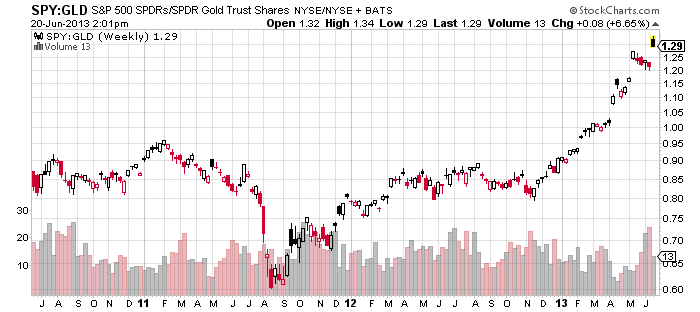
| Posted: 20 Jun 2013 11:00 AM PDT The ratio of SPY to Gold is really quite fascinating:
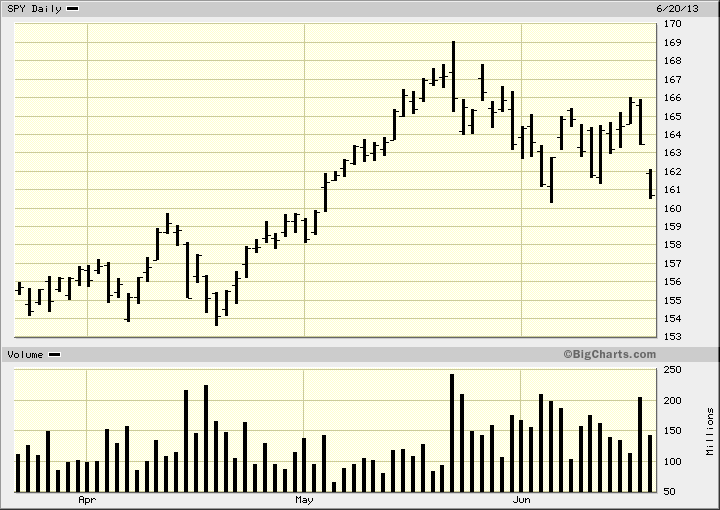
The S&P500 is off 1.75% today, it looks pretty ugly:
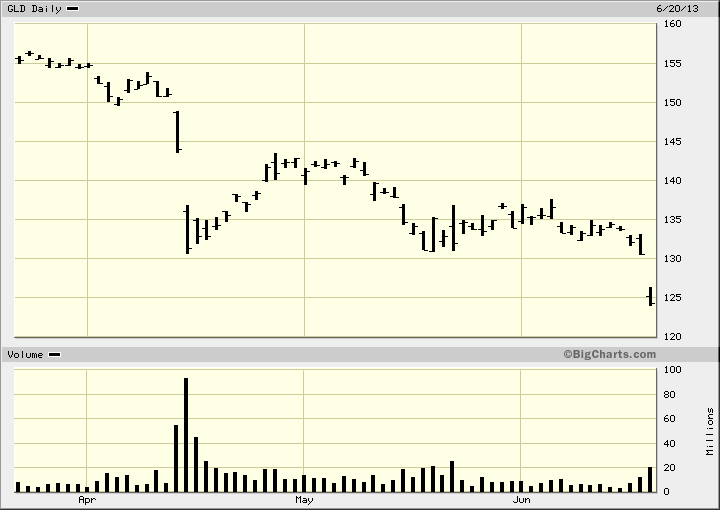
But look at Gold! Its down almost 5% today!
Astonishing! Buckle up, its going to be a bumpy ride this summer!  |
| Posted: 20 Jun 2013 07:00 AM PDT My morning reads:
What are you reading?
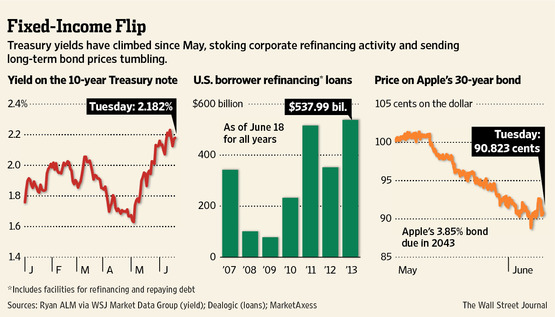
Bond Investors Head for the Hills  |
| Posted: 20 Jun 2013 04:15 AM PDT Look Out Below, Fed Tapering Edition
Really!?! Really traders!?! Did you really believe that the Fed was never going to stop buying bonds? Really?!? Do you think that the Fed was going to have an infinite accommodation, and that rates were going to stay at zero forever? Is that what you expected from the Central bank. C’mon, Really!? And what about the dreaded hyper-inflation you have been warning us about for so long? Inflation has been so low for so long that it had its name legally changed to Deflation. Really!
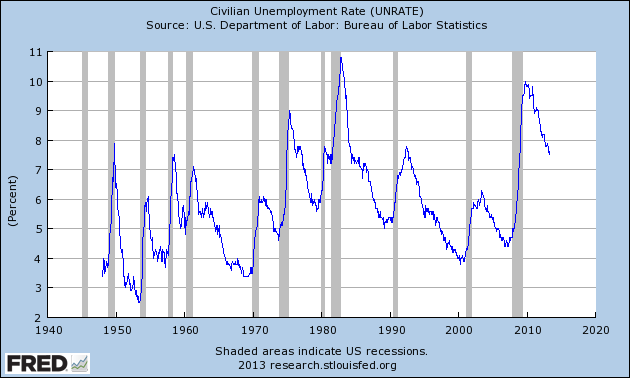
Where you out the day Bernanke said he was targeting Unemployment, which has fallen from nearly 11% to 7.6%? Did you forget about that? Really!?!
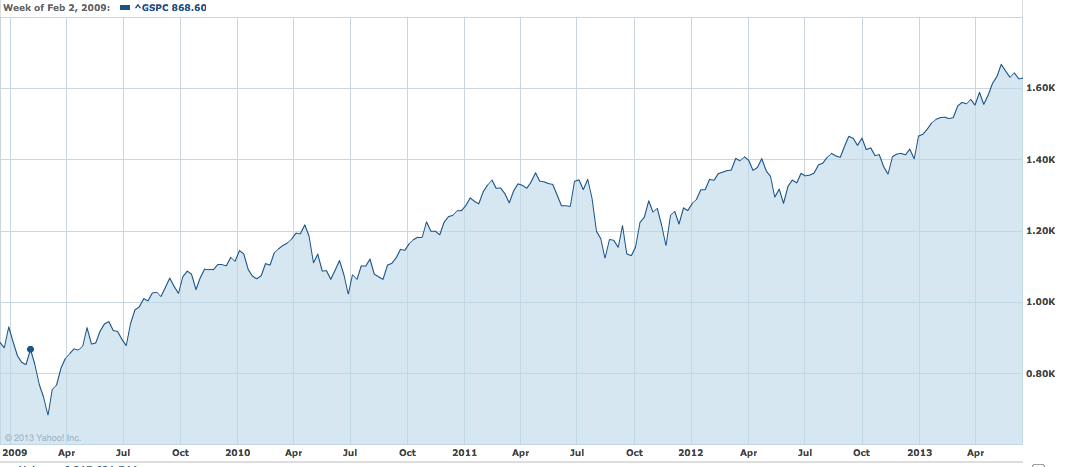
And this entire Risk On rally — did you really think it was going to last forever? Really? US Equity are up nearly 150% over the past 5 years, didn’t you think it had to eventually slow down? Did you actually believe Markets were a uni-directional bet? Really?!?
The Fed has a dual mandate — stable prices and maximum employment. Did you really think there was a third component of maximizing your risk free equity returns? Really!? ~~~ This has been Really!?! With Ben & Janet.
~~~  |
| Lanny Breuer at DOJ Was a “Disaster” Posted: 20 Jun 2013 03:00 AM PDT
Eliot Spitzer, former Governor and Attorney General for the State of New York, talks with Bloomberg Law’s Lee Pacchia about the so-called revolving door between the public and private spheres. While he doesn’t think the entire concept requires regulatory change, he does feel particular examples have shown an enormous problem of individuals improperly internalizing defenses of the private sector when they go to work for the government. Spitzer feels the issue is more about a person’s capacity to change with their given roles. “Can people separate, emotionally and intellectually, one job from the past job…that’s a very hard thing to do,” he says. Asked whether the broad discrepancy in pay between private and public sector jobs is making the situation worse, Spitzer points to the non-monetary benefits of working in government. “[Government workers] are a lot happier…lawyers in the government tend to draw their joy and satisfaction not from their paycheck but from, theoretically, the existential joy of what they are doing”, he says. Spitzer adds that he is “disappointed” in the government’s current slate of regulators, pointing to what he sees as an “overstated fear” of the economic consequences of prosecuting systemically important companies. Spitzer also gives his thoughts on the upcoming mayoral election in New York City.
 |




| You are subscribed to email updates from The Big Picture To stop receiving these emails, you may unsubscribe now. | Email delivery powered by Google |
| Google Inc., 20 West Kinzie, Chicago IL USA 60610 | |



0 comments:
Post a Comment