.

{2} GoogleTranslate (H)

English French German Spanish Italian Dutch Russian Portuguese Japanese Korean Arabic Chinese Simplified

Our New Stuff

{3} up AdBrite + eToro

Your Ad Here

Sunday, June 23, 2013

The Big Picture

The Big Picture


Austerity is a Four-Letter French Word

Posted: 23 Jun 2013 02:00 AM PDT

Austerity is a Four-Letter French Word
By John Mauldin
June 21, 2013


A Great Deal If You Can Get It
Cyprus, Croatia, Geneva, and a Search for Art


The France that I see as I look out from the bullet train today is far different from the France I see when I survey the economic data. Going from Marseilles to Paris, the countryside is magnificent. The farms are laid out as if by a landscape artist – this is not the hurly-burly no-nonsense look of the Texas landscape. The mountains and forests that we glide through are glorious. It is a weekend of special music all over France, and last night in Marseilles the stages were alive and the crowds out in force. The French people smile and graciously correct my pidgin attempts at speaking French. I have found it diplomatic not to mention that I think France is in for a very difficult future. Why spoil the party?

But for you, gentle reader, I will survey the economic landscape that I see on my computer screen. It shows a far different France from the one outside my window, one that resembles its peripheral southern neighbors far more than its neighbors to the north and east. The picture is not all bad, of course. There is always much to admire and love about France. But there are a lot of hard political choices to be made and much reform to be undertaken if this beautiful country is to remain La Belle France and not become the sick man of Europe. This week, in what I think will be a short letter, we’ll look at a few of the problems facing France.

A Great Deal If You Can Get It

Yesterday (June 20) the French called a Grand Summit of businesses, unions, and government officials to address the needed reforms to make France more competitive and its national budget more sustainable. Debt and deficits are high and rising as the country rolls into yet another recession in response to President Hollande's hard left turn last year. One of the key issues is a very controversial plan to reform pensions.

Stratfor notes:

France spends roughly 12.5 percent of its gross domestic product on pensions, more than most almost any other Organization for Economic Co-operation and Development member. (For reference, Germany spends about 11.4 percent of its GDP on pensions, and Japan spends roughly 8.7 percent.)

[Note: elsewhere we find that France has a comprehensive social security (sécurité sociale) system covering healthcare, injuries at work, family allowances, unemployment insurance, and old age (pensions), invalidity and death benefits.  France spends more on 'welfare' than almost any other EU country: over 30 per cent of GDP as a total entitlement cost. As a reference, that would be about $5 trillion in the US.]

The fact that an increasingly larger proportion of France’s population qualifies for pensions factors into the debate. In 1975, there were 31 workers paying contributions for every 10 retirees; today, there are 14 workers paying contributions for every 10 retirees. As the baby boomers from the 1950s and 1960s begin to retire in the next decade, the pressure on France’s coffers will grow substantially. The deficit of the French pension system is projected to double between 2010 and 2020, when it will exceed 20 billion euros.

It is hard for Americans to understand just how much it costs to support the average French worker (or to be self-employed). From Paris Voice:

Total social security revenue is around €200 billion per year and the social security budget is higher than the gross national product (GNP), i.e. social security costs more than the value of what the country produces. Not surprisingly, social security benefits are among the highest in the EU. Total contributions per employee (too around 15 funds) average around 60 per cent of gross pay, some 60 per cent of what is paid by employers (an impediment to hiring staff).  The self-employed must pay the full amount (an impediment to self-employment!)  However, with the exception of sickness benefits, social security benefits aren’t taxed; indeed they’re deducted from your taxable income.  Equally unsurprisingly, the public has been highly resistant to any change that might reduce benefits, while employers are pushing to have their contributions lowered.

And of course, almost the first thing that Monsieur Hollande did when he took office last year was to return the retirement age at which you qualify for a pension back to age 60 from the extremely controversial 62 that his predecessor, Sarkozy, had barely managed to push it to. Sarkozy's "reforms" were greeted with massive protests, and Hollande used them to engineer a sweeping election victory for the Socialists. (I put "reforms" in quotes because nowhere else would a retirement age of 62 be seen as draconian, nor would the rest of the changes Sarkozy pushed through.)

Hollande faces a whole series of problems. Ambrose Evans-Pritchard notes:

The IMF's Article IV Report on France published before the elections draws up the indictment charges: a state share of GDP above 55pc (or 56pc this year), higher than in Scandinavia, but without Nordic labour flexibility.

One of the rich world's highest life expectancies but earliest retirement ages, a costly mix. Just 39.7pc of those aged 55 to 64 are working, compared with 56.7pc in the UK and 57.7pc in Germany. "French workers spend the longest time in retirement among advanced countries," [the IMF] said. (the London Telegraph)

France has the highest tax and social security burden in the Eurozone and the second lowest annual working time. There has been a sharp rise in unit labor costs, making France even less competitive.

These developments have not gone unnoticed in Germany. A report by one of the conservative political parties there (the FDP) said, "French President Francois Hollande was trifling with reform, scarcely making a dent on the sclerotic labour market. Which is true of course. Hollande was elected in May 2012 on a campaign to preserve the status quo and protect the privileges of the French." (Ambrose Evans-Pritchard, the Telegraph)

Not helping is the fact that France had a very anemic "recovery" after the Great Recession (never more than 1% a year) and is now back in full recession. Which means that tax revenues will go down, not up, and that deficits will swell.

And things are likely to get even worse. Charles Gave notes that French manufacturing is plummeting, and this has always led to further losses in GDP. The chart below from GaveKal shows the French Business Climate Survey advanced forward 9 months and the highly correlated GDP number, which follows. The IMF is now predicting a 2% annual recession in 2013, which means rising unemployment and very tepid 0.8% growth in 2014, not enough to really spur employment.

You can read a half a dozen reports and analyses of the French predicament, and they will all mention "labor rigidities" as being part of the problem. There is a high minimum wage cost, and it is hard to let employees go in difficult times, which discourages businesses from hiring young, inexperienced workers. New business start-ups, the source of real job growth, have fallen as a result of the relentless assault by the bureaucracy on entrepreneurs, not to mention the impredations of the tax-man. Corporate profit margins are thin in France, and companies are leaving for locales that afford them more-attractive cost options.

Debt servicing costs as a percentage of GDP have plunged in France from 3% in 1995 to 2% (today) even as the total amount of debt has risen four times. Low interest rates can be a thing of beauty if you want to lower costs, but when interest rates rise (and they would with a vengeance in the not too distant future if the ECB were not ready to step in, as the market clearly expects it to do) they can cripple a government already burdened with too large a deficit and unwieldy commitments. But without real reforms, how long will it be before the market sees France as another problem child, like Italy and Spain?

Austerity is a four-letter Anglo-Saxon – or even worse, Teutonic – word in socialist France, yet the market at some point is going to want to see a move toward sustainable budgets. Government bond investors are not philanthropists. They look for the least risk they can find. A realistic assessment will soon be made that France is no longer in the least-risky category.

Compounding Hollande's problems is a growing disenchantment with the whole European project in France, the putative home of the movement for integration.

No European country is becoming more dispirited and disillusioned faster than France. In just the past year, the public mood has soured dramatically across the board. The French are negative about the economy, with 91% saying it is doing badly, up 10 percentage points since 2012. They are negative about their leadership: 67% think President Francois Hollande is doing a lousy job handling the challenges posed by the economic crisis, a criticism of the president that is 24 points worse than that of his predecessor, Nicolas Sarkozy. The French are also beginning to doubt their commitment to the European project, with 77% believing European economic integration has made things worse for France, an increase of 14 points since last year. And 58% now have a bad impression of the European Union as an institution, up 18 points from 2012. (Tyler Durden, Zero Hedge)

And Stratfor adds:

Hollande thus faces a dilemma: He could try to push for comprehensive reforms unilaterally, but that would be incredibly unpopular, at least in the short term. Otherwise, he could try to enact diluted reforms, which would be more palatable for French citizens but ultimately would be ineffective at reducing the costs of the French pension system.

Hollande’s problem is shared by many Western European leaders, who have responded to the ongoing economic crisis by implementing painful reforms in their welfare states. The problem is that countries consider the welfare state one of the defining economic, political and social features of postwar Europe and a symbol of economic prosperity. The French have a long and rich tradition of fighting for their civil and social rights, and the notion of a social contract between rulers and the constituents is a key feature of French politics. For the French – not to mention the Italians, Spanish or Germans – a generous welfare state is an acquired right, a part of the social contract in Europe.

But what one group may see as an acquired right another will see as a tax burden, excessive cost, and unwanted risk. This is not just a French problem, of course. Governments everywhere have promised far more than they can ever deliver. And when a program gets prohibitively expensive, adjustments will be made. It goes without saying that when you cut a promised benefit to people who are already retired or soon will be, they will not be happy.

In July, 2012 Hollande called the first Grand Summit to solve the very same problems that were still facing at the latest one. As there is not yet a true crisis, no imminent cliff to fall over, I doubt that anything of substance will get done. Which means there will be yet another conference in the future as the stress intensifies.

Hollande is now down to a 30% approval rating. True reforms would anger his base, and a lack of them will lead to even lower ratings by the markets. He has no standing within his own party to force a compromise; and as elections draw closer, fewer and fewer within his party will want to be seen in a photo op with him.

France is on its way to becoming the new Greece. In 20 years, the Harvard Business School will do a case study on what not to do when faced with a massive fiscal crisis. France and Hollande will be Exhibit #1.

Cyprus, Croatia, Geneva, and a Search for Art  

I am in Paris this weekend, meeting with my Mauldin Economics partner Olivier Garret in his home country. (He now lives in Vermont, so he still resides in a socialist state.) I fly to Cyprus on Monday morning, where I will have a series of meetings with local businessmen and officials for two days. I speak Wednesday evening at 6 pm at the Central Bank, through the auspices of the University of Cyprus and the Cyprus Chamber of Commerce, on the topic of “Currency Wars and Quantitative Easing.”

Then I leave irrationally early the next morning for Split, Croatia, where I will spend a night before being gathered by the rogue Irish economist David McWilliams for a few days of relaxation and laughter. It is impossible to keep from laughing for very long around David, even when he is telling you that you are doomed. He has Irish gifts in abundance.

On Sunday I fly to Geneva, hoping my bags get there with me, to have meetings and face yet more deadlines; but I’ll also get to enjoy an encore al fresco dinner with Herwig van Hove and friends. I see that several mutual friends will be there, chief among them Louis Gave, who will be in town for a different set of meetings.

I remember (I think it was two years ago about this time) that Herwig hosted another dinner party where Louis's father, Charles, was in attendance and in rare form. I remember there were 16 people present, all involved in the investment business in one way or another. Charles and I were at the center of the table facing each other, bantering back and forth, with me serving as the straight man for Charles.

It was a gorgeous summer evening and the table was relaxed, with the wine and food matching the magnificence of the weather. We were debating the valuation of the euro, and I asked for a poll of the group as to whether they thought the euro would be higher or lower the next year. The show of hands had 11 voting lower, 7 thinking higher, and one abstention. (Yes, that is 19 votes for 16 people, but there were a number of economists present, who evidently felt compelled to vote in both directions, presumably using different hands, at least.)

I will remember the next moment all my life. I had noticed that Charles did not vote. I asked him about that, and he answered in that authoritative tone of voice that sounds to me exactly like what the voice of God should sound like, punctuating the air with his finger for emphasis, "John, that is an absurd question. The euro will not exist in a year." I will remind Louis and the table of that moment and ask the same question if Herwig will allow me – and I’ll report back.

I am in the midst of designing a new abode. Since it has been a very long time and I’ve undergone a few personal reinventions since I last owned a home, I have never really collected much in the way of art. And while I am not in a hurry to do so, I now find myself with an opportunity to discover some special pieces that I will enjoy seeing and sharing on a regular basis. I have "placeholder" pieces that can suffice while I patiently look, but I am currently seeking one special piece to hang over my dining room table. I am not looking for a chandelier, but rather a light that is art in and of itself. The apartment is a floor-to-ceiling glass high-rise, ten-foot ceilings, very open; and the table is glass. The overall theme is contemporary modern. When you walk in, almost the first thing you will notice after the view is that one piece of art suspended over the dining room table.

Except that I don't know what it is yet. Since my readers obviously have exquisite taste,  it seems reasonable to ask you. I am very open to suggestions.

It is time to hit the send button as there is a music festival near here that needs my attention. Although last night I ended up in an Irish pub in Marseilles, listening to old ballads as I read and thought. Have a great week and spend a few moments with friends. They always pay the best dividends.

Your planning on seeing a few museums analyst,

John Mauldin

subscribers@mauldineconomics.com

Growing Up with Social Media

Posted: 22 Jun 2013 10:30 PM PDT

ciick for giant infographic
start early
Source: Letterbox


Click to enlarge
Graphic
Source: Letterbox

QOTD: The World

Posted: 22 Jun 2013 12:00 PM PDT

Here is a quote to distract you from the Red on your screens this week:

“The world is so big, so complicated, so replete with marvels and surprises that it takes years for most people to begin to notice that it is, also, irretrievably broken. We call this period of research ‘childhood.’

“There follows a program of renewed inquiry, often involuntary, into the nature and effects of mortality, entropy, heartbreak, violence, failure, cowardice, duplicity, cruelty, and grief; the researcher learns their histories, and their bitter lessons, by heart. Along the way, he or she discovers that the world has been broken for as long as anyone can remember, and struggles to reconcile this fact with the ache of cosmic nostalgia that arises, from time to time, in the researcher’s heart: an intimation of vanished glory, of lost wholeness, a memory of the world unbroken. We call the moment at which this ache first arises ‘adolescence.’ The feeling haunts people all their lives.”

- Michael Chabon, writer.

Missed the big market rally? Here’s what to do now.

Posted: 22 Jun 2013 07:00 AM PDT

Missed the big market rally? Here's what to do now.
Barry Ritholtz,
Washington Post June 14 2013


So, you missed the big market rally. U.S. stocks have moved nearly 150 percent since the March 2009 lows, and you sat out most of those gains.

I've heard all the reasons: Maybe you jumped out of stocks in 2008 and stayed out. Perhaps you were in at the lows, but after the first 20 percent advance, you lost your nerve. The Flash Crash of May 2010 sent you running for cover? Or was it the 19 percent drop before QE2 was announced in August 2010?

There's always some reason that looked good at the time. The asset management business, it turns out, involves a lot more behavioral counseling than you might guess. In any case, the markets have powered upward and onward without you.

What do you do now? How to begin to repair the damage?

It is a two-part process: The initial steps are designed to help you overcome your risk aversion — the emotional aspects of investing. Call it your "erroneous behavioral economic zone." After we fix that big underutilized brain of yours, we can move on to the investment steps that allow you to work your way back into markets.

1 Acknowledge the error: First thing you need to do is own up to the mistake. No, this wasn't the fault of the Fed or President Obama or some algorithm trading server somewhere in New Jersey. It is your portfolio, your retirement account, your future. You cannot fix it if you are still blaming everyone else. (I find that tracking my blunders in annual mea culpas to be helpful).

2 Stop beating yourself up: This market has confounded amateurs and pros alike. Unless you came to an early understanding of how the Fed has been driving liquidity and, therefore, equities, it was easy to miss. As we noted last month, even the supposed best and brightest hedge fund managers have stunk up the joint. Give yourself a break, and move on.

3 Change your sources: Most of the people I speak with who have missed this huge move have been consuming a diet of doom and gloom. If you think that it doesn't affect you, you're kidding yourself. Constantly reading about hyperinflation and the collapse of the dollar and the end of the United States as a world power and the student loan crisis and omigod Obamacare is going to crush America and the Chinese are taking over the world and . . . STOP! Right now.

It is recession porn, a focus on the negative that is a leftover effect of the crash and great recession.

Go through your bookmarks, and delete all of these sites: the goldbugs, the end-of-worlders, the doom-and-gloomers, the outraged Fed critics, the Obama haters. They all have agendas that typically have to do with selling you subscriptions or advertising. They are not at all concerned with your returns, your portfolio or your retirement.

4 Review your process: Now that you have eliminated the crazies, look at the rest of your process. How do you make investment decisions? Are you careening from stock pick to stock pick, after watching too much financial TV? Do you even have a process?

Whatever it is you have been doing obviously has not been working. It is likely you are missing two important components of an investment plan: the plan itself and an error-correction method that allows you to reverse the inevitable mistakes that will occur.

5 Create an asset-allocation model: Of course, if you missed the entire rally, you don't have much of a plan. You need a full-blown investment strategy.

Own five to nine broad indexes, typically in exchange-traded funds (ETFs) or low-cost mutual funds. In decreasing amounts (35 percent, 30 percent, 20 percent, 5 percent), you should own: large caps, small caps, emerging markets, global equities, technology, real estate, bonds (corporates, Treasurys, munis) and commodity indices.

This is your asset allocation model. And here's what to do with it:

6 Deploy your capital: You need to make your capital work for you, not sit in cash. Deploy this capital based on time, on market levels, on a model or any objective metric, just so long as it is not driven by your gut instinct.

When it comes to investing, your emotions will betray you every time, sending you running in the wrong direction and at the worst possible moment. Using a framework of entries that are objectively derived overcomes this risk-aversion problem.

7 Dollar-cost average: You can allow time to work in your favor by deploying your capital in 12 monthly (or four quarterly) equal amounts. This avoids the classic market timing issue, and allows any market volatility to work in your favor. The other advantage is that if the market runs away to the upside before you fully deploy, you at least have some exposure, and you are averaging up into the rally.

Historically, the math works better with lump-sum investing, but understand that this strategy is about emotions, not numbers.

An alternative is to use purchase points based on market levels: Set a series of levels in 5 or 10 percent increments above and below where your favorite index (Dow, Russell, etc.) is today. With each market move, up or down, deploy another 10 or 20 percent of your capital to the equity side (decide this in advance, or you will mess it up). If the market gets cut in half, you are fully invested in equities at enormously advantaged prices. This sounds great in theory, but the reality is that when markets are at their cheapest, they also look their scariest. Very few people have the discipline to make buys into the mess.

8 Rebalance regularly: You now have a simple model with various asset classes held in different weightings (35 percent to 5 percent). Over time, some will do better or worse than others. Eventually, the model drifts. The process of returning the portfolio to its original percentage weightings is called rebalancing.

Plan on rebalancing regularly — quarterly for larger portfolios of more than $1 million, semiannually for mid-size and annually for accounts less than $100,000.

What this means in practice is that as any asset class gets expensive or cheap, you get to make small, advantageous shifts. You buy a little of what has become cheap and sell a bit of what has become dear.

The academic data show this creates about 1 percent in additional performance over longer investment cycles. It doesn't cost anything and adds no extra risk. It is the closest thing to a free lunch that exists in finance.

9 Be diversified: We own stocks and bonds and real estate and commodities (pretty much in that order). When one market or asset class is falling, others tend to go in the opposite direction. We also own a broad variety of equities: There is geographic variation, differing market-capitalization sizes and economic sectors. Diversification usually means that different asset classes behave differently. When equities get shellacked (like this past week), bonds tend to rally. (It was reversed last month: Stocks rallied, bonds sold off).

A balanced portfolio approach tends to underperform markets on the way up but suffer much less on the way down. The goal is to allow you to pursue your financial goals but still sleep at night.

10 Understand your time line: People have a foolish tendency to lose sight of the long term in the midst of the day-to-day noise.

Most of you have an investing timeline between 10 to 40 years. (If you plan to start withdrawing money to live on in 10 years or less, you will need to be more conservative). But those of you in your 20s, 30s, 40s or even early 50s have a much longer time horizon. Secular (or long-term) bear markets are to be expected, and they let you buy advantageously if you can overcome your own instincts. Volatility and short-term market swings are part of the nature of markets.

When your investing timeline is measured in decades, you cannot afford to continually miss an ongoing rally because of day-to-day volatility.

Markets that rally 150 percent come along once a generation. If you missed this one, it is probably because you based your investing on some form of guess as to what stocks were going to do. Experience teaches us that we are all pretty bad at making forecasts nearly all of the time. This is why any prediction-based investment strategy is doomed to failure. The outcome is binary: Your guesses are either right or wrong.

Consider instead a probability-based investment approach. The idea behind asset allocation is to allow mean reversion, rebalancing and diversification to work in your favor. No guesswork required.

~~~

Ritholtz is CEO of FusionIQ, a quantitative research firm. He is the author of "Bailout Nation" and runs a finance blog, the Big Picture. Follow him @Ritholtz.

10 Weekend Reads

Posted: 22 Jun 2013 03:00 AM PDT

Good Saturday morning. We once again have (unusually) glorious weather here in the NorthEast, so don’t expect me to be any where near a computer all day. No worries, though — here is my list of the longer form reading I have collected this week to keep you occupied:

• The Man Who Escaped Microsoft and Took a Whole Company With Him (Wired)
• Science of Storytelling: Why Narratives Are the Most Powerful Way to Activate Our Brains (Lifehacker)
Malcolm Gladwell: The Gift of Doubt (New Yorker)
• China's Great Uprooting: Moving 250 Million Into Cities (NYT)
• Why The Pie Chart is the Worst Chart In The World (Business Insider)
• A Foolproof Approach to Policy For Both Fiscalists + Monetarists (Macro & Other Market Musings)
• What Paintbrush Makers Know About How to Beat China (NYT) see also Portrait of the Artist as a Caveman (New Atlantis)
• Silent War (Vanity Fair) see also The Secret War (Wired)
• The Problem With Psychiatry, the 'DSM,' and the Way We Study Mental Illness (Pacific Standard)
• The Rise of the Tick (Outside)

Where are you sailing to today?


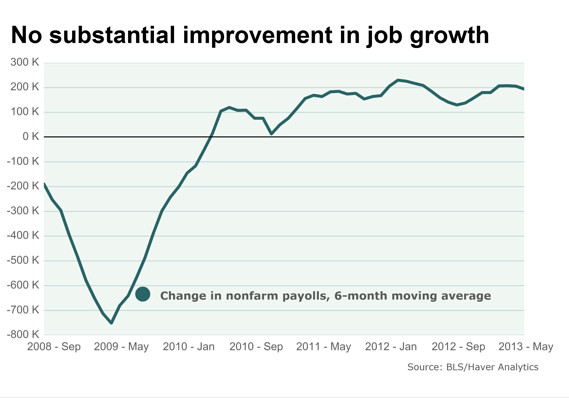
7 charts that tell the Fed not to taper QE3  
MW-BE258_payrol_20130618122551_MG
Source: Marketwatch

.

0 comments:

Post a Comment

previous home Next

{8} chatroll


{9} AdBrite FOOTER

{8} Nice Blogs (Adgetize)