.

{2} GoogleTranslate (H)

English French German Spanish Italian Dutch Russian Portuguese Japanese Korean Arabic Chinese Simplified

Our New Stuff

{3} up AdBrite + eToro

Your Ad Here

Saturday, December 31, 2011

Cara Community

Cara Community


Tables & Charts for Friday, Dec 30th, 2011

Posted: 30 Dec 2011 09:03 PM PST

Bill Cara's Blog for Dec 30, 2011

Posted: 30 Dec 2011 04:00 AM PST

CTA Trading Desk Morning Report

[9:00am ET] Good morning, Geoff here.

Yesterday's Italian bond auction was successful. The 10 year notes went for 6.98% which is lower than last months 7.56% rate. Staying below the 7% mark will be important to the market moving forward. This news combined with a better than expected Chicago Purchasing Managers Index and a rise in pending home sales lifted the stock market.

read more

.

DailyFX - Forex Market News

DailyFX - Forex Market News


Trading the News in 2012

Posted: 30 Dec 2011 06:00 PM PST

Developing themes in the world economy are expected to drive price action in 2012, but doing your homework and having a good set of rules will be key to trading the news.

USD Rebound On Tap, Aussie To Carve Lower Lows

Posted: 30 Dec 2011 08:59 AM PST

The greenback tumbled lower ahead of the New Year, with the Dow Jones-FXCM U.S. Dollar index slipping to a low of 9,924, but the recent weakness is likely to be short-lived as the fundamental outlook for the world’s largest economy improves.

Guest Commentary: Gold & Silver Daily Outlook 12.30.2011

Posted: 30 Dec 2011 07:15 AM PST

Gold continued to decline yesterday, while silver changed direction and slightly rose yesterday. Both precious metals didn't do well in recent weeks, but what is up ahead for gold and silver on the last business day of 2011?

Euro Lags Behind Ahead Of 2012, Sterling May Play Safe-Haven Role

Posted: 30 Dec 2011 07:00 AM PST

Risk sentiment picked up ahead of the New Year despite the drop in market participation, but the rebound in risk-taking behavior is likely to be short-lived as the outlook for 2012 remains clouded with high uncertainty.

Crude Oil, Gold Expected to Decline as the New Year Begins

Posted: 30 Dec 2011 02:06 AM PST

Crude oil and gold prices are expected to decline in the new year as risk aversion returns and the US Dollar gains on the back of safe-haven demand.
.

The Big Picture

The Big Picture


Housing: Been Down So Long It Looks Like Up (to them)

Posted: 30 Dec 2011 04:57 PM PST

Ever since the housing boom bursted in 2005, Homebuilder Confidence collapsed and Prospective Buyer Traffic  has been at very low levels.

Yet another twitch upturn is being heralded as the real deal — as being driven by a real improvement in underlying fundamentals. These charts look to me a slow reversion towards normalcy – but we have a long way to go.

Homebuilder confidence and Traffic are tertiary indicators this Housing cycle — I am far more concerned with 1) Employment and Wage Gains, 2) Household formation; 3) Median Income to Median Home Price, and 4) Shadow Inventory.

>
click for ginormous charts

NAHB data via Investech

Projecting US Military Power

Posted: 30 Dec 2011 11:30 AM PST

Click for ginormous chart

Source: National Post

‘Tis two days yet to New Year

Posted: 30 Dec 2011 11:00 AM PST

By Art Cashin, UBS Financial Services Inc.

‘Tis two days yet to New Year
but despite what you're hopin'
The folks in the Board Room
say "the full day we're open"

So we’ll buy and we’ll sell
as the tape crawls along
And though “Bubbly’s” verboten
we may still sing a song

Two Thousand Eleven
looked good at the start
But deadlocks in D.C.
took things all apart

We finished up with a rally
thanks to old Santa Claus
But some late Euro troubles
Almost caused us to pause

We lost special people
as we seem to each year
It just makes us treasure
each one that's still here

Peter Falk, dear Columbo
put his raincoat away
James Arness, Marshall Dillon
wears a new star today

Jack Kevorkian left us
without an assist
Harry Morgan, Colonel Potter
will also be missed

And Christopher Hitchens
said of God he had doubt
Now he's taken that journey
when we each will find out

Andy Rooney's curmudgeon
up to heaven has gone
Jack La Lanne and his juicer
have also moved on

Amy Winehouse so troubled
has joined heaven's choir
And Betty Ford also
in this year did expire

Joe Frazier, once smokin'
went down for the count
And Jane Russell, the Outlaw
found a heavenly mount

Liz Taylor's great beauty
now in heaven's halls glows
Jackie Cooper, the child star
donned some angelic clothes

Steve Jobs left his iPad
he won't need it now
His final words as he left us
were just a simple "Oh Wow!"

Mark Haines left the floor too
without saying good-bye
Though he growled & he grumbled
he was still a good guy

Kim Jong Il has departed
yet North Korea's no fun
We're stuck with his third kid
who he named Kim Jong Un

Navy Seals got Bin Laden
now Khaddafi's gone too
Two of the worst kind
that we ever knew

Japan had a huge earthquake
followed by a great wave
Which engulfed a reactor
that they couldn't quite save

A tornado hit Joplin
Alabama slammed too
Lots of tears then rebuilding
nothing else could they do

And in once civil Norway
one day folks ceased to smile
When a gun totting loner
shot some kids on an isle

While in Middle East cities
young folks took to the streets
And they spoke to each other
Using YouTube and tweets

In Washington – Gridlock
was the theme of the year
It brought ratings cuts to us
and left nothing to cheer

Up sprang "Occupy Wall Street"
it was almost a flop
'Til a YouTube explosion
of that pepper spray cop

Corzine's MF Global
misplaced lots of dough
When they asked where it went
he said – damned if I know

Herman Cain scored debate points
his three "nines" moved up fast
But he made a quick exit
shocked by things from his past

We saw Merkel, Sarkozy
a cliff-hanger in Greece
Bonga boy Berlusconi
claimed some girl was his niece

The Prez had a few struggles
in the polls he did slip
Prompting new speculation
that Hil & Biden he'll flip

Casey Anthony's jury
somehow had a doubt
And some Italian justice
let Amanda Knox out

A chambermaid pointed
to a guy named Strause-Kahn
But the District Attorney
said her tale was a con

And then Anthony Weiner
emailed some pointed tweets
Charlie Sheen had a meltdown
as he screamed of his feats

Let not this year’s memories
of sadness or sleaze
Disturb you this day
just give your heart ease

Have faith that this New Year
will bring a new sign
And believe in yourself
it will all work out fine

Just lift up your spirits
and some fruit of the vine
And kiss ye a loved one
and sing Auld Lange Syne

And late in the evening
as you watch the ball fall
Wish yourself all the best
Happy New Year to All!!

Monty Python – Dennis Moore

Posted: 30 Dec 2011 09:30 AM PST

This redistribution of wealth is trickier than it looks . . .

Hat tip Naked Keynesianism

Friday Week Ending Reads

Posted: 30 Dec 2011 09:02 AM PST

One of our last reads of 2011:

• The Dumbest Idea In The World: Maximizing Shareholder Value (Forbes)
• Occupy Beijing? (Diplomat) see also Tokyo and Beijing Agree on Currency Pact (WSJ)
• Goldman Sachs + Warren Buffett = Not Many Jobs (Bloomberg)
• Soros Sees Gold Prices on Brink of Bear Market (Bloomberg) see also Commodities Poised for First Annual Decline Since 2008 on European Crisis (Bloomberg)
• Traditional lenders shiver as shadow banking grows (FT.com)
• Retailers Get Late Lift (WSJ)
• Choose Your Tech Bullshit (Macro) see also People Who Didn’t Get What They Wanted For Christmas (Buzz Feed)
Krugman: Keynes Was Right (NYT)
• Gingrich 'Loophole' Offers Lobbyist Access for Cash (Bloomberg) see also Matt Stoller: Why Ron Paul Challenges Liberals (Naked Capitalism)
• Jon Stewart Spanks Fox News In the Year-End Ratings (Warming Glow)

What are you reading?
>

Source: WSJ

Handbook for Life: 52 Tips for Happiness and Productivity

Posted: 30 Dec 2011 09:00 AM PST

Around this time of year, people begin making New Year’s resolutions. They are invariably doomed to failure for the same reason most diets don’t work: One-offs fail to change the underlying habits and beliefs that drive our daily behaviors.

That is why I found this list of Zen Habits by Leo Babauta so enchanting. The full run with an explanation for each bullet point is found at his blog Zen Habits and is posted under the title Handbook for Life.

Here are the 52 suggestions for a happier and more productive New Year:

  1. Try rising early.
  2. Do less.
  3. Slow down.
  4. Practice patience.
  5. Practice compassion.
  6. Find your passion.
  7. Lose weight.
  8. Exercise.
  9. Eat healthy.
  10. Meditate.
  11. Get organized.
  12. Think positive.
  13. Simplify your finances.
  14. Simplify your life.
  15. Accept what you have.
  16. Envision your ultimate life.
  17. Set long-term goals.
  18. Review goals.
  19. Life mission.
  20. Plan your big tasks for week and day.
  21. Maintain focus.
  22. Enjoy the journey.
  23. Create a morning and evening routine.
  24. Develop intimate relationships.
  25. Eliminate debt.
  26. Enjoy the simple pleasures.
  27. Empty your inbox and clear your desk.
  28. Build an emergency fund.
  29. Keep a journal.
  30. Use the power of others.
  31. Read, and read to your kids.
  32. Limit your information intake.
  33. Create simple systems.
  34. Take time to decompress after stress.
  35. Be present.
  36. Develop equanimity.
  37. Spend time with family and loved ones.
  38. Pick yourself up when you're down.
  39. Don't compare yourself to others.
  40. Focus on benefits, not difficulties.
  41. Be romantic.
  42. Lose arguments.
  43. Get into the flow.
  44. Single-task.
  45. Be frugal.
  46. Start small and slow.
  47. Learn to deal with detractors.
  48. Go outdoors.
  49. Retire early.
  50. Savor the little things.
  51. Be lazy.
  52. Help others.

>

Source:
Handbook for Life: 52 Tips for Happiness and Productivity
Zen Habits, by Leo Babauta

Meredith Whitney, 2011 Winner, Elaine Garzarelli One-Hit Wonder Award

Posted: 30 Dec 2011 08:30 AM PST

With this post, we officially move Meredith Whitney into the Unguru camp. You can blame the headline on me; the rest is by David and Janet. -BR

~~~

Janet Tavakoli Gets 5 Stars!
December 30, 2011

A year ago, Muniland faced a Rubicon as Meredith Whitney's words caused a wholesale slaughter in the tax-free and taxable Muni bond market. Investors who listened sold their Munis at about the worst relative pricing they could experience. We have encountered Whitney all year. We took the opposite view and our clients have benefitted by owning their bonds and not panicking. We were buyers during the Whitney-exacerbated sell off. We have written about that many times. The comments are archived at www.cumber.com.

There is more to the Whitney saga. Today, it was superbly revealed by Janet Tavakoli in her Huffington Post column. With her full permission, we have reproduced the entire piece below. We thank Janet for allowing us to reproduce her column and wish her all the best for the New Year. We wish the same for you, dear reader. 2012 promises to be full of surprises and laced with volatility. We will do our best to help readers navigate through the storm. For those clients who have helped make Cumberland a success, we promise to try to anticipate the storm for you. Now to Janet's post. The link and the full text are below.

Here is the link.

2011: The Year 60 Minutes Misled Americans About Municipal Bonds

Huffington Post – December 30, 2011

Here is the full text.

In previous posts, I’ve mentioned serious fiscal problems that need to be addressed at state and local levels. This varies by region and some issues are potentially solvable.

I live in Illinois, which is ground zero for fraud, corruption, underfunded pension funds and general fiscal mismanagement. It’s an example of one of the worst fiscal messes in the United States. This year Illinois hiked personal income taxes from 3% to 5%, and increased corporate taxes. We’ll be slammed with hidden tax increases in utilities, purchases, and more. When now Mayor Rahm Emanuel left his post as White House Chief of Staff to run his election, the Chicago mayoral race centered partly around steps, including budget cuts, needed to solve Chicago’s serious fiscal issues: See “Third World America: Drowning in Debt and Chocking on Lies,” Huffington Post, June 24, 2011, and ‘Fast-Tracking to Anarchy;” August 25, 2010.

On December 19, 2010, I was (at first) happy to see 60 Minutes highlight fiscal problems of states and municipalities. It explained how Illinois was late on payments to service suppliers, and it’s a huge problem for people doing business with the state. The state’s pension fund is underfunded and although 60 Minutes didn’t mention it, state pension funds are the prey of Wall Street cronies that stuff them with losses and then propose fee-loaded leveraged financial products that are bets to make up the shortfall. Then 60 Minutes went completely off the rails by suggesting that these problems would lead to widespread defaults on municipal bonds in 2012. You can still view the segment, “State Budgets: Day of Reckoning,” on the CBS web site.

A “Performance”

Instead of focusing on the implication of these problems to public services including police protection, fire departments, city maintenance, and city jobs (among other things), 60 Minutes let a pundit claim these problems translate into near-term massive municipal bond defaults. Meredith Whitney, the pundit, had written a report, “Tragedy of the Commons,” which supposedly backed her claims.

Contrary to 60 Minutes‘s assertion, Meredith Whitney, a banking analyst, did not have a great track record. Gullible reporters had given her great PR for an October 31, 2007, call on Citigroup that had been correctly made many months earlier in her presence by my friend Jim Rogers, a legendary investor. They appeared on television together, and at the time she refuted Rogers. I was later bemused to see that either she or her PR flacks apparently took credit for my early warnings about serious problems at AIG. (See: “Reporting v. PR: Meredith Whitney and AIG,” TSF, March 23, 2009.)

Whitney was quoted as claiming: “Clients are not pleased with my call and I have had several death threats.” A 2008 Fortune cover story reported she had received “one death threat.” (Perhaps clients were displeased that her ignoring Rogers had already cost them thirteen points and even then she didn’t directly tell people to bail out.) With characteristic humor Rogers quipped: “Gosh, I have never received a death threat ever for saying I was short a stock or that a company would be going bankrupt. What have I been doing wrong?”

Whitney told 60 Minutes: “You could see 50 sizable defaults. Fifty to 100 sizeable defaults. More. This will amount to hundreds of billions of dollars’ worth of defaults….It’ll be something to worry about within the next 12 months.”

A Wild Guess

Subsequently, Whitney wouldn’t justify her analysis saying “Quantifying is a guesstimate at this point.” (“Whitney Municipal-Bond Apocalypse Short on Specifics,” by Max Abelson and Michael McDonald, Bloomberg News, Feb 1, 2011.) 60 Minutes admitted it had never reviewed her much-touted report. The report never mentioned sizable defaults, only that there “invariably” would be defaults. Bloomberg also reported that 60 Minutes was wrong about her “untarnished’ track record. Since she started her company in 2009, about two-thirds of her stock picks since starting her company underperformed market indexes. A 2008 Fortune cover story ranked Whitney 1,205th out of 1,919 equity analysts the previous year, based on stock picks.

Whitney told Bloomberg’s reporters: “A lot of this is, you know it, but can you prove it? There are fifth-derivative dimensions that I don’t think I need to spell out to my clients.” As a derivatives expert I can attest that this is gibberish. But I want to hear her explanation of “fifth-derivative dimensions,” because I adore a good belly laugh.

Genuine Research via Bloomberg

Bloomberg is also the financial news service that has done great early work on fraud and related municipal bond defaults, because that’s a worthy story. Municipal credit issues are granular and the severity of the problem — or non-problem — depends on the specific situation.

In September 2005, Bloomberg broke a story about Jefferson County’s hair raising problems, “The Banks that Fleeced Alabama,” by Martin Z. Braun, Darrell Preston and Liz Willen. According to the article, “taxpayers blame the $160 million in fees JPMorgan Chase and other banks have charged to arrange the county’s financing–in deals that were never put out to bid.” This year, Jefferson County filed for bankruptcy.

As the year wore on, Meredith Whitney waffled and by May she told a Bloomberg radio host: “In the cycle of this municipal downturn, I stand by it. But we never had a specific estimate for that.” Fortunately, Joe Mysak, a Bloomberg print reporter, exposed that for the nonsense it was. Whitney had indeed given a one-year time frame on 60 Minutes and had called for hundreds of millions of dollars in defaults with 50 to 100 or more sizable defaults. (“Meredith Whitney Trips Over Her Muni Default Tale,” May 19, 2011.)

A Stellar Performance

Whitney’s prediction of “hundreds of billions” of defaults was way off the mark. Even with Jefferson County’s $943 million filing, defaults for 2011 were down from 2010. Bonds that dipped into reserves to make payments totaled only $24.6 billion according to Richard Lehmann, publisher of the Distressed Debt Securities Newsletter. Defaults defined as bonds that missed payments are down to only $2.1 billion from $2.8 billion in 2010. In 2011, municipal bonds had stellar performance as an asset class returning more than 10% of potentially tax exempt returns. They beat the S&P, treasuries, corporate bonds and most commodities. (“Whitney’s Armageddon Belied by ’11 Returns,” by Martin Z. Bruan, Bloomberg News, December 16, 2011).

CNBC Schools 60 Minutes

As for the actual analysis in Meredith Whitney’s “Tragedy of the Commons” report, it seems that it had serious flaws, at least when it came to Nevada.

Nevada State Treasurer Kate Marshall appeared on CNBC to debunk Whitney’s claim that Nevada’s municipal bonds were troubled. Marshall challenged Whitney’s analytics saying (among other things) that Whitney apparently misinterpreted a PEW report on pension plan liabilities. Nevada only represented 1/16th of the plan, and state employees pick up half the tab. Marshall then explained why Nevada’s municipal bond claims paying ability is much better than it would appear to the casual observer. The economy was still tough, but Nevada managed in anticipation of the ongoing crunch. Property tax revenues dropped, but sales tax revenues were up, gambling revenue was up, and business modified tax revenues were up. Her cash position in June 2011 was much better than 2010.

Thank you, Janet.

~~~

Janet Tavakoli is the president of Tavakoli Structured Finance, a Chicago-based firm that provides consulting to financial institutions and institutional investors. Ms. Tavakoli has more than 20 years of experience in senior investment banking positions, trading, structuring and marketing structured financial products. She is a former adjunct associate professor of derivatives at the University of Chicago’s Graduate School of Business.

She is the author of: Credit Derivatives & Synthetic Structures (1998, 2001), Collateralized Debt Obligations & Structured Finance (2003), Structured Finance & Collateralized Debt Obligations (John Wiley & Sons, September 2008). Tavakoli's book on the causes of the global financial meltdown and how to fix it is: Dear Mr. Buffett: What an Investor Learns 1,269 Miles from Wall Street (Wiley, 2009).

David R. Kotok, Chairman and Chief Investment Officer

Four Whoppers of 2011

Posted: 30 Dec 2011 07:00 AM PST

The Big Lie is the gift that keeps giving:

No. 1. "The financial crisis was caused not by Wall Street but by the federal government, namely Fannie Mae (FNMA) and Freddie Mac."

This is a convenient argument made by conservatives trying to gut regulation of Wall Street (or attack Freddie "consultant" Newt Gingrich), one that draws its force from Fannie and Freddie's role as a piggy bank for ex-officials from both parties over the last 20 years. The two institutions performed abominably and attempted to conceal their mistakes and thwart regulators; so far, six of their former executives have been sued by the Securities and Exchange Commission.

But the abuses of Fannie and Freddie did not cause our woes. David Min of the Center for American Progress makes mincemeat of Peter Wallison, a lonely dissenter on the Financial Crisis Inquiry Commission who has loudly and fallaciously insisted that the government's affordable housing policies lie at the root of the entire financial crisis. Min points out that bubbles in commercial real estate and consumer credit developed independent of housing, and that the crisis extended around the globe to regions and institutions with no U.S. residential housing exposure. Besides, mortgages from private lenders defaulted at higher rates than those from Fannie and Freddie, which got into the securitization racket much later and at lower levels than Wall Street, the true source of the mess. This week's $335 million settlement in the Countrywide case, where private lenders preyed on blacks and Hispanics, is a reminder that Fannie and Freddie were hardly the only miscreants and shouldn't be immortalized as the direct cause of the crisis.

Economics is now divided into two camps: Those who see the world as it is, and those who see the world as they want it to be.

Which camp are you in?

>

Source:
Lies, Damn Lies and the Four Whoppers of 2011
Jonathan Alter
Bloomberg Dec 22, 2011 7:01 PM ET     
http://www.bloomberg.com/news/2011-12-23/lies-damn-lies-and-the-big-whoppers-of-2011-commentary-by-jonathan-alter.html

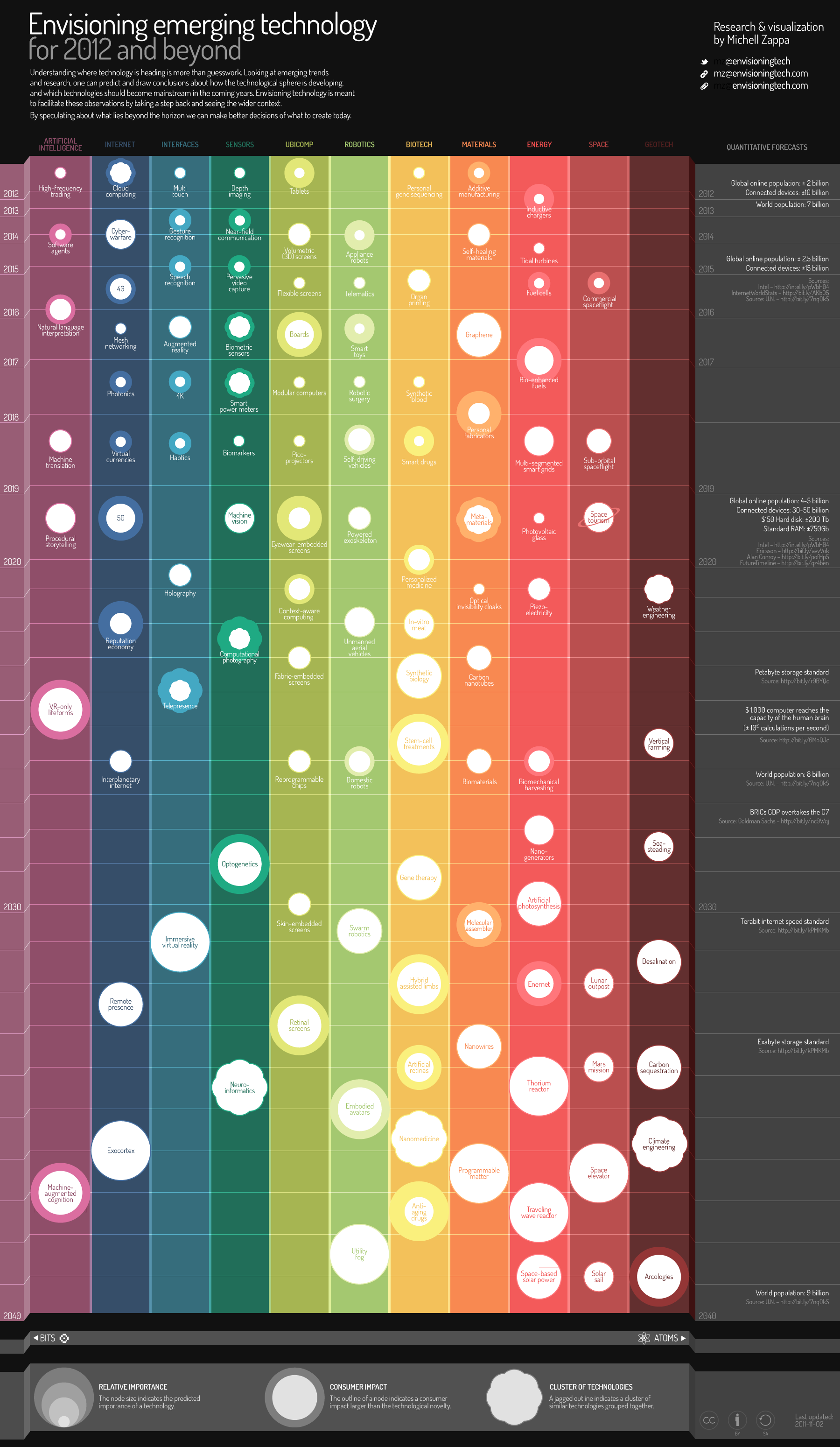
Envisioning Emerging Technology For 2012 And Beyond

Posted: 30 Dec 2011 05:30 AM PST

Click for interactive chart:

Source:
Envisioning Emerging Technology For 2012 And Beyond
Envisioning Technology, November 2011

2011 Markets: Lots of Motion, Nothing to Show For It

Posted: 30 Dec 2011 05:04 AM PST

Here we are, the final session for equity markets in Europe and the United States. As has been my habit forever, I take this week off to recharge (though it has not worked out that way). I feel comfortable doing this is because whatever happens this week is rarely of much consequence; markets tend towards a modest upward bias, with terribly light volume. The action is effervescent, gains or losses are easily reversed when volume comes back in.

This year, we have seen enormous swings, lots of volatility. Yet with the last session of the year about to begin, markets are essentially unchanged YTD:

S&P500:
December 31 2010 close: 1257.64
Yesterday’s close: 1,263.02
52-wk High 1,370.58
52-wk Low 1,074.77
Total Range (based on 2010 year end): 23.5%
YTD performance: 0.43%

Nasdaq Composite
December 31 2010 close: 2652.87
Yesterday’s close: 2613.74
52-wk High 2,887.75
52-wk Low 2,298.89
Total Range (based on 2010 year end): 22.20%
YTD performance: -1.48%

Dow Jones
December 31 2010 close: 11,577.51
Yesterday’s close: 12,287.04
52-wk High 12,928.50
52-wk Low 10,362.30
Total Range (based on 2010 year end): 22.17%
YTD performance: 6.13%

I will update these with year end data next week

.

Friday, December 30, 2011

DailyFX - Forex Market News

DailyFX - Forex Market News


FOREX: Euro Under Pressure, Aussie and Kiwi Rise as 2011 Winds Down

Posted: 29 Dec 2011 10:45 PM PST

The Euro came under pressure amid debt crisis fears while the Aussie and Kiwi Dollars rose with Asian stocks heading into the final trading hours of the year.

US Dollar Should Be Across the Board Outperformer in 2012

Posted: 29 Dec 2011 10:09 PM PST

With the Eurozone debt crisis still far from resolved and evidence of additional slowing in the Chinese economy, we see the US economy and US Dollar as the safest place to be in the year ahead…

Guest Commentary: Spain’s Muted Christmas Shopping

Posted: 29 Dec 2011 06:00 PM PST

The downturn in the Spanish economy is evident in rising unemployment, that reached 22.8%. Some thought that the euro-zone’s fourth largest economy will enjoy some mercy during the festive Christmas shopping season.

USD Index Poised For Higher High, Deflation Dampens Outlook For Yen

Posted: 29 Dec 2011 08:29 AM PST

The greenback is struggling to hold its ground during North American trade, with the Dow Jones-FXCM U.S. Dollar index falling back from a fresh weekly high of 10,062, and the reserve currency may continue to consolidate over the remainder of the week as market participation thins ahead of the New Year.

Guest Commentary: Gold & Silver Daily Outlook 12.29.2011

Posted: 29 Dec 2011 06:51 AM PST

Gold and silver sharply declined yesterday along with the rest of market including oil, Euro, and major stock market indexes.

Euro Outlook Turns Increasingly Bleak, Sterling Search For Support

Posted: 29 Dec 2011 06:15 AM PST

Market sentiment waned on Thursday following the disappointing bond action in Italy, but we may see the major currencies consolidate over the remainder of the week as market participation thins ahead of the New Year.

European Currencies Lag as Japanese Yen Leads Majors

Posted: 29 Dec 2011 05:32 AM PST

The Euro’s tailspin continued in the overnight, with the EUR/USD holding below 1.2900 for much of the overnight session leading up to trading in New York. The pressure on the common currency has dragged down its European counterparts, the British Pound and Swiss Franc, stirring demand for safety, particularly the Japanese Yen.
.

The Big Picture

The Big Picture


Why is the AFL-CIO Supporting Job Destroying SOPA ?

Posted: 29 Dec 2011 10:30 PM PST

Sopa Would DESTROY Jobs and the Economy … So Why are Unions Supporting It?

No, Sopa Would Not Save Jobs or Help the Economy … It Would DESTROY Jobs and the Most Vibrant Sector of Our Economy

The promoters of the Stop Online Privacy Act (Sopa) are pretending that it would save jobs and help the economy.

But it would actually destroy jobs and hurt the economy.

No one is going to invest in the next Facebook, Google, Yahoo, Reddit, or YouTube if they know that websites can be shut down after a single unsubstantiated copyright complaint.

The only sector of our economy that's in good shape is web technology (for example, Google is hiring like crazy right now). Sopa would put a huge dent in the web sector and destroy jobs.

Venture capitalist Fred Wilson notes:

Big companies . . . can afford to defend themselves from litigious content companies. But three person startups cannot. And Facebook, Twitter, and YouTube were three person startups not so long ago. If they had not had the protection of the safe harbors of the DMCA, they could have been litigated out of business before they even had a chance to grow and develop into the powerhouses they have become. And venture capitalists will think more than twice about putting $3mm of early stage capital into startups if they know that the vast majority of the funds will go to pay lawyers to defend the companies instead of to hire engineers to create and build product.

A group of well-known law professors say:

SOPA is a dangerous bill. It threatens the most vibrant sector of our economy – Internet commerce. It is directly at odds with the United States' foreign policy of Internet openness, a fact that repressive regimes will seize upon to justify their censorship of the Internet. And it violates the First Amendment.

Vice President Joe Biden admits:

The digital marketplace of ideas that welcomes every blog and tweet is the same one that inspires the next generation of innovators to fuel our economies. And when businesses consider investing in a country with a poor record on Internet freedom, and they know that their website could be shut down suddenly, their transactions monitored, their staffs harassed, they'll look for opportunities elsewhere.

The Hill points out:

SOPA is the equivalent of curing a headache with a guillotine. It may stop piracy, but it would shut down our economy and unconstitutionally erode our most basic freedoms in the process.

Edward J. Black – President and CEO of the Computer and Communications Industry Association – says:

The … legislation will also threaten the growth of the most economically dynamic and technologically innovative sector of the U.S. economy.

***

From an economic standpoint, the proposed legislation promises to saddle one of the U.S.'s most internationally competitive economic sectors with significant legal risk and a massive number of lawsuits — seriously hampering growth of and investment.

TechFreedom argues:

SOPA, regrettably, represents a big step backward in Washington's efforts to support the digital revolution, one of the only sectors of the economy that continues to grow.

A group of high-powered Internet leaders note:

We are concerned that these measures pose a serious risk to our industry's continued track record of innovation and job-creation, as well as to our Nation's cybersecurity.

David Ulevitch – CEO of OpenDNS – points out:

If passed, they will be devastating to the growth of the Internet economy in the United States, will take jobs overseas and will have a chilling effect on innovation.

Andrew Lee – CEO of ESET North America – writes:

This legislation, if passed as currently written, would have a chilling effect on the economy of the United States.

The San Jose Mercury News editorializes:

There are times when Silicon Valley really can help you understand the complexities of legislation that will affect the tech industry – and the world economy. The raging debate over the proposed Stop Online Piracy Act is one of those times. . . . It's not just the future of the industry that's at stake here. It's national security.

The Atlantic argues:

Congress is considering sweeping Internet legislation that purports to target "rogue websites" with the intent of cracking down on the theft of everything from movies to songs to designer handbags. While the goal is laudable, too many innocent websites would wind up in the crosshairs. These bills (the PROTECT IP Act in the Senate and the Stop Online Piracy Act, or SOPA, in the House) would do more harm than good to cybersecurity, the Internet economy, and online free expression.

The Daily Caller writes:

The Stop Online Privacy Act (SOPA) — a bill currently before the House Judiciary Committee — is a threat to America's ability to lead the Internet, and must be defeated before it has a chance to damage America's ability to generate jobs and economic growth online.

TechDirt notes:

SOPA & PIPA don't attack the real problem, do nothing to build up the services that do solve the problem, and won't work from a technological standpoint. And that's just if we look at the what these bills are supposed to do.

The real fear is the massive collateral damage these bills will have to jobs, the economy and innovation.

Why Are Unions Supporting It?

The AFL-CIO, Teamsters Union, International Brotherhood of Electrical Workers and some other unions are supporting Sopa. Their uneducated position gives cover to the other knuckleheads still supporting the bill.

Given that Sopa would destroy jobs and the economy – and is contrary to their members' and the nation's interest – everyone should immediately educate the unions and pressure them to withdraw their support.

A Visual History of the American Presidency

Posted: 29 Dec 2011 03:30 PM PST

click for ginormous version

Source:
(Timeplots)

Work Smart: The Power Of Circles

Posted: 29 Dec 2011 12:30 PM PST

Scott Belsky is the CEO of Behance, a company that develops products and services for creative industries. He is also the author of Making Ideas Happen: Overcoming the Obstacles Between Vision and Reality.

What Happened To My Country?

Posted: 29 Dec 2011 11:00 AM PST

My father was a real estate appraiser.

He started out as an engineer, but that lasted less than a year, he wasn’t an ass-kisser, he couldn’t play the game, he was bounced out.

So he opened a liquor store and tried his hand at commercial real estate. Unsuccessfully, because he didn’t have enough money to purchase property.

Trying to improve his lot in life, he relocated the package store next to an exit by the newly-finished I-95, otherwise known as the Connecticut Turnpike. And when redevelopment hit Bridgeport, his friend Maury Magilnick said no one knew as much about local real estate as my dad, and if he became an appraiser, he’d hire him.

My father spent a week at UConn. Another at the University of Chicago. He got licensed. And with his engineering background and his natural acumen he became a legend in the state, Attorneys General feared him, and my dad garnered the income of a doctor or a lawyer, he sent three children to private universities and graduate schools.

That dream is dead today.

I’m in Vail, Colorado. My family started skiing when I was ten. Used to be an egalitarian sport, you saw Beetles in the parking lot, sandwiches were de rigueur in the base lodge, brought from home. Skiers were not the upper crust, they were us.

No more.

So I’m riding up the lift with a fourth year medical student. I ask him what he’s gonna be.

“An anesthesiologist.”

Why? Because he loves it? No, because he can make good bread and vacation and live the high life.

I’d like to tell you I met some musicians on the lift, some regular people, but I kid you not when I tell you the only people I met were in finance. Oh, and there was one dentist.

They traded for the family account. They were “consultants”. They worked for hedge funds. They had their own private ski instructors, at $700 a day. They were the 1%.

And everybody in America is scrambling to get into the club.

That’s what’s wrong with the music business. The executives want to be as rich as the bankers, they too want to fly in private jets and tip with hundred dollar bills. What is the right tip these days? For a ride through town? I’m thinking $20, because the bankers have driven up the rate and the employees expect it and they’re struggling to make ends meet.

I grew up in the sixties. We were all in it together. Sure, my dad told me to be a lawyer, so he didn’t have to worry about me, but instead of taking the LSAT, I went to Montreal. There were no corporate recruiters on campus. Life was about personal fulfillment.

But now life is about money.

Either you’ve got it or you’re struggling to get it.

That wannabe anesthesiologist? He’s a Republican. He doesn’t want socialized medicine and he doesn’t want taxes.

Nobody wants taxes. Everybody thinks life is a personal struggle, that there’s no common infrastructure, no freeways, no police department, no power utility.

What’s mine is mine.

And if you don’t watch out, I’m gonna take yours.

No wonder musicians sell out to the Fortune 500. They too want to be rich. But the joke is upon them, they can never be that rich, the corporations laugh at them, they’re pawns in their game.

We live in a completely duplicitous country where no one’s honest, no one does what he believes in, everybody’s just motivated by the money.

And the problem?

PUBLIC EMPLOYEES!

Those teachers ruined the economy. Hell, you can barely make it on a teacher’s salary, you can’t vacation in Vail, Colorado, you’re closed out.

And somehow we accept all this. We shrug our shoulders and say it’s the way it is and will always be.

Why?

I feel like I’ve been asleep for thirty-odd years. While I was pursuing my dream, everybody else was pursuing the dollar. Reagan made greed legitimate and the baby boomers filled that hole and now their kids want more of the same. They just want to play on their hand-helds and feed at the trough. No one wants to innovate, they just want to get rich.

Ever speak to someone in finance? It’s a rare bird who likes it.

They do it for the money.

And with this money they buy up those concert tickets so you can’t get a good seat. They’ve got a shortage of time. When they get to the amusement park, they want to close you out. Get concierge treatment, cut the line…and you think this is okay because you think you’re gonna be rich too.

Ain’t that a laugh.

At least at Middlebury I saw what rich was.

Most people can’t afford a private college education any longer. 50k a year? Hell, public education keeps going up and up. Most people never even get into the game they think they’re gonna win.

There’s a ruling class, pulling the strings, and you’re not a member.

This is not a Democratic or Republican issue. This is a money issue. Money’s corrupted the system. You’ve got to be on the take to get elected. So you’re beholden to the corporations, not the people.

But you’ve read Steve Jobs’s biography and you think you’re gonna make it.

Don’t you get it? The odds of music success are infinitesimal, all the things you want most musicians haven’t got, a house, a spouse, kids, health insurance…

Don’t be angry with me.

And don’t be angry with the music business titans, keeping you out. They’re just worrying about themselves, they don’t care about you, they just want to live in a gated community and vacation where you aren’t.

They’re revolting in Russia. And they overthrew the government in a bunch of Middle Eastern countries. And if you don’t think it can’t happen here, you’re nuts.

Everybody thinks just because people have flat screens, they’re happy. But have you been following the shenanigans in cable? You’re paying for all this stuff you don’t watch just to keep rich people rich.

Music is a game for the poor. A place where the uneducated with no status can get a bit of notoriety and money. And as long as someone makes it, no one pays attention to the real problem.

The game is rigged.

You’re gonna be left behind unless you start making yourself number one and doing what’s expedient to get ahead.

What kind of country is that?

Not one I want to live in.

P.S. That great middle class of yore? It created the classic rock you’re still listening today. Music was a reasonable pursuit, rock stars were as rich as anybody in America. That framework expired decades ago, rock stars are no longer rich. There are bankers who make $20 million a year every year! So the Grace Slicks of today, people born with a silver spoon in their mouths, don’t go into the arts, it just doesn’t pay. Tom Rush was a Harvard graduate. He revolutionized the folk circuit, he pioneered the singer-songwriter game. Now we’ve just got poor people rapping about Benzes and boats. How fulfilling is that? I get it, they want in. But you used to follow your dreams, not the dollar. But now if you ain’t got the moolah, you’re gonna have a heart attack and no health insurance and you’re gonna be bankrupted. Hell, the dirty little secret is one health episode puts many people in bankruptcy even when they have insurance! But we’ve got to have less corporate regulation and as far as
health insurance goes…you’re on your own. Don’t you see, health insurance is a metaphor for our entire country! Can you imagine someone writing “Get Together” today? Come on people now, smile on your brother, everybody get together and love one another right now… Who sings about that? Chumps.


Visit the archive: http://lefsetz.com/wordpress/

http://www.twitter.com/lefsetz


If you would like to subscribe to the LefsetzLetter,

http://www.lefsetz.com/lists/?p=subscribe&id=1

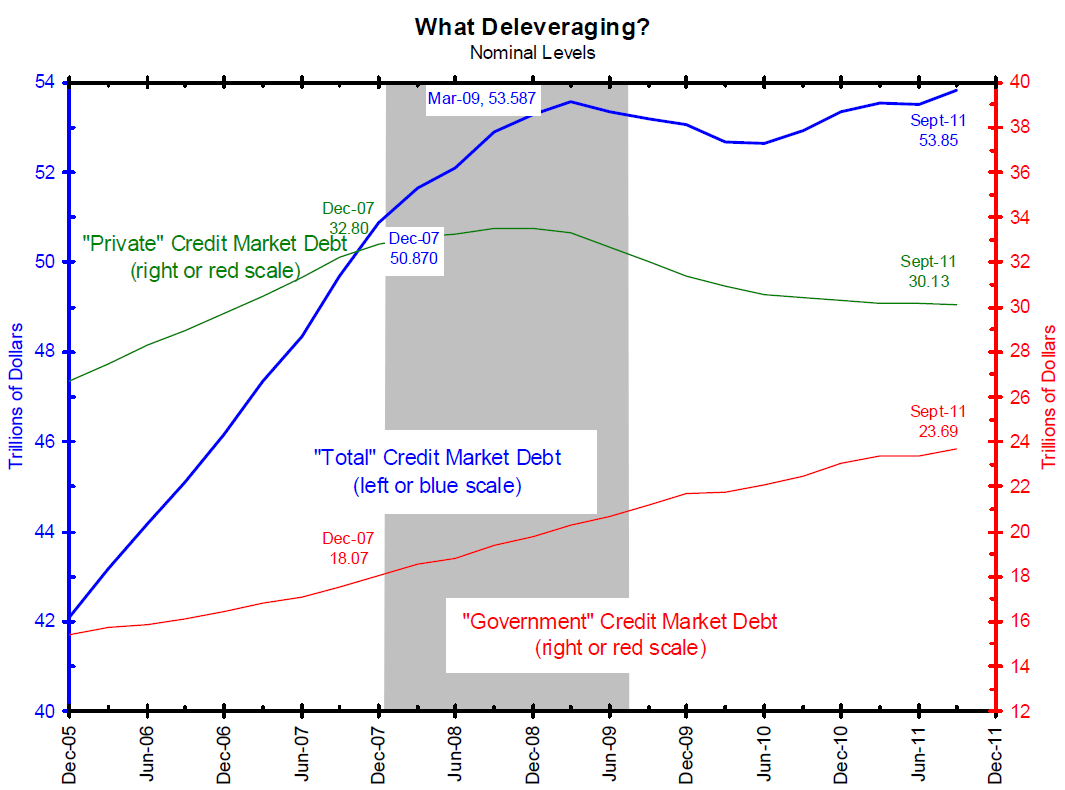
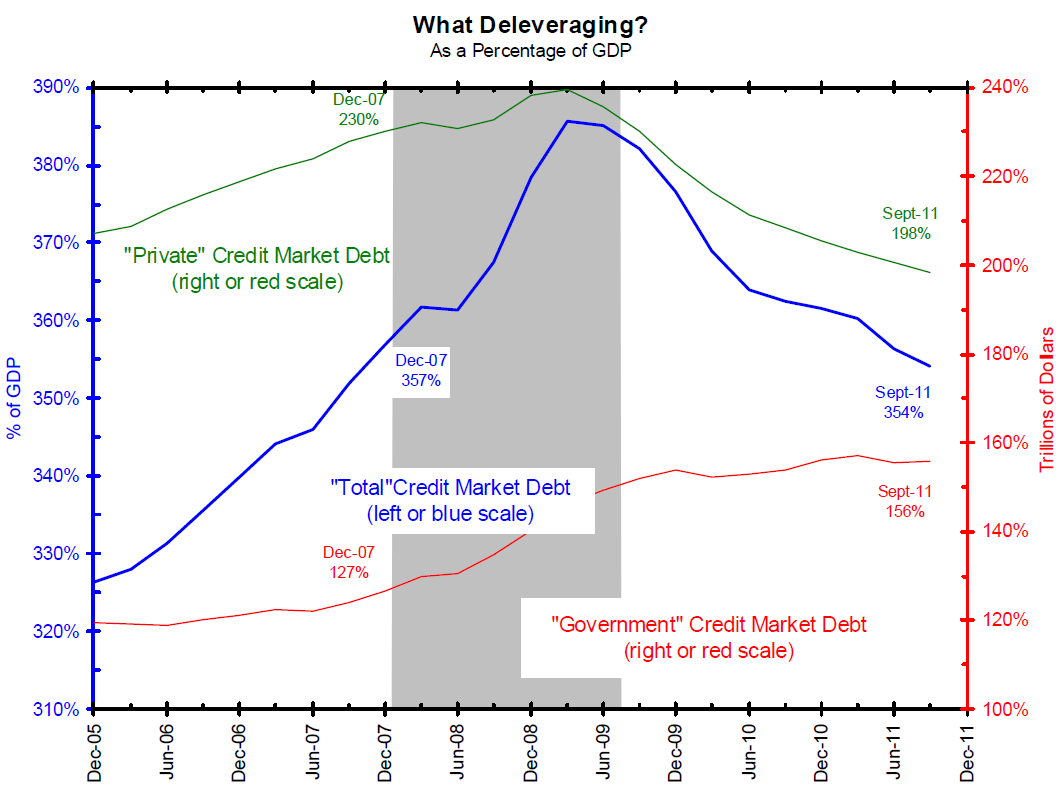
What Deleveraging?

Posted: 29 Dec 2011 10:15 AM PST

What is this deleveraging you continue to babble about . . . ?

Click to enlarge charts:

˜˜˜

˜˜˜

Source:
Bianco Research LLC
Charts Of The Week Updated
Pictures of Current Interest
For the week of December 14, 2011

2011: A Year in Review (video)

Posted: 29 Dec 2011 09:53 AM PST

2011 was a year of conflict, a year of tragedy, and for some a year of hope. WSJ takes a look back at the most important news and events of the year.


12/24/2011 11:19:19 AM

GIC Conference: Warsaw and Krakow, Poland May 23-27, 2012

Posted: 29 Dec 2011 09:00 AM PST

"Economies of the Baltic Sea Countries and Their Capital Markets: A Sustainable Recovery? "

Join the Global Interdependence Center as we examine the economies of the Baltic Sea region. How have their experiences led to economic recovery and is it sustainable?
Confirmed Speakers Include:

Marek Belka, President, Bank of Poland
Jeffery Lacker, President, Federal Reserve Bank of Richmond
Governor Stefan Ingves, Sveriges Riksbank
Governor Nils Bernstein, Danmarks Nationalbank
David Kotok, CIO, Cumberland Advisors and GIC Program Chair

The conference will conclude with a private roundtable discussion on the 26th.
Participants will have a one-of-a-kind opportunity to tour some of Poland's most historic places including the Old Town and Ghetto of Warsaw, Basilica and Library at Czestochowa, guided tour of Auschwitz and Birkenau, and a guided tour of Old Town Krakow.

Registration*

Members $250 / Non-Members $350 (includes one year membership)
Registration is available online at
http://www.interdependence.org/programs/economies-of-baltic-sea-countries-and-their-capital-markets-a-sustainable-recovery/
*Touring options are not included in registration price. Participants will be able to register for different tours at an additional cost.
For more information contact Jillian Fornito, jfornito@interdependence.org

The Global Interdependence Center
3701 Chestnut St. Philadelphia, PA 19104 • 215.898.9453 •Fax: 215.898.0893
www.interdependence.org

Agenda

May 22, 2012 – Arrival in Warsaw

May 23, 2012 – Tour of Old Town & Ghetto, Welcome Dinner

May 24, 2012
Private Conference with National Bank of Poland
Session I: Current State and Outlook of Polish Economy
Marek Belka, President, National Bank of Poland
Session II: Monetary Policy in the Environment of Recovery: Experiences of Baltic Sea Countries
Moderator: Marek Belka, President, National Bank of Poland
Participant: Jeffery Lacker, President, Federal Reserve Bank of Richmond
Participant: Governor Stefan Ingves, Sveriges Riksbank
Participant: Governor Nils Bernstein, Danmarks Nationalbank
Conference with Polish Academy of Sciences
Session I: Economic Interdependencies among the Capital Markets of the Baltic Sea Region

May 25, 2012 – Travel to Krakow via Czestochowa – Depart Warsaw via Chartered Bus
Tour Basilica/Library at Czestochowa
Unveiling of the Black Madonna
Arrive in Krakow

May 26, 2012
Private Roundtable Discussion
Guided tour of Old Town, including Church

May 27, 2012
Guided Tour of Auschwitz and Birkenau
Hotel Information
Sheraton Warsaw, May 22-23-24, 2012
Double Occupancy 630PLN ($190*)/night, or Single Occupancy 558PLN ($168*)/night
Book online: http://www.startwoodmeeting.com/StarGroupsWeb/res?id=1112135746&key=7C094
Rooms must be booked by April 22, 2012
Sheraton Krakow, May 25-26-27, 2012
Double Occupancy 655PLN ($197*)/night, or Single Occupancy 595PLN ($179*)/night
Book online: http://www.starwoodmeeting.com/StarGroupsWeb/res?id=1112064904&key=AB4
Rooms must be booked by April 16, 2012

*Exchange rate as of December 19, 2011

Source:
Cumberland Advisors Commentary
GIC Conference: Warsaw and Krakow, Poland May 23-27, 2012

Economic data

Posted: 29 Dec 2011 07:38 AM PST

Nov Pending Home Sales rose 7.3%, much better than expectations of a gain of 1.5% and follows a 10.4% rise in Oct. All 4 regions of the country saw gains in contract signings with the West showing the biggest rise. The NAR chief economist is saying some of the gains may be “from buyers recommitting after an initial contract ran into problems, often with the mortgage.” The NAR is also saying that historical pending home sales are not being readjusted as with the existing home sales data as the calculations of both use different methodologies. Bottom line, whether due to even lower prices, historically low mortgage rates, falling inventory and a better tone to the labor market or a combination of all, the housing market is showing signs of stabilizing. I say stabilize instead of bottom as its too early to make that claim just yet with still a huge amount of foreclosure that hasn’t worked its way through the judicial system and prices that haven’t likely stopped going down as a result.

Following the better than expected NY and Philly mfr’g surveys and weaker than forecasted Richmond and Dallas mfr’g reports, the Chicago PMI at 62.5 was 1.5 pts above estimates but flattish with Nov. New Orders fell to 68 from 70.2 but that’s off the best since March. Backlogs rose 2.8 pts to the best since April. Employment rose 1.7 pts but after falling 5.4 pts in Nov. Inventories fell 1.4 pts to 52.2. Prices Paid rose 5.5 pts to back in line with the 6 month average. Bottom line, in light of the concerns with Europe, manufacturing is still hanging in there but the ISM next week needs to be seen to both reconcile the regional surveys but to also show us the all important EXPORT component which the regional reports don’t have.

Initial Jobless Claims totaled 381k, 6k more than expected and up from 366k last week (revised up by 2k). To smooth out the recent level due to the holiday and unusual seasonals, the 4 week average fell to 375k from 381k, the lowest since June ’08. Continuing Claims rose by 34k but Extended Benefits fell a net 8k. With another extension of unemployment benefits agreed upon before the expiration of the current one, we’ll thus see no disruption in the claims data. Bottom line, initial claims are running below 400k now for the 7th week in the past 8 but it still doesn’t answer the question of when the pace of hiring’s will pick up to a higher and more sustainable level from where we’ve been.

EU Crisis: The Graphic Novel Edition

Posted: 29 Dec 2011 07:30 AM PST

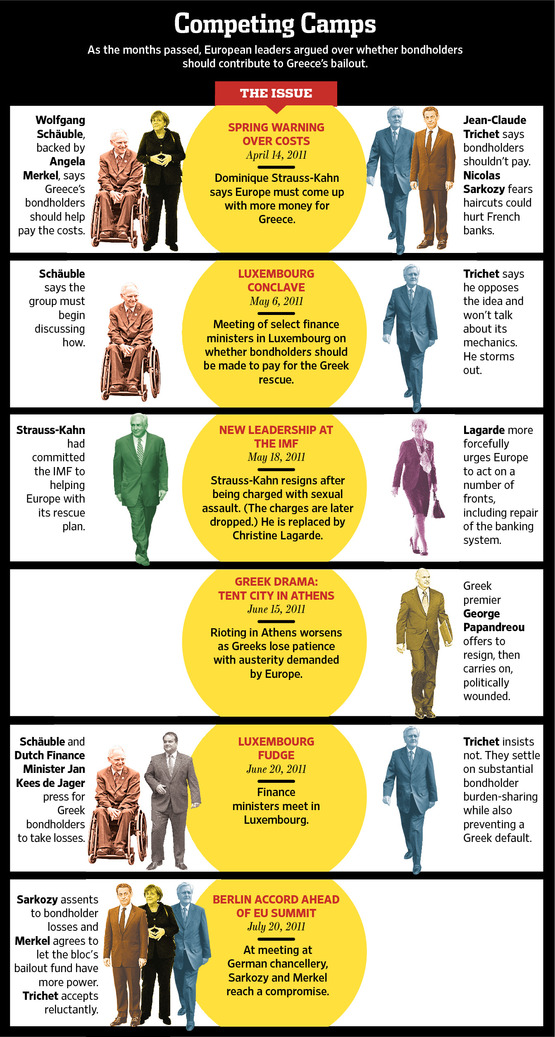
Huge story in the WSJ about how Europe almost caused another global collapse. The same could be said for the US Congress and the debt ceiling debate, which led to the downgrade and ugly August.

Regardless, the paragraphs below sets the tone, but what I really liked were the graphic novel illustrations that accompanied the piece. (click any of thesefior  larger versions).

All of which begs the question: When will we get a graphic noel about the EU crisis?

Here’s the Journal:

At a closed-door meeting in Washington on April 14, Europe’s effort to contain its debt crisis began to unravel. Inside the French ambassador’s 19-bedroom mansion, finance ministers and central bankers from the world’s largest economies heard Dominique Strauss-Kahn, then-head of the International Monetary Fund, deliver an ultimatum.

Greece, the country that triggered the euro-zone debt crisis, would need a much bigger bailout than planned, Mr. Strauss-Kahn said. Unless Europe coughed up extra cash, the IMF, which a year earlier had agreed to share the burden with European countries, wouldn’t release any more aid for Athens.

The warning prompted a split among the euro zone’s representatives over who should pay to save Greece from the biggest sovereign bankruptcy in history. European taxpayers alone? Or should the banks that had lent Greece too much during the global credit bubble also suffer? The IMF didn’t mind how Europe proceeded, as long as there was clarity by summer. “We need a decision,” said Mr. Strauss-Kahn.

It was to be Europe’s fateful spring. A Wall Street Journal investigation, based on more than two dozen interviews with euro-zone policy makers, revealed how the currency union floundered in indecision—failing to address either the immediate concerns of investors or the fundamental weaknesses undermining the euro. The consequence was that a crisis in a few small economies turned into a threat to the survival of Europe’s common currency and a menace to the global economy.

I suspect the key to the graphic novel is coming up with the appropriate super hero costume for each political figure . . .

>
click for larger graphic

>

Source:
Dithering at the Top Turned EU Crisis to Global Threat
CHARLES FORELLE and MARCUS WALKER
WSJ, DECEMBER 29, 2011
http://online.wsj.com/article/SB10001424052970203518404577094843835831390.html

End of Corn Ethanol?

Posted: 29 Dec 2011 06:00 AM PST

I listed these two articles in the morning reads, but I am so delighted over this that I had to make sure you did not miss this: Congress has apparently failed to extend the corn ethanol subsidy, a terrible energy idea that has subsidized the burning of food/corn for 30-years.

It is unclear whether this has simply lapsed, and has not been renewed yet or if the wasteful, engine damaging, negative-net-energy Corn Ethanol nightmare is finally over.

Here is the Detroit News:

The United States has ended a 30-year tax subsidy for corn-based ethanol that cost taxpayers $6 billion annually, and ended a tariff on imported Brazilian ethanol.

Congress adjourned for the year on Friday, failing to extend the tax break that’s drawn a wide variety of critics on Capitol Hill, including Sens. Tom Coburn, R-Okla., and Dianne Feinstein, D-Calif. Critics also have included environmentalists, frozen food producers, ranchers and others.

The policies have helped shift millions of tons of corn from feedlots, dinner tables and other products into gas tanks.

What this means is that the domain “ihatecornethanol.com” is now for sale . . .

>

Source:
Congress ends corn ethanol subsidy; Trade group expects industry to ‘survive’
David Shepardson
The Detroit News, December 24, 2011  
http://www.detroitnews.com/article/20111224/AUTO01/112240320/1148/rss25

30-year-old corn ethanol subsidy nixed by Washington
Dan Roth
Autoblog, Dec 27th 2011 11:31AM 
http://www.autoblog.com/2011/12/27/30-year-old-corn-ethanol-subsidy-nixed-by-washington/

.
previous home Next

{8} chatroll


{9} AdBrite FOOTER

{8} Nice Blogs (Adgetize)