


The Big Picture |

- Media Appearance: The Kudlow Report (4/28/11)
- Anatomy of a Conspiracy Theory. . .
- Energy Policy: Mark Fisher and Barry Ritholtz
- Missing Best & Worst Days in Markets
- 7 Reasons Leaders Always Fail to See Catastrophe Coming
- What’s Changed Since The Flash Crash
- Economic data
- Why Technology Price Drops Are Not Proof of Deflation
- Fight of the Century
- An unfortunate broken record
| Media Appearance: The Kudlow Report (4/28/11) Posted: 28 Apr 2011 03:00 PM PDT
> Back on the Kudlow Report at 7:00 pm this evening with Vince Farrell. We will be discussing Markets, the Fed, and Inflation. My takeaway:
We are looking to add more trades opportunistically, we are now 90/10 long cash, with no shorts (which feels dangerous to me emotionally) ~~~ Videos posted later |
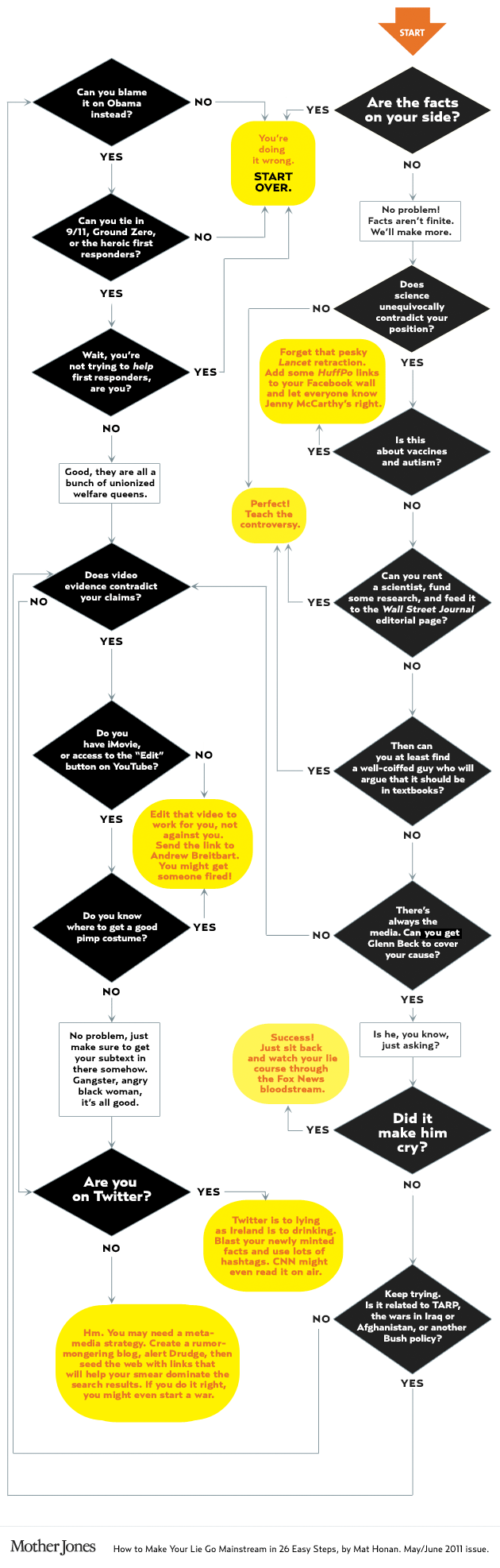
| Anatomy of a Conspiracy Theory. . . Posted: 28 Apr 2011 12:30 PM PDT . . . or, how to fool the gullible amongst us in 26 easy steps! > Click for larger graphic MoJo via boingboing |
| Energy Policy: Mark Fisher and Barry Ritholtz Posted: 28 Apr 2011 11:09 AM PDT Author Barry Ritholtz and Mark Fisher, CEO of MBF Asset Management discuss how Chairman Ben Bernanke addressed the rising commodity prices in his news conference on Wednesday.
Visit msnbc.com for breaking news, world news, and news about the economy |
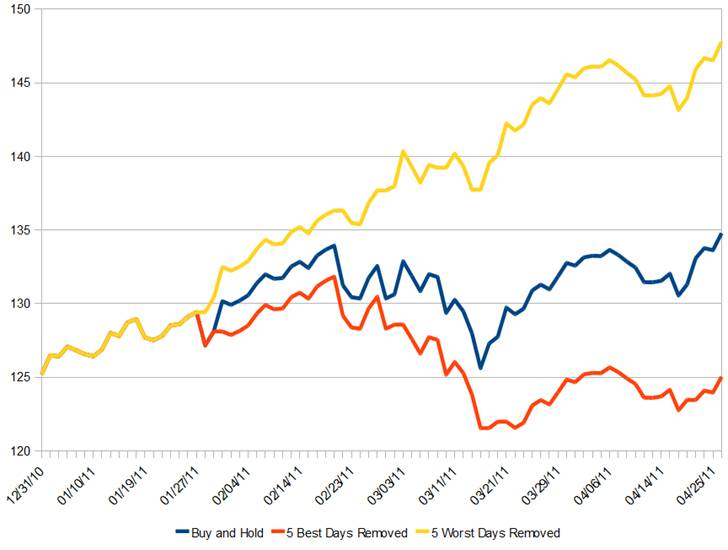
| Missing Best & Worst Days in Markets Posted: 28 Apr 2011 10:15 AM PDT It has been a while since we last showed a Best & Worst days chart, so we are overdue for another update. Today’s version is courtesy of Mike Gayed of Pension Partners, and it shows what your returns look like if you were merely a Buy & Hold investor, if you were unlucky enough to miss the 5 best days, or lucky enough to avoid the 5 worst ones: Missing the 5 Best/Worst Days, S&P500
> Previously: |
| 7 Reasons Leaders Always Fail to See Catastrophe Coming Posted: 28 Apr 2011 08:44 AM PDT Paul Farrell notes that “Many, many experts did predict and warn of the 2008 meltdown years in advance.” Yet it seems that business, finance and political leaders ALWAYS fail to see the next collapse coming. Why is that? To answer this, Farrell channels Jeremy Grantham:
Farrell enumerates seven reasons this always has, and is likely again, to lead to more trouble. He advises you to not forget any of the following elements:
File this away, and look back at it in a few years — I like to do that with Outlook or Yahoo Calendars, and get a pop message. This one is scheduled for 2014 . . . > Source: |
| What’s Changed Since The Flash Crash Posted: 28 Apr 2011 07:56 AM PDT From Sal Arnuk, Co-authored with R.T. Leuchtkafer: THEM — Analysis — Whats Changed Since the Flash Crash — FINAL 04 25 11 (2) |
| Posted: 28 Apr 2011 06:47 AM PDT March Pending Home Sales rose 5.1% m/o/m, better than expectations of a gain of 1.5% but is still down 11.5% y/o/y which was boosted by the tax credit. The best gain was seen in the South where contract signings rose by 10.3%. The West and Midwest also saw gains while the Northeast region saw a drop of 3.2%. This data is seasonally adjusted but we are in the best season of the home buying business and we’ll see how many of the contract signings translate into closings because of the repeated issues of tight lending standards and appraisal issues. With respect to the overall economic data seen of late, there has been a moderation relative to expectations and likely explains why the 10 yr note yield is matching the lowest level in 6 weeks, notwithstanding the daily depreciation in the US$ and repeated highs in US stocks. Initial Jobless Claims disappointed for a 3rd straight week totaling 429k, 34k higher than expected and up from 404k last week. It’s the highest since the end of Jan. The 4 week average is now back above 400k at 409k. Continuing claims, delayed by a week, fell by 68k and Extended Benefits, delayed by two weeks, fell by a net 76k. Bottom line, the trend over the past few weeks is clearly disappointing as signs were pointing to a more sustainable pick up in the labor market. It is likely though that with the growing concern with rising commodity prices as co’s do their best to maintain margins combined with uncertainty for those that rely on Japan, a short term reluctance to expand is occurring. Q1 Real GDP rose 1.8% annualized, below expectations of 2% and Nominal GDP was up just 3.7% vs the forecast of 4.3%, thus a price deflator .4% below forecasts prevented Real Q1 GDP from coming in even less than estimated. While Personal Consumption rose a better than expected 2.7% (est 2.0%) and spending on equipment and software rose a solid 11.6%, construction, trade and government spending (led by defense and local gov’t) were a drag. Inventories added about 1% pt to GDP. Of noticeable weakness, Real Final Sales which take out inventory, rose just .8%, the weakest since Q3 ’09. Bottom line, some factors that negatively influenced Q1 GDP (such as weather) some believe will reverse over the next few quarters and that this slowdown will be reversed as the consensus for the next few Q’s are 3%+. A positive influence in the 2nd half of ’11 will be co’s taking advantage of the accelerated depreciation for R&D with a bump in cap ex which will reverse in ’12. With this said, overall GDP growth is only averaging 2.3% so far in this recovery. |
| Why Technology Price Drops Are Not Proof of Deflation Posted: 28 Apr 2011 05:30 AM PDT
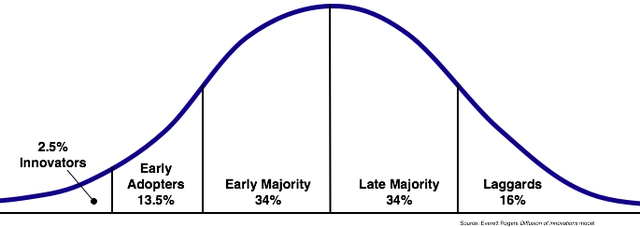
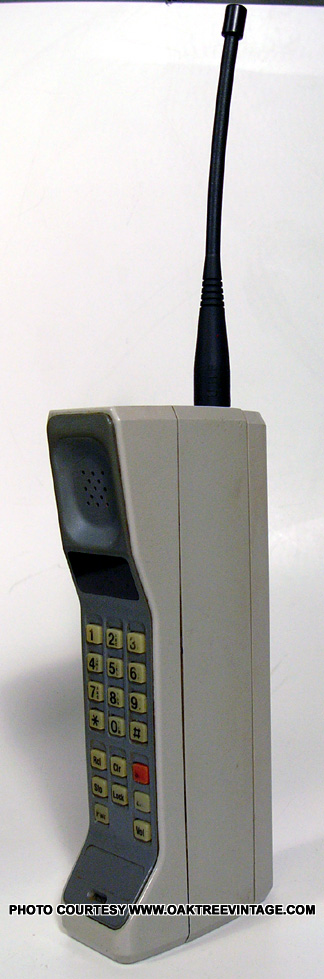
With everyone so focused on Inflation, I (naturally) want to discuss Deflation. Or rather, the lack of it in Technology prices. Instead, lets look at the Recency Effect and the life cycles of new tech products. Technology poses a special challenge to the hordes of inflation watchers — Larry Kudlow calls them inflationistas. During the 2000s, this crowd completely missed the biggest inflationary spike since the 1970s until Oil was well over $100 and foodstuffs had skyrocketed. This was after decades of ignoring ballooning medical and college costs. Having missed the last run up in prices, this same crowd now sees hyper-inflation everywhere. There seems to be an inability to understand how CPI is officially constructed, and why it typically understates inflation. Complicating matters is the challenge of recognizing the impact of Technology, and how it create the appearance of deflation. The key is understanding Technology’s normal adaptation cycle, what this means for cyclical pricing declines, and why falling prices do not automatically equate with Deflation. The Fed gets this wrong. Wall Street misunderstands this. Most economists seem not to recognize qualitative difference between the 1st Big Screen TV that rolls of the assembly line and the 10 millionth. (Those who want to delve into the finer wonkish points about this can see the Technology adoption lifecycle by Joe M. Bohlen and George M. Beal, (1957), later refined in Everett M. Rogers’ Diffusion of Innovations). Consider this simple factoid: New technologies and products come down in price over time, regardless of the state of the economy, Fed monetary policies, Federal stimulus, or even income inequality in the broader society. If tech prices are independent of the Fed and Congress and money supply and the value of a dollar, then its hard to say (as so many do) that this is deflationary per se. It is a simple fact of adoption cycles, and not the usual drivers of inflation. Whether we are discussing washing machines, radios, auto airbags, cellphones, or even PCs — all manufactured goods go through a well established adoption process. In the classic definition (see chart below), the first group of people to use any new technology are called “innovators,” followed by “early adopters,” then the “early majority” and “late majority,” and lastly, the “laggards.” > Technology Adoption Lifecycle
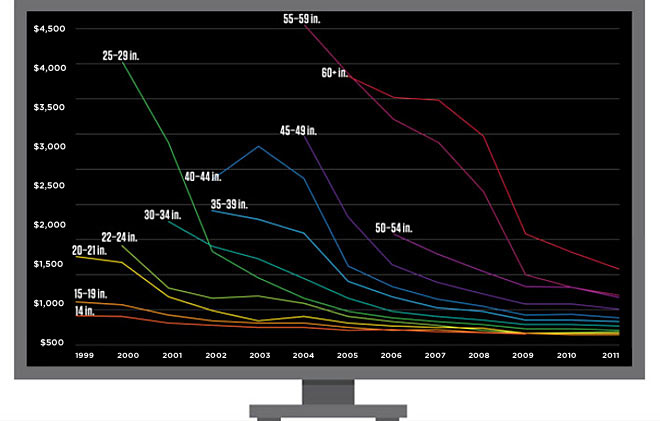
> The key to understanding this is recognizing the differences in perceived social status value of these products. The impact of this adoption process and the manufacturing economies of scale are significant determinant of technology product prices. But understand the following: What the Innovators buy is a very different product qualitatively — in terms of social status and perceived value – than what the laggards purchase. Here is a grossly over-simplified version of how this works: When innovators buy a product, they essentially pay for all of the R&D costs, and other development expenses. You paid 365 labor units for a VCR in 1972 because they were a limited production, custom product that was practically hand made. When a PC cost 465 labor units, chip fabs were nowhere near as plentiful as today — and the biggest cost in early PCs were the exorbitant chipsets contained in them. Let’s take a closer look at the perceived social status value of these products: When you are the only person in town in 2000 who has a 50 inch flat screen TV — and it cost $10,000 — there are non-monetary, status benefits of ownership. Compare that in 2010, when EVERYONE has a big screen, thanks to the cheap Korean flatties sold for less than $600 at Best Buy. The claim that the price drop is deflationary assumes these two products are nearly identical, and further ignores irrational human behavior regarding these early innovator purchases. These products are not identical, at least in terms of the value conferred social value of status-seeking consumers. The early adopters pay less than the innovators, as factories get built to mass produce chips or tape transport mechanisms or cell phone keypads. But they also buy a product with lower social status. What was a nearly custom made product becomes a merely limited-production, high-end one. Where the innovators paid for the R&D, the early adopters paid for the fabs and factories to be built.
But the status associated with being the very first to own this is why the Innovators pay more for these products. And its also why the 100 millionth 50 inch television screen to roll off the assembly line has no status associated with it — where has the first few 1000 had massive status attached to it. Technology adoption cycles reflect this in their price changes. Technology price decreases across their production life cycle are not only about industrial economies of scale — they are also about the decreasing status of an object as it becomes an everyday household product. > Previously: |
| Posted: 28 Apr 2011 05:00 AM PDT > Be sure to check out “Fight of the Century: Keynes vs. Hayek Round Two” posted earlier today in our video section. Great fun, educational stuff > |
| Posted: 28 Apr 2011 04:24 AM PDT The US$ index is down for an 8th straight day with gold rising to another record high. This is becoming an unfortunate broken record but the pace of declines have picked up as it’s down 3% over these 8 days. Bernanke yesterday said maintaining the purchasing power of the $ is a Fed goal by keeping inflation in check. Here is the report card on that using the CPI: since Bernanke took office on Feb 1, 2006, the purchasing power of the US$ is down 11%, it’s down 21% over the past 10 yrs, down 82% since the gold standard was ended in 1971 and down 91% since 1920. In Asia, the Shanghai index fell for a 5th straight day and is down 4.5% over this period as the Yuan moved to another high and expectations grow that another rate hike is coming soon. The Nikkei on the other hand rallied to the highest level since the earthquake. AAII: Bulls 37.9 v 32.2 Bears 30.7 v 31 |

| You are subscribed to email updates from The Big Picture To stop receiving these emails, you may unsubscribe now. | Email delivery powered by Google |
| Google Inc., 20 West Kinzie, Chicago IL USA 60610 | |
 The Big Picture (ritholtz)


0 comments:
Post a Comment