.

{2} GoogleTranslate (H)

English French German Spanish Italian Dutch Russian Portuguese Japanese Korean Arabic Chinese Simplified

Our New Stuff

{3} up AdBrite + eToro

Your Ad Here

Tuesday, May 3, 2011

The Big Picture

The Big Picture


Bin Laden Is Dead … But Why Didn’t We Kill Him 10 Year Ago?

Posted: 02 May 2011 11:00 PM PDT

President Obama announced tonight that U.S. special forces killed Osama Bin Laden.

That’s great … but we could have killed him years ago.

As I noted in 2009:

According to the U.S. Senate – Bin Laden was “within the grasp” of the U.S. military in Afghanistan in December 2001, but that then-secretary of defense Rumsfeld refused to provide the soldiers necessary to capture him.

This is not news: it was disclosed in 2005 by the CIA field commander for the area in Afghanistan where Bin Laden was holed up.

In addition, French soldiers allegedly say that they easily could have captured or killed Bin Laden in Afghanistan, but that the American commanders stopped them.

***

A retired Colonel and Fox News military analyst said that the U.S. could have killed Bin Laden in 2007, but didn’t:

We know, with a 70 percent level of certainty — which is huge in the world of intelligence — that in August of 2007, bin Laden was in a convoy headed south from Tora Bora. We had his butt, on camera, on satellite. We were listening to his conversations. We had the world's best hunters/killers — Seal Team 6 [Note: this is the exact same team that is credited with killing Bin Laden yesterday] — nearby. We had the world class Joint Special Operations Command (JSOC) coordinating with the CIA and other agencies. We had unmanned drones overhead with missiles on their wings; we had the best Air Force on the planet, begging to drop one on the terrorist. We had him in our sights; we had done it ….Unbelievably, and in my opinion, criminally, we did not kill Usama bin Laden.

Indeed, a United States Congressman claims that the Bush administration intentionally let Bin Laden escape in order to justify the Iraq war.

Similarly, Cenk Uygur pointed out:

The New York Times reported … that we sent in 36 U.S. Special Forces troops to get Osama bin Laden when we knew he was in Tora Bora. By contrast, we sent nearly 150,000 soldiers to get Saddam Hussein. In case you’re keeping count at home, we got Saddam and we didn’t get Osama. What does that tell you about this administration's priorities? This goes beyond incompetence. If you send only 36 soldiers to get somebody in the middle of Afghanistan, it means you don't want to get him…

Osama had about 1,500-2,000 well-armed, well-trained men in the region. 36 guys to get 2,000? Why would we let ourselves be outgunned like that?…

There is an inescapable fact – if you put this little effort into capturing someone, it means you don't want to capture him.

***

If people inside the administration actually held back from capturing Osama bin Laden when we had him cornered, it borders on treason.

Postscript: Of course, some people claim that Bin Laden was actually killed years ago. But as I pointed out in 2009, whether or not he was alive or dead was less important than the fact that the American government pretended that he was a supremely powerful boogeyman who justified an endless and all-consuming war on terror:

Many people claim that Bin Laden died a long time ago. According to Israeli intelligence, Pakistani intelligence, and other sources, Bin Laden is dead.

According to video experts and and top Bin Laden experts, recent Bin Laden videos are fake.

So if Bin Laden is alive, American leaders have to explain why they have repeatedly chosen not to pull the trigger.

And if he is dead, they have to explain why they are claiming that he’s alive and authenticating his videos.

Excessive Leverage Helped Cause the Great Depression and the Current Crisis … And Government Responds by Encouraging MORE Leverage

Posted: 02 May 2011 11:00 PM PDT

Washington's Blog strives to provide real-time, well-researched and actionable information.  George – the head writer at Washington's Blog – is a busy professional and a former adjunct professor.

~~~
It is well known that excessive leverage was one of the primary causes of the Great Depression. Specifically, many people bought stocks on margin, and when stock prices dropped, they were wiped out and their lenders got hit hard.

Banks also used leverage in the Roaring Twenties, but things have only gotten worse since then. As David Miles – Monetary Policy Committee Member of the Bank of England – noted this week:

Between 1880 and 1960 bank leverage was – on average – about half the level of recent decades. Bank leverage has been on an upwards trend for 100 years; the average growth of the economy has shown no obvious trend.

Indeed, as the New York Sun pointed out in 2008, the former director of the SEC’s trading and markets division blamed repeal of leverage rules as the cause of the Great Recession:

The Securities and Exchange Commission can blame itself for the current crisis. That is the allegation being made by a former SEC official, Lee Pickard, who says a rule change in 2004 led to the failure of Lehman Brothers, Bear Stearns, and Merrill Lynch.

The SEC allowed five firms — the three that have collapsed plus Goldman Sachs and Morgan Stanley — to more than double the leverage they were allowed to keep on their balance sheets and remove discounts that had been applied to the assets they had been required to keep to protect them from defaults.

Making matters worse, according to Mr. Pickard, who helped write the original rule in 1975 as director of the SEC’s trading and markets division, is a move by the SEC this month to further erode the restraints on surviving broker-dealers by withdrawing requirements that they maintain a certain level of rating from the ratings agencies.

“They constructed a mechanism that simply didn’t work,” Mr. Pickard said. “The proof is in the pudding — three of the five broker-dealers have blown up.”

The so-called net capital rule was created in 1975 to allow the SEC to oversee broker-dealers, or companies that trade securities for customers as well as their own accounts. It requires that firms value all of their tradable assets at market prices, and then it applies a haircut, or a discount, to account for the assets’ market risk. So equities, for example, have a haircut of 15%, while a 30-year Treasury bill, because it is less risky, has a 6% haircut.

The net capital rule also requires that broker dealers limit their debt-to-net capital ratio to 12-to-1, although they must issue an early warning if they begin approaching this limit, and are forced to stop trading if they exceed it, so broker dealers often keep their debt-to-net capital ratios much lower.

Many economists recognize the danger of excessive leverage. For example, on April 18th, Anat R. Admati – Professor of Finance and Economics at the Graduate School of Business at Stanford University – wrote:

Housing policies alone, however, would not have led to the near insolvency of many banks and to the credit-market freeze. The key to these effects was the excessive leverage that pervaded, and continues to pervade, the financial industry. The [Financial Crisis Inquiry Commission] reports mention this, but they fail to point out how government policies created incentives for leverage, and how the government failed to control it before and during the crisis. Excessive leverage is a source of great fragility. It increases the chances that an institution goes into distress, which interferes with credit provision. And, particularly in the presence of any guarantees, high leverage encourages excessive risk taking.

***

We must focus on developing a healthier system with better incentives, being mindful of unavoidable frictions and constraints. Addressing excessive leverage and controlling the ability to use growth and risk to take advantage of guarantees should be the first and most critical step.

As I noted in 2009, top Federal Reserve officials have said the same thing – that excessive leverage destabilizes the economy – while actually doing everything in their power to encourage more leverage:

The New York Federal published a report in July entitled “The Shadow Banking System: Implications for Financial Regulation”.

One of the main conclusions of the report is that leverage undermines financial stability:

Securitization was intended as a way to transfer credit risk to those better able to absorb losses, but instead it increased the fragility of the entire financial system by allowing banks and other intermediaries to "leverage up" by buying one another's securities. In the new, post-crisis financial system, the role of securitization will likely be held in check by more stringent financial regulation and by the recognition that it is important to prevent excessive leverage and maturity mismatch, both of which can undermine financial stability.

And as a former economist at the New York Fed, Richard Alford, writes today:

On Friday, William Dudley, President of FRBNY, gave an excellent presentation on the financial crisis. The speech was a logically-structured, tightly-reasoned, and succinct retrospective of the crisis. It took one step back from the details and proved a very useful financial sector-wide perspective. The speech should be read by everyone with an interest in the crisis. It highlights the often overlooked role of leverage and maturity mismatches even as its stated purpose was examining the role of liquidity.

While most analysts attributed the crisis to either specific instruments, or elements of the de-regulation, or policy action, Dudley correctly identified the causes of the crisis as the excessive use of leverage and maturity mismatches embedded in financial activities carried out off the balance sheets of the traditional banking system. The body of the speech opens with: "..this crisis was caused by the rapid growth of the so-called shadow banking system over the past few decades and its remarkable collapse over the past two years."

In fact, every independent economist has said that too much leverage was one of the main causes of the current economic crisis.

Federal Reserve Bank of San Francisco President Janet Yellen said today it's "far from clear" whether the Fed should use interest rates to stem a surge in financial leverage, and urged further research into the issue."Higher rates than called for based on purely macroeconomic conditions may help forestall a potentially damaging buildup of leverage and an asset-price boom," Yellen said in the text of a speech today in Hong Kong.
And on September 24th, Congressman Keith Ellison wrote a letter to Bernanke and Geithner stating:

As you know, excessive leverage was a key component of the financial crisis. Investment banks leveraged their balance sheets to stratospheric levels by using short-term wholesale financing (like repurchase agreements and commercial paper). Meanwhile, some entities regulated as bank holding companies (BHCs) used off-balance-sheet entities to warehouse risky assets, thereby evading their regulatory capital requirements. These entities' reliance on short-term debt to fund the purchase of oftentimes illiquid and risky assets made them susceptible to a classic bank panic. The key difference was that this panic wasn't a run on deposits by scared individuals, but a run on collateral by sophisticated counterparties.

The Treasury highlights this very problem in its policy statement before the recent summit of G-20 finance ministers in London. To address this problem, the Treasury advocates stronger capital and liquidity standards for banking firms, including "a simple, non-risk-based leverage constraint." The U.S. is one of only a few countries that already has leverage requirements for banks. Leverage requirements supplement risk-based capital requirements that federal banking regulators have in place pursuant to the Basel II Accord, an international capital agreement. While important features of our system of financial regulation, leverage requirements only apply to banks and bank holding companies and therefore have not covered a wide array of financial institutions, including many that are systemically important. Moreover, leverage requirements have generally not captured the considerable risks associated with off-balance-sheet activities …

On November 13th, Bernanke responded to Ellison (I received a copy of the letter from a Congressional source):

The Board’s authority and flexibility in establishing capital requirements, including leverage requirements, have been key to the Board’s ability to require additional capital where needed based on a banking organization’s risk profile.

***

We note that in other contexts, statutorily prescribed minimum leverage ratios have not necessarily served prudential regulators of financial institutions well.

***

The current authority and flexibility the Board has to establish and modify leverage ratios as a banking organization regulator is very important to the successful participation of the Board in the process of establishing and calibrating an international leverage ratio.

[In other words ... buzz off. We want flexibility, so that we can allow more leverage.]In reality, the Fed has been one the biggest enablers for increased leverage. As anyone who has looked at Bernanke and Geithner’s actions will tell you, many of the government’s programs are aimed at trying to re-start securitization and the “shadow banking system”, and to prop up asset prices for highly-leveraged financial products.

Indeed, Bernanke said in February:

In an effort to restart securitization markets to support the extension of credit to consumers and small businesses, we joined with the Treasury to announce the Term Asset-Backed Securities Loan Facility (TALF).

And he said it again in September:

The Term Asset-Backed Securities Loan Facility, or TALF … has helped restart the securitization markets for various types of consumer and small business credit. Securitization markets are an important source of credit, and their virtual shutdown during the crisis has reduced credit availability for many borrowers.

The Fed talking about reducing leverage is like a crack cocaine dealer handing out “just say no” stickers.Indeed, the central bankers’ central banker – BIS – has itself slammed the Fed:

In a pointed attack on the US Federal Reserve, [BIS and its chief economist William White] said central banks would not find it easy to “clean up” once property bubbles have burst…

Nor does it exonerate the watchdogs. “How could such a huge shadow banking system emerge without provoking clear statements of official concern?”

“The fundamental cause of today’s emerging problems was excessive and imprudent credit growth over a long period. Policy interest rates in the advanced industrial countries have been unusually low,” [White] said.

The Fed and fellow central banks instinctively cut rates lower with each cycle to avoid facing the pain. The effect has been to put off the day of reckoning…

“Should governments feel it necessary to take direct actions to alleviate debt burdens, it is crucial that they understand one thing beforehand. If asset prices are unrealistically high, they must fall. If savings rates are unrealistically low, they must rise. If debts cannot be serviced, they must be written off.

“To deny this through the use of gimmicks and palliatives will only make things worse in the end,” he said.

As Spiegel wrote in July of this year:

[BIS] observed the real estate bubble developing in the United States. They criticized the increasingly impenetrable securitization business, vehemently pointed out the perils of risky loans and provided evidence of the lack of credibility of the rating agencies. In their view, the reason for the lack of restraint in the financial markets was that there was simply too much cheap money available on the market …In January 2005, the BIS’s Committee on the Global Financial System sounded the alarm once again, noting that the risks associated with structured financial products were not being “fully appreciated by market participants.” Extreme market events, the experts argued, could “have unanticipated systemic consequences”.

The head of the World Bank also says:

Central banks [including the Fed] failed to address risks building in the new economy. They seemingly mastered product price inflation in the 1980s, but most decided that asset price bubbles were difficult to identify and to restrain with monetary policy. They argued that damage to the ‘real economy’ of jobs, production, savings, and consumption could be contained once bubbles burst, through aggressive easing of interest rates. They turned out to be wrong.

(Large amounts of leverage increase bubbles, and so the two concepts are highly interconnected.)

Remember also that Greenspan acted as one of the main supporters of derivatives (including credit default swaps) between the late 1990′s and the present (and see this). Greenspan was also one of the main cheerleaders for subprime loans (and see this). Both increased leverage, especially since the shadow banking system – CDOs, CDSs, etc. – were largely stacked on top of the subprime mortgages.

In fact, as I’ve repeatedly pointed out, Bernanke (like [all of the government economic leaders]), is too wedded to an overly-leveraged, highly-securitized, derivatives-based, bubble-blown financial system. His main strategy, arguably, is to re-lever up the financial system.

***

As former head BIS economist William White wrote recently, we have to resist the temptation to re-start high levels of leverage and to blow another bubble every time the economy gets in trouble:

Forest fires are judged to be nasty, especially when one's own house or life is threatened, or when grave harm is being done to tourist attractions. The popular conviction that fires are an unqualified evil reached its zenith after a third of Yellowstone Park in the US was destroyed by fire in 1988. Nevertheless, conventional wisdom among forest managers remains that it is best to let natural forest fires burn themselves out, unless particularly dangerous conditions apply. Burning appears to be part of a natural process of forest rejuvenation. Moreover, intermittent fires burn away the undergrowth that might accumulate and make any eventual fire uncontrollable.

Perhaps modern macroeconomists could learn from the forest managers. For decades, successive economic downturns and even threats of downturns ("pre-emptive easing") have been met with massive monetary and often fiscal stimuli…

Just as good forest management implies cutting away underbrush and selective tree-felling, we need to resist the ­credit-driven expansions that fuel asset bubbles and unsustainable spending patterns. Recent reports from a number of jurisdictions with well-developed financial markets seem to agree that regulatory instruments play an important role in leaning against such phenomena. What is less clear is that central bankers recognise that they might have an even more important role to play. In light of the recent surge in asset prices worldwide, this issue needs urgent attention. Yet another boom-bust cycle could have negative implications, social and political, stretching beyond the sphere of economics.

The Fed may be talking like Smokey the Bear, but it continues to hand out matches trying to increase leverage.

Indeed, as I pointed out last year:

On February 10th, Ben Bernanke proposed the elimination of all reserve requirements:

The Federal Reserve believes it is possible that, ultimately, its operating framework will allow the elimination of minimum reserve requirements, which impose costs and distortions on the banking system.

If reserve requirements are eliminated, or even significantly reduced, banks could hypothetically loan out hundreds of times their reserves, subjecting them – and the entire economy – to gargantuan risks.

Pimco’s El-Erian on Bloomberg TV: Bin Laden’s death and US economy

Posted: 02 May 2011 03:30 PM PDT

Bloomberg:

El-Erian on Bin Laden’s death and short-term security issues on the minds of investors:
“You have to balance a longer-term issue, which is that the threat has been eliminated and the overall risk has been reduced vs. the fact that certain parts of the world will not welcome this news. What the market is trying to do to navigate a longer-term issue with a short-term reality. The main question on my mind is a bigger issue. President Obama referred to it last night, which is will this be a moment for unity and for common purpose and that is critical right now.”

On Bin Laden’s death adding to geopolitical stability or contributing to uncertainty and moving people away from riskier asset classes:
“It is both. And I know you will not like that answer. On the medium term, there is no a certain terrorist has been taken out and that is good in risk assets. But also in the short term, not everyone in the world will welcome this. There are certain places that will want to react. In the short term, the market has to take that element into account. You see a medium-term trend with a qualifier short-term. The big issue is that this is a moment for the U.S. to seize. A moment for President Obama to bring unity and common purpose that we will need for the budget and other issues where right now there is no political middle. The discussion is so polarized it is difficult to see how we are going to get to where we need to get to.”

On Pakistan and what Bin Laden’s death means for the region:
“It makes that region as unpredictable as it has been. No one can predict what will happen in that part of the world right now. So many changes going on. Who would have thought that Egypt and Tunisia but go through revolution? Who would have thought that Libya and Yemen would be so close to being failed states. We don’t know what we are going to see in Pakistan after this news. The key issue for an investor is not necessarily to be able to predict that, but to be able to react quickly. To have the framework to incorporate this high-frequency information because it is almost impossible to predict.”

On his term “the global orchestra” and his suggestion that not all of the instruments are playing in sync:
“The first [discordant note in the global orchestra] is monetary policy. Certain parts of the world are tightening monetary policy–that is the emerging world. Other parts making very loose monetary policy. On the fiscal side, certain countries have been forced into adjustment, think of Greece. Others have chosen to adjust, think of the U.K. The third group is delaying the adjustment, think of the U.S. Then there are credit trends. It is a real differentiated outcome that investors have to navigate. The hope, and I say the hope because I don’t think it’s going to happen, is for some external body like the G-20 or even perhaps the IMF can be the conductor. But I do not think that will happen. More likely it will be a lot of noise and the global economy is going to be subjected to risk of a lack of coordination, it is what economists call an uncoordinated game.”

On “sleepwalking through the American unemployment crisis”:
“It is very serious. On the economic front, it is the most pressing…I think there is too much obsession with a number that is not very meaningful, so we all call it the unemployment number and we’ll do it again on Friday–8.8%. But there is something deeper. The size of the labor force is shrinking. The structural components of unemployment are going up. 24% of 16-19 year old is unemployed and it is a staggering number. At that age, if you are unemployed for more, you become unemployable."

“We have to recognize it for what it is–it is more than a cyclical problem–it is a structural problem. The economy created jobs in the last few years, but mainly in construction, housing, retail and leisure. We need to now create better, higher quality jobs, which means fundamental work on the education system and worker retraining and better social safety nets. That is where the debate should be. Instead, the debate is stuck elsewhere and meanwhile the structural component of the unemployment problem is getting worse. I do not even call it a problem anymore, I call it a crisis.”

On Fed Chairman Bernanke labeling inflationary pressures as transitory:
“I wish we could eliminate that word from the dictionary. That word transitory results in complacency. We are calling the inflation problem transitory. Unemployment problems transitory. Which is another way of saying we can look through it. I do not think that that is the case. Today we are facing inflation issues and I think people are going to be surprised by the extent to which headline inflation is going to drag up core inflation are going to meet in the middle.”

On the global consequences he is most concerned about:
“The dollar. It is inevitable that the dollar will weaken as the U.S. runs a loose monetary policy relative to the rest of the world. That has consequences. We can’t simply ignore it and say it is other people’s problems. It is also our issue. Therefore, in formulating monetary policy, we have to look first and foremost the national dimension, but we must not totally ignore the global dimension.”

On the adjustment downward in growth rates to 1.8%:
“I am worried. Some of the impact is reversible. It had to do with weather. Some of the impact unfortunately not as quickie reversible–oil prices. But fundamentally, this economy still needs a lot of stimulus to keep growing.”

“I do not think [that we will get more stimulus]. I think the political debate has evolved in Washington to make fiscal stimulus more difficult. I think that Bernanke acknowledged last week that the benefits of unconventional policies no longer dominate to the same extent to the costs and the risks.. I do not think that we can depend on stimulus. We need high-quality growth, not borrowed growth.”

On Pimco not investing in Treasuries or buying U.S. debt:
“We are out of Treasuries because we find better value elsewhere. It is a value proposition. Any investor has to ask the question, if I own this in my portfolio, is it because it dominates other opportunities? When we look at treasuries at the current price and when we look at the outlook, we think that the current price is a better value elsewhere.”

“There is certain debt in the U.S. that is more attractive, such as high-quality companies, multinationals, that have gotten their act together. We find other opportunities in the world. As we said, it is a global marketplace. There is no reason that you should limit yourself because of a label.”

What Drives the Deficit?

Posted: 02 May 2011 01:30 PM PDT

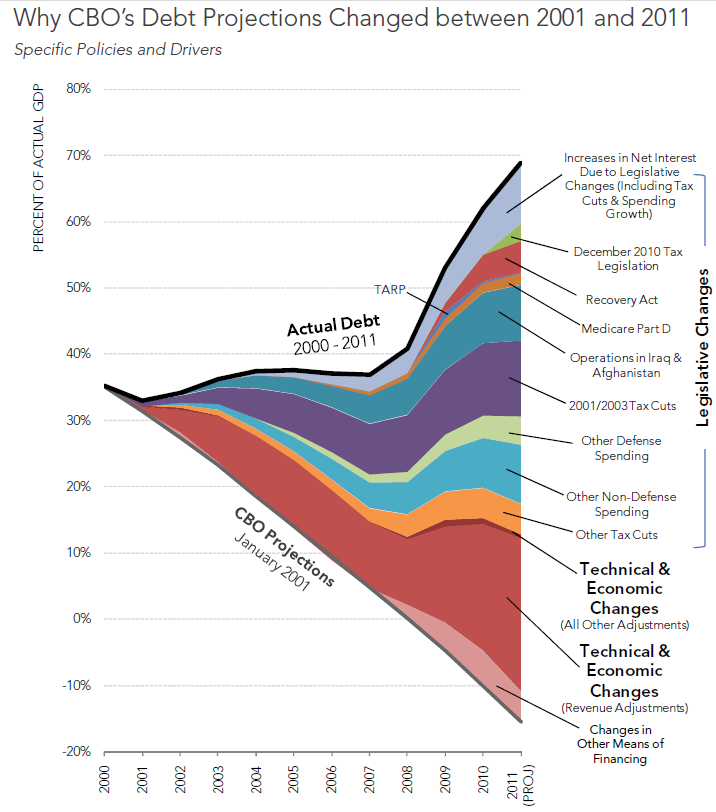
Excellent set of charts and analysis from the Pew Fiscal Analysis Initiative breaking down the sources of the deficit:

The U.S. will likely owe $10.4 trillion this year, its largest debt relative to the economy since 1950.  However, the Congressional Budget Office (CBO) projected in 2001 that the federal government would erase its debt in 2006 and be $2.3 trillion in the black by 2011 – a $12.7 trillion difference from today's reality.

This fact sheet highlights the extent to which major legislation enacted over the last decade and other factors have contributed to the Great Debt Shift – the difference between CBO’s 2001 projections and actual debt today.

Click for larger graphic

>

PDF here

Behaviour as the Engine of Product Design

Posted: 02 May 2011 01:00 PM PDT

How Mariano Rivera Dominates Hitters

Posted: 02 May 2011 12:40 PM PDT

The closer Mariano Rivera has confounded hitters with mostly one pitch: his signature cutter.

NYT: How Mariano Rivera Dominates Hitters

Planetary iPad App Turns Music into Interstellar Flybys

Posted: 02 May 2011 11:30 AM PDT

Very cool app from Planetary that turns your iTunes music collection into an interstellar flyby:

>

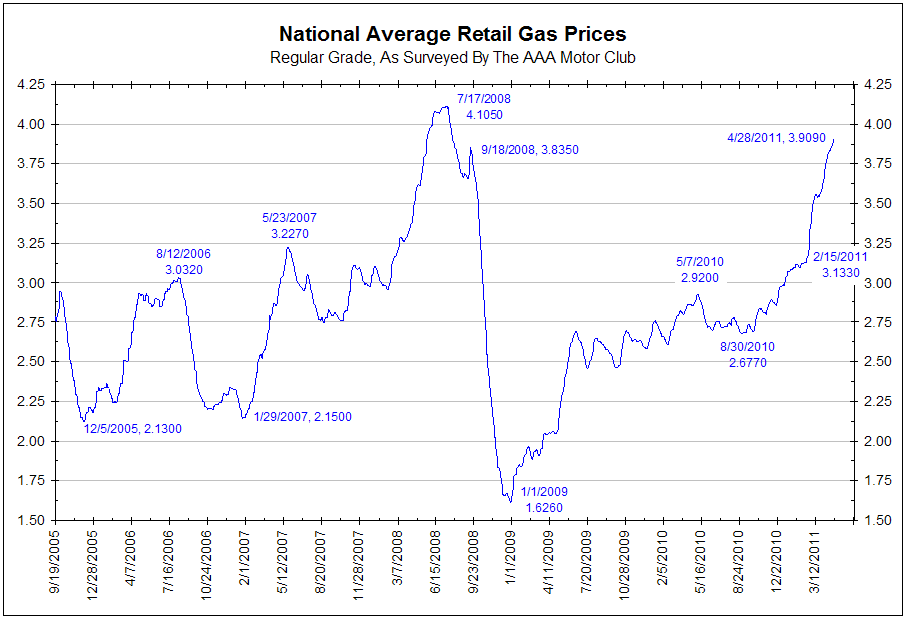
Chart of the Day: National Gasoline Prices

Posted: 02 May 2011 08:30 AM PDT

After initially selling off on the bin Laden news, Oil prices have rallied back to new highs. Since we are about to enter the prime driving/gasoline consumption period fo the year, let’s have a closer looks at Gasoline Prices across the US:

>
click for larger chart

Chart courtesy of Bianco Research

Defending the Economists

Posted: 02 May 2011 07:30 AM PDT

If you did not happen to read our piece discussing Shiller’s Sunday NYT column, its here:

Uh-Oh: Is Shiller Defending the Failures of Economists?

Its well worth your time to peruse it.

Reinhart: Bad Loans Clogging the Arteries of the Financial System

Posted: 02 May 2011 06:44 AM PDT

~~~

Source:
Bad Loans "Clogging the Arteries of the Financial System," Reinhart Says
Aaron Task
Yahoo Tech Ticker, May 2, 2011

http://finance.yahoo.com/blogs/daily-ticker/bad-loans-clogging-arteries-financial-system-reinhart-says-124804653.html

.

0 comments:

Post a Comment

previous home Next

{8} chatroll


{9} AdBrite FOOTER

{8} Nice Blogs (Adgetize)