


The Big Picture |

- Rail vs Air: Which Gets More Government Subsidies?
- Monday Reading List
- Why is Healthcare Absurdly Expensive in USA (Part 2)
- INSTRUCTIONS FOR THE GOVERNMENT OF ARMIES OF THE UNITED STATES IN THE FIELD (1898)
- Best Market Analogy: 1973 or 1907 ?
- Fire Your Mutual Fund Manager . . . ?
- No, Virginia, the Housing Market Has Not Yet Bottomed
- Crapshoot Investing: How Tech-Savvy Traders and Clueless Regulators Turned the Stock Market into a Casino
- More talk and still no action on Greece
- Dodo Bird Bankers
| Rail vs Air: Which Gets More Government Subsidies? Posted: 09 May 2011 05:00 PM PDT This morning, Becky Quick tweeted:
That is a fair observation — but it is rather incomplete, at least regarding air travel. We build massive airports, there is the entire FAA; We now have the TSA, and we bailed the airlines out after 9/11. All of which raises the following query:
Feel free to explain what transport subsidies are out there . . . |
| Posted: 09 May 2011 01:00 PM PDT Some interesting reads for Monday:
By popular demand, whenever I add a link to my Instapaper, it will now show up as a Tweet ! To follow me on Twitter, click here. |
| Why is Healthcare Absurdly Expensive in USA (Part 2) Posted: 09 May 2011 11:30 AM PDT We looked at Part I this question last month ; here is Part II:
via Business Pundit |
| INSTRUCTIONS FOR THE GOVERNMENT OF ARMIES OF THE UNITED STATES IN THE FIELD (1898) Posted: 09 May 2011 11:21 AM PDT For those of you who want to learn a little about the US Army’s position on torture, check out items #56 and #80. Military law via Military Legal Resources Hat tip Invictus |
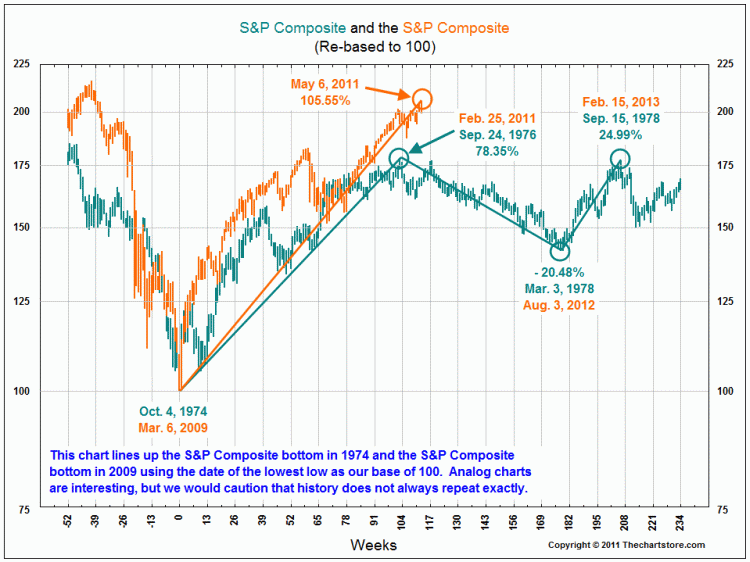
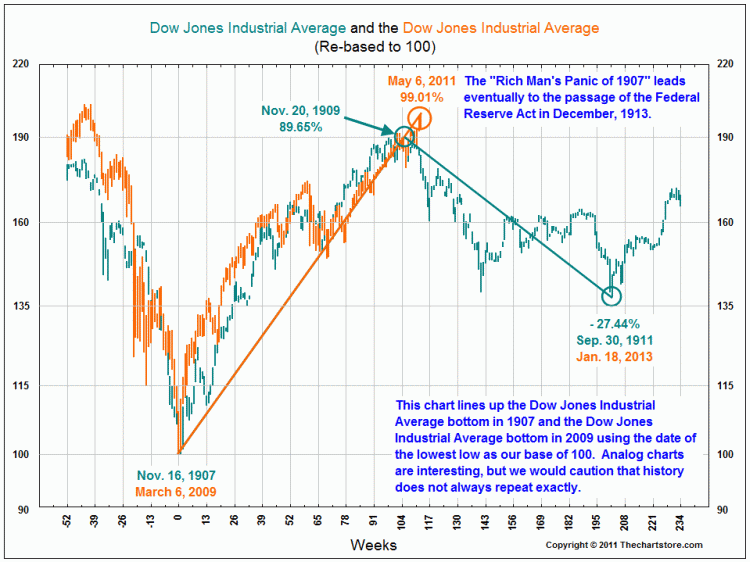
| Best Market Analogy: 1973 or 1907 ? Posted: 09 May 2011 08:30 AM PDT For most of the selloff and recovery, I have mentioned that my favorite market analogy to our current situation has been 1973-74, which had a 55% collapse and 74% snapback rally. However, as this market has continued to power higher, it has left 1973 behind, and is looking more and more like the Great Panic of 1907: 1973-75 Market versus 2008-11Click for bigger charts > 1907-09 Market versus 2008-11
|
| Fire Your Mutual Fund Manager . . . ? Posted: 09 May 2011 07:30 AM PDT My Washington Post column was published in Sunday’s print edition, but the digital version went into purgatory. It is online now:
It was written to get fund owners to turn off their auto-pilots, and manage their assets and managers more proactively. I left the important question of active vs. passive investing — ETFs vs. mutual funds — for another column . . . > Source: |
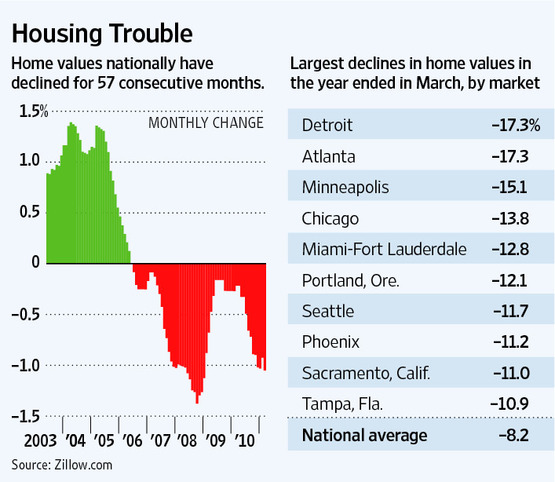
| No, Virginia, the Housing Market Has Not Yet Bottomed Posted: 09 May 2011 06:15 AM PDT In depth WSJ column that essentially states that there is more downside to come in Residential RE, and how many economists were fooled by the price action:
The full article is definitely worth your time . . . >
> Previously: Source: |
| Posted: 09 May 2011 05:00 AM PDT
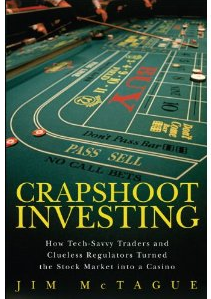
McTague say that equity markets are now “high-speed casinos rigged against individual investors.” In the book, he traces the development of HFT, explains why the Flash Crash happened, and why the odds strongly favor a major re-occurrence again. Due to high technology of super heated computers, co-location, and heavy algorithmic trading activity, stocks bought and then sold all in a matter of milliseconds, with profits of a tenth of a cent per share traded. HFTs are pulling between ten and twenty billion dollars of profits annually — and it comes straight out of the pockets of mom and pop investors. I don’t agree with all that Jim discusses — volatility was rising long before 9/11, the dot com bubble cracked in March 2000, the recession ended November 2001 — but for those people who want to learn more about HFT, this is the book for you. ~~~ |
| More talk and still no action on Greece Posted: 09 May 2011 04:29 AM PDT Other than the obvious that Greece needs more help, nothing really new came out of the “emergency” meeting of European finance ministers on Friday. The Germans on one hand want an extension of the maturity of Greek debt which is a technical default but would prevent the writedown of Greek paper on European banks as the principal would be paid back but just on a longer payback schedule. The Greeks, the ECB and some others on the other hand still don’t want any kind of restructuring but we know that’s wishful thinking at this point. Either way, it will still take time for some agreement to take place. While we wait, yields are also spiking again in Ireland and Portugal and higher in the all important Spain and S&P downgraded Greece’s sovereign credit rating to B from BB-. Greek stocks are down 1.1% to match the lowest level since 1997 and the rest of Europe is trading lower led by the banking sector. Economically in the region, Germany remains the powerhouse as March exports rose 7.3%, well above expectations of up 1.1%. |
| Posted: 09 May 2011 04:25 AM PDT
> In biology, extinction occurs when an organism or species dies off. Through evolution, new species arise and thrive when they are able to find and exploit an ecological niche — while other species become extinct when they are no longer able to survive in changing conditions or against superior competition. We should have had an extinction event in late 2008, but unnatural forces prevented the natural order of things from coming to pass. One of the most significant downsides to the bank bailouts was that they kept on life support creatures whose failings should have led to their demise. We prevented the normal process of failure to take place. Thus, the economy is presently saddled with banks so maladapted to their environment, to changing conditions, that, despite the fact they could no longer survive on their own, they are still with us. Rather than allow superior competitors to arise naturally, we artificially prolonged the lifespan of these maladapted banking creatures. Hence, we created an entire generation of Dodo Bird Bankers. Their design, development and management was what sent them towards an ignoble end. If you truly believe in Free Market Capitalism, that end would have been a fitting denouement. These banks high leverage and insufficient capital was the equivalent of nesting on the ground when Dogs & Pigs — i.e., SubPrime Securitization and Derivatives — were introduced. But the Dogs & Pigs merely revealed a host of other errors. From loan origination, to securtitization to loan processing to foreclosing, there has been substantial illegality every step of the way.Why there has not been more prosecutions remains a great mystery of our age. These were inept firms who, when left to their own devices, would have collapsed under their own weight and disappeared. They needed massive leverage to appear profitable and attract shareholders. They could not maintain sufficient capital ratios for the same reason – they would have appeared less profitable than desired. This same philosophy permeated all of the Dodo Bird Banks’ many divisions. They had to cut corners in order to survive. There is a famous quote that says words to the effect “Financial panics don’t bankrupt firms — they merely reveal who is already insolvent.” That is especially true when it comes to the Dodo Bird Banks. Despite their natural evolutionary deaths, these maladaptive corporate behemoths were saved. What we have now is an unnatural, artificial banking ecosystem. Gross failures, incompetence and inadequacies are what we preserved. These dodos cannot operate properly. They engage in misbehaviors because that is what they must to survive. They cut corners, take short cuts, behave illegally. They do this because they must. Given that their structures, managements and internal processes failed to follow the prime directive — stay alive! — it is fair to assume other important things they do are similarly suspect. These dying beasts are on the wrong side of the law so often becauase they cannot afford to do things legally. The surviving Dodo Bird Bankers are an unnatural blasphemy on Capitalism. Their continued existence undermines faith on our laws, institutions, and economy. This morning, I will be meeting with a group of regulators to discuss why Dodo Bird Bankers must be prosecuted to the fullest extent of the law. Having a background in both Law & Finance, I hope to make a persuasive case as to why not prosecuting criminality will have enormous negative consequences for the economy. I also hope to impress upon them what areas of criminality are ripe for fast and easy convictions. > Previously: |

| You are subscribed to email updates from The Big Picture To stop receiving these emails, you may unsubscribe now. | Email delivery powered by Google |
| Google Inc., 20 West Kinzie, Chicago IL USA 60610 | |
 The Big Picture (ritholtz)


0 comments:
Post a Comment