


The Big Picture |

- What Happens on Wall Street . . .
- Fun with Gold Bugs . . .
- Late Afternoon Reading
- Minus (min.us) 22 Economic Charts
- Real Estate Reality
- Why Are We Surprised When Artist’s Values Fluctuate?
- Employed Persons: 1999, 2001, 2003, 2011
- THE END IS NIGH?
- Tuesday Morning Reads
- The data continues to slow
| What Happens on Wall Street . . . Posted: 01 Jun 2011 02:00 AM PDT . . . stays on Wall Street !
|
| Posted: 31 May 2011 05:00 PM PDT An old friend swung by the office today to chat. She is a rather well known in certain circles, a savvy investor who has done very well with miners and precious metals. We discuss the economy, inflation, markets, oil. Near the end of her visit, she proceeds to tell me that the paper money I have is worthless, and that Gold is the only currency of any value. “May I see your purse?” I ask. She hands it to me. “And your wallet is in the purse?” She pulls out the wallet. I open it up, remove all her cash — about $1000 in 20s and 50s — and then toss it right in the waste paper basket. “That’s worthless, right?” She immediately sees my point, smirks, and to prove her point, gets up to leave — without the cash. As she heads out the door, she says, “I need cab fare.” and fishes a $20 out of the garbage. |
| Posted: 31 May 2011 01:30 PM PDT Quite a few things added to my Instapaper today — This is what I will be reading on the way home tonight:
What are you reading? |
| Minus (min.us) 22 Economic Charts Posted: 31 May 2011 11:30 AM PDT |
| Posted: 31 May 2011 11:11 AM PDT CNBC’s Gary Kaminsky discusses the poor housing data and the idea that things in the industry continue to get worse, despite the government’s best efforts. In short, there’s a sea change in attitudes toward buying vs. renting.
Double Dip House Prices CNBC’s Diana Olick breaks down the latest Case/Shiller data, showing home prices are way down, and not expected to get better anytime soon. Also, a look at the fallout for banks due to the decline in housing, with Paul Miller, FBR Capital Markets; and Peter Boockvar, Miller Tabak. |
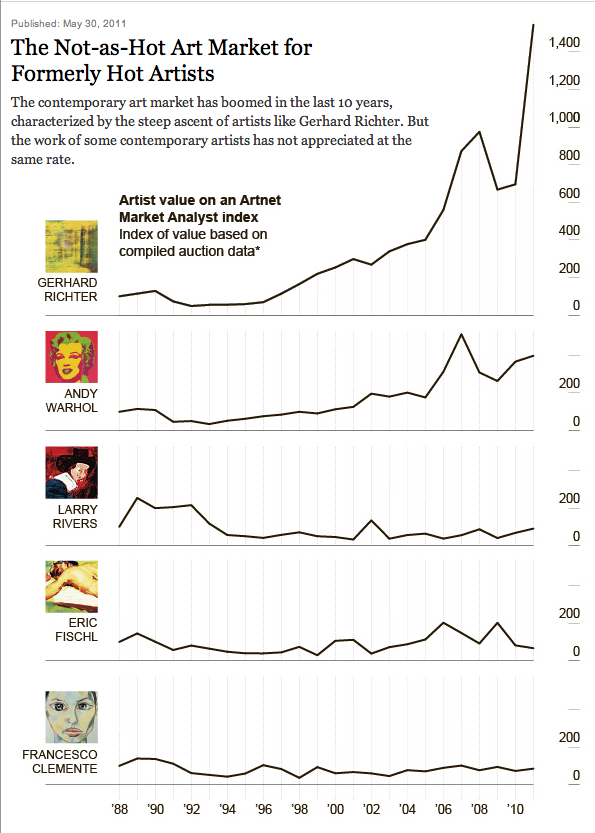
| Why Are We Surprised When Artist’s Values Fluctuate? Posted: 31 May 2011 10:00 AM PDT One of the biggest problems caused by the Contemporary Art market boom of the last 13 years is the ways in which it has confused the world about how the art market works and what determines value. The issue isn’t trivial. The art market is generally believed to have $50-60 billion dollars a year in global turnover. Which makes it a substantial industry by any measure.
Imagine the Times running a story on the front page of the business section that says “Some Bond Prices Fall as Most Rise.” If you were to read that story, your interest would be in the credit issues specific to the companies with falling bond prices. It would be an indication that the companies themselves faced peculiar problems unrelated to the overall bond market which is rising. So what you would want to see from the story is details on why each company’s bonds were scaring investors. That’s essentially what today’s art market story is about. Each of the three living artists whose Artnet market indices—a product that doesn’t seem to be available through artnet.com—are the featured graphic in the Times story online has his own market story to tell. It’s a little like Tolstoy’s famous line about families: All artists with rising markets are all alike; every artist with an unhappy market is unhappy in its own way. The Times picks out Larry Rivers, Francesco Clemente and Eric Fischl as examples of unhappy artists. Looking at the chart for Rivers, we see that his price index rose during the last great art recession. While others were licking their wounds on the art market in the early 1990s, Rivers was enjoying a moment in the spotlight. Then, again, in 2002, another short trough in the art market, Rivers rises through it only to fall again before next market acceleration. According to the Times’s chart, Rivers’s prices are waxing even as the story adduces this bit of market ugliness:
There could be many reasons for the difference in prices reflected here. One is that the two works are from a similar series but wildly dissimilar in size, condition or quality. There’s also the chance that the market for Rivers’s work was effected by the revelations in the Times nearly a year ago (a couple of months before the $4,000 sale) of Rivers’s daughters accusations about a disturbing and distasteful video project undertook with her. The Times does at least try to explain that Francesco Clemente’s market has changed since leaving Gagosian gallery. It would be difficult to trace the cause and effect of the loss of representation. An artist and a gallery have a complex relationship. The gallery supports and shapes the artist’s market but tensions can come from either end of the value chain. The artist’s new work–its volume or quality–may make the gallery’s role untenable. On the other side, collectors taste, interests or estimation of art history may move away from the artist leaving him frustrated with his gallery’s lack of sales. Art advisors will tell you that Clemente has some supply issues that gum up his prices. Then, again, looking at the chart, Clemente seems to have had a fairly consistent market since 2004. Then there is Eric Fischl whose charts show a bubbly path that follows the boom, bust and recovery before falling off a cliff in the last year and a half. Whether Fischl, still a fairly young artist when one looks at an old lion like Lucien Freud who had to wait will into his senior years to command impressive auction prices, will eventually be seen as an important artist remains to be seen. But then, again, the art market is cluttered with painters who were huge during their lifetimes but faded into obscurity as time went on. Value in the art market is conferred by art history with an emphasis on the history. Artists and artworks become more meaningful and valuable over time because of events beyond the artist’s control. If you anticipate or influence later artistic achievements, your work becomes more valuable to museums and collectors. One of the goals of art collecting is tracing ideas through art history. That’s what many collectors are after when they buy—something significant, something meaningful, something lasting. Unfortunately, there’s no telling in the short term which artists will remain relevant. Like stocks or options, art prices are really just claims on an artist’s future cultural relevance and importance. So we shouldn’t be surprised when that value fluctuates. > Source: |
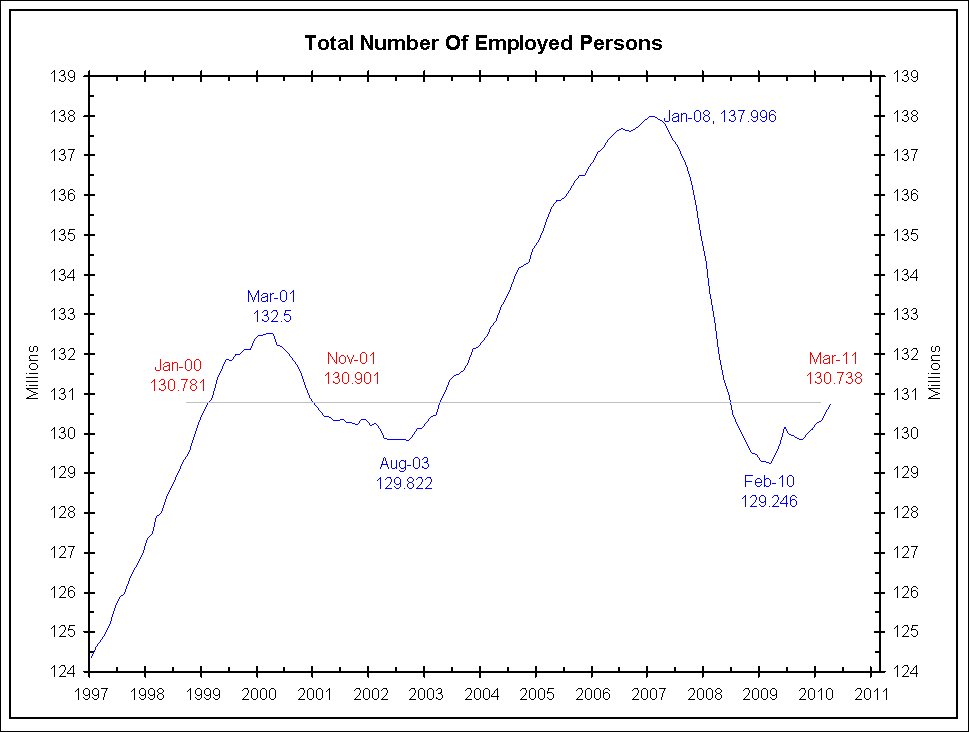
| Employed Persons: 1999, 2001, 2003, 2011 Posted: 31 May 2011 08:30 AM PDT
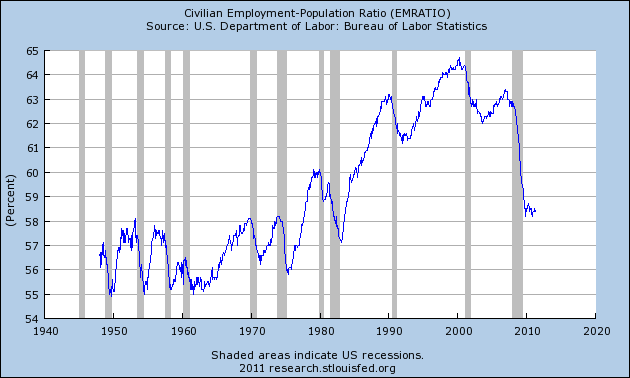
> Since we have the NFP report at the end of the week, I thought it might be instructive to use our lunchtime chart slot each day to look at assorted employment data. Today’s chart comes to us from Jim Bianco of Bianco Research. The chart looks at the Total number of employed people in the US. Note that in 2011 we are back to levels last seen 1999, 2001 and 2003. But the caveat is that the population has grown substantially since then; On a percentage basis, employment is considerably worse than it was in any of those years . . . ~~~ Invictus adds: To put this into context, see the Civilian Employment-Population Ratio (EMRATIO) click for larger chart |
| Posted: 31 May 2011 08:00 AM PDT Peter T Treadway, PhD ~~~
> Spencer might have been a little harsh. He shouldn't have said fools; he should have said voters. The good citizens of the Kingdom of Spain and the 26th Congressional District in upstate New York have shown the world that in a democracy no politician can be elected if he or she should suggest taking away or in any way curtailing or even modifying any established government entitlement. Established entitlement programs – like Medicare – once in place with millions of grateful recipients become inalienable rights which can never be withdrawn regardless of a government's dire fiscal condition. Most serious investors are by now familiar with the increasingly dire fiscal condition of the United States government. But for many citizens the country's fiscal problems are just poorly understood abstract statistics and one more gloomy forecast. There is no shortage of gloomy forecasts to worry the citizenry – for example (religious) predictions for the end of the world or impending environmental disasters or the world running out of energy or earthquakes in California. Sometimes bad things happen as predicted but often they don't. Nobody knows exactly when the Federal government will have a real problem and besides the rich can pay for it when it comes. Forecasts and statistics don't count compared to real entitlements upon which people have come to depend on. In my opinion, serious fiscal reform will only come when the big existential Crisis comes. The only alternative to the Crisis would be a clean sweep of the House, the Senate and the Presidency by radical fiscal reformers in 2012. In other words an army of Paul-like clones – Ryan, Ron and Rand that is – would take over. The probability of that happening is …J The Crisis would bring a collapse of the dollar and probable emergence of a less dollar-centric, less bubble-creating international financial system, a collapse in US government bond prices and an acceleration of dollar inflation. While the dollar has certainly slipped over the last few years on a trade weighted basis, keep in mind that ten year government bonds are yielding just over 3 percent and the latest CPI as reported is "only" up 3.1 percent. No crisis yet. So far anyway Bernanke with a big help from Asian treasury buyers has been very successful at manipulating interest rates down. (And the stock market up.) The dollar-centric international financial system affords the US a lot of rope. The Big Global Macro Call The big global macro call is when and if the Crisis will occur. Nobody really knows the answer because the massive global monetary and fiscal stimuli that we have witnessed in the last two years are unique in history. We haven't seen how this story ends. Everybody is just guessing. It has been said that cataclysmic changes often come later than anyone thinks and they are always worse. I am reminded of my Wall Street days over 1985-1997 as an equity analyst following Fannie Mae and Freddie Mac. It was obvious then that Fannie and Freddie's superior politically-derived cost of funds advantage would enable them to gobble up the whole mortgage market. But I also believed somewhere in the distant future the political forces from which they derived their advantage would force them into becoming eleemosynary institutions that took on undue risk and they would suffer severe problems as all their socially mandated deadbeat loans defaulted. The trouble was I had no idea when that sad day would come and it never occurred to me they would actually go into government conservatorship. Consequently I never even mentioned my misgivings to money manager clients who weren't paid to worry about anything that could happen more than five years out. Knowing in 1988 that Fannie and Freddie would go into government conservatorship twenty years hence would have been useless information. Instead I concluded that as long as Fannie and Freddie were early enough in their "gobble up" phase the stocks were Buys. "It's not too late to get a little Fannie" was my mantra and over 1985-1997 this was right on. Well on the Crisis I doubt we have twenty years to wait. It would not surprise me if it happened soon after the 2012 elections, particularly if it was clear the results were not conducive to serious reform. A divided government, so revered in the Clinton era, is not what is needed this time. I will always remember the hapless Ernesto Zedillo in 1994 assuming the Presidency of Mexico just in time to see the Mexican peso collapse, the Mexican banks go bust and the US come riding to the rescue to bail the country out and keep half of Mexico's citizens from flooding over the border into the US. Query: If the 2012 election is inconclusive and the Crisis comes, will it be Americans turn to flood over the border? Maybe to Canada? ( I would prefer Singapore. It's warmer.) Today it's hard to find an economic forecaster who does not foresee some kind of crisis coming someday for the US if fiscal reforms are not undertaken. Many smart people such as PIMCO's Bill Gross are reportedly selling their Treasuries now. Still, other equally smart people are taking the opposite tack. "It's not too late to buy more govies," seems to be the mantra of smart people like Gary Shilling who was dead on in his analysis of the subprime crisis. Stay on the Titanic until the band stops playing. The Mother of Bubble Algorithms Plus Entitlements I just finished leading a workshop in Hong Kong on sovereign risk. In teaching this course I relied heavily on the work of Kenneth Rogoff and Carmen Reinhart, whose research every serious student of sovereign risk and financial crises should become familiar. From reading their work as well as a variety of other sources on financial history and monetary theory including Charles Kindleberger and Hyman Minsky, I have derived what I call a Bubble/Banking Crisis Default "Algorithm." It's sort of a cookbook description of a bubble combined with a banking crisis that in so many cases has ended in deflation of the bubble asset, a banking crisis, a recession and a sovereign default. Here's the Algorithm:
In the late twentieth century numerous countries have gone through something resembling this "algorithm". Each country's bubble crisis had its own unique characteristics of course. The US is probably on step 9 and is on the real estate deflation side of the bubble. The people who are buying government bonds are counting on this deflation to last a while longer. It's interesting to look at the sequence banking crises/bubbles/defaults that occurred in the late twentieth century. All of the following bubbles except Japan ended in some kind of default or IMF/Treasury/ other government entity rescue. The market vigilantes seemed to take their time, moving on one country then another.
Courtesy of our inflation prone, reserve creating global international fiat monetary system, money sloshed around the world from country to country into deregulated and risk oriented financial systems (where governments assumed the downside risk thereby promoting the excessive risk-taking) leaving bubbles and busts in its wake. But now a new round may be underway. The list starts with Iceland, then Greece, Portugal, and Ireland, all of which have either defaulted or required a rescue. I am tempted to add some American states to the list. None have defaulted at least on their public debt (although some states like Illinois have reportedly stiffed their suppliers) but the Federal government via its "stimulus" plan has been providing a rescue. After the weaker "periphery"countries have been taken down, is the big guy,i.e. the US, next on the list? According to Rogoff and Reinhart the US and the other developed countries have come out of the Algorithm with a total publicdebt/GDP ratio as high as those prevailing right after World War II. But lying dead ahead is the new historically unprecedented aging population/ explosion of entitlements problem. This second problem gets added to the real estate bubble/banking crisis. Scary. Some Things to Expect As the Crisis Looms · Slower economic growth. This is likely even without the Crisis. Rogoff and Reinhart claim their data show a negative impact on growth when a nation's public debt/GDP jumps above 90%. Moreover, in my opinion, the massive monetary and fiscal stimulus that has occurred is a major misuse of resources and will contribute to slower total factor productivity growth. The simple Keynesian models are wrong. It does make a difference how money is spent. · Financial repression. This is a recent Rogoff and Reinhart prediction and one that many have been worrying about for a while. A government hungry for cash and eager to preserve the role of the dollar will be tempted to impose interest rate caps, restrictions on foreign investment, punitive measures vis a vis gold, raids on pensions etc. · Higher tax rates. Higher tax rates of course may not bring in the expected higher tax revenues as the evil rich – who pay most of the taxes – either cut back on working or spend more their time avoiding taxes. And small business activity in particular may be discouraged. All this makes for slower economic growth and lower than expected tax revenues even as tax rates rise. · Default by inflation. A major tool countries have used in the past is to inflate their way out of their debt burden when this debt is denominated in their own currency. It remains to be seen whether countries which borrow in their own currencies – the US, Japan, and the Eurozone—can pull this off if investors anticipate the inflation ahead of time. ~~~ Peter T Treadway also serves as Chief Economist, CT RISKS, Hong Kong |
| Posted: 31 May 2011 07:15 AM PDT This is what I read this morning: A mix of unusual and interesting reading to start my week:
What are you reading? |
| Posted: 31 May 2011 06:55 AM PDT According to the S&P/CaseShiller home price index, home prices have officially double dipped, falling to the lowest level in 8 years. Prices fell .23% m/o/m and 3.6% y/o/y in the 20 city composite. Washington, DC is the only city to see a y/o/y gain for reasons obvious. The y/o/y declines were led by Minneapolis, Phoenix, Chicago, Portland and Seattle in that order. Aside from the hit to household net worth by declining home prices, the US banking system is still very vulnerable as bank balance sheets don’t expect and thus aren’t priced for another downturn in home prices. Following a string of softer regional manufacturing numbers in May, Chicago PMI also moderated more than expected. At 56.6, its the lowest since Nov ’09, below estimates of 62 and down 11 points from April. New Orders fell almost 13 pts to the lowest since Sept ’09 at 53.5 and Backlogs were down almost 10 pts to the weakest since Nov at 51.7. Production fell 14 pts to 56 and Employment was down by almost 3 pts to 60.8. Also of note, inventories rose by 8 pts to the most since Sept ’06. The ISM on Wednesday will reconcile all the regional surveys but the message is clear, manufacturing moderated in May with the question being whether its a change in trend or just a midcycle lull. Considering the concerted effort taken on by most Asian nations to slow growth to slow inflation, Europe ex Germany/France growing modestly and a US recovery that is still lackluster, one has to be worried more about the former. Certainly the US treasury market has voted with yields falling sharply over the past month. Add the Dallas Fed mfr’g survey to the list of moderating data. Similar to the Richmond survey, Dallas Business Activity in May went negative with a -7.4 reading, well below expectations of +8.5 and from +10.5 in April. It’s the first negative print since Sept as New Orders fell 3 pts, Backlogs were down by 4.6 pts, Orders Growth Rate fell by 10 pts and Employment dropped by 1.8 pts (but the workweek rose 14 pts). Production did rise as orders were fulfilled and the Reserve Bank of Dallas said that even though General Business Activity went negative, 3/4 of respondents “said activity was unchanged from April.” Prices paid and received fell following the drop in commodity prices. The 6 month outlook fell to 10.5 from 16.9, the lowest since Sept. Consumer Confidence in May fell 5.2 pts from April to 60.8 and was well below expectations of 66.6. It’s the lowest since Nov as the future Expectations component fell to the weakest since Oct, down 8 pts from April. The Present Situation fell just 1 pt. As one year inflation expectations rose to 6.6% from 6.3%, this survey didn’t capture the decline in gasoline prices over the past few weeks as the survey was filled out in the beginning to middle of May when prices were near highs and thus maybe renders today’s results somewhat old news if we assume the price of gasoline is a key factor in confidence. With the labor market, the answers were mixed as those that said jobs were Plentiful rose .5 pt and those that said jobs were Not So Plentiful fell by 2 pts but those that said jobs were Hard To Get rose by 1.5 pts. Those that plan on buying a home was unchanged and those that plan to buy an auto rose 1.3 pts. Overall Business Conditions both today and with the outlook softened somewhat. Bottom line, its a heavy week for economic data just as its beginning to soften, thus making the US news more relevant this week to markets than whether Greece is getting saved again or not. |


| You are subscribed to email updates from The Big Picture To stop receiving these emails, you may unsubscribe now. | Email delivery powered by Google |
| Google Inc., 20 West Kinzie, Chicago IL USA 60610 | |



0 comments:
Post a Comment