


The Big Picture |

- Corruption At The Top Leads To Lawlessness By The People
- The Real Reason the SEC Has Been Shredding Documents For Decades
- Investors: Think For Yourselves
- Bear Sell Offs, Bull Recoveries & Regaining 2007 Highs
- What Is The Internet Doing To Our Brains?
- The Idiot’s Guide to the S&P Credit Downgrade
- Governor Perry and Fed Independence
- Gold = Treasuries
- Hubble Stares Deep into Dust-Choked Galaxy
- US Markets Off 5%; 10 Year @ 1.97%
| Corruption At The Top Leads To Lawlessness By The People Posted: 19 Aug 2011 12:00 AM PDT Corruption At The Top Leads To Lawlessness By The PeopleEconomist Noted 150 Years Ago That Corruption At the Top Leads to Lawlessness By The PeopleI’ve repeatedly noted that corruption at the top leads to lawlessness by the people. Specifically, Bastiat said that corruption and “plunder” by government officials causes lawlessness among the people (skip to the second half of the following interview): Unfortunately, the lawlessness by those at the top will lead to lawlessness by the people. This will lead to the break down of the economy and the financial system … and society as a whole. Ron Paul “Just Think Of All Those Troops Spending All That Money Back At Home!”~~~ Many economists have demonstrated that – contrary to commonly-accepted myth – war is actually bad for the economy. Ron Paul gives yet another reason to bring the troops home:
While those claiming that war stimulates the economy and creates jobs might say that bringing a bunch of unemployed veterans home would hurt the economy, the truth is that government stimulus money spent in the private sector stimulates more than money spent on the military. |
| The Real Reason the SEC Has Been Shredding Documents For Decades Posted: 18 Aug 2011 10:00 PM PDT The Real Reason the SEC Has Been Shredding Documents For DecadesSEC Attorney Reveals that Agency Has Shredded Documents for Decades to Cover Up Wall Street FraudWhat should we make of the new revelations by Securities and Exchange Commission attorney Darcy Flynn (background here, here and here) that the SEC has been shredding documents for decades? As many commentators have noted, the SEC did this to cover up fraud on Wall Street. The Entire Government Strategy Is To Cover Up FraudWilliam K. Black – professor of economics and law, and the senior regulator during the S & L crisis – says that that the government’s entire strategy now – as during the S&L crisis – is to cover up how bad things are:
Top Government Officials Created the Conditions In Which Fraud Would FlourishI noted last year:
(Here’s the definition for criminogenic.) I noted last month:
I pointed out in January that fraud is Wall Street’s business model, which is being supported by the government:
Corruption At the Top Leads to Lawlessness By The PeopleCorruption at the top leads to lawlessness by the people. Unfortunately, the lawlessness by those at the top will lead to lawlessness by the people. This will lead to the break down of the economy and the financial system … and society as a whole. |
| Investors: Think For Yourselves Posted: 18 Aug 2011 07:35 PM PDT What is it about these four Bloomberg headlines that are imparting some sort of a lesson?
Which of these buy calls should you follow? Might some of these calls be suffering from bias? And if you are always telling people to buy-buy-buy, can anyone really follow your advice? |
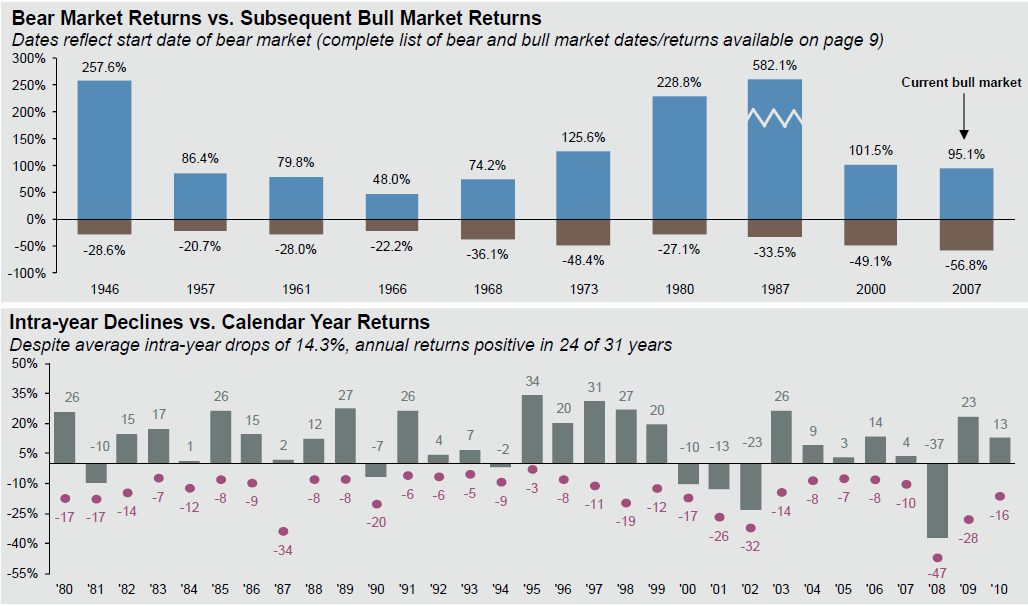
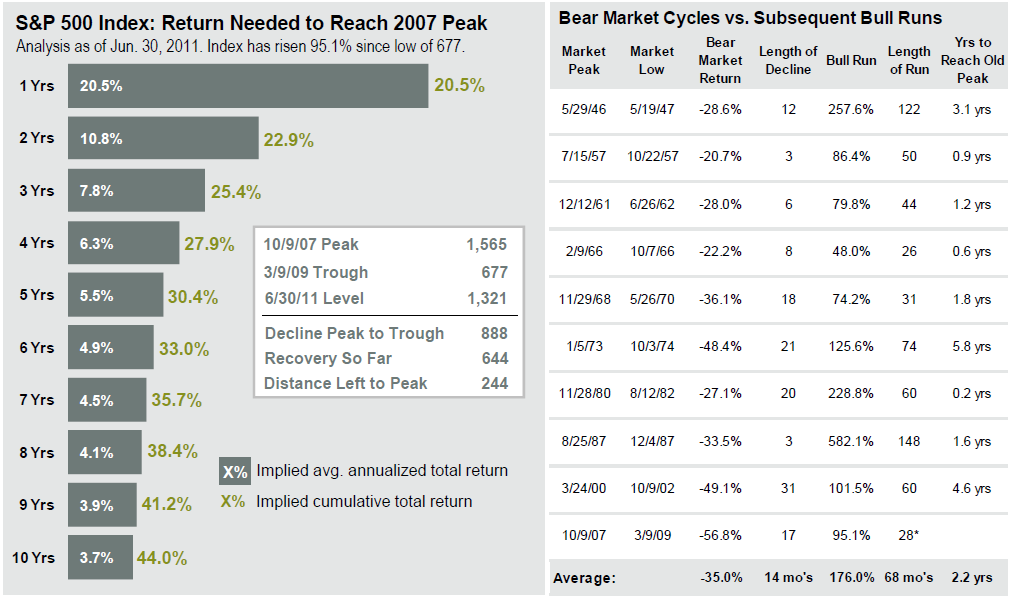
| Bear Sell Offs, Bull Recoveries & Regaining 2007 Highs Posted: 18 Aug 2011 02:18 PM PDT Two interesting long term charts to help put today’s action into a bit of perspective: Both of these are sourced from JP Morgan funds: The first chart shows various US Bear markets since 1980, and the Bull markets that followed. That may be cold comfort to people who are caught leaning the wrong way today, but its a reminder that “This too, shall pass.” The second chart shows what it will take to recover the 2007 peak (note this is dated June 30th, and thus is from higher levels. Add 10% or so to the numbers). >
~~~~
Interesting stuff! |
| What Is The Internet Doing To Our Brains? Posted: 18 Aug 2011 12:00 PM PDT
|
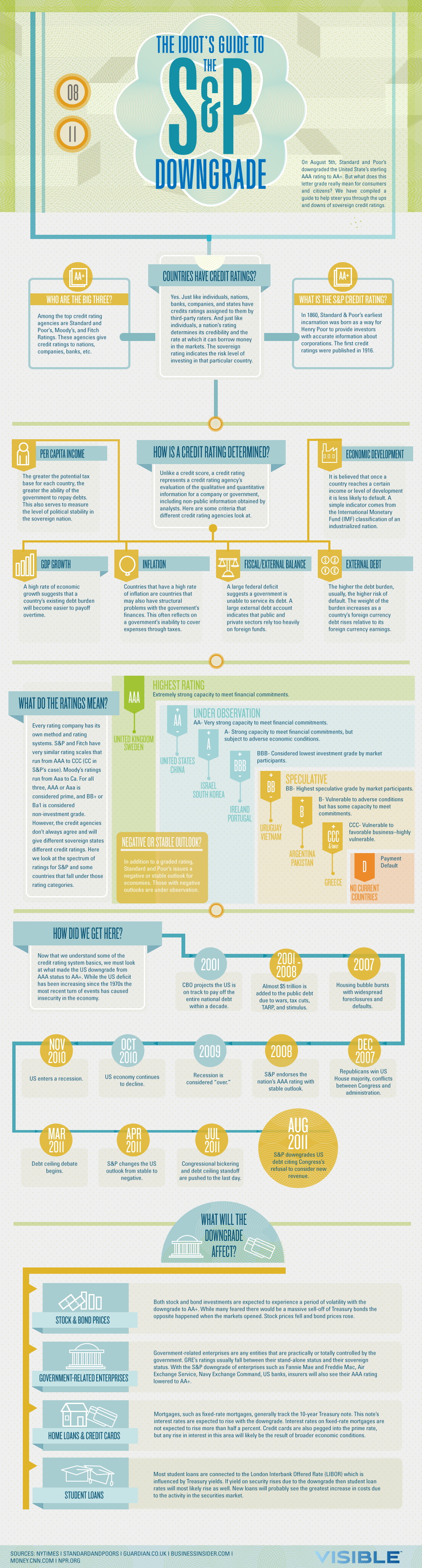
| The Idiot’s Guide to the S&P Credit Downgrade Posted: 18 Aug 2011 11:30 AM PDT From Visible: > Click To Enlarge Infographic: Source: |
| Governor Perry and Fed Independence Posted: 18 Aug 2011 10:00 AM PDT Governor Perry and Fed Independence ~~~ For the past twelve years, this writer has chaired the Central Banking Series of the Global Interdependence Center. The purpose of this series is to develop an understanding of central banking and to communicate the different views about central bank policy. As its principal function, the Global Interdependence Center acts as a neutral facilitator for dialogue, conversations, discussions, explanations, and education. Policy making, research, studies of implementation, alternatives to implementation, distinguishing features among the central banks – all of these are among the items that are discussed and studied during this series. One of the conclusions reached over the years and affirmed numerous times is the importance for citizens, investors, bankers, individuals – everyone who is concerned with finance and economics – to defend the independence of the central bank and to permit the central bank to function without political interference. History has a terrible record when it comes to political interference in central banking. Under the worst circumstances, we get hyperinflations, like the Weimar Republic or Zimbabwe. In cases such as these, the central bank is completely folded into the government, succumbing entirely to the political whim of the individual in power. The more politics get involved with central banking, the worse the outcome. History holds no examples of a benign governmental interference. Over time, there may have been some temporary interludes of positive intervention, but they remained short in length and deficient in output. The bottom line is simple: the government is best contained by creating a barrier between the executive branch and the central bank of the country. In the United States, we have now had a new phenomenon injected into our presidential race. A presidential candidate, Governor Rick Perry of Texas, has attempted to intervene and pledged to do so if he becomes president. He has used political campaign rhetoric to threaten the Chairman of the Federal Reserve; and when asked in detail about it, he subsequently affirmed his position. Governor Perry did not have to do so. He could have said, "I am worried about central bank policy; it is something to be examined. We have to have an independent central bank, but we also need to watch what they do and weigh in on conversation." That is not what Perry did. Perry reiterated the threat. There is great danger in this notion that the United States of America could tolerate a president who would use the early stages of his political campaign to vilify the Chairman of the Federal Reserve and to threaten intervention in central bank policy making. The Federal Reserve Act established staggered fourteen-year terms for the seven governors of the Federal Reserve board. The reason was to attempt to eliminate the interference of the executive branch. We have seen the corruption and destruction of central bank independence in the Federal Reserve appointment process. It occurred under President Bush when Senator Dodd, Chairman of the Senate Banking Committee, held up appointments. It happened again under President Obama when Senator Shelby, senior Republican on the Senate Banking Committee, held up an appointment. We now see additional uncertainty introduced as President Obama attempts to appoint new governors to the unfilled positions. Readers, please note that the Federal Reserve, the central bank of the United States, has not had a full complement of seven governors during the entire financial crisis and the period following. Not one day did we have the benefit of the full board. Is it not time for seasoned politicians who want to lead us declare their commitment to independent central banking? This does not mean they give up congressional oversight or the liberty to express their opinions. It does mean they cease to threaten and allow central banking functions to take place as much as possible outside the political spectrum. Governor Perry of Texas should think about what he has done. I cannot recall any other presidential candidate taking such an extreme position. One exception may be a Congressman from Texas by the name of Ron Paul, who has called for the abolition of the central bank and sponsored the notion of the gold standard. Is Governor Perry claiming he wants to return to the gold standard? If so, let him say so. ~~~ David R. Kotok, Chairman and Chief Investment Officer |
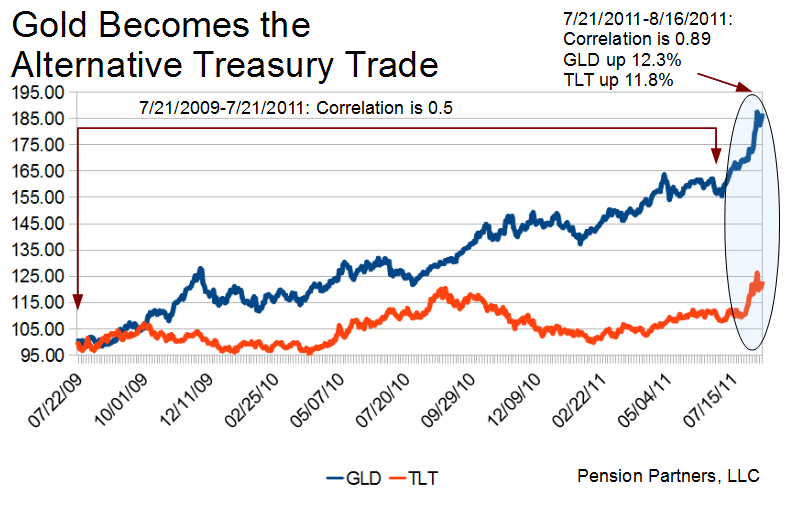
| Posted: 18 Aug 2011 08:30 AM PDT click for larger graphic > Gold! Are a new class of investors treating it like Treasuries? The evidence: A stunningly high correlation of Gold to 20+ Year Treasuries (Symbol: TLT) from July 21 through August 16 is 0.89. Over that period, Gold is up 12.3%, while Treasuries up 11.8% (not counting today’s spasm). Contrast this to a correlation of 0.5 over the periods July 21, 2009 – July 21, 2011 and it appears Gold and Treasuries are now behaving as one and the same, moving in lockstep fashion. Of course, Treasuries are a much broader and deeper market, and a move in Bonds represents trillions of dollars of activity, versus Gold, which is orders of magnitude smaller. Perhaps investors who might otherwise flock to Treasuries during risk-off modes are now flocking to Gold? After all, S&P cannot downgrade a metal… Source: Michael A. Gayed, CFA is Chief Investment Strategist at Pension Partners, where he structures portfolios. Prior to this role, Michael served as a Portfolio Manager for a large international investment group, trading long/short investment ideas in an effort to capture excess returns. In 2007, he launched his own long/short hedge fund, using various trading strategies focused on taking advantage of stock market anomalies. Michael earned his B.S. from New York University, and is a CFA Charterholder. |
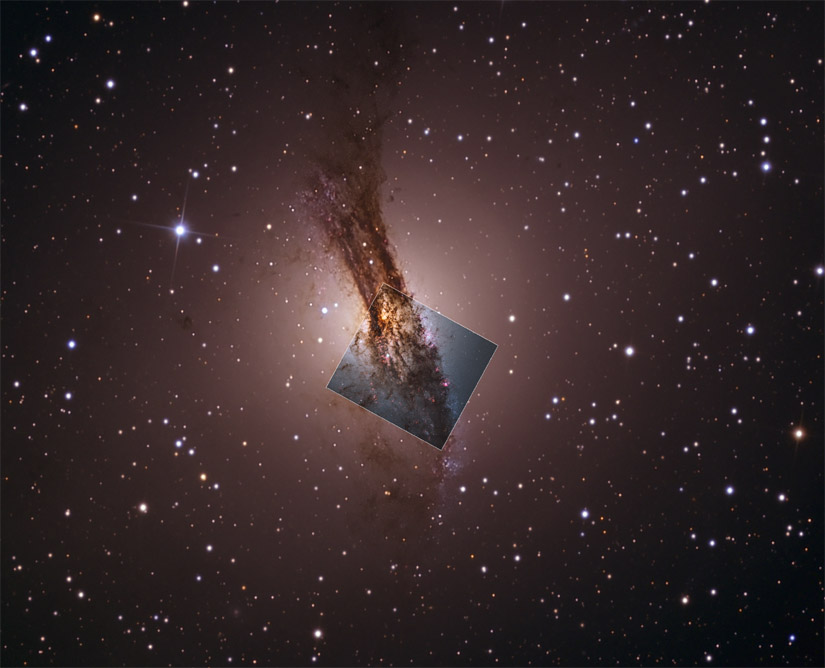
| Hubble Stares Deep into Dust-Choked Galaxy Posted: 18 Aug 2011 07:45 AM PDT 11 million light-years away, deep inside the massive spiral galaxy Centaurus A (also known as NGC 5128), baby stars are bursting into existence. Although these enigmatic events appear to be choked by a thick shroud of dust, the Hubble Space Telescope has looked into the cosmic smog, revealing previously unseen intricacies of this well-known galaxy.
Below: The new Hubble image superimposed over an older photograph of Centaurus A, showing the region of detail.
Source: |
| US Markets Off 5%; 10 Year @ 1.97% Posted: 18 Aug 2011 07:24 AM PDT The Dow was off 500 points, S&P down 60 points, and the Nasdaq down almost 150 points. Quite astonishing to see the US 10 year bond with a one handle. Kudos to David Rosenberg, who wins his bet with Mark Faber over the below 2% yield. As noted August 1, I have limited exposure to equities — mostly value indices, some managed funds that can run up heavy cash positions. Our tactical portfolio flipped form 100% stocks in June to 50/50 stock/bonds in July to 100% bonds in August. All told, not a bad day to be a bear . . . > Previously: There's Something Happening Here . . . (August 2nd, 2011) Sell the Bounce (August 3rd, 2011) Man the lifeboats: This is not a drill! (August 7th, 2011) |

| You are subscribed to email updates from The Big Picture To stop receiving these emails, you may unsubscribe now. | Email delivery powered by Google |
| Google Inc., 20 West Kinzie, Chicago IL USA 60610 | |



0 comments:
Post a Comment